

[Research Contribution] The Journey of a Multidisciplinary & Sustainable University: From ESG Integration to SDGs Impact
27 Tháng Ba, 2026
Keywords: ESG, SDGs, sustainable growth, higher education, multidisciplinary
On the afternoon of March 23, 2026, in Hanoi, within the framework of the panel discussion “Connecting Businesses and Universities Toward Sustainable Growth” organized by the State Securities Commission of Vietnam in collaboration with the Institute of Chartered Accountants in England and Wales, Assoc. Prof. Bui Quang Hung – Interim President of the University of Economics Ho Chi Minh City (UEH) – presented a paper on the journey of developing a multidisciplinary and sustainable university, emphasizing an approach that moves from integrating ESG into education to creating impact through the Sustainable Development Goals (SDGs).
From global pressure to the need to reposition universities in the era of sustainable development
Sustainable development has become a global framework for action, reshaping the operation of economies, businesses, and education systems. From the 1987 Brundtland Report to the United Nations 2030 Agenda with its 17 SDGs, the world has established a common framework in which economic growth must go hand in hand with environmental and social responsibility. Climate commitments, such as COP26, continue to reinforce the pressure to transition to green, low-emission development models.
In Vietnam, this process has been institutionalized through several important policies, such as Resolution No. 136/NQ-CP on SDG implementation, the 2020 Law on Environmental Protection, and the Green Growth Strategy for 2021–2030, with a vision to 2050. These orientations create an urgent demand for human resources with ESG capabilities, while also encouraging higher education institutions to transform from traditional training models to models that generate value and social impact.
From ESG integration to SDG impact creation: A systematic approach of a multidisciplinary university
In his presentation, the UEH representative emphasized a systematic approach: clearly distinguishing between ESG and the SDGs while integrating both frameworks into the structure of education and research.
At the micro level, ESG is viewed as an implementation tool that helps businesses enhance governance capacity, increase operational transparency, and strengthen competitiveness. Therefore, the management and business programs at UEH are designed to equip learners to implement ESG in business practice.
At the macro level, the SDGs serve as an impact-oriented framework for addressing social and economic development challenges. Fields such as economics, policy, technology, and design are approached through the SDG framework to train human resources capable of creating solutions and policies.
The core of UEH’s approach is not to separate these two frameworks, but to place them in a mutually reinforcing relationship. In that relationship, businesses that practice ESG well provide practical resources and solutions; governments implementing SDGs create the institutional corridor; and universities play a central connecting role, transforming knowledge into social impact. This approach enables UEH to become a point of intersection between the private and public sectors in the sustainable development process.
The development roadmap of UEH’s Sustainable University strategy
UEH’s development strategy is implemented in two phases with a clear shift from awareness to action.
The 2021–2025 phase focuses on building the foundation of a multidisciplinary university and raising awareness of sustainable development. During this phase, UEH adjusted its curricula toward a “glocal” orientation, promoted interdisciplinary research, developed a sustainable governance strategy, and gradually formed a green campus model. At the same time, the University emphasized building an academic and sustainable practice community that connects stakeholders both inside and outside the University.
Entering the 2026–2030 phase, UEH shifts to an implementation stage aimed at becoming a comprehensive, sustainable university. The focus is no longer limited to content integration but to concrete actions: promoting learning tied to solving real-world problems, advancing community research, improving the sustainable governance system, moving toward a net-zero-emission campus, and building a co-creation community.
This roadmap clearly shows the shift from “awareness” to “impact,” and from “integration” to “implementation.”
Initial transitions: From ESG integration to SDG impact recognition
After the implementation process, UEH has recorded initial results in many aspects. In teaching, sustainability content has been integrated into more than 90 courses, while mandatory courses have also been designed to develop global citizenship competencies for students. ESG and SDG knowledge is embedded across multiple fields, from economics and finance to technology and the arts, clearly reflecting the multidisciplinary orientation.
In research, UEH has implemented nearly 500 projects and produced more than 2,400 international publications, most of which appear in reputable journals. These studies not only contribute academically but also aim to address practical issues related to sustainable urban development, green economics, and carbon neutrality, while covering all 17 SDGs.
In terms of operations, the “Living Lab” model has turned the university campus into an experimental space for sustainable solutions. Initiatives related to renewable energy, waste management, and emissions reduction have been implemented in a synchronized manner, serving both environmental goals and practical learning materials for students.
The governance system and community engagement have also been strengthened through a broad network of partners and programs that support startups, employment, and scholarships. These factors create a foundation for academic and research activities to be more closely connected to social needs.
However, the transformation process also poses many challenges. A shortage of materials and case studies suited to the Vietnamese context, limitations in ESG-SDG expert teams, and the complexity of synchronizing changes across the entire system are significant barriers. In addition, effectively connecting businesses with teaching activities still requires time to improve.
On the other hand, UEH also has important advantages, including a tradition of market-oriented education, a clear strategic direction, leadership commitment, and a strong partner network. These factors create favorable conditions for the University to implement sustainability initiatives consistently.
From implementation practice to policy lessons: Suggestions for the higher education ecosystem
From its implementation experience, UEH has drawn several core lessons that can be seen as a “formula” for effectively integrating ESG and the SDGs in higher education. First is the role of a clear strategy, in which the objectives and scope of each ESG and SDG framework must be clearly defined. Second, there is a need to translate goals into actions and measurable indicators, rather than stopping at orientation. Third is team development, viewing every lecturer and staff member as an agent for disseminating sustainability. Fourth is building a co-creation mechanism among the University, businesses, and the government to bring practice into the educational process. Finally, community impact must be used as the measure of effectiveness, ensuring that educational activities generate substantive outcomes.
On this foundation, UEH proposes the “UniverCity Innovation Hub” model as a development direction for the next generation of universities. This model positions the university not only as a place of education, but also as the core of an innovation ecosystem connecting multiple stakeholders – the University, businesses, government, and the community. Through this model, ESG knowledge is transformed into SDG solutions that can spread and contribute to sustainable development at the urban and regional levels.
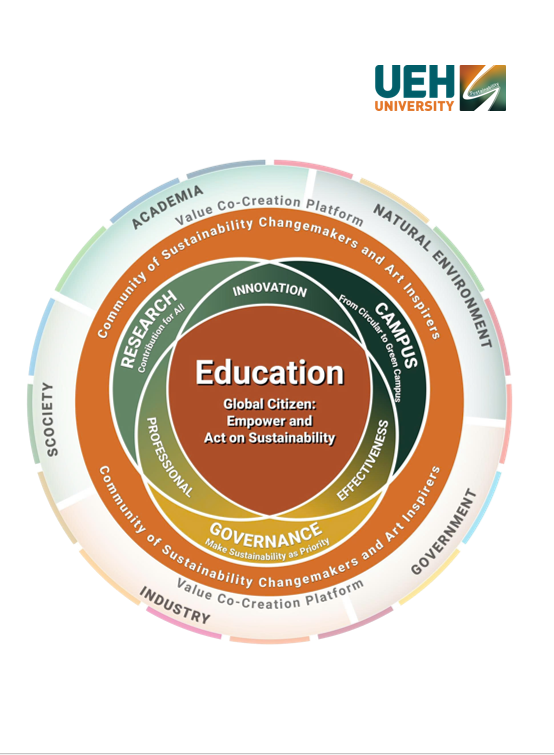
UEH’s journey from ESG integration to SDG impact creation demonstrates a systematic and pioneering approach. In a context where higher education is being called to redefine its role, this model opens a new direction: the university is not only a place to transmit knowledge, but also a center for creating solutions and leading sustainable development.
Author: Assoc. Prof. Bui Quang Hung – Interim President of the University of Economics Ho Chi Minh City (UEH)
This article is part of UEH’s series on research dissemination and applied knowledge with the message: “Research Contribution For All.” UEH respectfully invites readers to look forward to the next issue of UEH Research Insights.

News, photos: Author, UEH Department of Communications and Partnerships
 Chia sẻ:




[Research Contribution] Người dùng xanh có đang rời xa ứng dụng gọi xe?
11 Tháng Tám, 2026

[Research Contribution] Khi đại học cùng giải bài toán của thành phố
28 Tháng Bảy, 2026















[Unbox Glo-cal Program] Vi vu Đông Nam Á cùng Chương trình Cử nhân ASIA Co-op
20 Tháng Mười Hai, 2025


[Research Contribution] Đồng đổi mới sáng tạo cho nền kinh tế đại dương bền vững
12 Tháng Mười Hai, 2025


![[ueh] 500x333](https://future.ueh.edu.vn/wp-content/uploads/2025/12/UEH-500x333-1-370x260.png)
[Research Contribution] Khám phá sự đối lập giữa nghiện thương hiệu và tình yêu thương hiệu
24 Tháng Mười Một, 2025



[Research Contribution] Phát triển bền vững – Góc nhìn đa chiều về hạnh phúc
8 Tháng Mười, 2025

![1. [ueh] Thumb 500x333](https://future.ueh.edu.vn/wp-content/uploads/2025/10/1.-UEH-Thumb-500x333-1-370x260.png)
![1. [ueh] 500x333](https://future.ueh.edu.vn/wp-content/uploads/2025/09/1.-UEH-500x333-1-370x260.png)




[Research Contribution] Những góc nhìn mới về tương lai của thế giới ảo
16 Tháng Sáu, 2025


![[ueh] 500x333](https://future.ueh.edu.vn/wp-content/uploads/2025/04/UEH-500X333-370x260.png)


[Podcast] Góp ý giải pháp phát triển giáo dục Đại học
5 Tháng Hai, 2025

[Podcast] Các yếu tố ảnh hưởng đến động lực học tập của sinh viên
22 Tháng Một, 2025


[Podcast] “Mô hình Campus thích ứng – Giải pháp dành cho Mekong bền vững”
13 Tháng Một, 2025


[Podcast] Đào tạo nhân lực Mekong tương lai: Trao quyền hành động bền vững
30 Tháng Mười Hai, 2024

[Podcast] Dự án Phát triển khung công bằng giao thoa nhằm khuyến khích khả năng đi bộ
30 Tháng Mười Hai, 2024


[Podcast] Chiến lược thiết kế hậu kỹ thuật số trong nghệ thuật truyền thông
27 Tháng Mười Một, 2024


[Podcast] Đồng sáng tạo và xây dựng cộng đồng ArtTech hướng tới tương lai bền vững
26 Tháng Mười Một, 2024


[Podcast] NFTs – Cuộc cách mạng nghệ thuật hay cơn sốt nhất thời?
18 Tháng Mười Một, 2024


[Podcast] CareFeeder – Giải pháp công nghệ hỗ trợ người già và bệnh nhân Parkinson tự ăn uống
11 Tháng Mười Một, 2024


[Podcast] Ứng dụng học máy trong phân tích dữ liệu quản trị nguồn nhân lực
11 Tháng Mười Một, 2024


[Podcast] Nghệ thuật dân gian thời 4.0: Múa rối nước tự động dựa trên nền tảng robot
7 Tháng Mười Một, 2024

[Podcast] Bứt phá hiệu suất sáng tạo nhân viên nhờ phản hồi mang tính phát triển
7 Tháng Mười Một, 2024

[Podcast] Giải pháp MPIA: Lối thoát tạm thời cho cuộc khủng hoảng thương mại quốc tế?
7 Tháng Mười Một, 2024


[Podcast] “Căn bệnh Hà Lan” trong việc nhận kiều hối và trường hợp Việt Nam
31 Tháng Mười, 2024


[Podcast] Phong Cách Lãnh Đạo Đạo Đức Và Hành Vi Ngoài Vai Trò Của Công Chức
29 Tháng Bảy, 2024


[Podcast] Định Hình Chiến Lược Phát Triển Toàn Diện, Bền Vững Cho Đất Nước
25 Tháng Bảy, 2024


[Podcast] Mô Hình Đại Học Bền Vững Dành Cho Các Thị Trường Mới Nổi
19 Tháng Bảy, 2024

[Podcast] Những Tiếp Cận Mới Nhất Dành Cho Các Đại Học Bền Vững
11 Tháng Bảy, 2024


[Podcast] Tác Động Của Nguồn Nhân Lực Xanh Đến Các Mục Tiêu Về Môi Trường
24 Tháng Năm, 2024

Kinh Tế Xã Hội Và Sự Phát Thải CO2 Ở Việt Nam Giai Đoạn 1990 – 2018
23 Tháng Năm, 2024


Pháp Luật Dữ Liệu – Kỳ 1: Cần Một Cách Tiếp Cận Mới
15 Tháng Năm, 2024

[Podcast] Pháp Luật Dữ Liệu – Kỳ 1: Cần Một Cách Tiếp Cận Mới
14 Tháng Năm, 2024


Đánh Giá Quảng Cáo Trên Nền Tảng Tiktok
8 Tháng Năm, 2024

[Podcast] Đánh Giá Quảng Cáo Trên Nền Tảng Tiktok
7 Tháng Năm, 2024






[podcast] Phản Ứng Của Chính Sách Xã Hội Đối Với Đại Dịch Covid-19 Ở Một Số Quốc Gia (Kỳ 1)
8 Tháng Mười Hai, 2023
Promoting Learner Autonomy in English Language Learning (Part 2)
28 Tháng Mười Một, 2023



[Podcast] Ngoại giao kinh tế Việt Nam trong thời kỳ đổi mới và hội nhập quốc tế
10 Tháng Mười Một, 2023



ArtTech and sustainable development
27 Tháng Mười, 2023


Cộng đồng ArtTech đầu tiên tại Việt Nam – Một năm nhìn lại
9 Tháng Mười, 2023
ArtTech – Một xu hướng tương lai
5 Tháng Mười, 2023
ArtTech và phát triển bền vững
3 Tháng Mười, 2023


[Podcast] Máy Tính Và Công Nghệ “Không Đi Một Mình” – Phần 4
24 Tháng Bảy, 2023





[Podcast] Tác Động Của Đồng Tiền Kỹ Thuật Số Đến Tỷ Giá Hối Đoái
14 Tháng Mười Một, 2022






















[Podcast] Chuyển Đổi Số Trong Ngành Du Lịch Việt Nam
5 Tháng Năm, 2022





[Podcast] Chuyển Đổi Số Trong Lĩnh Vực Y Tế Ở Việt Nam
25 Tháng Ba, 2022

[Podcast] Phân Tích Dữ Liệu Con Người Tại Việt Nam
18 Tháng Ba, 2022

[Podcast] Chuyển Đổi Số Trong Nông Nghiệp Ở Việt Nam
11 Tháng Ba, 2022



[Podcast] Mô Hình Kinh Tế Chia sẻ: Các Vấn Đề Quản Lý Ở Việt Nam
21 Tháng Một, 2022
[Podcast] Nâng Cao Trải Nghiệm Khách Hàng Trực Tuyến Trong Ngành Du Lịch
15 Tháng Một, 2022


[Podcast] Chính Sách Lao Động Việc Làm Cho TP. HCM Trong Giai Đoạn Sau Giãn Cách
28 Tháng Mười Hai, 2021

[Podcast] Xây Dựng Thị Trường Chứng Khoán Phi Tập Trung Dựa Trên Công Nghệ Blockchain
24 Tháng Mười Hai, 2021

[Podcast] Học Tập Suốt Đời Trong Thế Giới Số: Góc Nhìn Từ Nghề Nghiệp Kế Toán, Kiểm toán
21 Tháng Mười Hai, 2021
[Podcast] Học Tập Suốt Đời Tại UEH: Hướng Đến Đại Học Bền Vững
14 Tháng Mười Hai, 2021
[Podcast] Xu Hướng Kinh Doanh Bán Lẻ Trực Tuyến Thời Kỳ Covid
10 Tháng Mười Hai, 2021

[Podcast] Big Data Cho Mục Tiêu Phát Triển Bền Vững: Kinh Nghiệm Quốc Tế
7 Tháng Mười Hai, 2021
[Podcast] Cải Cách Luật Đất Đai Để Thúc Đẩy Phát Triển Kinh Tế
2 Tháng Mười Hai, 2021

[Podcast] Cuộc Cách Mạng Trong Kinh Tế Học Thực Nghiệm
30 Tháng Mười Một, 2021



[Podcast] Chỉ Số Giá Tiêu Dùng Từ Góc Nhìn Khai Thác Dữ Liệu Lớn (Big Data)
17 Tháng Mười Một, 2021



[Podcast] Toàn Cảnh Tiền Tệ Kỹ Thuật Số – Phần 5 : Tiền Ổn Định Tư Nhân Diem
5 Tháng Mười Một, 2021



Đứt gãy chuỗi cung ứng vùng trọng điểm phía Nam: 8 giải pháp
20 Tháng Mười, 2021
[Podcast]Toàn Cảnh Tiền Tệ Kỹ Thuật Số – Phần 2: Những Cột Mốc Phát Triển
19 Tháng Mười, 2021

[Podcast] Toàn cảnh tiền tệ kỹ thuật số – Phần 1: Xu thế của thời đại
15 Tháng Mười, 2021

NGÂN HÀNG BẮT TAY FINTECH (Phần 3): Các Giải Pháp Hỗ Trợ
8 Tháng Mười, 2021

UEH chủ trì thành công Hội thảo ICBF 2021
7 Tháng Mười, 2021

GRSD 2021- Hội thảo khoa học “Tăng trưởng xanh và phát triển bền vững”
6 Tháng Mười, 2021

NGÂN HÀNG BẮT TAY FINTECH (phần 2): Chọn đối tác theo tiêu chí nào?
4 Tháng Mười, 2021

‘Đổi mới giáo dục nghề nghiệp là động cơ tăng trưởng kinh tế’
30 Tháng Chín, 2021


Giải pháp “mở cửa” an toàn với các khu công nghiệp tại TP Hồ Chí Minh
27 Tháng Chín, 2021
Khi cuộc sống “bình thường mới”, nơi ở cho người lao động cần được quan tâm
9 Tháng Chín, 2021

Hướng phát triển mô hình đào tạo luân phiên (Dual Education) tại Việt Nam
6 Tháng Chín, 2021
Webinar: Tương lai ngành Thẩm định giá trong thập niên mới
17 Tháng Tám, 2021

Hãy là người dùng thông minh khi đón nhận và chia sẻ thông tin
9 Tháng Tám, 2021


Webinar: An toàn thông tin kế toán trong kỷ nguyên số
3 Tháng Tám, 2021


Có nên đưa lãi suất tiền gửi VND về 0 phần trăm?
20 Tháng Bảy, 2021


Chu kỳ giảm giá của đồng USD?
TS. Đinh Thị Thu Hồng và nhóm nghiên cứu
26 Tháng Sáu, 2021

Việt Nam cần kịch bản cho thương mại tương lai
ThS. Tô Công Nguyên Bảo
26 Tháng Sáu, 2021

Hệ thống tiền tệ tiếp theo như thế nào?
TS. Lê Đạt Chí và nhóm nghiên cứu
26 Tháng Sáu, 2021

Chuyển đổi số trong trường đại học: Dạy học trực tuyến sẽ trở thành xu hướng tất yếu
GS.TS. Nguyễn Trọng Hoài
26 Tháng Sáu, 2021

Tiền số ngân hàng Trung ương – Vận hành và thử nghiệm
Châu Văn Thành
26 Tháng Sáu, 2021
Chuyển đổi số trong khu vực công tại Việt Nam
Khoa Quản lý nhà nước
26 Tháng Sáu, 2021

“Cấp cứu” doanh nghiệp trước làn sóng COVID-19 thứ 4
23 Tháng Sáu, 2021

Chuyên gia UEH: Việt Nam nên kết hợp tiêm vaccine miễn phí và dịch vụ
23 Tháng Sáu, 2021

Hội thảo khoa học về Thị trường bảo hiểm Việt Nam (Conference on Vietnam’s Insurance Industry – CVII)
Khoa Toán – Thống Kê
7 Tháng Sáu, 2021

Muốn có trung tâm tài chính phải có chiến lược thích ứng
Khoa Tài chính
5 Tháng Sáu, 2021
Cần đưa giao dịch công nghệ lên sàn chứng khoán
Bộ Khoa học và Công nghệ
5 Tháng Sáu, 2021
Sự hữu ích của Lý thuyết trò chơi: Thảo luận về giải Nobel Kinh tế năm 2020
JABES
5 Tháng Sáu, 2021

Đoán định tư pháp: Xu thế mới trong hành nghề Luật
Khoa Luật
5 Tháng Sáu, 2021
Thiết kế đô thị: tầm nhìn vững chắc cho đô thị bền vững
Viện Đô thị thông minh và Quản lý
5 Tháng Sáu, 2021
Phục hồi du lịch và nỗ lực thoát khỏi vòng xoáy ảnh hưởng bởi Covid-19
Viện Đô thị thông minh và Quản lý
5 Tháng Sáu, 2021
Nghiên cứu Kinh tế học lao động trong sự biến động của thế giới
JABES
5 Tháng Sáu, 2021
Kết hợp Nghệ thuật và Công nghệ hướng đến Thành phố thông minh đáng sống
Viện Đô thị thông minh và Quản lý
5 Tháng Sáu, 2021
Chuỗi bài “The Basics of B2B”: Thị trường việc làm rộng mở nhiều sinh viên chuyên ngành Marketing đang bỏ quên
TS. Đinh Tiên Minh
5 Tháng Sáu, 2021

Môi trường không phải để nhà đầu tư xài miễn phí!
TS. Phạm Khánh Nam
5 Tháng Sáu, 2021
2021 sẽ là năm khởi đầu của chu kỳ tăng trưởng mới
PGS.TS Nguyễn Khắc Quốc Bảo
5 Tháng Sáu, 2021
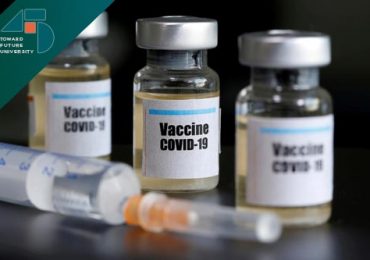
Quỹ vaccine sẽ khả thi khi có người dân đóng góp
Phạm Khánh Nam, Việt Dũng
5 Tháng Sáu, 2021
Kích thích kinh tế, gia tăng vận tốc dòng tiền
Quách Doanh Nghiệp
5 Tháng Sáu, 2021

Đi tìm chiến lược hậu Covid-19 cho doanh nghiệp bảo hiểm Việt Nam
PGS TS Nguyễn Khắc Quốc Bảo, ThS Lê Văn
5 Tháng Sáu, 2021
Insurtech – Cơ hội và thách thức cho Startup Việt
Ths. Lê Thị Hồng Hoa
5 Tháng Sáu, 2021