[Research Contribution] Using AI Responsibly: Don’t Chase the Model, Build the Process
27 June, 2026
Keywords: Artificial Intelligence (AI); Generative AI; responsible AI use; AI risk management; labor productivity; digital transformation
The rapid development of ChatGPT, Gemini, Claude, and Grok is changing the way people learn, work, and make decisions. However, the critical issue is not which AI model is more powerful, but how humans use this technology in practice. Dr. Phan Hoang Diep – University of Economics Ho Chi Minh City (UEH) has analyzed the common limitations and risks of AI, while suggesting principles to help individuals and organizations exploit this technology effectively and responsibly.
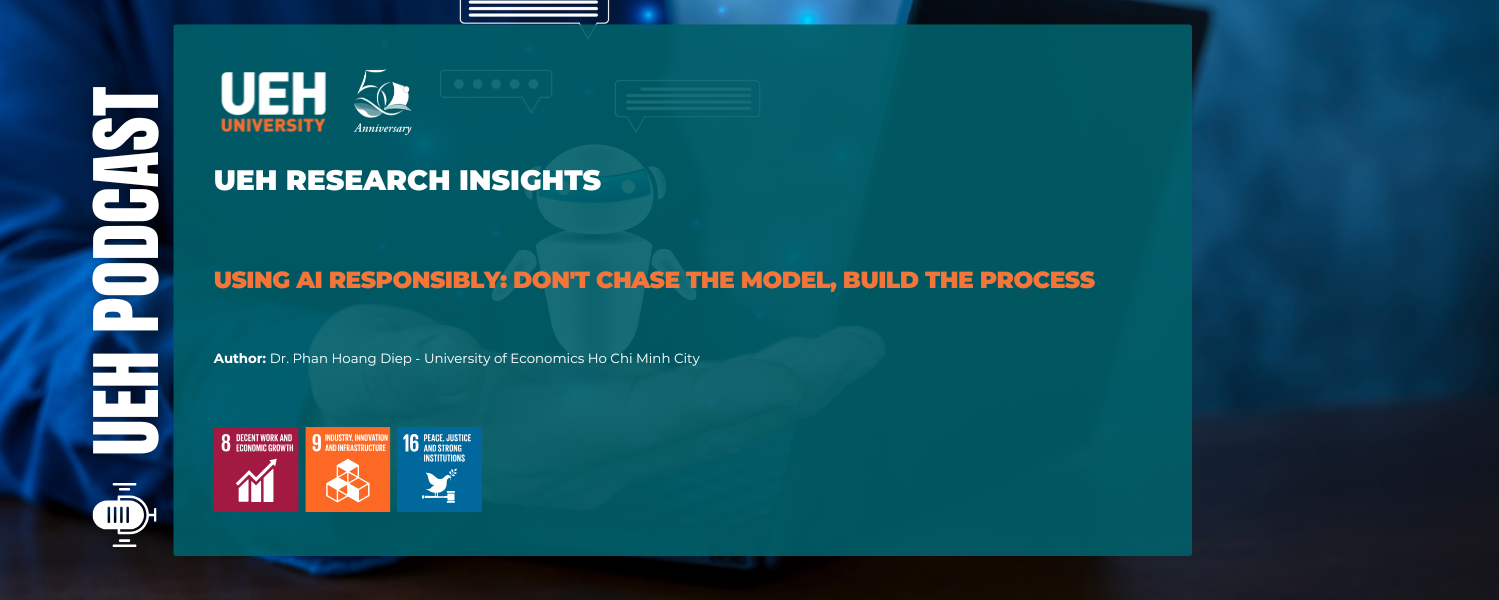
The core issue of artificial intelligence today is not about commanding machines to think for humans. The real challenge is how we learn to collaborate and work effectively alongside technology.
On May 11, 1997, IBM’s Deep Blue supercomputer defeated former world chess champion Garry Kasparov. This machine was capable of calculating 200 million chess positions per second. This is considered a milestone marking the beginning of the modern AI era -13. At that time, many believed that machines would eventually replace human thinking. Nearly 30 years later, that fear has returned in a different form. ChatGPT, Gemini, Grok, and Claude can now write, analyze, program, and converse directly in natural language.
AI has never been so close to us. Nor has this technology ever been so prone to misunderstanding.
The Stanford University AI Index Report shows that generative AI reached a 53% population adoption rate within just three years. This pace is faster than both the personal computer and the internet. In some technology-leading countries, this rate is even higher, with Singapore reaching 61% and the United Arab Emirates 54%. Studies show that productivity can increase by 14% to 26% in customer support and software development. A PwC survey of 100,000 workers across 11 occupations exposed to AI also shows that users expect ChatGPT could reduce working time by 50% for one-third of their tasks.
But we should not celebrate these statistics too soon. Many people are falling into a dangerous illusion, thinking that all they need to do is open their computer, give a command, and the work is done. They mistakenly believe AI is like a magic pot – just throw in ingredients and spices, press a button, and a delicious meal appears. This is a very naive perspective.
Sophisticated AI models can achieve extraordinary feats, such as winning a gold medal at the International Mathematical Olympiad. Conversely, that same leading model can only read an analog clock correctly 50.1% of the time. Researchers call this phenomenon the “jagged frontier” of AI -1 – where AI is both extremely intelligent and remarkably naive.
The operating nature and bottlenecks of AI
To use AI effectively, professionals need to confront three core issues with this technology.
First is hallucination. Large language models operate by predicting the next word based on probability from patterns in vast datasets. They do not store knowledge or possess memory-based thinking like humans.
This mechanism is akin to a test-taker writing an IELTS English essay. That test-taker does not memorize sample essays. Instead, they learn the overall structure of an essay – introduction, body, conclusion. They learn how to write topic sentences, argument patterns, illustrative examples, counter-arguments, and transition words for coherence. When faced with a completely new prompt, the test-taker draws on learned patterns and skills to construct a new essay on the spot. AI works similarly. When given a question, it generates the answer with the highest probability of fitting the context. Precisely because of this probabilistic nature, rather than fact-checking, AI can easily produce responses that sound logical and convincing but are entirely factually incorrect. It can fabricate academic papers, website links, or citations to non-existent sources.
Second is bias. Because AI is trained on human-generated data, it easily reproduces pre-existing societal biases. This leads to unfair outcomes in AI-powered automated hiring systems or AI medical diagnoses. Additionally, AI creates a form of “persuasive distortion.” When users ask leading questions, AI tends to bend or pull in less relevant information to support the user’s viewpoint. AI does not just carry bias; it inadvertently helps humans reinforce their own personal biases.
Third is process errors when delegating work. This is the greatest risk for businesses. The DELEGATE-52 study across 52 professional domains demonstrates a concerning reality. When humans delegate entire document editing processes to AI, even the most advanced models corrupt an average of 25% of document content after long interactions. These errors appear sparsely, accumulate silently, and are very difficult to detect with the naked eye.
The biggest risk when using AI is not that it lies clumsily. The biggest risk is that it produces a wrong result presented fluently, confidently, and attractively. AI reduces experimentation costs but significantly increases verification costs. The most important shift today is that core skills no longer lie in execution but in checking and process design.
The solution lies in better processes
The most important lesson today is not which AI model to choose. The greatest lesson is how to build a process for using AI. Workflow always matters more than the technology model. We should optimize work through the following five specific steps:
- Start with the problem, not the tool: Before opening AI applications, clearly identify the nature of the problem you need to solve.
- Provide full context: AI cannot read the user’s mind. The more accurate internal data you provide, the better the results. The more AI is trained with quality data from individuals and businesses, the more reliable the output.
- Break it down into small steps: Don’t ask AI to write a complete report immediately. Ask for an outline, write each section, check, and then proceed with edits to minimize hallucination risks.
- Verify before scaling: We should only use AI in areas where we already have deep expertise. Users must actively verify information from reputable sources and check practical logic. This is particularly important with numerical data, financial analysis, and strategic decisions.
- Always keep humans in the loop: Keep records of effective prompts, revised versions, and decision-making logic. Businesses need clear policies on AI use to protect copyright and data privacy. AI can propose options, but final decisions and responsibility must always remain with you.
AI is not intelligence that replaces humans. It is a tool that amplifies how we think. If the process is good, AI helps us work faster, deeper, and more creatively. If the process is poor, AI only helps us make mistakes faster, under a very convincing guise.
In the digital age, the core human capabilities lie in oversight, judgment, and accountability. Those who build a scientific workflow with AI today will have a distinct competitive advantage tomorrow. The future will belong to those who know how to use AI – not those who let AI use them.
Author: Dr. Phan Hoang Diep – University of Economics Ho Chi Minh City (UEH)
This article is part of a series disseminating research and applied knowledge with the message “Research Contribution For All,” implemented by UEH. UEH respectfully invites readers to watch the next bulletin.

News & Photos: Author, UEH Department of Communications and Partnerships
References:
1/ https://hai.stanford.edu/assets/files/ai_index_report_2026.pdf
3/ https://arxiv.org/abs/2604.15597
4/ https://www.ibm.com/think/topics/history-of-artificial-intelligence
 Chia sẻ:















































[Research Contribution] Co-innovating for a Sustainable Ocean Economy
12 December, 2025











[Podcast] Recommendations for University education development
14 February, 2025


[Podcast] Developing Vung Tau into a World-Class Tourism City
16 January, 2025


[Podcast] Postdigital Design Strategies for Media Art
6 January, 2025


[Podcast] NFTs – Artistic Innovation or Just a New Hype?
27 December, 2024


[Podcast] Boosting Employee Creativity with Constructive Feedback
23 November, 2024


[Podcast] “Dutch Disease” in Remittances and the Case of Vietnam
4 November, 2024


[Podcast] Latest approaches for sustainable universities
11 July, 2024


Data Law – Part 1: Necessity for a New Approach
18 May, 2024

Advertising Evaluation on Tiktok Platform
14 May, 2024

[Podcast] Advertising Evaluation on Tiktok Platform
13 May, 2024






Promoting Learner Autonomy in English Language Learning (Part 1)
24 November, 2023






ArtTech And Sustainable Development
27 October, 2023

Motivation of EFL Vietnamese Students in Economics-related Majors
12 October, 2023

Climate Change And Our Society: The Urgency Of Gender Inequality
12 October, 2023








People Analytics in Vietnam
10 March, 2022





Revolution in Experimental Economics
30 January, 2022

The Sharing Economy: Governance Issues in Vietnam
24 January, 2022
Employment Policy For Ho Chi Minh City in Post-social distancing Period
28 December, 2021

Lifelong learning at UEH: Towards a Sustainable University
28 December, 2021

Building a Decentralized Stock Market based on Blockchain Technology
24 December, 2021



Consumer price index from big data mining perspective (Big data)
17 November, 2021

Overview Of Digital Currency – Part 5: DIEM Private Stabilized Currency
11 November, 2021