[Research Contribution] The Co-creation University: Preparing human resources for a transforming Ho Chi Minh City
24 July, 2026
Keywords: Co-creation university; Human resources; Ho Chi Minh City; Higher education; Urban development
Ho Chi Minh City is entering a new phase of development with the goal of becoming a regional center for economy, finance, science and technology, and innovation. As the growth model shifts from reliance on labor and capital to one based on knowledge, technology, and creativity, the challenge of human resource development demands a novel approach. Consequently, the role of universities extends beyond learner training to direct participation in the knowledge creation process, resource connectivity, and alignment with the city’s development strategy.
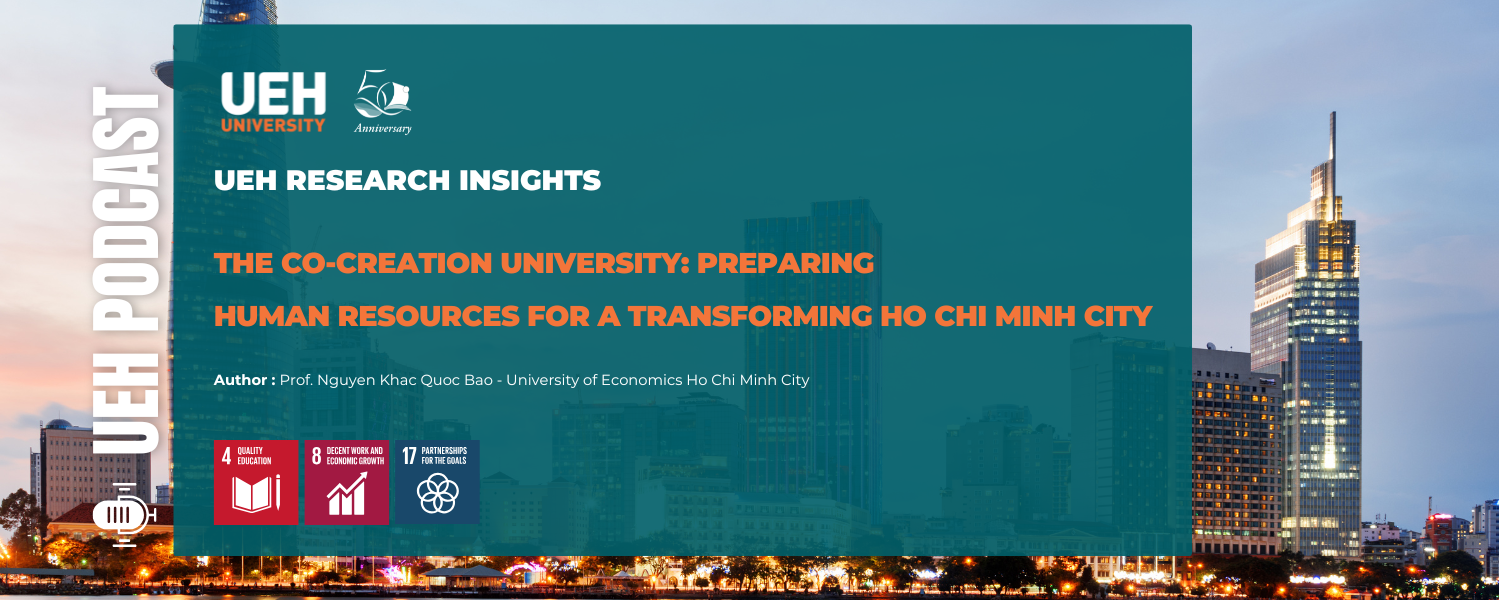
During the “Nguoi Trong Cuoc” program themed “Investment in Human Resources – Creating a Breakthrough for Ho Chi Minh City” broadcast by the Ho Chi Minh City Television and Radio Station, Prof. Nguyen Khac Quoc Bao, Vice Secretary of the Party Committee and Vice President of the University of Economics Ho Chi Minh City (UEH), shared his views on the transformation of higher education’s role in response to the city’s new development requirements. From these analyses, the “Co-Creation University” model is seen as a necessary approach to preparing high-quality human resources for the city’s next phase of development.
Human resources become the city’s competitive advantage
Making Ho Chi Minh City a civilized, modern, and dynamic urban area; maintaining its role as the country’s growth pole; and gradually becoming a regional center for economy, finance, science, technology, and innovation are goals established in numerous major policies of the Party and State. To realize these goals, alongside institutions, infrastructure, and investment capital, the decisive factor is human resources.
If in the past a locality’s competitive advantage might have come from natural resources, geographical location, or an abundant labor force, in a knowledge-based economy, this advantage is increasingly determined by the quality of human resources and innovation capacity.
The development of the digital economy, artificial intelligence, the green transition, and high-tech industries is rapidly changing labor market requirements. Enterprises are no longer only seeking people with specialized knowledge; they need personnel with adaptability, global thinking, technological proficiency, and a commitment to lifelong learning.
According to Prof. Nguyen Khac Quoc Bao, in response to this change, universities cannot simply adjust a few majors or add a number of new skills. What needs to change is the very role of the university within the development ecosystem.
“Universities must engage more deeply in the development process of the locality and the country; not only training learners but also accompanying the process of creating knowledge, solutions, and preparing resources for the future.”
This is also the foundation for many universities around the world to transition to a new development model: the co-creation university.
The university is no longer an “ivory tower”
According to Prof. Nguyen Khac Quoc Bao, the development of higher education has always been linked to changes in the economy and society.
In the initial stage, the university mainly performed the function of transmitting knowledge and training human resources. As scientific research became more deeply integrated into teaching activities, universities began to become places that generate new knowledge, contributing to the development of science and technology.
Over the last decade or so, many universities have continued to expand their role through technology transfer, promoting innovation, and supporting the startup ecosystem. From providing human resources, universities have gradually become a driver of economic growth.
Today, this process is entering a higher stage of development.
Under the co-creation university model, the university no longer stands apart from development challenges; it collaborates with the government, businesses, and the community to research, analyze, and co-create solutions for specific urban and economic issues.
“The university is no longer an ‘ivory tower’ that only focuses on teaching and research; it must incorporate socio-economic development issues into its research and training activities.” – Prof. Nguyen Khac Quoc Bao emphasized.
This perspective also reflects a shift in the mindset of human resource development. Training is no longer the sole responsibility of the education sector; it has become an integral component of local development strategy, where universities participate from the initial stages of trend forecasting, resource preparation, and collaborative problem-solving.
From “training commissioning” to co-creating human resources
Over the years, the mechanism of “training commissioning” has helped universities better align with the needs of the labor market and the locality. However, according to Prof. Nguyen Khac Quoc Bao, given the rapid pace of economic and technological change, this approach needs to be further developed.
Instead of only identifying the quantity of human resources to be trained, universities, management agencies, businesses, and research institutes need to participate from the outset in the process of forecasting development trends, identifying future competency clusters, and co-designing training programs.
This is the fundamental difference between “output commissioning” and “capacity co-creation.”
When all parties jointly develop output standards, knowledge, skills, and professional competencies, the training program will be more closely aligned with practical realities, while also narrowing the gap between the city’s development needs and the human resource preparation process.
This is also the condition for universities to proactively prepare for strategic fields such as international finance, the digital economy, artificial intelligence, logistics, high technology, and green development, rather than only adjusting programs when the market already shows a shortage of human resources.
Universities must become a part of the development strategy
For Ho Chi Minh City, as development goals go beyond mere economic growth and aim toward becoming an international financial center, a regional center for innovation and science and technology, the role of universities also needs to be viewed in a new light.
Universities must not only supply human resources for the current labor market but must also participate in building the capacities that will shape the city’s future; not only train according to demand but also contribute to forecasting demand, creating knowledge, and accompanying the policy-making process for development.
This is also the direction that UEH is pursuing in its development strategy: building a co-creation university model, connecting the State, businesses, research institutes, and the community to jointly address the development challenges of Ho Chi Minh City and the country.
Stay tuned for Part 2: When the university joins the city’s problem-solving – from training human resources for the Ho Chi Minh City International Financial Center and researching urban planning to the “three-party” model connecting the State – University – Enterprises to prepare resources for future strategic development sectors.
Author: Prof. Nguyen Khac Quoc Bao – University of Economics Ho Chi Minh City
This article is part of a series dedicated to disseminating research and applied knowledge under the message “Research Contribution For All” initiated by UEH. UEH cordially invites readers to stay tuned for the next edition of the UEH Research Insights newsletter..

News, photos: Department of Communications and Partnerships
 Chia sẻ:














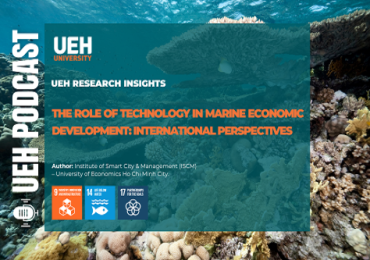
[Research Contribution] Co-innovating for a Sustainable Ocean Economy
12 December, 2025







[Podcast] Recommendations for University education development
14 February, 2025


[Podcast] Developing Vung Tau into a World-Class Tourism City
16 January, 2025


[Podcast] Postdigital Design Strategies for Media Art
6 January, 2025


[Podcast] NFTs – Artistic Innovation or Just a New Hype?
27 December, 2024


[Podcast] Boosting Employee Creativity with Constructive Feedback
23 November, 2024


[Podcast] “Dutch Disease” in Remittances and the Case of Vietnam
4 November, 2024


[Podcast] Latest approaches for sustainable universities
11 July, 2024


Data Law – Part 1: Necessity for a New Approach
18 May, 2024

Advertising Evaluation on Tiktok Platform
14 May, 2024

[Podcast] Advertising Evaluation on Tiktok Platform
13 May, 2024






Promoting Learner Autonomy in English Language Learning (Part 1)
24 November, 2023




ArtTech And Sustainable Development
27 October, 2023

Motivation of EFL Vietnamese Students in Economics-related Majors
12 October, 2023
Climate Change And Our Society: The Urgency Of Gender Inequality
12 October, 2023







People Analytics in Vietnam
10 March, 2022




Revolution in Experimental Economics
30 January, 2022

The Sharing Economy: Governance Issues in Vietnam
24 January, 2022

Employment Policy For Ho Chi Minh City in Post-social distancing Period
28 December, 2021

Lifelong learning at UEH: Towards a Sustainable University
28 December, 2021
Building a Decentralized Stock Market based on Blockchain Technology
24 December, 2021



Consumer price index from big data mining perspective (Big data)
17 November, 2021

Overview Of Digital Currency – Part 5: DIEM Private Stabilized Currency
11 November, 2021