[Research Contribution] Mekong Delta Transport Infrastructure: The Key to Sustainable Development
31 August, 2026
Keywords: Mekong Delta, transport infrastructure, sustainable development, climate change, logistics, regional connectivity.
The Mekong Delta is one of Vietnam’s key agricultural production regions, yet it continues to face significant bottlenecks in transport infrastructure, ranging from limited connectivity among different modes of transportation to constraints in investment funding and climate change adaptation. Consequently, a researcher from UEH Mekong, University of Economics Ho Chi Minh City (UEH) analyzed the current state of transport infrastructure across the region, identifying its strengths, limitations, and available development resources. The study also proposes solutions to strengthen connectivity, reduce logistics costs, and move toward a modern, integrated, and sustainable transport system for the Mekong Delta.
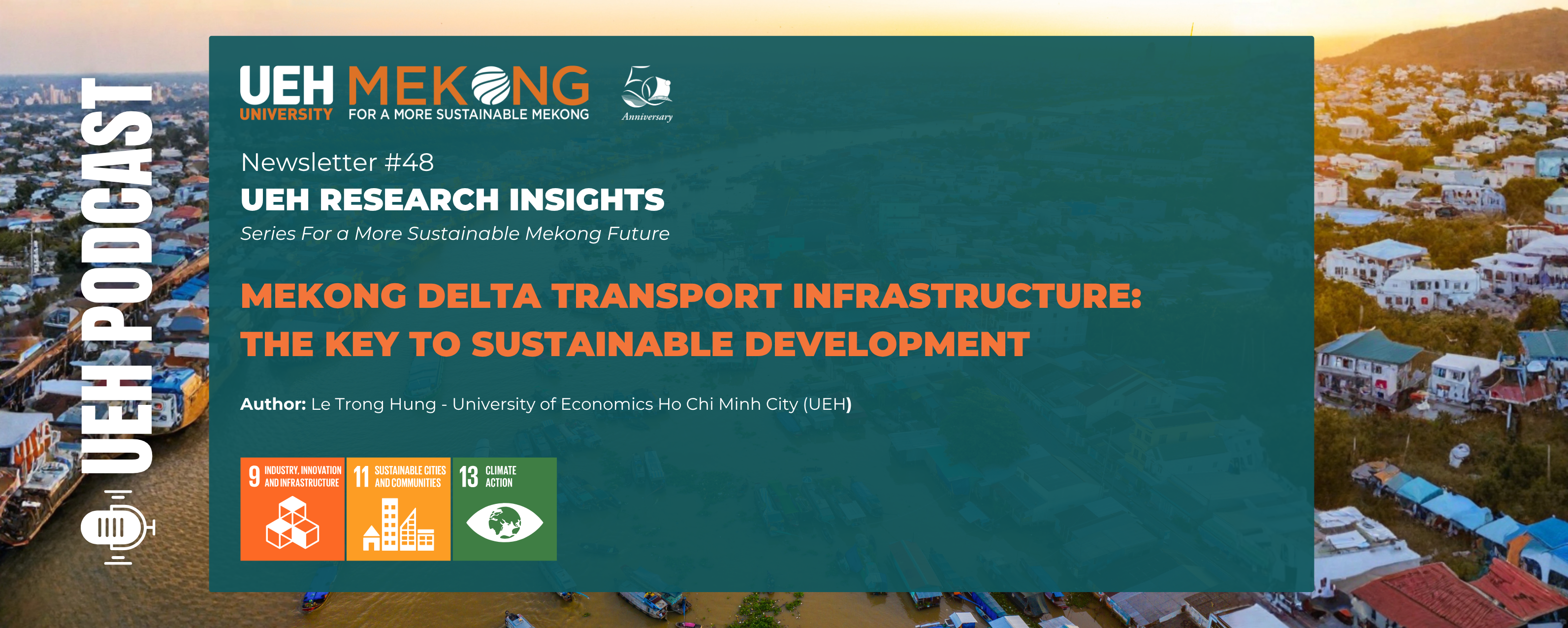
Transport infrastructure – A foundation for unlocking the region’s connectivity potential
The Mekong Delta holds strategic importance for Vietnam’s economic and social development, as well as national defense and security. It is also the country’s major hub for agricultural production and agricultural exports. According to the study, the region accounts for more than 50% of Vietnam’s rice production, approximately 65% of its aquaculture output, and nearly 70% of its fruit exports.
In recent years, transport infrastructure in the Mekong Delta has undergone significant transformation. An expressway network is gradually taking shape, with the Ho Chi Minh City – Trung Luong, Trung Luong – My Thuan, and My Thuan – Can Tho routes already in operation, while the Chau Doc – Can Tho – Soc Trang and Ha Tien – Rach Gia – Bac Lieu projects are being implemented to enhance inter-regional connectivity. Major bridges, such as My Thuan, Can Tho, Vam Cong, and Cao Lanh – have also contributed to boosting trade and reducing travel times.
Beyond road transport, waterways represent a distinctive advantage of the Mekong Delta, with more than 28,000 km of rivers and canals. This extensive network provides favorable conditions for transporting high-volume goods such as agricultural products, seafood, and construction materials at competitive costs. Meanwhile, airports in Can Tho, Phu Quoc, Rach Gia, and Ca Mau help connect the region with major economic centers both domestically and internationally.
Alongside infrastructure investment, regional development policies have also become increasingly comprehensive. Resolution No. 13-NQ/TW of the Politburo and Resolution No. 120/NQ-CP of the Government have established development orientations for the Mekong Delta toward sustainability and climate change adaptation. These policies provide an important foundation for mobilizing resources and advancing key transport infrastructure projects in the years ahead.
These improvements in transport infrastructure have gradually strengthened both intra-regional and inter-regional connectivity, facilitating the movement of goods, attracting investment, and supporting production and business activities. However, the transport system still does not fully meet the region’s growing transportation needs. Gaps in integration among different modes of transport, high logistics costs, and the increasingly visible impacts of land subsidence, riverbank erosion, and saltwater intrusion continue to pose challenges to the Mekong Delta’s development.
Key “bottlenecks” to be addressed
Despite these positive developments, the study shows that transport infrastructure in the Mekong Delta still faces several critical bottlenecks that need to be addressed.
- Limited integration among different modes of transport is one of the region’s major challenges. The Mekong Delta currently has approximately 2,173 km of national highways, more than 3,450 km of provincial roads, and over 35,677 km of rural roads. However, some routes remain relatively small in scale and have narrow road surfaces. At the same time, ports, terminals, waterways, and logistics services have not yet been developed in an integrated manner, limiting connectivity among road, waterway, and air transport.
- Climate change is also placing direct pressure on transport infrastructure. Land subsidence, riverbank erosion, saltwater intrusion, and sea-level rise can accelerate infrastructure deterioration while increasing repair and maintenance costs.
- Investment funding remains insufficient to meet demand. According to the study, the estimated funding requirement for transport infrastructure development in the Mekong Delta is approximately 391.2 trillion VND, while central government budget allocations for regional transport during the 20212025 period were projected at around 86 trillion VND. This funding gap has made it difficult to implement some key infrastructure projects, while efforts to attract private investment remain constrained by investment procedures, project preparation timelines, and risks associated with capital recovery.
These challenges demonstrate that the Mekong Delta’s transport problem is not simply a matter of building more roads or bridges. More importantly, the region needs to develop an integrated transport system that connects multiple modes of transportation while remaining resilient to climate change.
Policy Implications
The findings indicate that transport infrastructure development in the Mekong Delta can make an important contribution to shaping transport and regional connectivity policies in the years ahead.
First, strengthen multimodal connectivity and develop logistics. Connectivity among road, waterway, and air transport, as well as logistics centers, should be enhanced to create an integrated transportation network from production areas to end markets. Investment in transshipment hubs and intermodal connections can help shorten transportation times, reduce logistics costs, and improve the competitiveness of Mekong Delta products.
Second, make effective use of the region’s waterway advantages. With its dense network of rivers and canals, the Mekong Delta has strong potential for waterway transport, particularly for agricultural products, seafood, and other high-volume goods. Priority should therefore be given to upgrading waterways, inland ports, and logistics services associated with waterborne transport. This would help reduce pressure on the road network while maximizing the region’s natural advantages.
Third, integrate climate change adaptation into infrastructure planning. Factors such as land subsidence, riverbank erosion, saltwater intrusion, and sea-level rise should be incorporated from the earliest stages of transport infrastructure planning, design, and investment. This approach can strengthen infrastructure resilience, extend asset lifespans, and reduce long-term repair and maintenance costs.
Fourth, strengthen regional coordination and mobilize investment resources. Local authorities need to coordinate more closely in planning, investing in, and operating infrastructure projects that have inter-provincial significance, avoiding fragmented and uncoordinated investments. At the same time, mechanisms for attracting private-sector resources should be improved, while funding sources should be diversified to meet the Mekong Delta’s substantial transport infrastructure investment needs.
The study therefore emphasizes that transport infrastructure development in the Mekong Delta should be approached through regional integration, multimodal connectivity, and climate resilience. This is not merely a solution to the region’s transport bottlenecks; it can also help reduce logistics costs, expand development opportunities, and strengthen the competitiveness of the region as a whole – contributing to a dynamic and sustainable Mekong Delta.
View the full research paper “Mekong Delta Transport Infrastructure: The Key to Sustainable Development” HERE.
Authors: Le Trong Hung – University of Economics Ho Chi Minh City (UEH)
This article is part of the series disseminating research and applied knowledge under the message “For a More Sustainable Mekong,” within the “Research Contribution For All” program conducted by UEH. UEH respectfully invites readers to stay tuned for the next edition of the UEH Research Insights newsletter.

News, photos: Author, Department of Admissions – Communications UEH Mekong, Department of Communications and Partnerships UEH
 Chia sẻ:








































[Research Contribution] Co-innovating for a Sustainable Ocean Economy
12 December, 2025












[Podcast] Recommendations for University education development
14 February, 2025


[Podcast] Developing Vung Tau into a World-Class Tourism City
16 January, 2025


[Podcast] Postdigital Design Strategies for Media Art
6 January, 2025


[Podcast] NFTs – Artistic Innovation or Just a New Hype?
27 December, 2024


[Podcast] Boosting Employee Creativity with Constructive Feedback
23 November, 2024


[Podcast] “Dutch Disease” in Remittances and the Case of Vietnam
4 November, 2024


[Podcast] Latest approaches for sustainable universities
11 July, 2024


Data Law – Part 1: Necessity for a New Approach
18 May, 2024

Advertising Evaluation on Tiktok Platform
14 May, 2024

[Podcast] Advertising Evaluation on Tiktok Platform
13 May, 2024






Promoting Learner Autonomy in English Language Learning (Part 1)
24 November, 2023






ArtTech And Sustainable Development
27 October, 2023


Motivation of EFL Vietnamese Students in Economics-related Majors
12 October, 2023

Climate Change And Our Society: The Urgency Of Gender Inequality
12 October, 2023





People Analytics in Vietnam
10 March, 2022





Revolution in Experimental Economics
30 January, 2022

The Sharing Economy: Governance Issues in Vietnam
24 January, 2022

Employment Policy For Ho Chi Minh City in Post-social distancing Period
28 December, 2021

Lifelong learning at UEH: Towards a Sustainable University
28 December, 2021

Building a Decentralized Stock Market based on Blockchain Technology
24 December, 2021



Consumer price index from big data mining perspective (Big data)
17 November, 2021

Overview Of Digital Currency – Part 5: DIEM Private Stabilized Currency
11 November, 2021