[Research Contribution] Enhancing the Intention to Use Home Composting Bins Amidst Climate Change Driven by Food Waste in HCMC
30 October, 2025
Keywords: Climate Change, Carbon Footprint, Food Waste, Sustainable Development, Green Behavioral Intention, Home Composting Bin.
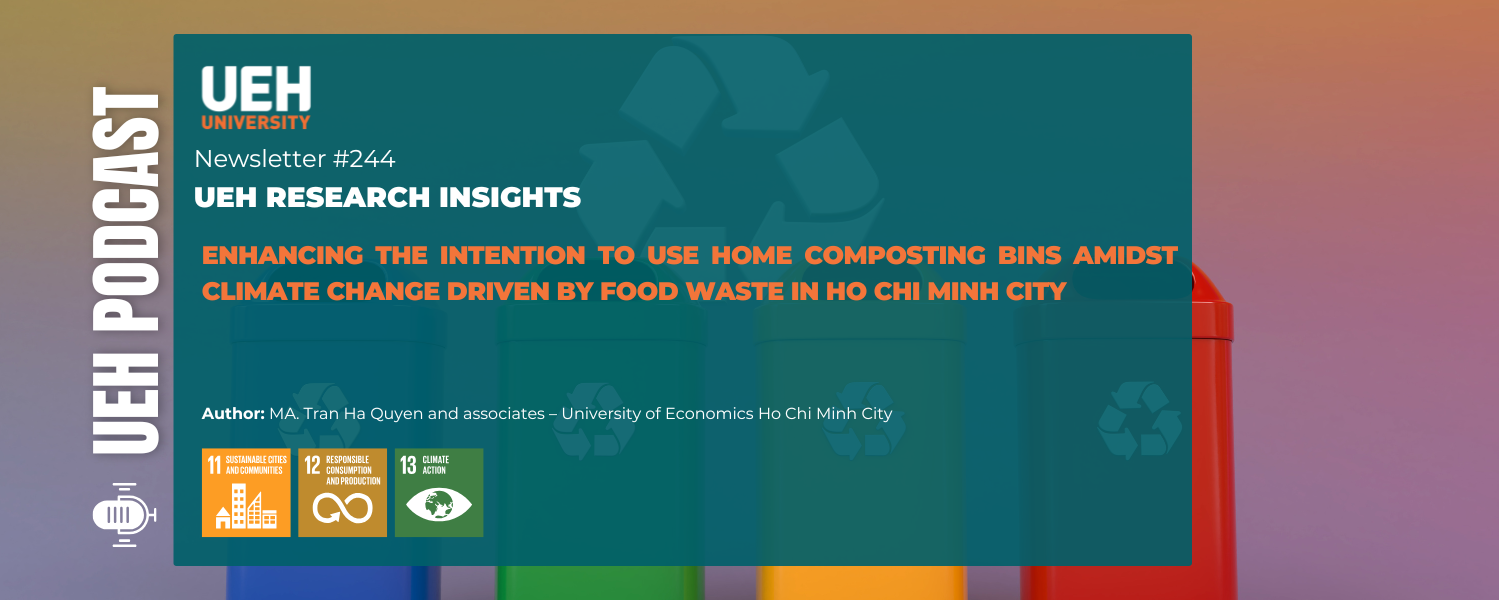
In the context of worsening climate change, food waste is a silent contributor to the exacerbation of greenhouse gas emissions. Ho Chi Minh City, with its high population density and rapid urbanization, is facing a large volume of inefficiently treated domestic waste, particularly organic waste. Therefore, according to a study by researchers from the University of Economics Ho Chi Minh City (UEH), at-source waste treatment using home composting bins emerges as a critical solution to reduce carbon footprints, contribute to sustainable development goals, and shift consumer behavior towards environmental friendliness.
Food Waste – The “Silent” Emitter
In Vietnam, food waste is an alarming issue that is becoming increasingly severe. The country ranks second in the Asia-Pacific region for food waste, with over 8 million tons of food lost annually, causing nearly $3.9 billion in losses, equivalent to about 2% of its GDP. Notably, according to 2020 statistics from the Department of Natural Resources and Environment, Ho Chi Minh City significantly contributes to the national food waste volume, with an average domestic waste generation of 0.98 kg/person/day, projected to reach approximately 13,000 tons/day by 2025.
The rise in food waste not only causes soil, water, and air pollution but also contributes to global warming. According to Our World in Data, in 2020, food waste was responsible for 6% of total global greenhouse gas emissions.
Home Composting Bins – A Small Initiative with a Big Impact
As pollution from food waste continues to rise, home composting bins represent a highly promising solution for reducing food waste. These bins are made from virgin HDPE plastic, a heat-resistant material that maintains stability and durability over time. Their design includes circular holes spaced approximately 10–15 cm apart, combined with a lower access door, which helps separate organic materials like food scraps and vegetables from other types of waste. This reduces odors from decomposition and limits the growth of pathogenic bacteria. The product creates a circular waste cycle through an anaerobic fermentation method that breaks down organic waste into compost fertilizer.
The Influence of Factors on the Decision to Use Composting Bins
The research findings indicate that “Product Availability,” “Subjective Norm,” and “Attitude” have a positive correlation with the intention of HCMC residents to use home composting bins.
“Product Availability” has the strongest impact on the intention to use home composting bins. Survey results show that the statement “The current variety of composting bin options influences my intention to use them” was the most frequently chosen. This suggests that consumers value diversity in both the locations and methods of purchasing these products.
“Subjective Norm” is the second most influential factor. Specifically, the statement “My family believes that protecting the environment is important, and this influences my intention to use a home composting bin” received a high level of agreement. This indicates that people’s intentions are more easily influenced by the opinions of those important to them, which can be explained by Vietnam’s strong collectivist culture that emphasizes interpersonal relationships (Hofstede, 2001).
“Attitude” ranks third in its impact on usage intention. Among the options, the statement “I feel that letting leftover food decompose in landfills is a waste of useful resources” was rated the highest. The research team noted that people’s tendency to use composting bins is driven by a positive attitude towards environmental protection and the product’s role in this regard.
Solutions to Promote the Habit of Using Composting Bins
Based on the study, the authors propose several solutions to help Vietnamese people gradually adopt the habit of using composting bins in their daily lives:
First, manufacturers and retailers can respond to customer demand by regularly updating the quantity, design, and features of composting bins. They can also increase product accessibility by expanding distribution to retail stores, joining e-commerce platforms, or establishing dedicated sales websites.
Second, the popularity of home composting bins needs to be more widespread within the community. Media channels such as newspapers, radio, television, and social media can help promote the product’s image and disseminate information about its benefits, thereby enhancing product recognition.
Third, public awareness of the food waste issue needs to be improved through active promotion, calls to action, and collaboration with programs and campaigns aimed at reducing food waste and protecting the environment.
Author: MA. Tran Ha Quyen and associates – University of Economics Ho Chi Minh City
This article is part of the series spreading research and applied knowledge from UEH with the message “Research Contribution For All.” UEH cordially invites readers to look forward to the next UEH Research Insights newsletter.
News, photos: Authors, UEH Department of Communications and Partnerships

 Chia sẻ:
















[Research Contribution] Co-innovating for a Sustainable Ocean Economy
12 December, 2025








[Podcast] Recommendations for University education development
14 February, 2025


[Podcast] Developing Vung Tau into a World-Class Tourism City
16 January, 2025


[Podcast] Postdigital Design Strategies for Media Art
6 January, 2025


[Podcast] NFTs – Artistic Innovation or Just a New Hype?
27 December, 2024


[Podcast] Boosting Employee Creativity with Constructive Feedback
23 November, 2024


[Podcast] “Dutch Disease” in Remittances and the Case of Vietnam
4 November, 2024


[Podcast] Latest approaches for sustainable universities
11 July, 2024


Data Law – Part 1: Necessity for a New Approach
18 May, 2024

Advertising Evaluation on Tiktok Platform
14 May, 2024

[Podcast] Advertising Evaluation on Tiktok Platform
13 May, 2024





Promoting Learner Autonomy in English Language Learning (Part 1)
24 November, 2023




ArtTech And Sustainable Development
27 October, 2023
Motivation of EFL Vietnamese Students in Economics-related Majors
12 October, 2023

Climate Change And Our Society: The Urgency Of Gender Inequality
12 October, 2023





People Analytics in Vietnam
10 March, 2022




Revolution in Experimental Economics
30 January, 2022

The Sharing Economy: Governance Issues in Vietnam
24 January, 2022
Employment Policy For Ho Chi Minh City in Post-social distancing Period
28 December, 2021

Lifelong learning at UEH: Towards a Sustainable University
28 December, 2021

Building a Decentralized Stock Market based on Blockchain Technology
24 December, 2021



Consumer price index from big data mining perspective (Big data)
17 November, 2021

Overview Of Digital Currency – Part 5: DIEM Private Stabilized Currency
11 November, 2021