[Research Contribution] The Impact of National Innovation Infrastructure on Innovation Trends in Vietnamese Enterprises
30 July, 2025
Keywords: Infrastructure; State-owned enterprises; Innovation; Development investment funds; Vietnam.
In recent years, Vietnam has increased its investment in national innovation infrastructure (NII) to promote innovation activities within enterprises and nurture technology-based startups. A study conducted by the University of Economics Ho Chi Minh City (UEH) revealed that Vietnamese enterprises tend to increase their allocations to development investment funds when the national innovation infrastructure – primarily driven by information and communication technology (ICT) infrastructure – is improved. State-owned enterprises, in particular, show a stronger tendency to allocate resources to such funds compared to non-state-owned firms. The study’s findings indicate that the government’s efforts to enhance innovation infrastructure are producing positive outcomes and provide several policy recommendations to further promote innovation trends among Vietnamese enterprises.
Innovation in Vietnam: Current Landscape and the Question of Diffusion
Innovation has been identified as a national strategic priority in numerous government policy documents. Decision No. 569/QĐ-TTg, issued on May 11, 2022, emphasized that “the development of science, technology, and innovation is a top national policy and plays a breakthrough role in the new development phase,” underlining the government’s strong commitment to innovation as a driving force for national progress.
According to the Vietnam Innovation & Tech Investment Report 2023 by NIC and Do Venture, investment in innovative startups has grown significantly over the past decade, with a notable leap in 2018 when capital increased from USD 48 million in 2017 to USD 443 million. This increase has been accompanied by a corresponding rise in the number of deals.
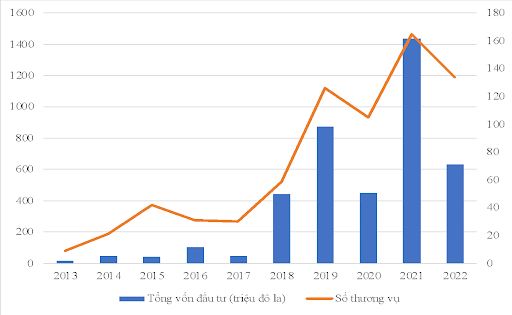
Figure: Investment capital and number of startup deals (2013–2022)
Source: Vietnam Innovation & Tech Investment Report 2023
This growth cannot be separated from the government’s role in initiating and supporting the national innovation ecosystem. In 2015, Deputy Prime Minister Vu Duc Dam signed the decision to establish the National Innovation Center (NIC) under the Ministry of Planning and Investment, with a mandate to support and develop the startup and innovation ecosystem. The government has continued investing in innovation infrastructure through initiatives such as the Hoa Lac High-Tech Park and other technology clusters in major cities. Centers modeled after NIC and innovators affiliated with NIC have enjoyed various incentives related to taxation, facilities, and access to domestic and international funding.
Beyond infrastructure and legal frameworks, public authorities have also embraced digital transformation, simplifying administrative procedures and enhancing interaction with citizens and organizations through online platforms.
In this context, where innovation is central to Vietnam’s socio-economic strategy, it is important to investigate how businesses are responding. This study aims to answer a key question: Do current government efforts to build innovation infrastructure influence enterprise-level innovation behavior, as evidenced by increased attention to innovation activities?
A secondary focus of the research lies in understanding the role of state ownership—a distinct characteristic of Vietnam’s economy. State-owned enterprises (SOEs), as key policy conduits, are well-positioned to be early adopters of innovation and may serve as catalysts for sector-wide innovation trends. With their stronger ties to government and access to more abundant resources, SOEs may have advantages in leveraging national innovation infrastructure.
Research Findings
To explore these questions, the UEH researcher utilized a sample of companies listed on Vietnam’s HNX and HOSE stock exchanges. The development investment fund – used for expansion, fixed asset replacement, and innovation – is employed as a proxy for enterprise innovation trends. The study uses the “Infrastructure” pillar from the Global Innovation Index as a measure of a country’s innovation infrastructure.
Analytical results show that enterprises are more likely to allocate resources to development investment funds – signaling a greater intention to invest in innovation – when national innovation infrastructure improves. This effect is particularly pronounced for improvements in ICT infrastructure. Moreover, enterprises with higher levels of state ownership demonstrate a greater tendency to allocate such funds when innovation infrastructure improves. This suggests that SOEs may have better access to and utilization of NII, possibly due to existing ties with the state and superior resources compared to private firms.
Policy Implications
The study offers several policy recommendations:
First, strengthening national innovation infrastructure is a sound strategy, as it stimulates enterprise-level investment in innovation. A foundational step toward encouraging business innovation is creating an environment where firms are motivated to accumulate resources for future innovation initiatives. Given the strong influence of ICT infrastructure improvements, policymakers should prioritize the development of digital infrastructure to capitalize on the momentum of the digital era.
Second, the government should recognize the leadership role of SOEs in promoting national innovation. Despite the rising prominence of private enterprises, SOEs remain foundational pillars of Vietnam’s economy. With high innovation readiness and resource advantages, they are well-suited to lead the national innovation agenda and inspire participation from other firms.
The research also highlights a concerning trend: large and highly profitable firms appear less responsive to the current wave of innovation. This complacency could pose risks in a rapidly evolving technological landscape, where outdated practices quickly erode competitive advantage. A reluctance to trade short-term profits for long-term innovation underscores a short-sighted orientation in business strategy. Lawmakers must address this mindset and implement measures that encourage a longer-term focus on innovation.
Another critical point concerns the use of the development investment fund post-allocation. To steer enterprises toward innovation-related expenditures, the state must lead by example. Immediate steps could include raising awareness of innovation benefits and providing widespread training programs for enterprises across regions to reshape their perceptions of innovation. With abundant funding and increased awareness of innovation’s strategic value, enterprises will be better positioned to implement practical innovation initiatives aimed at sustainable development.
Educational institutions also have a vital role to play. By embedding innovation-related content more thoroughly into business and management curricula, particularly at the university level, Vietnam can cultivate a workforce equipped with a strong understanding of enterprise innovation. Each employee is a potential driver of innovation; thus, fostering innovation literacy among future professionals is essential.
Full article: The Impact of National Innovation Infrastructure on Innovation Trends in Vietnamese Enterprises – [READ HERE]
Author: Dr. Hoang Viet Huy – University of Economics Ho Chi Minh City
This article is part of the UEH Research Contribution For All series, promoting applied research and knowledge dissemination. We sincerely invite readers to follow upcoming editions of UEH Research Insights.
News and photos: Author, UEH Department of Communications and Partnerships

 Chia sẻ:






























































[Research Contribution] Co-innovating for a Sustainable Ocean Economy
12 December, 2025















[Podcast] Recommendations for University education development
14 February, 2025


[Podcast] Developing Vung Tau into a World-Class Tourism City
16 January, 2025


[Podcast] Postdigital Design Strategies for Media Art
6 January, 2025


[Podcast] NFTs – Artistic Innovation or Just a New Hype?
27 December, 2024


[Podcast] Boosting Employee Creativity with Constructive Feedback
23 November, 2024


[Podcast] “Dutch Disease” in Remittances and the Case of Vietnam
4 November, 2024


[Podcast] Latest approaches for sustainable universities
11 July, 2024


Data Law – Part 1: Necessity for a New Approach
18 May, 2024

Advertising Evaluation on Tiktok Platform
14 May, 2024

[Podcast] Advertising Evaluation on Tiktok Platform
13 May, 2024






Promoting Learner Autonomy in English Language Learning (Part 1)
24 November, 2023







ArtTech And Sustainable Development
27 October, 2023


Motivation of EFL Vietnamese Students in Economics-related Majors
12 October, 2023

Climate Change And Our Society: The Urgency Of Gender Inequality
12 October, 2023








People Analytics in Vietnam
10 March, 2022





Revolution in Experimental Economics
30 January, 2022

The Sharing Economy: Governance Issues in Vietnam
24 January, 2022

Employment Policy For Ho Chi Minh City in Post-social distancing Period
28 December, 2021

Lifelong learning at UEH: Towards a Sustainable University
28 December, 2021

Building a Decentralized Stock Market based on Blockchain Technology
24 December, 2021



Consumer price index from big data mining perspective (Big data)
17 November, 2021

Overview Of Digital Currency – Part 5: DIEM Private Stabilized Currency
11 November, 2021