[Research Contribution] Climate Transition Risk and Bank Risk-Taking: The Role of Digital Transformation – A Perspective from Vietnam
30 October, 2025
Keywords: Digital transformation, bank risk, climate transition risk (CTR)
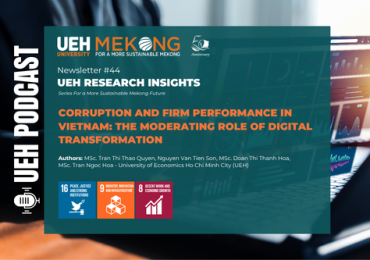
In the context of escalating global climate change, climate transition risk (CTR) has emerged as a critical component of bank risk management. Vietnam, with its commitment to achieving net-zero emissions by 2050, is witnessing a growing interest from commercial banks in integrating environmental factors into their business operations while controlling risk. Building on this context, a study by researchers from UEH Mekong, University of Economics Ho Chi Minh City (UEH), analyzes the impact of CTR on banks’ risk-taking levels—including total risk, systemic risk, firm-specific risk, and Z-score—under the moderating effect of digital transformation within the Vietnamese commercial banking system.

Climate Transition Risk Has a Dual Impact on Bank Risk-Taking
Bank operational stability can be significantly affected by the impact of climate transition risk. Some studies have suggested solutions such as applying higher interest rates to loans with greater climate risk or establishing sustainable development indicators to enhance resilience. However, the role of digital transformation in the relationship between climate transition risk and bank risk-taking has not been thoroughly investigated. In reality, digital transformation can be both an opportunity and a challenge: it enhances operational efficiency, improves information flow and financial performance, but it also introduces new risks such as data breaches and fraud. Most prior studies have only examined these impacts in isolation, without considering the simultaneous context of climate risk management and digital transformation. Therefore, the research team conducted this study to assess the impact of digital transformation on the management of climate transition risk in Vietnamese banks.
Secondary data was collected from 25 commercial banks, comprising 250 observations from 2013–2023, based on financial reports, sources from the Department of Information Technology under the Ministry of Information and Communications, statistical yearbooks, State Bank reports, and stock prices.
The analysis reveals that climate transition risk has a dual impact on bank risk-taking.
On the one hand, this risk reduces total risk and systemic risk by prompting banks to proactively adjust their credit portfolios and expand environmentally friendly financial products. This adjustment contributes to enhancing the financial stability of the banking system.
On the other hand, climate transition risk increases the insolvency risk and idiosyncratic risk of individual banks. As this risk level rises, high-carbon-emitting enterprises often face a higher risk of default, deteriorating the credit quality and capital recovery capacity of banks. This impact leads to a short-term increase in the insolvency and specific risks of individual banks.
Thus, while climate transition risk may have positive effects on overall and systemic risk, it simultaneously exerts greater pressure on the solvency and credit security of individual banks.
The Combined Impact of Climate Transition Risk and Digital Transformation
The analysis indicates that digital transformation—measured by the ICT index, technical infrastructure, and online services—has a moderating effect on the relationship between climate transition risk and bank risk. While digitalization improves operational efficiency and risk management capabilities, it also introduces new risks such as cyber-attacks, data breaches, and operational risks. Consequently, digitalization can increase bank risk at both micro and macro levels.
In the short term, without adequate adaptation measures, the combination of climate transition risk and the digitalization process can diminish financial stability and increase a bank’s total risk. The results show that the negative impact of the interaction between CTR and digital transformation is also evident in insolvency risk, particularly when digitalization is linked to investments in technical infrastructure and internal applications. This stems from the fact that high-carbon-emitting enterprises face a greater risk of default, directly affecting the banks’ debt recovery capacity. Furthermore, the increased data and fraud risks associated with digitalization also contribute to elevating this risk level.
Additionally, the combined impact of climate transition risk and digitalization can also increase systemic risk. Climate risk, especially transition risk, affects asset value fluctuations, while digitalization—through the rapid growth of Fintech—increases competition, inter-bank risks, and technical risks. Particularly in the initial stages of digital transformation, banks often need to make significant investments in infrastructure and human resources, leading to extended payback periods and potential instability in the financial system.
Discussion and Policy Implications
Our research reveals that climate transition risk has a dual impact on the banking sector. On one hand, this risk compels banks to adjust their strategies and adopt sustainable governance measures, thereby helping to mitigate overall and systemic risks. On the other hand, in the short term, climate transition risk can increase the likelihood of insolvency and the idiosyncratic risks of individual banks, especially for loans extended to high-carbon-emitting enterprises.
In this context, digital transformation emerges as a crucial solution, helping banks improve operational efficiency and enhance their risk management capabilities. However, it is not an “absolute shield,” as alongside its benefits, the digitalization process also creates new challenges such as the risk of cyber-attacks, data breaches, and systemic instability.
Therefore, banks cannot afford to be complacent. Instead, they must increase investment in technological infrastructure, develop a high-quality workforce, and build a digital ecosystem aligned with climate change adaptation goals. This is not just a risk management challenge but also an opportunity for Vietnam’s finance and banking sector to transform more robustly towards a green, sustainable, and secure future.
Read the full research paper: Climate Transition Risk and Bank Risk-Taking: The Role of Digital Transformation – A Perspective from Vietnam HERE
Authors: MA. Nguyen Dang Khoa, Tran Thi Thao Quyen – University of Economics Ho Chi Minh City
This article is part of the series spreading research and applied knowledge with the message “For a More Sustainable Mekong,” under the “Research Contribution For All” program implemented by UEH. UEH cordially invites readers to look forward to the next UEH Research Insights newsletter.
News, photos: Authors, UEH Mekong Department of Admissions and Communications, UEH Department of Communications and Partnerships
 Chia sẻ:
































[Research Contribution] Co-innovating for a Sustainable Ocean Economy
12 December, 2025









[Podcast] Recommendations for University education development
14 February, 2025


[Podcast] Developing Vung Tau into a World-Class Tourism City
16 January, 2025


[Podcast] Postdigital Design Strategies for Media Art
6 January, 2025


[Podcast] NFTs – Artistic Innovation or Just a New Hype?
27 December, 2024


[Podcast] Boosting Employee Creativity with Constructive Feedback
23 November, 2024


[Podcast] “Dutch Disease” in Remittances and the Case of Vietnam
4 November, 2024


[Podcast] Latest approaches for sustainable universities
11 July, 2024


Data Law – Part 1: Necessity for a New Approach
18 May, 2024

Advertising Evaluation on Tiktok Platform
14 May, 2024

[Podcast] Advertising Evaluation on Tiktok Platform
13 May, 2024






Promoting Learner Autonomy in English Language Learning (Part 1)
24 November, 2023






ArtTech And Sustainable Development
27 October, 2023


Motivation of EFL Vietnamese Students in Economics-related Majors
12 October, 2023

Climate Change And Our Society: The Urgency Of Gender Inequality
12 October, 2023







People Analytics in Vietnam
10 March, 2022





Revolution in Experimental Economics
30 January, 2022

The Sharing Economy: Governance Issues in Vietnam
24 January, 2022

Employment Policy For Ho Chi Minh City in Post-social distancing Period
28 December, 2021

Lifelong learning at UEH: Towards a Sustainable University
28 December, 2021

Building a Decentralized Stock Market based on Blockchain Technology
24 December, 2021



Consumer price index from big data mining perspective (Big data)
17 November, 2021

Overview Of Digital Currency – Part 5: DIEM Private Stabilized Currency
11 November, 2021