[Research Contribution] High-quality, International-standard Tourism linked to the airport city model: Long Thanh International Airport as the core
24 April, 2026
Keywords: Airport city, aerotropolis, high-quality tourism, Long Thanh, regional development, non-aeronautical services, MICE, transit tourism
In the context of increasing competition among aviation hubs, optimizing value from passenger flows has become a strategic imperative, extending beyond pure aviation operations. Modern airports are no longer mere transit points but are gradually becoming integrated economic centers where passengers are simultaneously consumers and tourists.
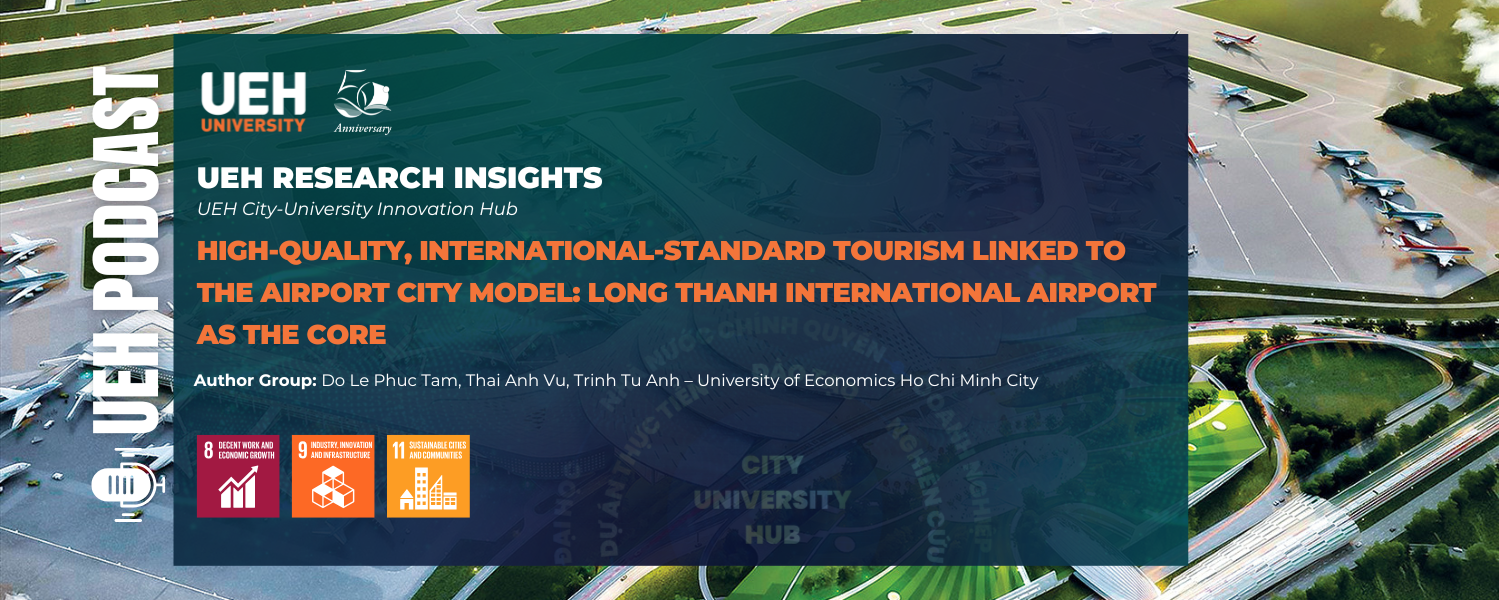
From this perspective, the research team from the University of Economics Ho Chi Minh City (UEH) views Long Thanh International Airport as the core of the aerotropolis model. This article proposes ways to convert passenger throughput into economic value through tourism development and service ecosystem expansion, contributing to enhancing the competitiveness of the Southeast region. Based on this, an integrated approach linking aerotropolis spatial structure with tourism development is suggested, employing a multi-layered model comprising the core zone, connecting corridors, and satellite clusters, thereby explaining how passenger flows can be transformed into economic value streams.
Development context of Long Thanh Airport and its surrounding area
Long Thanh International Airport is positioned not merely as a large-scale transportation infrastructure project but as a driver for restructuring the economic-urban space of the Southern Key Economic Region. With a projected capacity of 100 million passengers per year, the airport aims to become a major international transit hub in Southeast Asia -8-10.
However, the substantial investment scale also brings high pressure for capital recovery, while revenue from pure aviation activities offers limited profit margins. This necessitates seeking added value from the ecosystem surrounding the airport, where tourism and non-aeronautical services play a particularly crucial role.
This reality is not unique but reflects a development trend occurring at many aviation hubs worldwide.
Development context of Aerotropolis in the region
In Asia, airports are increasingly evolving into centers of multi-functional economic ecosystems. The theoretical frameworks of the airport city (the area developed directly around the airport) and the aerotropolis (the expanded airport metropolis) help explain this trend, where commercial, service, and tourism activities are organized around the global connectivity provided by aviation -4-9.
Typical models such as Incheon, Changi, or Hong Kong demonstrate that success lies not only in passenger volume but in the ability to convert passengers into consumers and tourists. The integration of shopping, entertainment, conventions, and transit tourism has helped extend dwell time and increase on-site spending.
Industry studies and reports also show that non-aeronautical revenue at leading airports can account for approximately 35–50% of total revenue. Notably, transit passengers often have higher spending levels than regular passengers due to their demand for experiences during waiting times. This indicates that the design of space, services, and experiences plays a decisive role in converting passenger flows into economic value.
Orientation for tourism development linked to Long Thanh Aerotropolis
*Spatial structure for tourism development
The orientation for tourism development linked to the Long Thanh aerotropolis can be organized according to a multi-tiered structure, including the core zone, connecting corridors, satellite clusters, and an expanded sphere of influence.
Within a 5–10 km radius, the Airport City area serves as an international gateway with rapid connectivity. This is where tourism activities directly associated with air passengers are concentrated, such as MICE centers, airport hotels, duty-free shopping, entertainment, and the night-time economy. This space needs to be designed as a destination, similar to the Jewel model at Changi Airport, where the airport becomes an experience hub. Inside the terminal, services for transit passengers such as short-stay nap rooms, spas, meeting rooms, and exhibition spaces can be developed, thereby turning waiting time into an experience.
Within a radius of approximately 30 km (extendable to 50 km once infrastructure is complete), the connecting corridors between Long Thanh and Ho Chi Minh City, Bien Hoa, and Vung Tau become spaces for developing international conference centers, commercial zones, and service facilities. This forms the foundation for short-term business tourism, allowing international visitors to work and return on the same day, while also potentially integrating a Free Trade Zone (FTZ) and experiential stopover points -2.
At the next level, satellite urban areas such as Bien Hoa, Nhon Trach, and Phu My can develop specialized clusters focusing on medical tourism, international education, high-end resorts, and sports. These models target experts, businesspeople, and high-spending travelers.
On a broader scale, the aerotropolis region with Long Thanh as its core will serve as a gateway distributing tourists throughout the Southeast region, connecting to coastal, ecological, and cultural tourism routes.
*Tourism development models
In addition to traditional types, tourism development linked to the aerotropolis needs to integrate new models to maximize value from air passenger flows.
First, infrastructure should be approached as a service and experience space, not merely for connectivity. Second, the “stopover economy” needs to be exploited through short-term tourism products suitable for the large volume of transit passengers. Third, a digital tourism ecosystem plays an important role, allowing for itinerary personalization based on flight data, transit time, and passenger needs.
In practice, successful aerotropolis often integrate multiple models such as transit tourism, MICE, medical tourism, same-day business travel, international training, and large-scale shopping and entertainment. Free trade zones linked to the airport also contribute to forming consumption and experience destinations.
Furthermore, connecting the airport with local natural and cultural resources is a crucial factor in enhancing destination value. From Long Thanh, post-conference tour routes can extend to Tri An Lake, Cat Tien National Park, and indigenous cultural spaces -2.
To improve operational efficiency, it is necessary to promote the development of non-aeronautical services, particularly the FTZ model associated with the Airport City, combining duty-free shopping, retail, entertainment, and exhibitions. Concurrently, the connecting corridors should be developed into “experience corridors” with stopover points for dining, culinary experiences, and eco-agricultural tourism.
*Mechanisms to attract investment capital
To realize these orientations, financial resources need to be diversified. State capital should play the role of “seed money” for framework infrastructure, while the PPP model should be promoted to develop services and multi-functional complexes.
Alongside this, specific mechanisms such as tax incentives, visa reforms, and a smart customs, immigration, quarantine, and security (CIQS) system will contribute to enhancing competitiveness. The development of a Transit-Oriented Development (TOD) model along connecting corridors also allows for land value capture, creating resources for reinvestment in infrastructure -1-5.
Conclusion
Long Thanh International Airport is not only a transportation infrastructure project but also the core of a new growth pole in the region’s economic structure. To realize this role, a shift is needed from a single-sector mindset to an integrated approach combining aviation, urban development, and tourism.
Key enabling conditions include: specific policy mechanisms (especially an FTZ), multimodal connectivity infrastructure with public transport playing a leading role, planning according to the “15-minute city” model, and the development of high-quality human resources.
If implemented synchronously, Long Thanh can become not only an aviation gateway but also a regional-scale transit and experience hub, making long-term contributions to the sustainable growth of the Southeast region.
Authors: Do Le Phuc Tam, Thai Anh Vu, Trinh Tu Anh – University of Economics Ho Chi Minh City
This article is part of the series disseminating research and applied knowledge from UEH with the message “Research Contribution For All.” UEH respectfully invites readers to stay tuned for the next UEH Research Insights newsletter.
News, Photos: Authors, Department of Communications and Partnerships

 Chia sẻ:





[Research Contribution] Co-innovating for a Sustainable Ocean Economy
12 December, 2025







[Podcast] Recommendations for University education development
14 February, 2025


[Podcast] Developing Vung Tau into a World-Class Tourism City
16 January, 2025


[Podcast] Postdigital Design Strategies for Media Art
6 January, 2025


[Podcast] NFTs – Artistic Innovation or Just a New Hype?
27 December, 2024


[Podcast] Boosting Employee Creativity with Constructive Feedback
23 November, 2024


[Podcast] “Dutch Disease” in Remittances and the Case of Vietnam
4 November, 2024


[Podcast] Latest approaches for sustainable universities
11 July, 2024


Data Law – Part 1: Necessity for a New Approach
18 May, 2024

Advertising Evaluation on Tiktok Platform
14 May, 2024

[Podcast] Advertising Evaluation on Tiktok Platform
13 May, 2024




Promoting Learner Autonomy in English Language Learning (Part 1)
24 November, 2023




ArtTech And Sustainable Development
27 October, 2023

Motivation of EFL Vietnamese Students in Economics-related Majors
12 October, 2023
Climate Change And Our Society: The Urgency Of Gender Inequality
12 October, 2023




People Analytics in Vietnam
10 March, 2022




Revolution in Experimental Economics
30 January, 2022

The Sharing Economy: Governance Issues in Vietnam
24 January, 2022
Employment Policy For Ho Chi Minh City in Post-social distancing Period
28 December, 2021

Lifelong learning at UEH: Towards a Sustainable University
28 December, 2021
Building a Decentralized Stock Market based on Blockchain Technology
24 December, 2021


Consumer price index from big data mining perspective (Big data)
17 November, 2021

Overview Of Digital Currency – Part 5: DIEM Private Stabilized Currency
11 November, 2021