[Research Contribution] Blended Climate Finance: Unlocking Green Financing for the Mekong Delta’s Agri-Aquaculture Sector
18 September, 2026
Keywords: Blended climate finance; green transition; Mekong Delta; Net Zero; agri-aquaculture value chains; carbon finance.
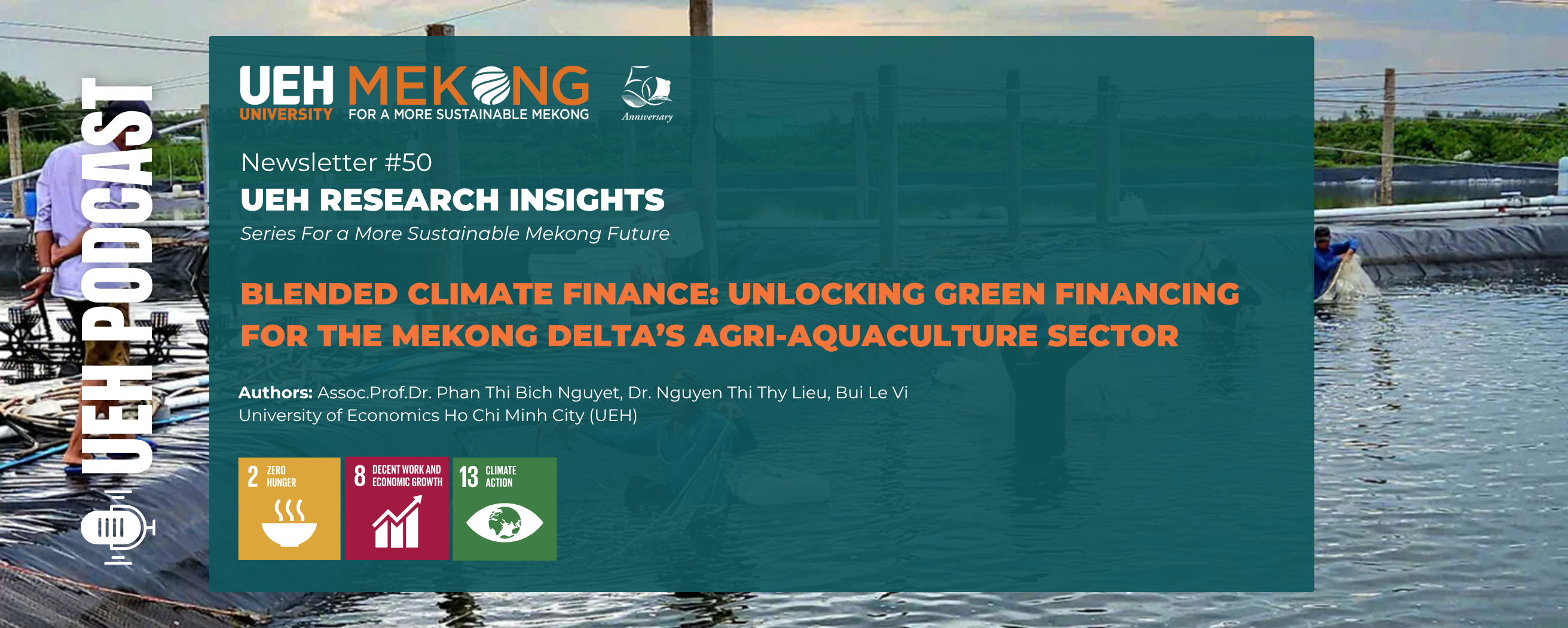
As the Carbon Border Adjustment Mechanism (CBAM), the EU Deforestation Regulation (EUDR), and ESG standards reshape the rules of global agricultural trade, the Mekong Delta faces an urgent need to green its production systems, while financial resources for this transition remain significantly limited. Against this backdrop, a research team from UEH Mekong, University of Economics Ho Chi Minh City (UEH) finds that blended climate finance, which combines public funding, international concessional finance, and private capital, can serve as a lever to share risks, attract investment, and unlock financing for greening the Mekong Delta’s agri-aquaculture value chains. Building on these findings, the study proposes a five-pillar policy framework aimed at developing a regionally integrated climate finance ecosystem and contributing to Vietnam’s goal of achieving Net Zero by 2050.
The Mekong Delta’s Growing Need for a Green Transition
In the past, the competitiveness of Vietnamese agricultural products was largely based on price and quality. Today, however, carbon footprints, traceability, and ESG standards are increasingly becoming the “passport” for Vietnamese agricultural products to enter global supply chains. Green trade barriers such as the EU Deforestation Regulation (EUDR) and the Carbon Border Adjustment Mechanism (CBAM) demonstrate that international trade is placing increasing emphasis on environmental and sustainability standards. Alongside Vietnam’s commitment at COP26 to achieve Net Zero emissions by 2050, the country has gradually strengthened its policy framework for green growth. Resolution No. 120/NQ-CP on sustainable development of the Mekong Delta in response to climate change and Decree No. 06/2022/ND-CP on the domestic carbon market are important foundations in this process.
However, the green transition in the Mekong Delta continues to face significant constraints in finance, technology, and measurement, reporting, and verification (MRV) capacity. As a major agricultural and aquaculture production region that is also highly exposed to climate change, the Mekong Delta requires resources both to adapt to saltwater intrusion, land erosion, and declining water resources and to transition toward low-emission production models. At the same time, financial institutions remain cautious about the risks associated with green agriculture, while private investors have yet to invest at scale due to unclear risk-sharing mechanisms.
This raises a critical question: How can climate finance be unlocked and effectively channeled to farmers, cooperatives, and businesses across the entire agri-aquaculture value chain, rather than remaining concentrated in isolated pilot projects? This is the central question addressed by the study, “Blended Climate Finance for Green Transition in the Mekong Delta’s Agri-Aquaculture Value Chains toward Net Zero.”
The Financing Gap in the Green Transition
The scale of production and green transition highlights the magnitude of the transformation facing the Mekong Delta, as well as its critical role in Vietnam’s food security and exports. The Mekong Delta remains Vietnam’s major agricultural production region, accounting for approximately 50% of national rice production, 65% of aquaculture output, and around 95% of Vietnam’s rice exports. Among current initiatives, the Project for Sustainable Development of One Million Hectares of Specialized High-Quality, Low-Emission Rice Cultivation represents a notable step forward. The project has reached 354,839 hectares, equivalent to 197% of the initial target of 180,000 hectares.
However, the scale of this transition entails substantial financing needs. Vietnam requires an estimated US$81.3 billion to achieve its Net Zero pathway, while the one-million-hectare low-emission rice project is estimated to require VND 82.989 trillion for infrastructure and value-chain development. Although total outstanding green credit in Vietnam exceeded VND 750 trillion by the end of 2025, financing remains concentrated primarily in the energy sector, while agriculture continues to face difficulties in accessing long-term capital. Globally, the same imbalance is evident: the agrifood system generates approximately one-third of greenhouse gas emissions but receives only around 4.3% of total climate finance.
The financing gap is not only about the availability of capital, but also about the connection between climate finance and value chains. A bibliometric analysis of 1,942 international studies published during 2006–2026 shows that research on “supply chain finance” and “climate finance” has grown substantially but remains relatively fragmented. This highlights the need for mechanisms that connect climate finance throughout the agri-aquaculture value chain, from producers to businesses and markets. Addressing this gap is a key focus of the study on blended climate finance for the Mekong Delta’s green transition.
International Experiences in Climate Finance
The study examines experiences from Thailand, Brazil, and Indonesia, highlighting different approaches to mobilizing and allocating resources for the green transition.
In Thailand, the Thai Rice NAMA project combines funding from the German Government, the Green Climate Fund (GCF), and domestic concessional finance. Through the Bank for Agriculture and Agricultural Cooperatives (BAAC), financing is channeled to farmers through a revolving fund to support technologies such as laser land leveling, alternate wetting and drying irrigation, and weather-indexed insurance.
Brazil has leveraged the role of development banks through the Low-Carbon Agriculture Program (Plano ABC), combining green credit, green bonds, and carbon removal credits, while linking concessional financing to environmental registration and deforestation-free requirements.
In Indonesia, Green Sukuk has been used to finance mangrove restoration and the development of blue carbon, contributing to the country’s Net Zero pathway.
Based on these three models, the study identifies three key conditions: (i) Climate finance needs to connect public, concessional, and private capital, rather than being implemented through fragmented programs; (ii) Reliable emissions data and MRV systems are essential for connecting financing with carbon markets; and (iii) The green transition needs to cover the entire value chain, rather than focusing on individual actors in isolation. These are the links that the Mekong Delta is gradually developing, helping explain why, despite the introduction of various policies, climate finance has yet to effectively reach farming households and businesses.
Five Pillars for Unlocking Climate Finance
Based on its analysis of current conditions and international experiences, the study proposes five policy pillars to address bottlenecks in the Mekong Delta’s green transition.
Pillar 1 – Strengthen Institutions and Build a Climate Finance Ecosystem. Establish a regional climate finance coordination body under the Mekong Delta Regional Coordination Council; develop a legal framework for blended finance and first-loss capital mechanisms; and explore the establishment of a regional green transition fund, drawing on Rwanda’s FONERWA Fund and Thailand’s revolving fund model.
Pillar 2 – Unlock Financing Through Blended Finance Models. Develop blended finance models for key value chains such as rice, shrimp, pangasius, and fruit; strengthen the role of commercial and policy banks; and expand financing channels including green bonds, sustainability bonds, and carbon credits.
Pillar 3 – Develop Green Data Infrastructure, MRV Systems, and Carbon Markets. Standardize MRV systems for key agricultural and aquaculture value chains, establish a shared regional green data platform, and develop carbon databases for low-emission production models. These foundations can provide evidence of emissions reductions and support farmers and cooperatives in accessing carbon credit markets.
Pillar 4 – Green Value Chains and Strengthen Market Linkages. Develop large-scale value chains and establish traceable green production areas, while strengthening the leading role of businesses at the core of value chains. At the same time, develop green agricultural and aquaculture brands aligned with international standards, such as the “Green Vietnamese Rice” model, under which 18,000 hectares have received certification and the first rice shipments have been exported to Japan.
Pillar 5 – Strengthen Human Capital and Expand International Cooperation. Provide farmers, cooperatives, businesses, and policymakers with knowledge of green finance, ESG, MRV, and carbon markets; strengthen agricultural extension services and scale up low-emission production models; while developing a pool of experts and a pipeline of priority projects to attract resources from the GCF, World Bank (WB), Asian Development Bank (ADB), and Global Environment Facility (GEF).
A Regional Role Map After the Administrative Merger
The study places the five-pillar policy framework within the context of the Mekong Delta’s reorganization of its development space, with roles allocated according to the comparative advantages of different localities. Specifically, Can Tho is positioned as a hub for coordinating climate finance, data, and innovation; An Giang can leverage its strengths in rice production and low-carbon agriculture; Dong Thap can connect value chains with green export markets; Vinh Long can promote green processing and the circular economy; while Ca Mau can develop the blue economy, low-emission aquaculture, and blue finance.
This approach aims to strengthen coordination and complementarity among localities, thereby contributing to the development of a region-wide climate finance ecosystem.
Accordingly, the study adopts a policy-oriented approach. Rather than simply analyzing the current situation, it systematizes theoretical foundations and international experiences in blended climate finance, develops a framework for connecting climate finance throughout the agri-aquaculture value chain, and proposes five solution pillars aligned with the region’s development orientation. Strengthening institutions, diversifying financing sources, developing green data infrastructure and carbon markets, and enhancing value-chain linkages can provide a foundation for the Mekong Delta to accelerate its green transition, strengthen competitiveness, and gradually advance toward Net Zero by 2050.
View the full research paper “Blended Climate Finance: Unlocking Green Financing for the Mekong Delta’s Agri-Aquaculture Sector” HERE.
Authors: Assoc. Prof. Dr. Phan Thi Bich Nguyet, Dr. Nguyen Thi Thuy Lieu, Bui Le Vi – University of Economics Ho Chi Minh City (UEH)
This article is part of the series disseminating research and applied knowledge under the message “For a More Sustainable Mekong,” within the “Research Contribution For All” program conducted by UEH. UEH respectfully invites readers to stay tuned for the next edition of the UEH Research Insights newsletter.

News, photos: Authors, Department of Admissions – Communications UEH Mekong, Department of Communications and Partnerships UEH
 Chia sẻ:




















[Research Contribution] Co-innovating for a Sustainable Ocean Economy
12 December, 2025








[Podcast] Recommendations for University education development
14 February, 2025


[Podcast] Developing Vung Tau into a World-Class Tourism City
16 January, 2025


[Podcast] Postdigital Design Strategies for Media Art
6 January, 2025


[Podcast] NFTs – Artistic Innovation or Just a New Hype?
27 December, 2024


[Podcast] Boosting Employee Creativity with Constructive Feedback
23 November, 2024


[Podcast] “Dutch Disease” in Remittances and the Case of Vietnam
4 November, 2024


[Podcast] Latest approaches for sustainable universities
11 July, 2024


Data Law – Part 1: Necessity for a New Approach
18 May, 2024

Advertising Evaluation on Tiktok Platform
14 May, 2024

[Podcast] Advertising Evaluation on Tiktok Platform
13 May, 2024






Promoting Learner Autonomy in English Language Learning (Part 1)
24 November, 2023





ArtTech And Sustainable Development
27 October, 2023
Motivation of EFL Vietnamese Students in Economics-related Majors
12 October, 2023
Climate Change And Our Society: The Urgency Of Gender Inequality
12 October, 2023



People Analytics in Vietnam
10 March, 2022





Revolution in Experimental Economics
30 January, 2022

The Sharing Economy: Governance Issues in Vietnam
24 January, 2022
Employment Policy For Ho Chi Minh City in Post-social distancing Period
28 December, 2021

Lifelong learning at UEH: Towards a Sustainable University
28 December, 2021

Building a Decentralized Stock Market based on Blockchain Technology
24 December, 2021



Consumer price index from big data mining perspective (Big data)
17 November, 2021

Overview Of Digital Currency – Part 5: DIEM Private Stabilized Currency
11 November, 2021