[Research Contribution] Sustainable Tourism Begins with Residents – Part 1: What Drives Community Support?
18 August, 2026
Keywords: Sustainable tourism; Resident support; Community empowerment; Resident well-being; Destination social responsibility; Place attachment
Sustainable tourism development cannot be determined solely by policy, businesses, or tourist demand; it must begin with the genuine consensus and participation of local residents. Drawing on the case of tourism cities in Central Vietnam, a study by researchers from the University of Economics Ho Chi Minh City (UEH) reveals that residents are more likely to support sustainable tourism when they feel empowered, experience improved quality of life, are attached to their place of residence, and perceive clear social responsibility from the destination.
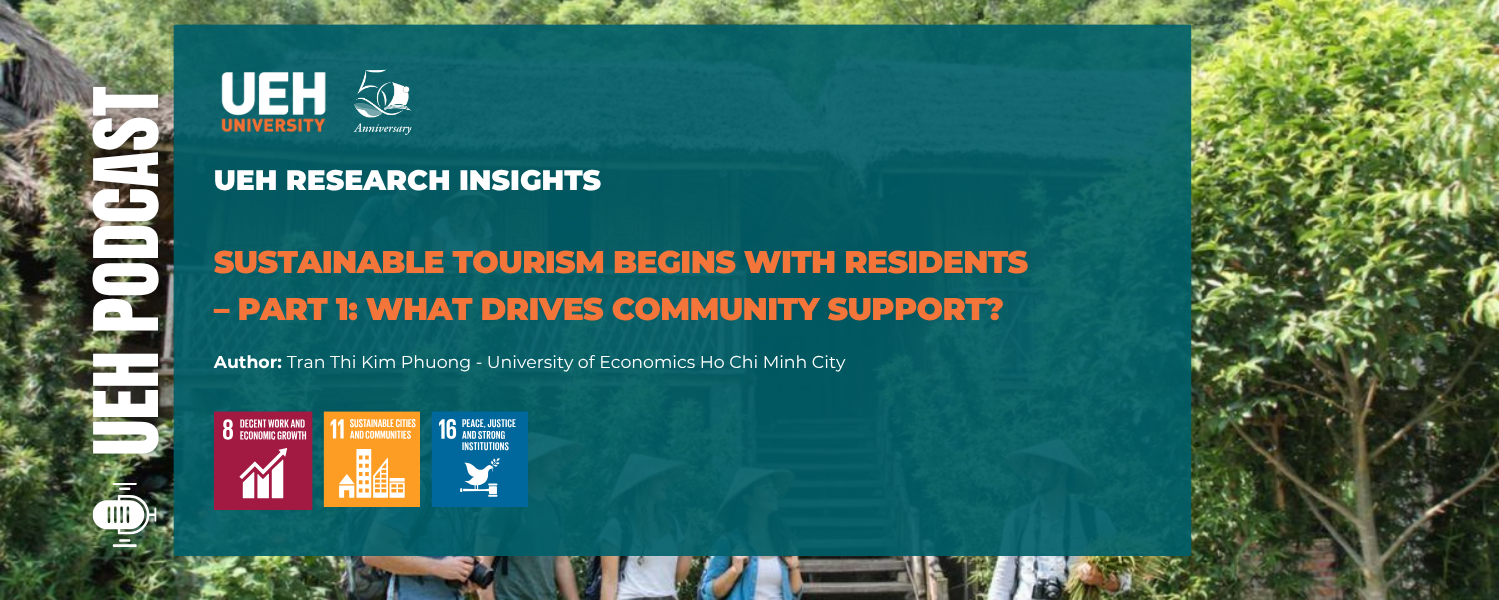
Sustainable tourism development requires internal community consensus
Tourism has long been viewed as a key growth driver for many developing countries and localities. With its capacity to create jobs, attract investment, stimulate services, promote culture, and increase community income, tourism is often placed at the center of economic development strategies. In Vietnam, many localities, particularly tourism cities in the Central region, regard tourism as a spearhead economic sector, linked to economic restructuring, destination image enhancement, and integration promotion.
However, tourism growth also presents numerous challenges. As visitor numbers rise rapidly, localities may face pressures on the environment, infrastructure, culture, living costs, benefit distribution, and residents’ quality of life. A destination may attract many tourists, but if local residents feel excluded from the decision-making process, do not benefit equitably, or bear the negative consequences, support for tourism will decline. When that happens, sustainable tourism development will struggle to become substantive.
This issue is particularly important for developing destinations. In many contexts, residents depend on tourism for their livelihoods but lack adequate voice in tourism planning, governance, and monitoring. They may work in hotels, restaurants, transportation, souvenir sales, tour guiding, or local services, but are not always involved in shaping the destination’s future.
If tourism development proceeds only in a top-down manner, lacking listening mechanisms and participation channels, residents may support tourism for short-term livelihood needs but not necessarily trust or commit to long-term sustainability goals.
Thus, the critical question is not merely how to develop sustainable tourism, but also: What makes residents willing to support and participate in this process?
The research approaches sustainable tourism development from the perspective of local residents – who are simultaneously cultural subjects, labor forces, and those directly experiencing tourism’s impacts. Rather than viewing residents solely as beneficiaries or casualties, the research recognizes them as individuals with emotions, perceptions, agency, place attachment, and influence from community norms.
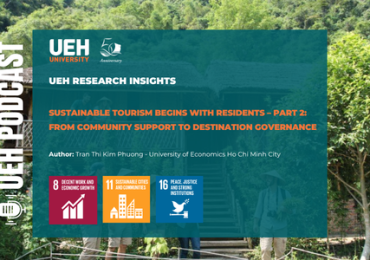
From a sustainable development perspective, this topic directly connects to multiple SDGs: SDG 3 on health and well-being; SDG 8 on sustainable employment and economic growth; SDG 11 on sustainable cities and communities; SDG 12 on responsible consumption and production; SDG 16 on effective institutions; and SDG 17 on partnerships.
From affected subjects to co-creators of sustainable tourism
A significant contribution of the research is reframing how residents are viewed in tourism development. In many strategies, residents are often mentioned as beneficiaries, labor forces, or groups that need to be communicated with to accept policies. However, this perspective may overlook a fundamental reality: residents are holders of local knowledge, maintainers of living culture, creators of the destination’s atmosphere, and determinants of the warmth and authenticity of the tourism experience.
A destination can hardly be sustainable if residents feel alienated from the development occurring in their own homeland. Therefore, resident support should not be understood simply as “agreeing with tourism,” but more broadly: residents’ willingness to participate in activities, policies, and initiatives that promote tourism development balanced across economic, cultural, social, and environmental dimensions.
To explain this mechanism, the research integrates two theoretical frameworks: the push–pull–anchor model and the theory of planned behavior.
Accordingly, residents’ support for sustainable tourism is shaped by three groups of factors:
- Internal push factors: Perceived empowerment and perceived well-being.
- External pull factors: Destination social responsibility and place attachment.
- Anchors: Social norms and perceived behavioral control.
This approach moves beyond traditional explanations based primarily on benefit–cost analysis. In sustainable tourism development, residents do not act solely for material benefits but also for pride, a sense of belonging, community responsibility, trust in the destination, and the feeling that their voice matters.
Empowerment and well-being: Internal push factors for support
Research findings show that perceived empowerment positively affects residents’ attitudes and intentions to support sustainable tourism development.
Empowerment in tourism is not merely about having a job or income. Psychologically, residents feel proud when local culture, environment, and way of life are appreciated by visitors. Socially, they feel more connected to the community through tourism activities. Politically, they feel they have a voice in decision-making processes. Economically, they see opportunities to improve their lives. Environmentally, they feel capable of participating in protecting the destination’s natural resources.
When these dimensions are strengthened, residents are not just asked to support but can directly participate, contribute, monitor, and benefit. This is a crucial condition for shifting from passive consensus to active engagement.
Alongside empowerment, residents’ perceived well-being is also an important driver. When residents feel that sustainable tourism development helps them live and work better, achieve personal goals, experience greater life satisfaction, and envision a more positive future, they tend to offer stronger support.
This suggests that sustainable tourism cannot be measured solely by visitor numbers, revenue, or investment projects; it must be assessed through residents’ quality of life. If tourism generates income but simultaneously increases stress, pollution, inequality, or a sense of loss of control, sustainability becomes questionable.
Social responsibility and place attachment: Pull factors that build trust
Alongside internal drivers, the research identifies destination social responsibility and place attachment as two important pull factors that encourage residents to support sustainable tourism development.
Destination social responsibility is understood as the commitment and actions of stakeholders at the destination to develop tourism responsibly toward the economy, environment, society, and stakeholders. When residents see that the destination cares about the environment, contributes to the community, operates on an ethical foundation, treats stakeholders well, and creates economic value, they tend to form more positive attitudes toward sustainable tourism.
Residents are also the closest observers of the consistency between the destination’s words and actions. Therefore, social responsibility is only persuasive when people can see, feel, and believe that those actions genuinely benefit the community.
Similarly, place attachment positively affects residents’ attitudes and intentions to support sustainable tourism development. When residents feel that where they live is part of themselves, holds special meaning, and is not easily replaceable, they have additional motivation to protect and develop that place for the better.
This is particularly noteworthy in the context of modernization and commercialization in tourism cities, which can gradually make residents feel alienated from their own places of residence. Thus, sustainable tourism development must attend not only to infrastructure and products but also to local sentiment, community memory, and residents’ right to place attachment.
How community helps transform attitudes into action
The research also highlights the role of two “anchors”: social norms and perceived behavioral control.
In other words, when the community collectively views sustainable tourism as worthwhile, positive signals from the destination and place attachment are more readily translated into supportive attitudes.
Perceived behavioral control also plays an important role. This is residents’ feeling that they have enough time, energy, opportunity, and ability to participate in supporting sustainable tourism development. Research findings indicate that this factor strengthens the impact of well-being on supportive attitudes.
Many residents may agree with sustainable tourism but have not yet participated because they do not know where to engage, lack time, have no feedback channels, have not been invited, or feel their voice makes no difference. Therefore, to transform attitudes into action, destinations need to create conditions for residents to genuinely have the capacity to contribute.
These findings raise a subsequent question: having identified the factors that drive resident support, how can destinations translate them into policy and governance solutions? Drawing on the case of 686 residents in Hue, Da Nang, and Quang Nam, Part 2 will delve into these practical implications – from managing tourists to governing an ecosystem that places local communities at the center.
Author: Tran Thi Kim Phuong – University of Economics Ho Chi Minh City
This article is part of the Knowledge Dissemination Series from UEH, conveying the message “Research Contribution For All.” UEH respectfully invites readers to stay tuned for the next edition of the UEH Research Insights newsletter.

News, photos: Author, Department of Communications and Partnerships
 Chia sẻ:


























[Research Contribution] Co-innovating for a Sustainable Ocean Economy
12 December, 2025








[Podcast] Recommendations for University education development
14 February, 2025


[Podcast] Developing Vung Tau into a World-Class Tourism City
16 January, 2025


[Podcast] Postdigital Design Strategies for Media Art
6 January, 2025


[Podcast] NFTs – Artistic Innovation or Just a New Hype?
27 December, 2024


[Podcast] Boosting Employee Creativity with Constructive Feedback
23 November, 2024


[Podcast] “Dutch Disease” in Remittances and the Case of Vietnam
4 November, 2024


[Podcast] Latest approaches for sustainable universities
11 July, 2024


Data Law – Part 1: Necessity for a New Approach
18 May, 2024

Advertising Evaluation on Tiktok Platform
14 May, 2024

[Podcast] Advertising Evaluation on Tiktok Platform
13 May, 2024





Promoting Learner Autonomy in English Language Learning (Part 1)
24 November, 2023






ArtTech And Sustainable Development
27 October, 2023

Motivation of EFL Vietnamese Students in Economics-related Majors
12 October, 2023

Climate Change And Our Society: The Urgency Of Gender Inequality
12 October, 2023








People Analytics in Vietnam
10 March, 2022




Revolution in Experimental Economics
30 January, 2022

The Sharing Economy: Governance Issues in Vietnam
24 January, 2022

Employment Policy For Ho Chi Minh City in Post-social distancing Period
28 December, 2021

Lifelong learning at UEH: Towards a Sustainable University
28 December, 2021
Building a Decentralized Stock Market based on Blockchain Technology
24 December, 2021



Consumer price index from big data mining perspective (Big data)
17 November, 2021

Overview Of Digital Currency – Part 5: DIEM Private Stabilized Currency
11 November, 2021