[Research Contribution] Are Green Consumers Moving Away from Ride-Hailing Apps?
11 August, 2026
Keywords: Sharing economy, ride-hailing technology, user behavior, sustainable development, green consumption, ride-hailing technology, customer loyalty, ESG, green transition
The more consumers care about the environment, the less they use ride-hailing services. This seemingly paradoxical finding has just been published in an international study in 2026, offering a fresh perspective on the “attitude–behavior gap” in the sharing economy. As sustainable development becomes a global priority, the challenge of retaining customers is no longer solely about low prices or convenience.
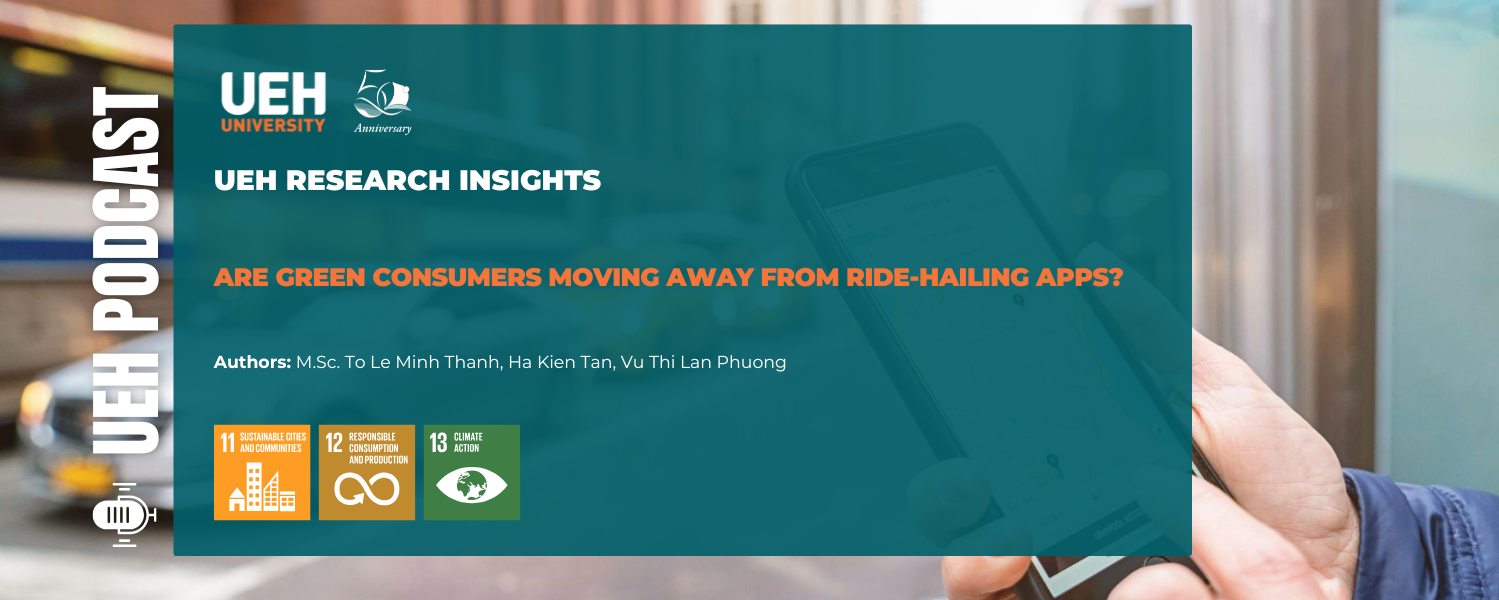
From the story of urban youth…
Every morning, Minh Anh (26, Ho Chi Minh City) follows a familiar routine: opening her phone, comparing prices between two ride-hailing apps to book a trip to the office. This habit repeats at noon when ordering food, and in the evening when meeting friends. For urban youth like Minh Anh, technology platforms have long been an indispensable part of optimizing their busy lives.
However, in recent months, as discussions about carbon emissions and air pollution in major cities have become more alarming than ever, Minh Anh’s behavior has begun to shift. She hesitates more before each screen tap. Minh Anh has started choosing to walk for short distances under 2km and proactively wakes up early to catch an electric bus for her fixed commute.
Minh Anh’s change is not an isolated phenomenon but a clear testament to a new consumption trend quietly taking shape.
For years, ride-hailing platforms have grown rapidly based on three core advantages: faster, more convenient, and cheaper. However, as the sharing economy enters a mature stage, the critical question for managers is no longer “how to get users to download the app” but “what makes them stay.” This is precisely the central question of the study “What keeps users loyal to ride-hailing? Insights from the sharing economy,” published in the Journal of Hospitality and Tourism Technology in 2026. This research focuses on analyzing factors directly affecting user loyalty, including: environmental awareness, personal innovativeness, perceived value, and the feeling of safety when using the service.
…To the discovery of a fascinating paradox
The analysis results from the study brought good news for marketers: all the above factors promote positive word-of-mouth (WOM). This means users are always willing to recommend the service to friends and family if they find the app safe, useful, modern, and reasonably priced.
However, the most surprising and notable finding lies in the environmental awareness factor. The data reveals a paradox: Those with a high awareness of environmental protection are the very group that tends to limit their personal use of the service, even though they still evaluate the app positively and enthusiastically recommend it to others.
The researchers call this phenomenon the “attitude–behavior gap.” Cognitively, these “green” customers believe that ride-hailing is a more optimal solution compared to owning and operating a personal vehicle. Yet behaviorally, it is precisely their consciousness of “reducing consumption to lessen environmental impact” that drives them to proactively cut down their own travel needs.
This redefines the very meaning of business success: In the context of sustainable development, a “loyal customer” is no longer simply someone who generates the most trips on the app. Sometimes, a customer who “uses less” reflects a powerful personal value system they are committed to pursuing.
When “Green” slogans are no longer enough
In the platform economy, user loyalty is a decisive factor for business survival. Apps now fiercely compete on experience, reliability, and brand emotion. However, most businesses have long approached “green customers” through conventional image-based marketing: promoting eco-friendly messages, launching plastic-reduction campaigns, or planting trees.
The 2026 study sounds a warning that these superficial solutions are no longer persuasive enough. Environmentally conscious users now tend to “resist” empty marketing slogans. Instead, they demand tangible, measurable actions from businesses. They care about whether the app is investing in a transition to electric vehicles, whether algorithms are optimizing routes to minimize emissions, whether the business has mechanisms to encourage carpooling, and whether the platform is transparent about its environmental impact and ESG (Environmental, Social, and Governance) standards in its operations.
Beyond the environmental story, the study also reaffirms a core value: The feeling of safety remains the “trust key” and the strongest factor influencing service recommendation behavior. In the digital environment, users are not simply buying a trip from point A to point B; they are “buying trust.” From personal data security and fare transparency during peak hours to the experience of interacting with drivers – every touchpoint determines whether the customer will stay within that ecosystem. As platforms increasingly integrate Artificial Intelligence (AI) and Big Data into their operations, users demand even higher standards of privacy and absolute peace of mind.
What path forward for a sustainable mobility ecosystem?
Beyond its theoretical findings, this study opens strategic and coordinated recommendations for both technology companies and policymakers to bridge the “attitude–behavior gap” and move toward a sustainable mobility future.
- For Businesses: “Green” must go hand-in-hand with “trusted digital experiences”.
The research indicates that to retain environmentally conscious customers, businesses cannot rely solely on superficial image campaigns. Instead, platforms need to implement core, substantive actions and transformations such as: Accelerating fleet electrification and infrastructure optimization; Flexible and personalized “green contribution” pricing strategies; and Strengthening the “trust anchor” through security and service quality.
- For Policymakers: Integrating shared mobility into the backbone of public transport. This can be achieved through solutions such as: Solving the “multimodal transport” puzzle; Prioritizing macro-infrastructure for green transition; and Promoting education and social norms.
A user who chooses to limit travel to reduce their carbon footprint is not necessarily a “customer leaving the brand.” They represent a new generation of consumers: tech-savvy, environmentally empathetic, and responsible in their actions. The mobility paradox is essentially a reflection of a great shift in modern society – a shift from “maximized consumption” to “conscious consumption.” The future of the sharing economy will certainly not lie in pushing people to use services more, but in the ability to accompany them and help them live a more sustainable life.
Authors: M.Sc. To Le Minh Thanh, Ha Kien Tan, Vu Thi Lan Phuong
This article is part of the knowledge dissemination series with the message “Research Contribution For All,” produced by UEH. UEH respectfully invites readers to stay tuned for the next edition.
News, photos: Authors, Department of Communications and Partnerships
 Chia sẻ:
























[Research Contribution] Co-innovating for a Sustainable Ocean Economy
12 December, 2025








[Podcast] Recommendations for University education development
14 February, 2025


[Podcast] Developing Vung Tau into a World-Class Tourism City
16 January, 2025


[Podcast] Postdigital Design Strategies for Media Art
6 January, 2025


[Podcast] NFTs – Artistic Innovation or Just a New Hype?
27 December, 2024


[Podcast] Boosting Employee Creativity with Constructive Feedback
23 November, 2024


[Podcast] “Dutch Disease” in Remittances and the Case of Vietnam
4 November, 2024


[Podcast] Latest approaches for sustainable universities
11 July, 2024


Data Law – Part 1: Necessity for a New Approach
18 May, 2024

Advertising Evaluation on Tiktok Platform
14 May, 2024

[Podcast] Advertising Evaluation on Tiktok Platform
13 May, 2024






Promoting Learner Autonomy in English Language Learning (Part 1)
24 November, 2023






ArtTech And Sustainable Development
27 October, 2023

Motivation of EFL Vietnamese Students in Economics-related Majors
12 October, 2023

Climate Change And Our Society: The Urgency Of Gender Inequality
12 October, 2023







People Analytics in Vietnam
10 March, 2022





Revolution in Experimental Economics
30 January, 2022

The Sharing Economy: Governance Issues in Vietnam
24 January, 2022
Employment Policy For Ho Chi Minh City in Post-social distancing Period
28 December, 2021

Lifelong learning at UEH: Towards a Sustainable University
28 December, 2021

Building a Decentralized Stock Market based on Blockchain Technology
24 December, 2021



Consumer price index from big data mining perspective (Big data)
17 November, 2021

Overview Of Digital Currency – Part 5: DIEM Private Stabilized Currency
11 November, 2021