[Research Contribution] Estimating DC Motor Parameters Using an RLS-EKF Hybrid Initialization Method Based on the ARX/MIMO Model
2 October, 2026
Keywords: Brushed DC motor, Parameter identification, ARX/MIMO, RLS, EKF, PSO.
Brushed DC motors are widely used in robotics, automated equipment, and drive systems. However, control performance depends heavily on the accuracy of the motor’s internal parameters. To address this issue, a research team from UEH Mekong, University of Economics Ho Chi Minh City (UEH), and Vinh Long University of Technology and Engineering proposed a hybrid Recursive Least Squares – Extended Kalman Filter (RLS-EKF) initialization method. In this approach, RLS rapidly generates initial parameter estimates, which are then refined by EKF to improve accuracy. Simulation results show that the proposed method reproduces current and speed more accurately than standalone RLS and PSO, while maintaining a reasonable computational cost. This approach shows potential for real-time control systems and embedded devices with limited computational resources.

Accurate Parameter Identification – A Foundation for Improved Control Performance
Brushed DC motors are widely used in robots, conveyors, actuators, educational equipment, and automation systems due to their simple structure, low cost, and ease of speed and position control. For stable operation and accurate response to control signals, key physical parameters such as armature resistance, armature inductance, back electromotive force and torque constants, moment of inertia, and viscous friction coefficient need to be accurately identified. These parameters determine the relationships among input voltage, current, torque, and rotational speed.
When these parameters are inaccurate, the mathematical model may deviate from the actual motor, leading to greater control errors, longer response times, or reduced system stability.
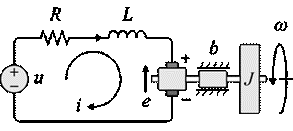
Figure 1. Brushed DC motor model
In practice, parameters provided by manufacturers are typically determined under specific operating conditions. During operation, resistance may vary with temperature, friction may be affected by mechanical wear, and the moment of inertia may change depending on the connected load. Therefore, identifying parameters from actual measurement data is an important step toward developing a model that more accurately reflects the motor’s operating state.
Combining RLS and EKF to Improve Identification Accuracy
The study uses an ARX/MIMO model to simultaneously describe the relationships among armature voltage, current, and angular speed, thereby establishing a parameter estimation problem involving five key physical motor parameters. Using the same model and dataset, the authors evaluate three methods: Recursive Least Squares (RLS), RLS-initialized Extended Kalman Filter (RLS-EKF), and Particle Swarm Optimization (PSO).
RLS offers fast processing and the ability to update parameters as new data become available. However, its accuracy may be limited for sensitive or difficult-to-observe parameters. EKF, meanwhile, combines a dynamic model with measurement data to refine states and parameters, but its performance depends strongly on the initial values. PSO can search for solutions in nonlinear parameter spaces, but it requires evaluating multiple parameter sets over successive iterations, increasing computational costs.
Building on these strengths and limitations, the research team proposed the RLS-EKF hybrid initialization method. Specifically, RLS first generates a preliminary set of parameter estimates, which is then used to initialize EKF. This approach allows EKF to start from a more reasonable solution region, reduces its dependence on manually selected initial values, and avoids the extensive search cost associated with PSO. Under this strategy, RLS performs the rapid initial estimation, while EKF subsequently refines the estimates to improve identification quality.
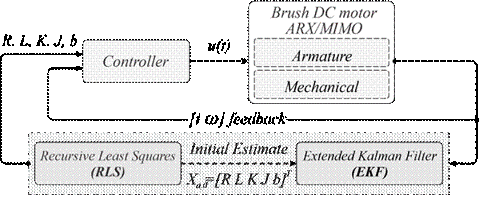
Figure 2. RLS-EKF hybrid initialization method
RLS-EKF Improves Current and Speed Reconstruction
The authors conducted simulations in MATLAB using a dataset of 2,001 samples, with noise added to voltage, current, and speed measurements. The results show that RLS-EKF achieves estimation errors of 0.25% for resistance, 0.18% for the voltage and torque constants, 1.70% for the moment of inertia, and 16.67% for the viscous friction coefficient. Armature inductance remains a challenging parameter to estimate and still shows a considerable error, indicating the need for further methodological improvements.
In terms of output reconstruction, the RLS-EKF model achieves FIT values of 93.50% for current and 99.51% for angular speed. The comparative plots also show that the model tracks the measurement data more closely, particularly when the signals change rapidly.
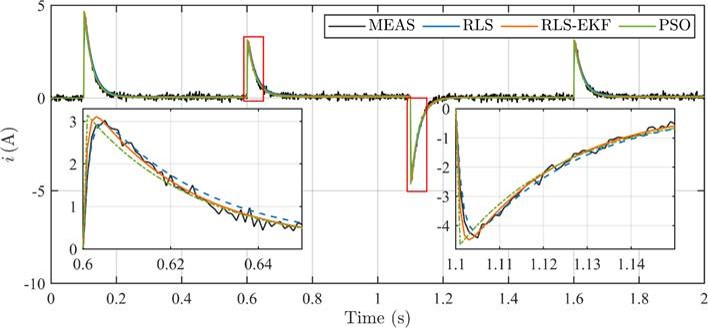
Figure 3. Comparison of actual current and estimated model outputs
The simulation results indicate that the RLS-EKF hybrid initialization method has the potential to improve both parameter identification quality and the ability to reproduce motor dynamics, while maintaining a reasonable computational cost. These findings provide a basis for further validating the method using experimental data and evaluating its implementation on embedded control platforms.
Toward Adaptive Control Systems and Embedded Devices
The study contributes to a better understanding of how recursive identification and state filtering can be combined for multi-parameter motor estimation. The RLS-EKF method provides a foundation for developing control systems capable of updating their models, adapting to changes in equipment, and operating on computationally constrained platforms. This approach has potential applications in robotics, electromechanical devices, automation systems, and smart manufacturing solutions.
In the next stage, the research team plans to examine the effects of load torque and implement and evaluate the method directly on microcontrollers. These steps will provide further insights into its applicability under real operating conditions, bringing research on intelligent identification and control closer to the practical needs of businesses and communities.
View the full research paper “Estimating DC Motor Parameters Using an RLS-EKF Hybrid Initialization Method Based on the ARX/MIMO Model” HERE.
Authors: Nguyen Ngoc Tuan, Dr. Nguyen Minh Trieu, Prof.Dr. Nguyen Truong Thinh – University of Economics Ho Chi Minh City (UEH). Dr. Nguyen Tan No – Vinh Long University of Technology and Engineering.
This article is part of the series disseminating research and applied knowledge under the message “For a More Sustainable Mekong,” within the “Research Contribution For All” program conducted by UEH. UEH respectfully invites readers to stay tuned for the next edition of the UEH Research Insights newsletter.

News, photos: Authors, Department of Admissions – Communications UEH Mekong, Department of Communications and Partnerships UEH
 Chia sẻ:














































































[Research Contribution] Co-innovating for a Sustainable Ocean Economy
12 December, 2025



















[Podcast] Recommendations for University education development
14 February, 2025


[Podcast] Developing Vung Tau into a World-Class Tourism City
16 January, 2025


[Podcast] Postdigital Design Strategies for Media Art
6 January, 2025


[Podcast] NFTs – Artistic Innovation or Just a New Hype?
27 December, 2024


[Podcast] Boosting Employee Creativity with Constructive Feedback
23 November, 2024


[Podcast] “Dutch Disease” in Remittances and the Case of Vietnam
4 November, 2024


[Podcast] Latest approaches for sustainable universities
11 July, 2024


Data Law – Part 1: Necessity for a New Approach
18 May, 2024

Advertising Evaluation on Tiktok Platform
14 May, 2024

[Podcast] Advertising Evaluation on Tiktok Platform
13 May, 2024






Promoting Learner Autonomy in English Language Learning (Part 1)
24 November, 2023







ArtTech And Sustainable Development
27 October, 2023


Motivation of EFL Vietnamese Students in Economics-related Majors
12 October, 2023

Climate Change And Our Society: The Urgency Of Gender Inequality
12 October, 2023








People Analytics in Vietnam
10 March, 2022





Revolution in Experimental Economics
30 January, 2022

The Sharing Economy: Governance Issues in Vietnam
24 January, 2022

Employment Policy For Ho Chi Minh City in Post-social distancing Period
28 December, 2021

Lifelong learning at UEH: Towards a Sustainable University
28 December, 2021

Building a Decentralized Stock Market based on Blockchain Technology
24 December, 2021



Consumer price index from big data mining perspective (Big data)
17 November, 2021

Overview Of Digital Currency – Part 5: DIEM Private Stabilized Currency
11 November, 2021