[Research Contribution] Organizing Information for Strategic Management Accounting Reports on the Platform of the Accounting Information System
10 September, 2026
Keywords: Management accounting, strategic management accounting, accounting information system, strategic management accounting reports, information organization
In a context where enterprises are increasingly focusing on long-term strategy and sustainable development, strategic management accounting plays an important role in providing information for planning and decision-making. From this perspective, a research team from the University of Economics Ho Chi Minh City (UEH) has studied how information is organized, integrated, and processed on the platform of the accounting information system; thereby proposing orientations to improve the quality of strategic management accounting reports, providing information that is long-term in nature, broad in scope, and better suited to managers’ strategic decision-making needs.
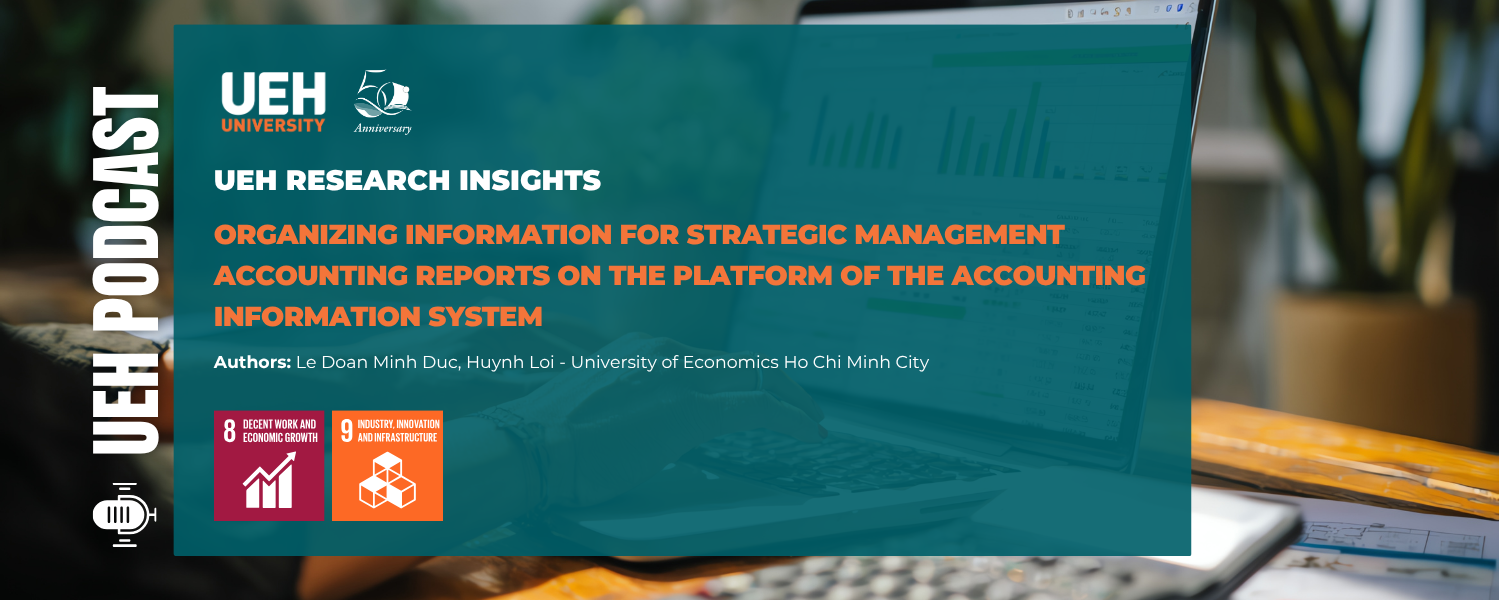
Organizing information for strategic management accounting reports on the platform of the accounting information system
Currently, many enterprises are shifting from the goal of maximizing short-term profit toward sustainable development, in line with globalization and an increasingly competitive environment fraught with risks and uncertainty. In this context, on the one hand, enterprises operate management accounting to provide timely, flexible, and future-oriented information to managers; on the other hand, they strengthen the application of information technology to improve operational efficiency.
Information technology not only supports reporting on financial position and business results but also provides information for strategic planning and control. Therefore, management accounting and information technology have become powerful tools supporting managers in the process of planning, organizing implementation, controlling, and making decisions.
Several notable studies on strategic management accounting in Vietnam show that enterprises are applying strategic management accounting techniques to varying degrees. This indicates that, although not yet fully developed, the presence of strategic management accounting in enterprises has become a clearly confirmed trend. The studies also identify the role of strategic management accounting and the factors driving the formation of strategic management accounting in enterprises.
From these results, to further deepen research and best promote the role of strategic management accounting, organizing information for the system of strategic management accounting reports in enterprises is an issue that needs attention.
Organizing strategic management accounting information on the platform of the accounting information system
With the objective of organizing information for strategic management accounting reports in enterprises on the platform of the accounting information system, the study employs a qualitative method. Data were collected during the 2023–2024 period at companies in Ho Chi Minh City, the former Binh Duong province, Dong Nai province, and several provinces and cities in the South.
In the first step, the research team conducted documentary research, reviewing related studies by international and domestic scholars, from which they identified trends and designed the research. Next, the team conducted in-depth interviews with experts until reaching saturation. On the basis of the results obtained, the study re-validated through a survey of respondents holding positions in the Board of Directors and specialist staff.
The research results identify three main contents: (i) The necessity of strategic management accounting in enterprises; (ii) The current state of information provided for strategic management accounting reports; and (iii) With the available resource being the accounting information system, enterprises can integrate part or all of the strategic management accounting techniques and reports according to managers’ requirements in each specific context.
Six phases of strategic management accounting integration
To implement effectively, enterprises need to establish specific step-by-step actions, in line with the development of the management accounting system and the accounting information system. Strategic management accounting techniques need to be organized into groups, linked with one another, and integrated into the accounting information system. This process can be carried out through the following phases:
Design phase: Enterprises organize a council to assess needs and determine the number of strategic management accounting reports to be applied. On that basis, enterprises orient the design of integrating strategic management accounting into the accounting information system, while assessing personnel capacity, current and planned physical conditions, and strategic plans; deciding the method, timing, personnel, and costs to carry out the integration.
Strategic management accounting reports do not necessarily need to have a uniform structure, layout, or template but can be named in various ways, in line with the characteristics of information, products, industry, and management requirements. What matters is that reports must be easy to understand, concise, and provide sufficient relevant information.
The content of each report needs to be designed to suit the requirements of enterprise managers, based on relevant content and information flows. When integrating the information processing method into the accounting information system, designers need to ensure the requirements for processing input and output information of each strategic management accounting technique.
Production phase: Enterprises proceed to integrate strategic management accounting modules into the accounting information system. This process can be based on the availability and compatibility of the accounting information system; building additional integration functions for the system; or building a new strategic management accounting module.
Testing phase: This is the phase of examining the compatibility between strategic management accounting and the accounting information system; while recording errors arising related to calculations, processing time, and how people operate. On that basis, enterprises have a comprehensive assessment report on whether the information of strategic management accounting reports on the platform of the accounting information system meets initial expectations.
Incomplete contents need to be adjusted; at the same time, personnel, software, hardware, procedures, and processes can be supplemented if necessary, to meet the information requirements of managers and suit the enterprise’s permitted resources.
Operation phase: Enterprises need to assess the actual effectiveness of strategic management accounting information in connection with business performance. During operation, the scope of control also needs to be established. If there are transactions or observations beyond the scope of control, managers need to focus on identifying causes to build remediation and improvement programs.
Evaluation phase: The accounting information system integrated with strategic management accounting needs to be periodically evaluated for the effectiveness of providing strategic management accounting information, in connection with operational results and managers’ information requirements.
Evaluation can focus on aspects such as: operating methods, processes, participating personnel, and control; costs related to the system compared with budgeted costs for control and adjustment orientation; as well as operational effectiveness brought by the system itself in financial and non-financial terms. Issues that do not meet expectations or activities that have not brought effectiveness need to be reported to establish a council and introduce an improvement program.
Improvement phase: Since strategic management accounting is oriented toward the long term, the accounting information system integrated with strategic management accounting also needs continuous and long-term improvement toward creating value and maintaining competitive advantage for the enterprise.
Improvement issues can be evaluated according to various criteria such as machinery, new technology, human resources; activities related to the system to create value; as well as changes in strategic management accounting information according to managers’ requirements, the macro environment, the business environment, and the competitive environment.
Toward sustainable production and business operations
Alongside efforts from enterprises, stakeholders such as state agencies, professional associations, and training institutions need to contribute to creating a legal framework and foundational knowledge so that strategic management accounting can truly be promoted effectively, thereby supporting enterprises toward sustainable production and business operations.
Authors: Le Doan Minh Duc, Huynh Loi – University of Economics Ho Chi Minh City
This article is part of the Knowledge Dissemination Series from UEH, conveying the message “Research Contribution For All.” UEH respectfully invites readers to stay tuned for the next edition of the UEH Research Insights newsletter.

News and photos: Authors, Department of Communications and Partnerships
 Chia sẻ:


















[Research Contribution] Co-innovating for a Sustainable Ocean Economy
12 December, 2025









[Podcast] Recommendations for University education development
14 February, 2025


[Podcast] Developing Vung Tau into a World-Class Tourism City
16 January, 2025


[Podcast] Postdigital Design Strategies for Media Art
6 January, 2025


[Podcast] NFTs – Artistic Innovation or Just a New Hype?
27 December, 2024


[Podcast] Boosting Employee Creativity with Constructive Feedback
23 November, 2024


[Podcast] “Dutch Disease” in Remittances and the Case of Vietnam
4 November, 2024


[Podcast] Latest approaches for sustainable universities
11 July, 2024


Data Law – Part 1: Necessity for a New Approach
18 May, 2024

Advertising Evaluation on Tiktok Platform
14 May, 2024

[Podcast] Advertising Evaluation on Tiktok Platform
13 May, 2024





Promoting Learner Autonomy in English Language Learning (Part 1)
24 November, 2023






ArtTech And Sustainable Development
27 October, 2023


Motivation of EFL Vietnamese Students in Economics-related Majors
12 October, 2023
Climate Change And Our Society: The Urgency Of Gender Inequality
12 October, 2023







People Analytics in Vietnam
10 March, 2022





Revolution in Experimental Economics
30 January, 2022

The Sharing Economy: Governance Issues in Vietnam
24 January, 2022
Employment Policy For Ho Chi Minh City in Post-social distancing Period
28 December, 2021

Lifelong learning at UEH: Towards a Sustainable University
28 December, 2021
Building a Decentralized Stock Market based on Blockchain Technology
24 December, 2021


Consumer price index from big data mining perspective (Big data)
17 November, 2021

Overview Of Digital Currency – Part 5: DIEM Private Stabilized Currency
11 November, 2021