[Research Contribution] Exploring the Link Between Students’ Knowledge, Attitudes, and Behaviors Toward Sustainable Development: The Role of Universities in the Mekong Delta
28 August, 2026
[Research Contribution] Exploring the Link Between Students’ Knowledge, Attitudes, and Behaviors Toward Sustainable Development: The Role of Universities in the Mekong Delta
Keywords: Mekong Delta, higher education, KAP model, sustainable development, students.
Sustainable development is not only reflected in what students know, but also in how they perceive and respond to environmental, social, and economic issues. But can knowledge about sustainable development truly be translated into action? And what role can universities play in this process?
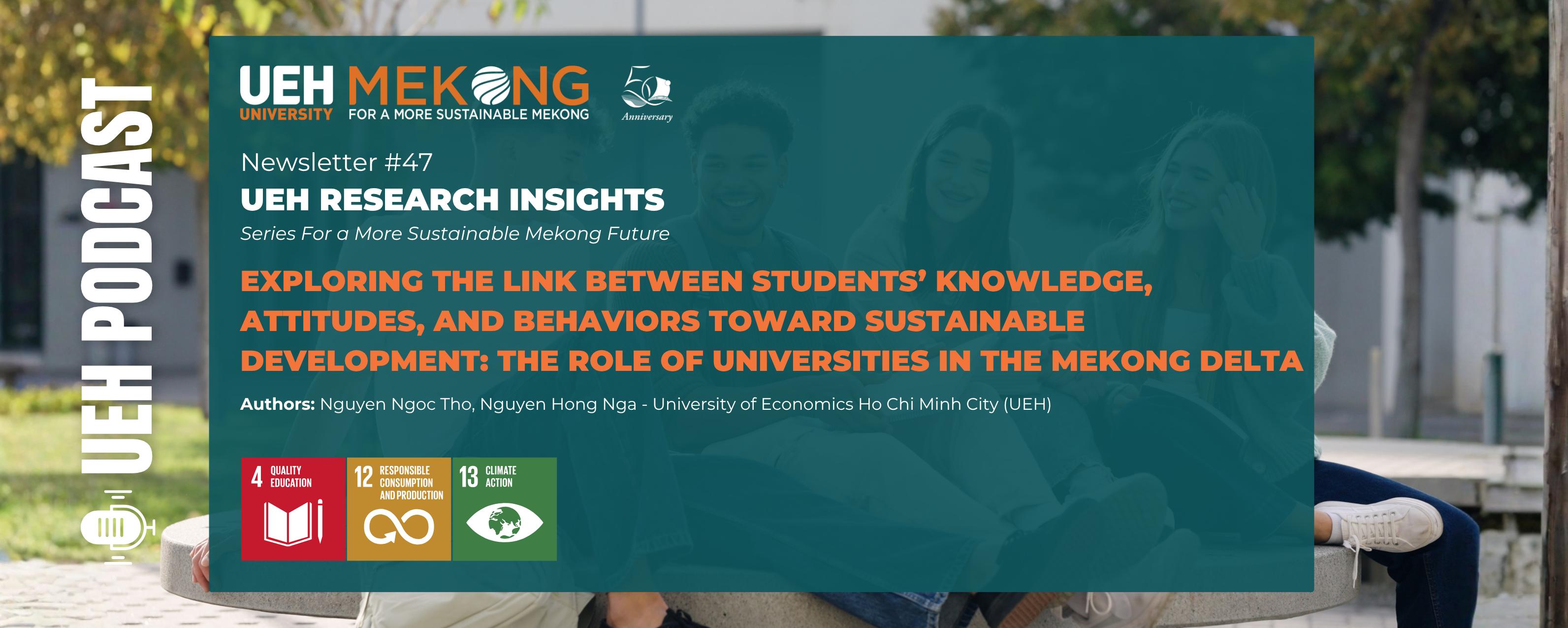
Against this backdrop, a research team from UEH Mekong, University of Economics Ho Chi Minh City (UEH) surveyed 935 university students across higher education institutions in the Mekong Delta to explore the relationships among knowledge, attitudes, and behaviors toward sustainable development, while examining the role of universities in shaping sustainable behaviors.
The relationship between students’ knowledge, attitudes, and behaviors toward sustainable development
The study finds that knowledge plays an important role in shaping students’ attitudes and encouraging their sustainable behaviors. Specifically, knowledge has a significant influence on attitudes and a strong influence on sustainable behaviors, highlighting the importance of equipping students with a solid understanding of sustainable development issues as a foundation for motivation of positive action.
Notably, the study also shows that attitudes serve as a link between knowledge and behavior. Students who hold positive attitudes toward sustainable development and believe in its value are more likely to actively seek out and adopt environmentally friendly solutions. This suggests that sustainability education should go beyond providing knowledge and also help learners develop positive attitudes and a commitment to sustainable values.
However, a gap between awareness and action remains. Although students may have a good understanding of sustainability issues, translating this knowledge into concrete actions in their daily lives remains limited. This indicates that while knowledge is an important prerequisite, students also need appropriate environments and supporting conditions to develop sustainable behaviors.
The role of universities
One notable finding is that universities can help bridge the gap between what students know and how they act for sustainable development. When universities proactively implement initiatives such as energy conservation, responsible resource use, community engagement, integrating sustainable development into teaching, and promoting related research, students have more opportunities to turn what they learn into concrete actions.
However, the study also finds that the role of universities is currently not strong enough to generate significant changes in students’ behaviors. Knowledge remains the most influential factor affecting sustainable behavior, while the impact of university activities is relatively modest. In other words, the university environment already plays a role, but it has yet to provide sufficient motivation for students to translate their knowledge and positive attitudes into stronger action.
This raises an important question: What can universities do to help students not only “know” about sustainable development, but also “act” on it? Rather than focusing solely on knowledge transmission or awareness-raising activities, universities can create more opportunities for students to directly experience and practice sustainable lifestyles on campus, from conserving energy and sorting waste to participating in community projects and activities addressing real local challenges. The study refers to this approach as viewing the university as a “living laboratory” for sustainable development.
From “awareness” to “action”: Universities as spaces for practicing sustainable development
The study’s findings raise an important issue: students may understand sustainable development, but for this knowledge to translate into action, universities need to create more opportunities for learners to experience and practice what they have learned. Therefore, universities in the Mekong Delta should integrate sustainable development into their curricula in ways that are closely connected to the region’s real-world challenges, such as climate change, saltwater intrusion, and green agriculture. Specialized courses and interdisciplinary projects can also help students develop the mindset and skills needed to address practical challenges.
However, learning becomes more meaningful when the university environment itself becomes a place where students can put their knowledge into practice. Universities can develop “Green University” or “Living Laboratory” models, turning their campuses into spaces where students can directly experience sustainable behaviors. From reducing single-use plastics and conserving resources to creating green learning spaces, changes within the campus can make sustainable behaviors more familiar and easier to adopt. At the same time, sustainability criteria can be incorporated into student activities and development assessments to encourage these behaviors.
More importantly, sustainable development should extend beyond the campus and connect with the real challenges facing the Mekong Delta. Students can participate in projects addressing saltwater intrusion, agricultural waste management, biodiversity conservation, and climate change adaptation, while connecting with local authorities, social organizations, and businesses undergoing green transformation. Internships, community-based projects, and mentoring networks can also help students develop practical skills while gaining a deeper understanding of the value of sustainable development for both their communities and future careers.
From this perspective, a sustainable university is not simply a place where students learn about sustainable development. It should also be a place where students can see, experience, and co-create sustainable change. This can be a meaningful way to bridge the gap between “awareness” and “action” – one of the key issues highlighted by the study.
View the full research paper “Exploring the Link Between Students’ Knowledge, Attitudes, and Behaviors Toward Sustainable Development: The Role of Universities in the Mekong Delta” HERE.
Authors: Nguyen Ngoc Tho, Nguyen Hong Nga – University of Economics Ho Chi Minh City (UEH)
This article is part of the series disseminating research and applied knowledge under the message “For a More Sustainable Mekong,” within the “Research Contribution For All” program conducted by UEH. UEH respectfully invites readers to stay tuned for the next edition of the UEH Research Insights newsletter.

News, photos: Authors, Department of Admissions – Communications UEH Mekong, Department of Communications and Partnerships UEH
 Chia sẻ:















[Research Contribution] Co-innovating for a Sustainable Ocean Economy
12 December, 2025







[Podcast] Recommendations for University education development
14 February, 2025


[Podcast] Developing Vung Tau into a World-Class Tourism City
16 January, 2025


[Podcast] Postdigital Design Strategies for Media Art
6 January, 2025


[Podcast] NFTs – Artistic Innovation or Just a New Hype?
27 December, 2024


[Podcast] Boosting Employee Creativity with Constructive Feedback
23 November, 2024


[Podcast] “Dutch Disease” in Remittances and the Case of Vietnam
4 November, 2024


[Podcast] Latest approaches for sustainable universities
11 July, 2024


Data Law – Part 1: Necessity for a New Approach
18 May, 2024

Advertising Evaluation on Tiktok Platform
14 May, 2024

[Podcast] Advertising Evaluation on Tiktok Platform
13 May, 2024





Promoting Learner Autonomy in English Language Learning (Part 1)
24 November, 2023




ArtTech And Sustainable Development
27 October, 2023
Motivation of EFL Vietnamese Students in Economics-related Majors
12 October, 2023
Climate Change And Our Society: The Urgency Of Gender Inequality
12 October, 2023






People Analytics in Vietnam
10 March, 2022




Revolution in Experimental Economics
30 January, 2022

The Sharing Economy: Governance Issues in Vietnam
24 January, 2022

Employment Policy For Ho Chi Minh City in Post-social distancing Period
28 December, 2021

Lifelong learning at UEH: Towards a Sustainable University
28 December, 2021
Building a Decentralized Stock Market based on Blockchain Technology
24 December, 2021



Consumer price index from big data mining perspective (Big data)
17 November, 2021

Overview Of Digital Currency – Part 5: DIEM Private Stabilized Currency
11 November, 2021