[Research Contribution] When the university collaborates on the city’s challenges
28 July, 2026
Keywords: Co-creation; Innovation; Living Lab; International Financial Center; University collaboration
If the previous installment examined the “co-creation university” model as an emerging direction for higher education in response to the demand for high-quality human resources, then in practice, this model only generates value when realized through specific collaborative programs. From training human resources for the Ho Chi Minh City International Financial Center and participating in urban planning research to building an innovation ecosystem, UEH is progressively positioning the university as an active participant in the city’s development process.
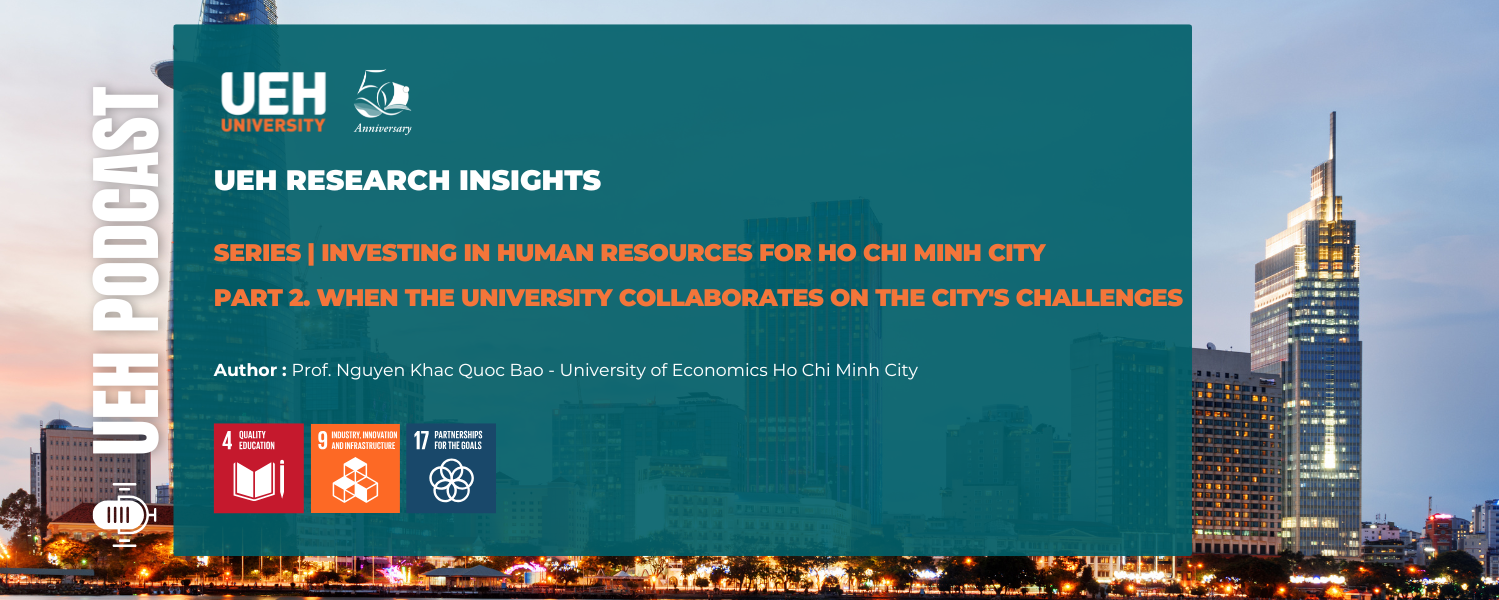
Continuing the discussion initiated by Prof. Nguyen Khac Quoc Bao on the “Nguoi Trong Cuoc” program themed “Investment in Human Resources – Creating a Breakthrough for Ho Chi Minh City,” this second installment focuses on the collaborative models and solutions UEH is implementing to prepare human resources for Ho Chi Minh City’s strategic development sectors.
Collaborating on the city’s strategic sectors
According to Prof. Nguyen Khac Quoc Bao, the role of the co-creation university is most evident when training and research programs are not solely driven by the university’s internal needs but are linked to the locality’s development strategy.
Recently, UEH has participated in numerous training programs aligned with the missions and needs of Ho Chi Minh City. Notable examples include the high-quality international finance training program and short-term courses on international financial management, designed to prepare human resources for the establishment and operation of the Ho Chi Minh City International Financial Center.
Alongside training, UEH is also developing an innovation ecosystem through startup incubators, supporting students in forming ideas, refining business models, and connecting with investors. Several projects have successfully secured funding, demonstrating that universities not only train learners but also contribute to creating future innovative enterprises.
In the research domain, UEH collaborates with the Ho Chi Minh City Institute for Development Studies to conduct research serving the city’s new planning initiatives. The university is also involved in preparing human resources for key projects such as the Long Thanh International Airport and the North-South high-speed railway.
According to Prof. Nguyen Khac Quoc Bao, a common feature of these activities is the university’s participation from the preparatory stage, rather than merely supplying human resources once projects are already operational.
Data must precede training
One issue Prof. Nguyen Khac Quoc Bao particularly emphasizes is the capacity to forecast human resource needs.
He notes that current data on labor, employment, and training remains fragmented across various management agencies, research institutes, industry associations, businesses, and universities. The absence of an interconnected data system significantly hinders the assessment and forecasting of human resource needs.
He proposes that Ho Chi Minh City establish a shared human resource data center or system to monitor domestic and international labor market fluctuations, identify emerging occupations and skills, and provide a scientific basis for policy formulation.
For universities, such a data system would serve as a crucial foundation for launching new majors, adjusting training programs, modifying enrollment scales, or restructuring fields no longer aligned with developmental needs.
“Data should not only serve management but must become a bridge between economic forecasting, development policy, and human resource training strategy.”
Bringing the city’s challenges into the classroom
According to Prof. Nguyen Khac Quoc Bao, one current limitation is that much research remains confined to conferences or scientific publications, while businesses and local authorities require solutions that can be readily applied in practice.
He suggests that the city should be bolder in integrating development challenges into research topics, theses, dissertations, and student projects.
Through this approach, research outcomes would return to serve businesses through concrete solutions, while also providing authorities with scientific arguments prior to policy formulation and implementation.
For learners, this also represents an opportunity to engage with practical issues while still in the classroom. Students not only study theory but also work with real data, authentic problems, and the genuine needs of businesses, authorities, and communities.
According to Prof. Nguyen Khac Quoc Bao, this is a powerful driver for enhancing training quality and increasing the university’s contribution to local development.
Ho Chi Minh City as a “Living Lab”
Drawing on the experience of many universities worldwide, Prof. Nguyen Khac Quoc Bao proposes that Ho Chi Minh City gradually develop a Living Lab model at the urban scale.
Under this model, university campuses—or more broadly, the city’s spaces—would become testbeds for solutions, technologies, and policies prior to large-scale implementation.
Learners would gain insights from the issues they encounter daily; lecturers would gain research topics linked to societal needs; businesses would have an environment to test products and new models; and authorities would gain practical data to evaluate policy effectiveness.
The Living Lab, therefore, is not merely a research model but a way to connect the State, universities, businesses, and the community within a unified innovation ecosystem.
This is also how universities become part of the urban development process, rather than remaining merely as human resource training providers.
Stay tuned for Part 3: AI-Era Workforce: What Businesses Need Is No Longer Just Degrees – As artificial intelligence transforms the concept of “high-quality human resources,” what should universities teach so that learners not only meet today’s demands but are also equipped to adapt to future professions?
This article is part of a series dedicated to disseminating research and applied knowledge under the message “Research Contribution For All” initiated by UEH. UEH cordially invites readers to stay tuned for the next edition of the UEH Research Insights newsletter..

News, photos: Department of Communications and Partnerships
 Chia sẻ:



















[Research Contribution] Co-innovating for a Sustainable Ocean Economy
12 December, 2025







[Podcast] Recommendations for University education development
14 February, 2025


[Podcast] Developing Vung Tau into a World-Class Tourism City
16 January, 2025


[Podcast] Postdigital Design Strategies for Media Art
6 January, 2025


[Podcast] NFTs – Artistic Innovation or Just a New Hype?
27 December, 2024


[Podcast] Boosting Employee Creativity with Constructive Feedback
23 November, 2024


[Podcast] “Dutch Disease” in Remittances and the Case of Vietnam
4 November, 2024


[Podcast] Latest approaches for sustainable universities
11 July, 2024


Data Law – Part 1: Necessity for a New Approach
18 May, 2024

Advertising Evaluation on Tiktok Platform
14 May, 2024

[Podcast] Advertising Evaluation on Tiktok Platform
13 May, 2024






Promoting Learner Autonomy in English Language Learning (Part 1)
24 November, 2023






ArtTech And Sustainable Development
27 October, 2023

Motivation of EFL Vietnamese Students in Economics-related Majors
12 October, 2023

Climate Change And Our Society: The Urgency Of Gender Inequality
12 October, 2023








People Analytics in Vietnam
10 March, 2022




Revolution in Experimental Economics
30 January, 2022

The Sharing Economy: Governance Issues in Vietnam
24 January, 2022

Employment Policy For Ho Chi Minh City in Post-social distancing Period
28 December, 2021

Lifelong learning at UEH: Towards a Sustainable University
28 December, 2021

Building a Decentralized Stock Market based on Blockchain Technology
24 December, 2021



Consumer price index from big data mining perspective (Big data)
17 November, 2021

Overview Of Digital Currency – Part 5: DIEM Private Stabilized Currency
11 November, 2021