[Research Contribution] Ben Thanh Market Through 6,604 TripAdvisor Reviews: A Data Perspective on International Tourist Experiences
13 August, 2026
Keywords: cultural tourism, local markets, Ben Thanh Market, topic modeling, LDA, TripAdvisor reviews, tourists
Traditional markets are not merely places of commerce but also cultural spaces where visitors experience the rhythm of local life through cuisine, products, bargaining, and interactions with vendors. In Ho Chi Minh City, Ben Thanh Market is one of the most iconic tourist landmarks, serving as a crossroads where indigenous cultural values meet commercial activities catering to international visitors.
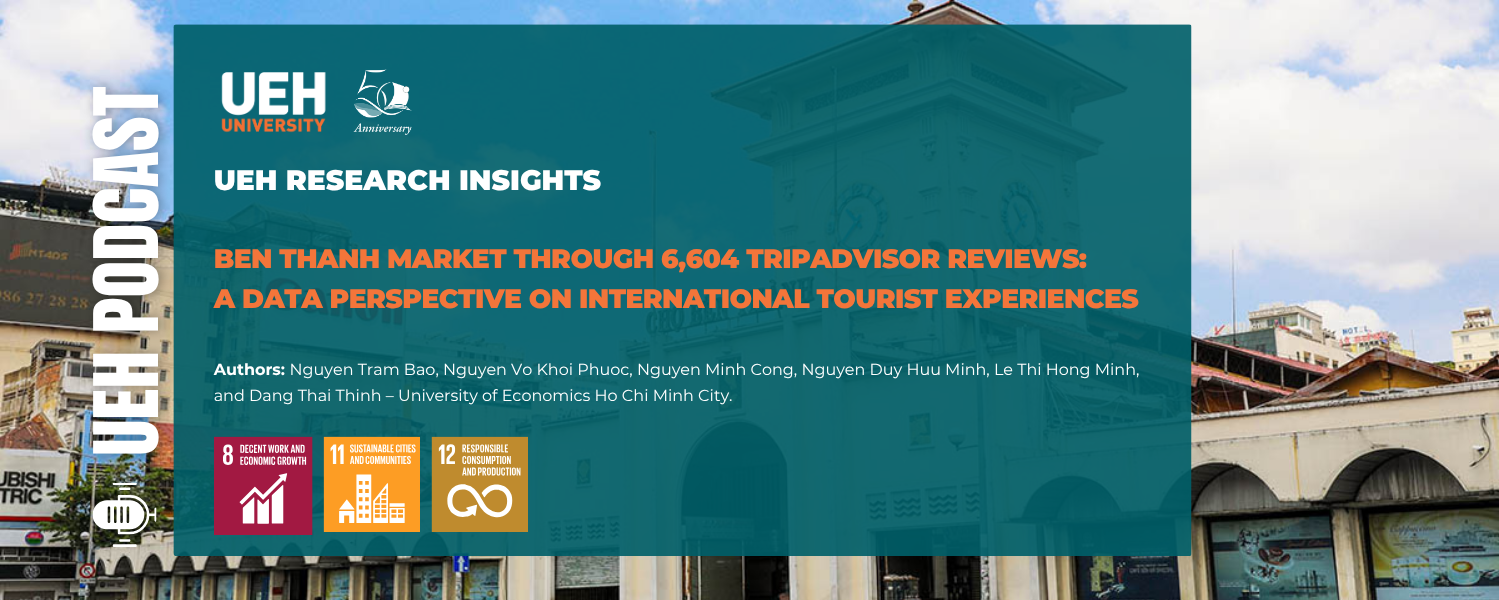
Seeking to understand the authentic experiences of tourists at a landmark destination like Ben Thanh Market, a research team from the University of Economics Ho Chi Minh City (UEH) conducted the study “Market Tourism and Tourist Perceptions: A Topic Modeling Analysis of Ben Thanh Market”. The study employs TripAdvisor review data and the Latent Dirichlet Allocation (LDA) topic modeling method to analyze the content most frequently mentioned by tourists regarding their market experiences.
Research methodology: Leveraging digital tourism data to identify tourist perceptions
Rather than relying solely on traditional surveys, the study taps into user-generated content on TripAdvisor. Following data collection, cleansing, and the removal of duplicate or irrelevant content using Python, the research team analyzed 6.604 tourist reviews of Ben Thanh Market.
The reviews were categorized into positive and negative sentiment groups and classified by geographic region, including Asia, Europe, the Americas, Oceania, and Africa. The LDA topic modeling method was employed to uncover latent themes within the review content. The team also validated the model using coherence and perplexity indices, combined with manual assessment, to ensure the interpreted topics accurately reflected real-world contexts.
This approach enables an understanding of what satisfies tourists, what leaves them dissatisfied, and how different visitor groups harbor distinct expectations.
The appeal of Ben Thanh Market lies in diversity, pricing, and atmosphere
Analysis results reveal that positive reviews cluster around eight primary topic groups. Most prominent among these are pricing and product diversity, accounting for 16.0% of positive topics. Other factors include the overall shopping experience, market atmosphere, bargaining activities, local interactions, culinary experiences, purchasing experiences, and surrounding amenities.
This indicates that Ben Thanh Market appeals to tourists not only through its goods or central location but through the entirety of the experience: the bustling atmosphere, bargaining opportunities, vendor interactions, sampling local dishes, and observing urban life. In market tourism, experiential value lies in the synthesis of commerce and culture.
Major drawbacks center on pricing, product quality, and vendor interactions
Conversely, the study identifies five primary negative topic clusters. Complaints frequently focus on the overall shopping experience, vendors and stalls, souvenirs/clothing, the market atmosphere, and pricing and bargaining issues.
Notably, negative feedback is heavily associated with perceptions of inflated pricing, product quality falling short of expectations, a lack of authenticity in goods, and uncomfortable vendor interactions. These are critical pain points as they directly impact tourist trust. When visitors perceive a lack of price transparency or encounter high-pressure sales tactics, a cultural experience can quickly devolve into a negative one.
Different tourist groups perceive Ben Thanh Market differently
A noteworthy contribution of the study is its analysis of perceptions by geographic region. The findings demonstrate that international tourists are not a homogenous group.
Asian tourists tend to focus heavily on pricing, bargaining, and specific products. Oceanian visitors prioritize product diversity, experiential value, and memorable impressions, but are also sensitive to perceptions of being overcharged. American tourists are interested in products, shopping activities, and vendor interactions, while their complaints largely relate to high prices, low quality, and poor service. European visitors emphasize product diversity and the overall experience, yet frequently express dissatisfaction with pricing and sales interactions.
This finding suggests that tourism management should not design a one-size-fits-all message for all visitors. Each group operates with distinct evaluative standards, shopping habits, and expectations.
Contributions of the Study: From Data Analysis to Destination Management
Academically, the study contributes to the fields of cultural tourism and market tourism by combining topic modeling with geographic segmentation. This approach clarifies differences in tourist behavior and perception, while providing evidence for the role of traditional markets as spaces embodying both economic functions and cultural value.
Practically, the study suggests that to enhance the experience at Ben Thanh Market, priority should be given to price transparency, improving intercultural communication skills among vendors, and enhancing the reliability of product quality and authenticity. Communication strategies should also be tailored to distinct tourist groups: emphasizing diversity and pricing flexibility for Asian visitors, while highlighting authenticity, quality, and fair value for Western tourists.
In an increasingly competitive urban tourism landscape, online review data can become a vital tool for evidence-based destination management. Using Ben Thanh Market as a case study, the research demonstrates that sustainable market tourism development requires a balance between preserving cultural identity, improving service quality, and meeting the diverse expectations of international tourists.
View the full research article: Market Tourism and Tourist Perceptions: A Topic Modeling Analysis of Ben Thanh Market HERE.
Authors: Nguyen Tram Bao, Nguyen Vo Khoi Phuoc, Nguyen Minh Cong, Nguyen Duy Huu Minh, Le Thi Hong Minh, and Dang Thai Thinh – University of Economics Ho Chi Minh City.
This article is part of the “Research Contribution For All” series disseminating research and applied knowledge from UEH. UEH respectfully invites readers to stay tuned for the next edition of the UEH Research Insights newsletter.

News, photos: Authors, Department of Communications and Partnerships
 Chia sẻ:























[Research Contribution] Co-innovating for a Sustainable Ocean Economy
12 December, 2025









[Podcast] Recommendations for University education development
14 February, 2025


[Podcast] Developing Vung Tau into a World-Class Tourism City
16 January, 2025


[Podcast] Postdigital Design Strategies for Media Art
6 January, 2025


[Podcast] NFTs – Artistic Innovation or Just a New Hype?
27 December, 2024


[Podcast] Boosting Employee Creativity with Constructive Feedback
23 November, 2024


[Podcast] “Dutch Disease” in Remittances and the Case of Vietnam
4 November, 2024


[Podcast] Latest approaches for sustainable universities
11 July, 2024


Data Law – Part 1: Necessity for a New Approach
18 May, 2024

Advertising Evaluation on Tiktok Platform
14 May, 2024

[Podcast] Advertising Evaluation on Tiktok Platform
13 May, 2024






Promoting Learner Autonomy in English Language Learning (Part 1)
24 November, 2023







ArtTech And Sustainable Development
27 October, 2023

Motivation of EFL Vietnamese Students in Economics-related Majors
12 October, 2023

Climate Change And Our Society: The Urgency Of Gender Inequality
12 October, 2023








People Analytics in Vietnam
10 March, 2022





Revolution in Experimental Economics
30 January, 2022

The Sharing Economy: Governance Issues in Vietnam
24 January, 2022

Employment Policy For Ho Chi Minh City in Post-social distancing Period
28 December, 2021

Lifelong learning at UEH: Towards a Sustainable University
28 December, 2021

Building a Decentralized Stock Market based on Blockchain Technology
24 December, 2021



Consumer price index from big data mining perspective (Big data)
17 November, 2021

Overview Of Digital Currency – Part 5: DIEM Private Stabilized Currency
11 November, 2021