[Research Contribution] Emotional Intelligence for Robots: When Vietnamese Robots Can “Sense” and “Express” Emotions Like Humans
30 June, 2026
Keywords: Emotional robot; Uncanny Valley; Fuzzy Logic; Vietnamese Anthropometry; Human-Robot Interaction; Fuzzy C-Means algorithm.
In the context of social robots being increasingly applied in education, healthcare, and services, the ability to communicate emotionally is becoming a decisive factor in building trust between humans and machines. Research by a team of authors from the University of Economics Ho Chi Minh City (UEH) has proposed a model combining Fuzzy C-Means (FCM), a Fuzzy Inference System (FIS), and Vietnamese anthropometric data to help robots recognize, interpret, and express emotions more naturally. The research results show that the system achieves up to 96% accuracy in identifying emotional states and 97% accuracy in controlling robot facial expressions, opening up prospects for developing generations of social robots with a distinct Vietnamese character
From intelligence to emotion: The missing piece of modern robots
In recent years, Artificial Intelligence (AI) has enabled robots to make significant strides in image recognition, language processing, and decision-making. However, most current robots still operate primarily on the principle of “receive command – execute command,” lacking the ability to express emotions – a fundamental element in human communication. In practice, in communication, humans do not just listen to words but also perceive emotions through glances, smiles, and subtle facial expressions. These non-verbal signals help create empathy, trust, and emotional connection. Therefore, the question is: How can robots not only be “intelligent” but also “empathetic”? This is the driving force behind the UEH research team’s development of a robot model capable of understanding and expressing emotions more like humans, thereby creating more natural and humane interactions between humans and machines.
Psychological barriers in human-robot interaction
One of the greatest barriers in the field of humanoid robotics is the phenomenon that researcher Masahiro Mori called the “Uncanny Valley”. According to this hypothesis, as a robot becomes more human-like, human affinity toward it increases. However, upon reaching a certain threshold, typically around 70% human-likeness, if the robot still has unnatural expressions or movements, people begin to feel uneasy, uncomfortable, or even fearful. In other words, a robot that is “almost human but not quite” can evoke a stronger negative feeling than a robot that is clearly mechanical -8-10. This explains why many modern robots, despite having very realistic appearances, have not been widely accepted in social communication environments. To overcome this challenge, robots need not only a human-like appearance but also the ability to express emotions softly, naturally, and appropriately to the communication context.
Designing robots from Vietnamese facial data
If the “Uncanny Valley” phenomenon stems from a lack of harmony between a robot’s appearance and expressions, then building a face with proportions and features close to humans is a prerequisite for creating a friendly feeling in communication. On this basis, the research team collected anthropometric data from 182 Vietnamese people with an average age of about 22, and calculated 12 important facial indices such as interocular distance, nose length, mouth width, forehead height, and other characteristic morphological ratios (Figure 1). This dataset was used to build a 3D robot head model, creating a face with a harmonious structure suitable for Vietnamese anthropometric characteristics. In addition to designing the external morphology, the study also identified 20 facial landmarks to track the movement of facial muscle areas during emotional expression. This is an important basis for converting human emotional expressions into quantitative data, serving to control movements on the robot’s face more accurately and naturally.
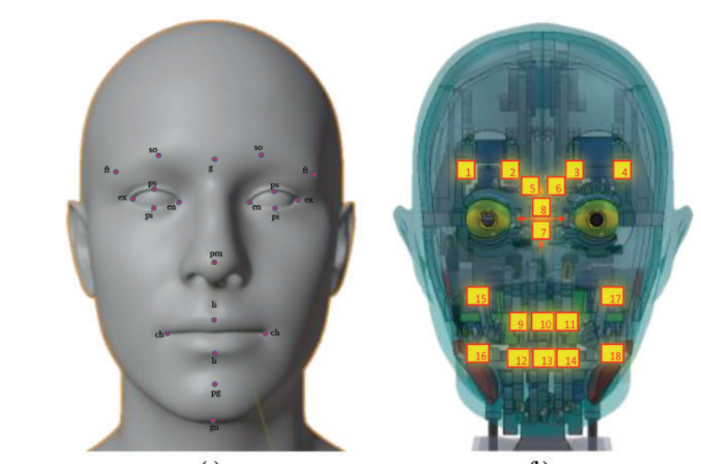
Figure 1: Facial anthropometric data and the actuator system structure used to recreate emotional expressions on the robot. (Source: Authors)
From human emotions to robot expressions
After establishing the system of facial landmarks, the next challenge for the research was how to transform the abstract emotional states of humans into specific movements on the robot’s face. Unlike physical quantities that can be measured precisely, emotions are often subjective and exist in varying degrees. Typically, a person can be “a little happy,” “very happy,” “quite surprised,” or “a little worried” – states that are difficult to represent with discrete values. To handle this ambiguity, the study applied Fuzzy Logic – a method that allows modeling how humans perceive and interpret emotions in reality. First, the Fuzzy C-Means (FCM) algorithm was used to analyze changes in facial landmarks and convert them into two basic psychological parameters: Valence and Arousal. Valence reflects the positive or negative degree of an emotion, while Arousal indicates the intensity or activation level of the emotion. For example, happiness typically has a positive Valence, while sadness has a negative Valence; similarly, excitement has a much higher Arousal than a calm state (Figure 2). Thanks to the fuzzy processing mechanism, the system can not only recognize basic emotions like happiness, sadness, or surprise but also distinguish many intermediate emotional nuances at different levels. This helps the robot understand more subtle emotional variations rather than just reacting in fixed states. The Valence and Arousal values are then fed into the Fuzzy Inference System (FIS). Based on a set of “IF-THEN” rules, the system converts the emotional state into specific control commands for the robot’s face. For example, when Arousal is high and Valence is positive, the system will control the mouth to open wider, raise the eyebrows, and make the eyes more lively to express happiness or excitement.
To recreate these expressions, the research team designed a system of 18 motors placed under the artificial skin (Figure 1). The motors are arranged corresponding to important muscle groups on the human face, including 4 motors for eyebrow control, 2 for eyelids, 2 for eye movement, 6 for lips, and 4 for jaw movement support. The synchronized coordination of these motors allows the robot to perform many subtle movements such as raising eyebrows, blinking, smiling, pursing lips, or opening the mouth wide when expressing emotions. Thanks to the combination of the Fuzzy Logic model and the bio-inspired actuator system, the robot can not only reproduce basic emotions but also express nuanced states such as mild happiness, excitement, fleeting surprise, or worry. This is an important factor that makes expressions more natural, helping to narrow the gap between humans and machines in communication.
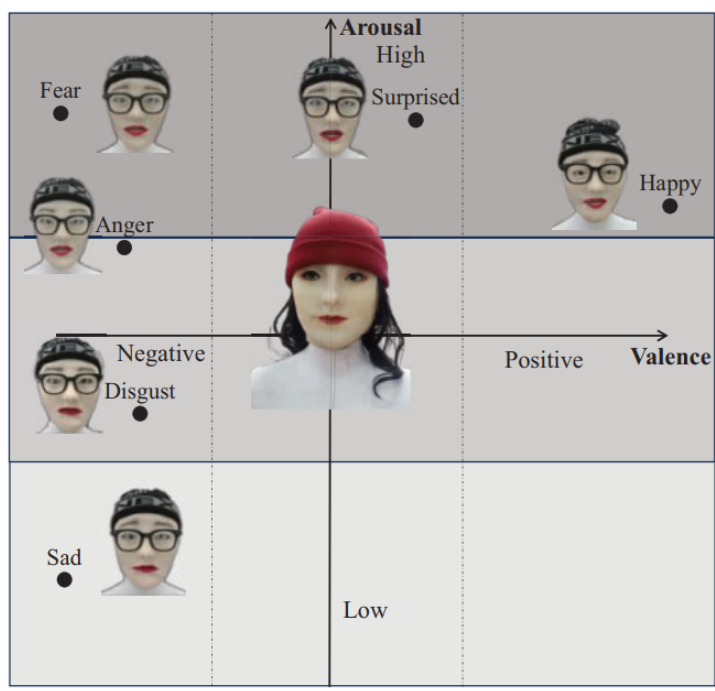
Figure 2: Representation of six basic robot emotions in the Valence-Arousal emotional space, including Happy, Surprised, Fear, Anger, Disgust, and Sad. (Source: Authors)
From natural expressions to practical social applications
Enabling robots to express natural emotions such as happiness, surprise, or worry not only helps bridge the gap between humans and machines in communication but also opens up new directions for application in social life. When robots can understand and respond to emotions appropriately in different situations, they can participate more effectively in educational, healthcare, and service activities. This is the core value that the research aims for: narrowing the emotional gap between humans and machines by equipping robots with the ability to understand and respond appropriately to the emotional state of the interlocutor. The potential applications of this technology are broad, specifically in education, where robots can serve as intelligent teaching assistants, recognizing students’ interest or stress levels to adjust their interaction accordingly. In healthcare, robots can support the elderly or patients by detecting signs of anxiety, stress, or loneliness, thereby creating interactions that provide emotional support. In the service and tourism sectors, robots can become smart receptionists or tour guides with flexible, friendly communication skills tailored to Vietnamese culture. These applications show that the future of robots is determined not only by information processing capabilities or intelligent decision-making but also by the capacity for understanding and emotional interaction. In other words, alongside Artificial Intelligence, a trend is gradually emerging: Artificial Emotional Intelligence – where robots not only help humans solve tasks but also bring a feeling of being heard, understood, and accompanied in daily life.
Thus, the research has demonstrated that integrating Vietnamese anthropometric data with Fuzzy Logic can create robotic systems capable of recognizing and expressing emotions naturally, flexibly, and with a high degree of humanity. With impressive performance in both emotional state recognition and facial expression control, the study not only contributes academically to the field of social robotics but also opens up many practical application directions in education, healthcare, and services. More importantly, this is a step forward in the journey of developing “Made in Vietnam” humanoid robots, contributing to the goal of making Vietnam one of the research and development centers for emotional robotics in Southeast Asia.
Authors: Prof. Dr. Nguyen Truong Thinh, Dr. Nguyen Minh Trieu – University of Economics Ho Chi Minh City
This article is part of a series disseminating research and applied knowledge with the message “Research Contribution For All,” implemented by UEH in coordination with Khanh Hoa Province’s Newspaper, Radio, and Television, aiming to accompany the sustainable development of Khanh Hoa province. UEH respectfully invites readers to watch the next Scientific Knowledge bulletin.

News, photos: UEH
 Chia sẻ:



















[Research Contribution] Co-innovating for a Sustainable Ocean Economy
12 December, 2025










[Podcast] Recommendations for University education development
14 February, 2025


[Podcast] Developing Vung Tau into a World-Class Tourism City
16 January, 2025


[Podcast] Postdigital Design Strategies for Media Art
6 January, 2025


[Podcast] NFTs – Artistic Innovation or Just a New Hype?
27 December, 2024


[Podcast] Boosting Employee Creativity with Constructive Feedback
23 November, 2024


[Podcast] “Dutch Disease” in Remittances and the Case of Vietnam
4 November, 2024


[Podcast] Latest approaches for sustainable universities
11 July, 2024


Data Law – Part 1: Necessity for a New Approach
18 May, 2024

Advertising Evaluation on Tiktok Platform
14 May, 2024

[Podcast] Advertising Evaluation on Tiktok Platform
13 May, 2024


Promoting Learner Autonomy in English Language Learning (Part 1)
24 November, 2023




ArtTech And Sustainable Development
27 October, 2023

Motivation of EFL Vietnamese Students in Economics-related Majors
12 October, 2023

Climate Change And Our Society: The Urgency Of Gender Inequality
12 October, 2023






People Analytics in Vietnam
10 March, 2022




Revolution in Experimental Economics
30 January, 2022

The Sharing Economy: Governance Issues in Vietnam
24 January, 2022

Employment Policy For Ho Chi Minh City in Post-social distancing Period
28 December, 2021

Lifelong learning at UEH: Towards a Sustainable University
28 December, 2021
Building a Decentralized Stock Market based on Blockchain Technology
24 December, 2021


Consumer price index from big data mining perspective (Big data)
17 November, 2021

Overview Of Digital Currency – Part 5: DIEM Private Stabilized Currency
11 November, 2021