[Research Contribution] How Can a Smart City Truly Be a Livable City?
26 June, 2026
Keywords: Smart City; Living City
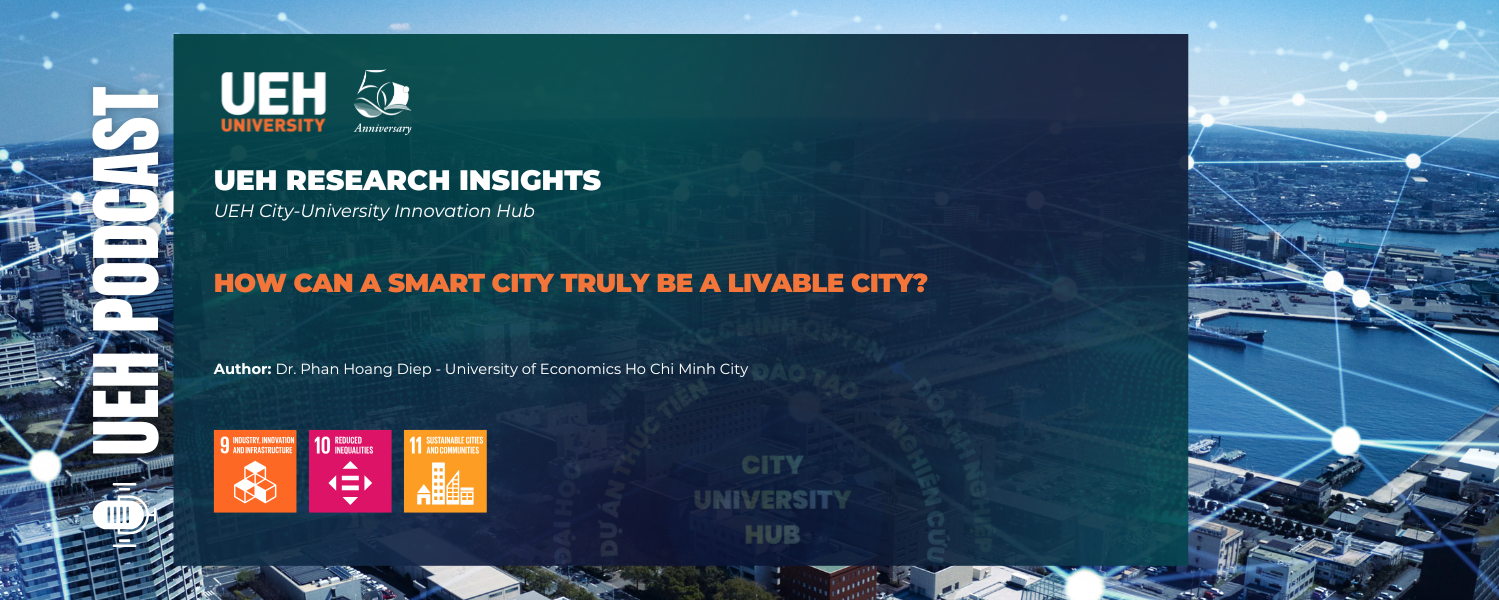
Many cities around the world are investing billions of dollars to become “smarter” with AI cameras, machine learning, big data, and dense sensor systems. However, according to international rankings, the world’s most livable cities are often not those with the highest technology density. This raises an important question for Vietnam: How can smart city solutions truly contribute to building livable urban areas that are more closely aligned with the actual needs of residents? From the perspective of Dr. Phan Hoang Diep – University of Economics Ho Chi Minh City (UEH), this article offers analysis and insights into this issue.
When “Smart” does not mean “Livable”
A smart city is often understood as the application of AI, IoT, and big data to optimize urban operations. In theory, this is the right direction. But in reality, “smart” does not automatically translate into “livable.”
International rankings clearly reflect this difference. Cities that lead in quality of life, such as Vienna, Copenhagen, Melbourne, Canberra, and Geneva, often stand out due to stability, healthcare, education, and friendly living spaces that are in harmony with nature and a slower pace of life. Conversely, rankings that prioritize technology and economy tend to favor London, New York, Tokyo, or Paris.
Technology can be measured by data and sensors, but quality of life must be measured by human perception. As Mr. Arturo Bris (Director of the IMD World Competitiveness Center) once noted, the most successful cities are not those with the most complex technology, but those that combine effective governance, public investment, and resident trust.
Experiences from Livable Cities
During six years of living in Brisbane and Melbourne, the author realized that what creates quality of life is not modern technology, but people-centered urban planning. Within a radius of just a few hundred meters, residents can easily access green parks, children’s playgrounds, sports centers, libraries, and public transportation at reasonable costs. Right in the city center is a large Botanic Garden with lush greenery, seasonal flowers, and even wildlife; nearby is a free public swimming pool where people can jog, cycle, or swim. These amenities are fairly evenly distributed, allowing both low-income people and students to benefit—a clear demonstration of equity in access to urban services.
In Vietnam’s major cities, the distribution of urban amenities remains uneven: while high-end urban areas and apartment complexes are well-invested in amenities, many ordinary residential areas still lack green spaces, sports facilities, libraries, parking lots, and certain basic public services.
Vietnam: What should a Smart City aim for?
In Vietnam, “smart city” initiatives are being increasingly implemented, from urban operation centers to monitoring and data management systems. These are necessary steps in the context of rapid urbanization.
However, an important question needs to be asked: What problems are these technologies solving, and what benefits are they bringing to residents?
If technology is mainly used for monitoring and urban operations, it can help the system run more efficiently. But to truly improve quality of life, technology must be accompanied by sound spatial planning and equitable distribution of public services. Conversely, if technology is merely layered on top without addressing core issues, a “smart city” will struggle to achieve sustainable effectiveness.
The case of Da Nang is a typical example. The city possesses many natural and infrastructural advantages, yet still faces certain challenges such as a lack of public spaces and green parks in many areas, uncoordinated car parking planning, a grid-pattern road system with many narrow streets prone to traffic congestion, inconvenient public transportation, and uneven distribution of amenities.
This shows that technology cannot replace planning; it can only support and enhance it.
From Smart City to Living City – A vision for the future
Rather than merely pursuing a firefighting-style “smart city” model, we should aim for a deeper and more progressive vision: the Living City – a concept developed by futurist Tom Cheesewright.
Instead of focusing on “command-and-control” centers with giant dashboard screens for top-down monitoring, the Living City views technology as a nervous system that brings urban infrastructure to life. Buildings, streets, parks, and bus stops are no longer static entities but have the ability to sense their environment, process information, and evolve according to the actual needs of residents.
This is a shift from control to collaboration. A smart bus stop does not just display arrival times but can use excess heat to warm passengers in winter or cool them in summer. An underutilized park can adjust its function, changing its layout to become a space more suited to community needs. Even underused buildings can be flexibly reconfigured into public spaces, sports centers, or playgrounds. The architect is not just a designer at the outset but also acts as a “gardener,” nurturing and refining the city over time, like caring for a living organism.
In Vietnam, we do not need flashy but fragmented technology projects. What is essential is building open connection interfaces, prioritizing inclusiveness and benefits for all segments of society. Technology must serve people, help narrow the wealth gap, and create harmony between planning, nature, and community.
A good city does not begin with high-rise buildings or dense camera networks. It begins with core residential areas equipped with comprehensive public amenities, with infrastructure that can adapt and evolve, and with a people-centered vision.
Only then can a smart city truly become a livable city – and beyond that, a living city.
Author: Dr. Phan Hoang Diep – University of Economics Ho Chi Minh City
This article is part of a series disseminating research and applied knowledge with the message “Research Contribution For All,” implemented by UEH. UEH respectfully invites readers to look forward to the next bulletin.
News & Photos: Author, UEH Department of Communications and Partnerships
 Chia sẻ:













[Research Contribution] Co-innovating for a Sustainable Ocean Economy
12 December, 2025








[Podcast] Recommendations for University education development
14 February, 2025


[Podcast] Developing Vung Tau into a World-Class Tourism City
16 January, 2025


[Podcast] Postdigital Design Strategies for Media Art
6 January, 2025


[Podcast] NFTs – Artistic Innovation or Just a New Hype?
27 December, 2024


[Podcast] Boosting Employee Creativity with Constructive Feedback
23 November, 2024


[Podcast] “Dutch Disease” in Remittances and the Case of Vietnam
4 November, 2024


[Podcast] Latest approaches for sustainable universities
11 July, 2024


Data Law – Part 1: Necessity for a New Approach
18 May, 2024

Advertising Evaluation on Tiktok Platform
14 May, 2024

[Podcast] Advertising Evaluation on Tiktok Platform
13 May, 2024




Promoting Learner Autonomy in English Language Learning (Part 1)
24 November, 2023






ArtTech And Sustainable Development
27 October, 2023

Motivation of EFL Vietnamese Students in Economics-related Majors
12 October, 2023

Climate Change And Our Society: The Urgency Of Gender Inequality
12 October, 2023




People Analytics in Vietnam
10 March, 2022





Revolution in Experimental Economics
30 January, 2022

The Sharing Economy: Governance Issues in Vietnam
24 January, 2022

Employment Policy For Ho Chi Minh City in Post-social distancing Period
28 December, 2021

Lifelong learning at UEH: Towards a Sustainable University
28 December, 2021

Building a Decentralized Stock Market based on Blockchain Technology
24 December, 2021



Consumer price index from big data mining perspective (Big data)
17 November, 2021

Overview Of Digital Currency – Part 5: DIEM Private Stabilized Currency
11 November, 2021