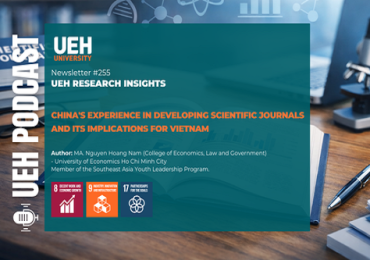
[Research Contribution] China’s Experience in Developing Scientific Journals and Implications for Vietnam
1 May, 2026
Keywords: scientific journals, academic publishing, science policy, China, Vietnam
Over the past two decades, China has emerged as a formidable force in innovation and scientific knowledge production. The Global Innovation Index (GII) Report 2025 ranked China 10th in the world, making it the only middle-income economy within the top 30 leading nations. Recently, as noted in a statistical report on the scientific publishing market in China, the 20 largest international publishers by output published 83% of all research articles involving China-based authors from 2012 to 2021. Drawing from research by an author at the University of Economics Ho Chi Minh City (UEH), this article analyzes the policies and current landscape of scientific journal development in China, thereby offering a number of implications for Vietnam in building and advancing scientific journals in the period ahead.
The Policy and Operational Ecosystem of Scientific Journals in China
Approaching from the perspectives of policy and academic governance, the study argues that the development of scientific journals in China is not the result of any single factor but rather has been shaped by the synchronized operation of an ecosystem comprising multiple closely interconnected components. Within this ecosystem, investment policies and research evaluation reforms provide the foundational orientation; organizational and management models ensure publishing quality; academic integrity serves as a “normative safeguard”; and human resources and international cooperation act as the driving forces behind internationalization. On this basis, the study analyzes each major component of the ecosystem in turn.
Investment Policies and Research Evaluation Reforms
The study reveals that the development of scientific journals in China is inseparable from the state’s long-term investment strategy in science, technology, and innovation. Since the late 1970s, China has continuously increased its spending on research and development (R&D), which currently accounts for approximately 22% of total global R&D expenditure. This resource base has created an essential foundation for research activities as well as for the rapid expansion of the scientific publishing system.
Alongside financial investment, China has implemented numerous reforms aimed at enhancing research quality, most notably a shift in evaluation philosophy. Rather than emphasizing the number of published articles and journal impact factors, new policies place greater weight on content quality and the practical impact of research outcomes. This is considered a critical adjustment to redirect the publishing behavior of scientists and enhance the substantive value of scientific journals.
Organizational and Management Models for Scientific Journals
Another key finding of the study concerns the rigorous management model applied to scientific journals in China. Accordingly, all journals seeking to operate must be approved and registered by the competent state authority. The licensing process involves a comprehensive evaluation covering the sponsoring organization, human resources, financial capacity, and academic orientation.
Additionally, China promotes the standardization of publishing processes through the implementation of a stringent, supervised peer-review system. Inviting experts within the same field to participate in review ensures the objectivity, professional rigor, and reliability of published articles. Scientific journals do not pursue profit but instead focus on their function of disseminating knowledge, thereby enabling the state to provide selective financial support to journals with strong potential.
Academic Integrity — The Pillar Sustaining the Credibility of Scientific Journals
The study places particular emphasis on the role of academic integrity within China’s scientific publishing system. In recent years, a series of policies and guidelines have been issued to prevent misconduct such as plagiarism, data fabrication, ghostwriting, and manipulation of the peer-review process. The public disclosure of violations, the establishment of early-warning lists for unreliable journals, and the application of strict sanctions demonstrate China’s vigorous efforts to restore integrity to the research environment. These measures not only protect the credibility of scientific journals but also help strengthen trust within the academic community both domestically and internationally.
Human Resources and International Cooperation
The study points out that high-quality human resources and international cooperation are critical drivers propelling the development of China’s scientific journals. Through substantial investment in higher education, the formulation of strategies to attract global talent, and the expansion of research collaboration networks with numerous countries, China has progressively enhanced its research quality and capacity for international integration. Extensive research collaboration has simultaneously increased both the volume and quality of scientific publications while creating conditions for Chinese scientific journals to approach and align with international publishing standards, thereby elevating their standing on the global scientific map.
Opportunities and Challenges in Developing Domestic Scientific Journals in China
Based on an analysis of science and technology policies, the academic publishing system, and international publication data, the study indicates that the development of scientific journals in China currently stands at a crossroads of significant opportunities coupled with numerous structural challenges, clearly reflecting the relationship between growing research capacity and the ability to translate knowledge into scientific journals with international credibility and influence.
First, China possesses exceptionally favorable conditions for developing its domestic scientific journal system. The scale and growth rate of scientific research activities generate an abundant supply of articles of steadily improving quality. China’s consistent position among the leading nations in international publication output reflects an academic foundation strong enough to nurture scientific journals of substantial stature.
Furthermore, robust support from national policies on science, technology, and innovation plays a pivotal role. The Chinese government has invested significantly in the research system, encouraging improvements in quality rather than merely pursuing publication volume. Reforms in research evaluation mechanisms, together with strategies to enhance academic publishing capacity, open up numerous opportunities for domestic scientific journals to progressively raise their standards, increase competitiveness, and expand their influence on the international stage.
However, the study also highlights considerable challenges confronting China’s scientific journal system. Despite rapidly growing research capacity, the majority of articles involving Chinese authors continue to be published in international journals controlled by foreign publishers. This reflects a pronounced gap between the capacity for knowledge production and the capacity for domestic academic publishing.
Moreover, many Chinese scientific journals still face limitations in meeting international standards for editorial processes, peer review, and publishing governance. A shortage of human resources with deep expertise in academic publishing, combined with the pressures of digital transformation and internationalization, has made it difficult for a significant number of journals to improve their quality and appeal to researchers. Unless these barriers are addressed, the domestic scientific journal system will struggle to fully capitalize on the potential offered by its rapidly developing research foundation.
Implications and Recommendations for Developing Scientific Journals in Vietnam
Drawing from China’s experience in developing its scientific journal system, the study offers a number of recommendations for Vietnam’s scientific journal landscape aimed at enhancing the quality, credibility, and international integration capacity of scientific journals in the period ahead.
First, Vietnamese scientific journals need to accelerate digital transformation in a strategic manner, prioritizing the establishment of a stable electronic publishing platform, expanding cooperation with professional publishing entities, and strengthening inter-journal linkages within specific fields. The application of new communication formats must be aligned with the core requirements of academic publishing: ensuring the rigor, systematization, and knowledge value of scientific content.
Second, the study recommends reforming the research evaluation and academic promotion system by reducing reliance on journal reputation and impact indicators while integrating quantitative assessment with expert judgment. This approach not only contributes to improving article quality but also fosters a healthy development environment for domestic scientific journals.
Third, to elevate their academic standing, Vietnamese scientific journals need to promote internationalization through clear publication orientation, strengthened international cooperation, and the encouragement of research with high novelty and practical applicability. In parallel, ensuring manuscript quality, standardizing the peer-review and editorial process, developing a professional editorial workforce, and establishing rigorous academic integrity regulations are regarded as foundational measures to help journals build credibility and achieve sustainable development.
Author: MSc. Nguyen Hoang Nam — UEH College of Economics, Law and Government, University of Economics Ho Chi Minh City; Member of the Southeast Asia Youth Leadership Program.
This article is part of the Series on Research Dissemination and Applied Knowledge from UEH, carrying the message “Research Contribution For All”. UEH cordially invites readers to follow the next edition of UEH Research Insights.

News and image: Author, UEH Department of Communications and Partnerships
 Chia sẻ:















[Research Contribution] Co-innovating for a Sustainable Ocean Economy
12 December, 2025








[Podcast] Recommendations for University education development
14 February, 2025


[Podcast] Developing Vung Tau into a World-Class Tourism City
16 January, 2025


[Podcast] Postdigital Design Strategies for Media Art
6 January, 2025


[Podcast] NFTs – Artistic Innovation or Just a New Hype?
27 December, 2024


[Podcast] Boosting Employee Creativity with Constructive Feedback
23 November, 2024


[Podcast] “Dutch Disease” in Remittances and the Case of Vietnam
4 November, 2024


[Podcast] Latest approaches for sustainable universities
11 July, 2024


Data Law – Part 1: Necessity for a New Approach
18 May, 2024

Advertising Evaluation on Tiktok Platform
14 May, 2024

[Podcast] Advertising Evaluation on Tiktok Platform
13 May, 2024





Promoting Learner Autonomy in English Language Learning (Part 1)
24 November, 2023





ArtTech And Sustainable Development
27 October, 2023
Motivation of EFL Vietnamese Students in Economics-related Majors
12 October, 2023

Climate Change And Our Society: The Urgency Of Gender Inequality
12 October, 2023





People Analytics in Vietnam
10 March, 2022




Revolution in Experimental Economics
30 January, 2022

The Sharing Economy: Governance Issues in Vietnam
24 January, 2022

Employment Policy For Ho Chi Minh City in Post-social distancing Period
28 December, 2021

Lifelong learning at UEH: Towards a Sustainable University
28 December, 2021
Building a Decentralized Stock Market based on Blockchain Technology
24 December, 2021

Consumer price index from big data mining perspective (Big data)
17 November, 2021

Overview Of Digital Currency – Part 5: DIEM Private Stabilized Currency
11 November, 2021