[Research Contribution] Developing Sustainable and Humanistic Fashion with AI
11 March, 2026
Keywords: Artificial intelligence, fashion, e-commerce
From personalized product recommendations to supply chain optimization, artificial intelligence (AI) is quietly reshaping the global fashion industry. Research by an author from the University of Economics Ho Chi Minh City (UEH) reveals that AI not only delivers economic benefits but also raises new demands regarding responsibility, ethics, and sustainability in industry development. Building on these findings, the study offers a number of proposals for Vietnam on its journey to promote humanistic and ethical values toward the development of a sustainable fashion industry.
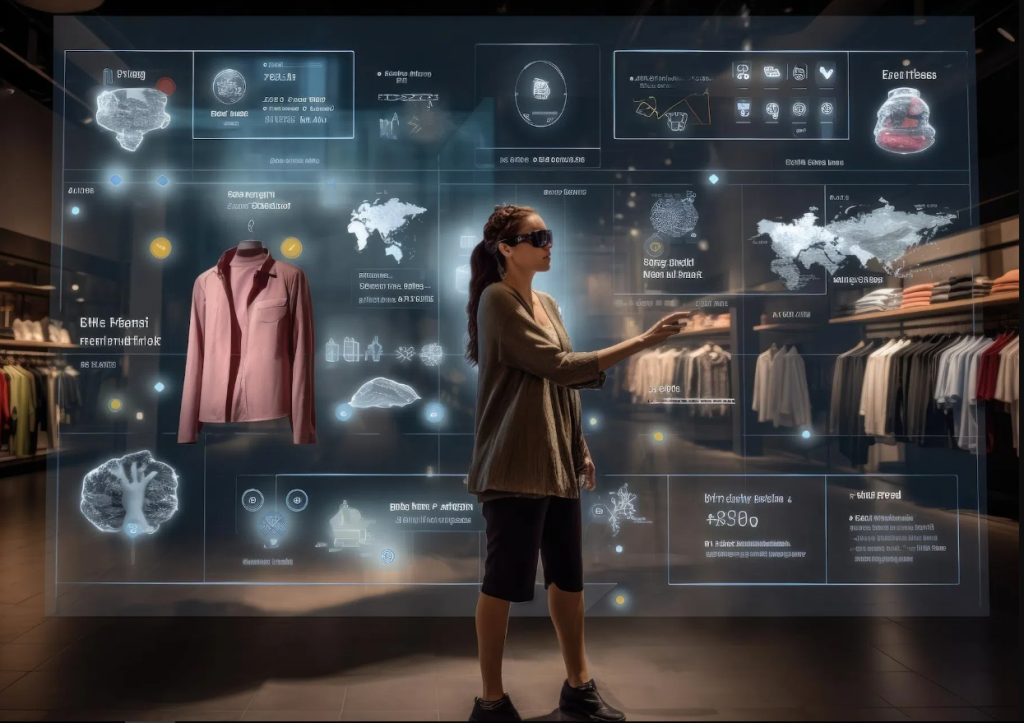
AI technology opens up breakthrough development opportunities for the fashion industry while enhancing the online shopping experience for consumers. Source: www.xcubelabs.com
Artificial Intelligence and the Reshaping of the Global Fashion Ecosystem
The application of AI technology in fashion design has been driving a revolution. A 2025 report by The Business Research Company shows that the AI market in the fashion industry is growing exponentially, with the market projected to reach USD 1.77 billion by the end of 2025 and continue rising to USD 6.99 billion by 2029, at a compound annual growth rate (CAGR) of 41%.
In recent years, AI technology has witnessed remarkable advances. The year 2021 marked the emergence of DALL-E, a text-to-image software developed by OpenAI. Building on DALL-E, director Paul Trillo and his wife (artist Shyama Golden) created a 30-second “AI fashion show” video combining AI technology with hundreds of fashion outfits. Meanwhile, Stability AI Ltd – a UK-based AI development company – introduced Stable Diffusion, an application hailed as a “breakthrough in rough design” for fashion products. With the ability to convert text descriptions into designs, Stable Diffusion helps create new design prototypes and modify existing ones, such as changing t-shirt styles or adding straps to handbags.
A 2024 McKinsey survey and analysis found that the pace of AI development poses one of the key challenges for businesses in deploying AI applications more effectively and responsibly. AI is creating an entirely new creative environment. The emergence of AI has opened an unprecedented creative space. By harnessing “unstructured” data such as text, images, and video, AI can generate 3D designs for virtual models, serving promotional video campaigns at major fashion weeks worldwide.
AI technology enables effective sentiment analysis from social media videos and consumer trend modeling. When AI technology is applied to production deployment systems, fashion enterprises demonstrate positive benefits in improving customer evaluation – in other words, applying AI to production allows fashion companies to optimize customer personalization through the collection and analysis of shopping behavior data as well as fashion trends.
From Design Concepts to Intelligent Operations: AI Across the Fashion Value Chain
In fashion industry operations, AI technology has become a “critical partner” throughout all stages of the business and production process. Today, many major global brands, including Zara, are focused on accelerating the integration of AI into their management systems. Zara’s 2024 report shows that the company applies AI to its production processes to optimize scheduling and inventory management, thereby responding promptly to fashion trends and reacting more swiftly to changes in customer preferences.
At the same time, AI applications help improve business performance, reducing costs related to premises rental, labor, and warehouse management. For instance, AI supports warehouse automation through robotics and real-time inventory management using augmented reality (AR) technology. Many businesses are also using AI in stores to detect counterfeit and fake goods. In South Korea, H&M employs AI tools such as Heuritech and Stylumia for pattern recognition, real-time monitoring, and predictive analysis to identify recurring themes in the market or culture.
On December 19, 2022, a group of designers from a Hong Kong (China)-based laboratory created the AI fashion assistant (AiDA) and successfully organized a fashion show featuring designs supported by AiDA. By using tools from technology companies such as Cala, Designovel, and Fashable, fashion designers have harnessed the power of AI to spark new ideas.
AI and Humanistic Values in Digital Fashion: Expanding Creativity and User Experience
AI algorithms are becoming increasingly sophisticated, offering significant potential to enhance and promote humanistic values in the design industry. A prime example is the development of smart clothing capable of providing medical functions and serving the needs of people with disabilities. Many major hospitals worldwide have chosen to collaborate with enterprises offering AI-powered features integrated with real-time AR. With virtual object simulation capabilities, AR-enabled products allow users to experience designs directly – interacting through touch or simulating the try-on of products (jewelry, clothing, footwear) with a high degree of visual realism. This allows patients with limited mobility to actively participate in online fashion experiences through modern technological devices.
Issues Arising in AI Application Toward Sustainable Fashion
Integrating AI into the development of the fashion industry opens vast potential for advancing sustainable fashion. However, on the flip side, this also exerts negative impacts on the environment – from the use of unsustainable raw materials and polluting production processes to enormous volumes of waste. Compounding this, pressure from “fast fashion” compels brands to continuously launch new collections, leading to overproduction and waste. In Vietnam, many fashion enterprises have proactively shifted from traditional business models to adopting AI in order to enhance production efficiency, optimize creativity, and personalize customer experiences. According to Mr. Nguyen Vu Linh – CEO of IVY Moda, strategic AI application will open numerous excellent opportunities for fashion enterprises at lower costs. AI serves not only as a springboard for Vietnam’s fashion industry to accelerate digital transformation but also as a means to narrow the technology and innovation gap amid global integration. However, in the long term, domestic enterprises need long-term strategies to maintain their unique identity in the face of challenges related to culture, data, and intellectual property.
Policy Implications for Sustainable Fashion Development in the Context of AI Application
To promote the development of sustainable and humanistic fashion through AI application, the following policy directions should be considered for implementation in the near future to provide appropriate support for organizations and enterprises in the industry.
First, consider issuing regulations related to sustainable and humanistic fashion development. Accordingly, the Government and relevant ministries and agencies can develop a system of standards and certifications for AI-enabled fashion products oriented toward sustainability, thereby assisting consumers in identifying and selecting products. At the same time, attention should be given to establishing regulations governing the relationships among designers, manufacturers, researchers, and consumers, with emphasis on the requirement to use AI responsibly across social, economic, and environmental dimensions, in order to mitigate risks related to business ethics and data security.
Second, encourage the participation of individuals and enterprises in the sustainable AI fashion ecosystem. Practices in countries with well-developed fashion industries such as France, the United Kingdom, and South Korea demonstrate a trend toward prioritizing sustainable materials in garment design. Designers are increasingly choosing environmentally friendly materials such as plant-based fabrics, recycled materials, bio-based materials, or other recyclable materials to optimize product lifecycles. Alongside this is the adoption of environmentally friendly production processes – from raw materials to the disposal stage – aimed at minimizing negative impacts on the ecosystem. In this context, creating a suitable “playing field” for domestic and international venture capital funds, particularly those investing in sustainable fashion technology startups, is considered an important factor warranting attention.
Third, develop supportive policies for organizations and fashion enterprises oriented toward integrating AI technology. Relevant agencies may consider implementing funding programs to encourage research and development of AI in the fashion industry. In parallel, organizing specialized training and consulting programs on AI, sustainable design, and transparent supply chain management will contribute to enhancing the international competitiveness of domestic fashion enterprises.
Conclusion
In the context of rapidly shifting consumer preferences, short product lifecycles, and demand for personalization, the modern fashion industry faces a speed race among enterprises. AI technology application is transforming the fashion sector by enhancing customer experiences, optimizing inventory management, and predicting fashion trends. With a growing middle-class population and rising interest in fashion, effectively leveraging AI in Vietnam will help enterprises meet customer preferences while reducing operational costs and maintaining competitiveness in a dynamic market, as well as helping businesses reduce repetitive tasks, focus on creativity and strategy, and move toward sustainability and humanistic values.
This article was published in the Vietnam Journal of Science and Technology, Issue 9/2025. View the full article “Developing Sustainable and Humanistic Fashion with AI” [HERE].
Author: Nguyen Hoang Nam – College of Economics, Law and Government, University of Economics Ho Chi Minh City (UEH); Member of the Southeast Asia Young Leaders Program (SEAYLP).
This article is part of the Series on Research Dissemination and Applied Knowledge from UEH, carrying the message “Research Contribution For All”. UEH cordially invites readers to follow the next edition of UEH Research Insights.

News and image: Author, UEH Department of Communications and Partnerships
Voice: Thanh Kieu
 Chia sẻ:























[Research Contribution] Co-innovating for a Sustainable Ocean Economy
12 December, 2025







[Podcast] Recommendations for University education development
14 February, 2025


[Podcast] Developing Vung Tau into a World-Class Tourism City
16 January, 2025


[Podcast] Postdigital Design Strategies for Media Art
6 January, 2025


[Podcast] NFTs – Artistic Innovation or Just a New Hype?
27 December, 2024


[Podcast] Boosting Employee Creativity with Constructive Feedback
23 November, 2024


[Podcast] “Dutch Disease” in Remittances and the Case of Vietnam
4 November, 2024


[Podcast] Latest approaches for sustainable universities
11 July, 2024


Data Law – Part 1: Necessity for a New Approach
18 May, 2024

Advertising Evaluation on Tiktok Platform
14 May, 2024

[Podcast] Advertising Evaluation on Tiktok Platform
13 May, 2024






Promoting Learner Autonomy in English Language Learning (Part 1)
24 November, 2023






ArtTech And Sustainable Development
27 October, 2023
Motivation of EFL Vietnamese Students in Economics-related Majors
12 October, 2023
Climate Change And Our Society: The Urgency Of Gender Inequality
12 October, 2023






People Analytics in Vietnam
10 March, 2022





Revolution in Experimental Economics
30 January, 2022

The Sharing Economy: Governance Issues in Vietnam
24 January, 2022

Employment Policy For Ho Chi Minh City in Post-social distancing Period
28 December, 2021

Lifelong learning at UEH: Towards a Sustainable University
28 December, 2021
Building a Decentralized Stock Market based on Blockchain Technology
24 December, 2021



Consumer price index from big data mining perspective (Big data)
17 November, 2021

Overview Of Digital Currency – Part 5: DIEM Private Stabilized Currency
11 November, 2021