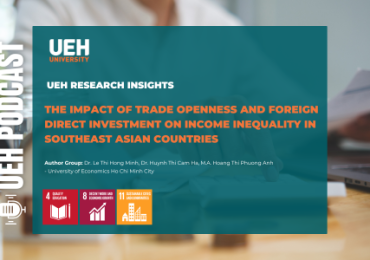
[Research Contribution] The Impact of Trade Openness and Foreign Direct Investment on Income Inequality in Southeast Asia
16 March, 2026
Keywords: income inequality; trade openness; foreign direct investment.
Over the past several decades, Southeast Asian countries (ASEAN) have emerged as one of the most dynamic regions in the world, largely driven by policies promoting trade openness and attracting foreign direct investment (FDI). However, alongside this remarkable growth come growing concerns about widening income gaps between social groups and across regions. In response to this issue, a research team from the University of Economics Ho Chi Minh City (UEH) conducted a study to examine how trade openness and FDI influence income inequality in ASEAN countries, in connection with the United Nations’ Sustainable Development Goals (SDGs).

Growth with a Hidden Cost: Rising Income Inequality
Expanding international trade and attracting FDI have generated many benefits for economic growth, including technology transfer, improved management skills, job creation, and better workforce capabilities. These factors have enabled many countries to integrate more deeply into globalisation and the technological transformations taking place worldwide.
However, when economies become highly dependent on international markets and FDI flows are unevenly distributed, income gaps among population groups may widen. This issue is particularly relevant in Southeast Asia, where the supply of highly skilled labor remains limited. As a result, the benefits of economic integration are not always evenly shared. Understanding the relationship between trade openness, FDI, and income inequality is therefore both timely and important.
Data analysis (2006–2022): A Non-Linear Relationship
The study uses data from ASEAN countries during the period 2006–2022 to analyse the link between economic integration and income inequality. The findings show that both trade expansion and FDI inflows significantly affect income inequality. However, this impact is not linear.
At the early stage, when trade and FDI increase rapidly, income gaps tend to widen. As the economy develops further, this trend may reverse and inequality begins to decline. In other words, the relationship resembles an “inverted U-shaped curve”: inequality rises initially and then decreases as economic and social conditions improve.
The study also examines exports and imports separately. Trade with developed countries tends to increase income inequality, as both exports and imports are associated with wider income gaps. In contrast, when trading with developing countries, exports tend to increase inequality, while imports may help narrow the income gap.
Education: A Key Lever in Shaping Inequality Outcomes
When expanding the model to examine the role of education, the research incorporates primary school enrollment rates alongside trade openness and FDI. The results indicate that education plays a critical role in shaping how trade and FDI affect income inequality. Specifically, trade openness alone still tends to increase inequality. However, when FDI reaches higher levels, its impact may shift toward reducing income disparities. This suggests that education acts as a moderating factor, helping mitigate some of the negative consequences of economic integration.
Regression analysis further shows that education is the most important factor determining whether inequality increases or decreases across ASEAN countries. In the context of globalisation and rapid trade liberalisation, many countries aim to expand trade and attract FDI to drive economic growth. Yet when the supply of skilled labor is limited, the benefits of integration may concentrate in a small segment of the population. As firms demand more highly skilled workers while the labor supply remains insufficient, low-skilled workers may face reduced employment opportunities and unstable incomes.
Policy Implications: Inclusive Growth Requires Investment in People
The study confirms that expanding trade and attracting FDI are key drivers of economic growth. However, this process also carries potential risks. If education systems fail to adapt in time, low-skilled workers may face unstable incomes and shrinking employment opportunities. Without appropriate policy measures, economic integration may deepen the gap between rich and poor and widen regional disparities.
To address these challenges, ASEAN countries should consider several policy priorities:
- Strengthening education and training. Improving vocational education quality – especially in disadvantaged and remote areas – is essential. Expanding access to education and supporting education costs can help workers develop the skills needed to adapt to rapidly changing labor markets.
- Managing investment flows. Governments should establish mechanisms to guide and distribute FDI more effectively, avoiding excessive concentration in existing and ensuring more balanced regional development.
In an increasingly integrated world, the success of an economy should not be measured solely by GDP growth, but also by how fairly the benefits of that growth are distributed. The findings of this study provide valuable insights for ASEAN countries as they adjust trade, investment, and education policies toward a more sustainable, inclusive, and balanced development path.
Read the full article: The Impact of Trade Openness and Foreign Direct Investment on Income Inequality in Southeast Asia HERE.
This article is part of the UEH Research and Applied Knowledge Dissemination Series, carrying the message “Research Contribution For All,” conducted by UEH. UEH cordially invites readers to stay tuned for the next edition of UEH Research Insights.

News and image: Author, UEH Department of Communications and Partnerships
 Chia sẻ:



[Research Contribution] Co-innovating for a Sustainable Ocean Economy
12 December, 2025






[Podcast] Recommendations for University education development
14 February, 2025


[Podcast] Developing Vung Tau into a World-Class Tourism City
16 January, 2025


[Podcast] Postdigital Design Strategies for Media Art
6 January, 2025


[Podcast] NFTs – Artistic Innovation or Just a New Hype?
27 December, 2024


[Podcast] Boosting Employee Creativity with Constructive Feedback
23 November, 2024


[Podcast] “Dutch Disease” in Remittances and the Case of Vietnam
4 November, 2024


[Podcast] Latest approaches for sustainable universities
11 July, 2024


Data Law – Part 1: Necessity for a New Approach
18 May, 2024

Advertising Evaluation on Tiktok Platform
14 May, 2024

[Podcast] Advertising Evaluation on Tiktok Platform
13 May, 2024





Promoting Learner Autonomy in English Language Learning (Part 1)
24 November, 2023




ArtTech And Sustainable Development
27 October, 2023
Motivation of EFL Vietnamese Students in Economics-related Majors
12 October, 2023
Climate Change And Our Society: The Urgency Of Gender Inequality
12 October, 2023



People Analytics in Vietnam
10 March, 2022




Revolution in Experimental Economics
30 January, 2022

The Sharing Economy: Governance Issues in Vietnam
24 January, 2022
Employment Policy For Ho Chi Minh City in Post-social distancing Period
28 December, 2021

Lifelong learning at UEH: Towards a Sustainable University
28 December, 2021
Building a Decentralized Stock Market based on Blockchain Technology
24 December, 2021



Consumer price index from big data mining perspective (Big data)
17 November, 2021

Overview Of Digital Currency – Part 5: DIEM Private Stabilized Currency
11 November, 2021