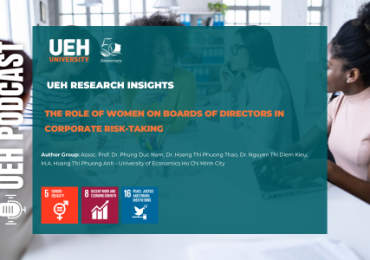
[Research Contribution] The Role of Women on Boards of Directors in Corporate Risk-Taking
16 March, 2026
Keywords: Board of Directors, Gender Equality, Corporate Risk
As gender equality increasingly becomes a global standard in corporate governance, the role of women on boards of directors carries not only social significance but also a substantive impact on corporate strategic decisions. A research team from the University of Economics Ho Chi Minh City (UEH) has examined the relationship between women’s representation on boards of directors and the level of risk-taking among listed companies in Vietnam, thereby providing additional empirical evidence affirming the growing importance of women in modern corporate governance.

Gender Diversity on Boards of Directors Is Becoming a Strategic Governance Issue
Over the past two decades, gender diversity on boards of directors has become a topic drawing widespread attention from policymakers, investors, and the academic community worldwide. Many developed countries have implemented regulations or recommendations to promote women’s participation in corporate governance bodies – notably Norway, with its minimum quota of 40% female board representation, and the corporate governance codes in the United Kingdom and the European Union.
International studies indicate that gender-diverse boards can improve oversight quality, enhance decision-making effectiveness, and strengthen corporate legitimacy. However, the relationship between women’s participation and corporate risk-taking remains a subject of debate. Some research suggests that women tend to be more cautious in risk-related decisions, while other studies point out that gender diversity enables companies to take risks in a more calculated and effective manner.
In Vietnam, empirical research on this topic remains relatively limited – particularly studies that distinguish between the roles of independent and non-independent female board members, as well as those examining the interaction between women on boards and foreign ownership. Motivated by this research gap, the present study was conducted to offer a more comprehensive perspective on the role of women in Vietnamese corporate governance.
Key Findings from Vietnamese Corporate Data
The UEH research team conducted their study on 222 non-financial companies listed on the Ho Chi Minh Stock Exchange (HOSE) during the period 2015–2021, examining the relationship between women’s representation on boards of directors and corporate risk-taking. Risk-taking capacity was approached from three dimensions: total risk, adventurous risk, and performance risk – reflecting not only the degree of willingness to accept risk but also the quality of risk-related decisions in business operations.
In addition to examining the proportion of women on boards, the study distinguished between independent and non-independent female board members, while also incorporating foreign ownership into the analysis to clarify the moderating role of women in corporate risk decisions.
The findings reveal that women’s presence on boards does not make companies more cautious or conservative. On the contrary, it exerts a multidimensional and nuanced impact on risk-taking behavior. Specifically, the proportion of women on boards shows a positive correlation with total risk and adventurous risk, suggesting that companies tend to be more proactive in seeking investment opportunities and making strategic decisions when women are involved in the governance process.
Conversely, the study also records a negative correlation between women on boards and performance risk. This indicates that while companies may accept greater risk, these risks are better managed – thereby limiting the likelihood of business outcomes falling below expectations. In other words, women not only contribute to increasing the level of risk acceptance but also enhance the quality of risk-related decisions.
When distinguished by role on the board, non-independent female members demonstrate a more pronounced effect in driving total risk and adventurous risk, while both independent and non-independent female members contribute to reducing performance risk. This result suggests that the role of women on boards is consistent in terms of oversight and strategic decision adjustment, regardless of whether they hold independent or non-independent positions.
Furthermore, the study reveals that women on boards play a moderating role in the relationship between foreign ownership and corporate risk. In the context of foreign-owned enterprises that typically pursue long-term and more cautious investment strategies, women’s participation helps companies strike a better balance between safety objectives and the need to seize growth opportunities.
Policy Implications for Corporate Governance in Vietnam
From the research findings, several important implications can be drawn for businesses and policymakers in Vietnam.
First, companies should proactively promote gender diversity on their boards – not only to advance gender equality but also for long-term economic benefits. Women’s participation helps companies take risks in a controlled manner, thereby enhancing operational performance.
Second, appointing women to substantive positions on boards – particularly those with direct involvement in the decision-making process – will more effectively leverage their role in shaping corporate strategy.
Third, for companies with foreign ownership, a harmonious combination of ownership structure and board gender diversity should be considered to optimize risk-taking behavior and enhance corporate value.
Overall, the study affirms that women on boards of directors are not merely symbols of gender equality – they are critical agents shaping corporate strategy and risk behavior in an era of deepening integration and intensifying competition.
Read the full article The Role of Women on Boards of Directors in Corporate Risk-Taking [HERE].
Authors: Assoc. Prof. Dr. Phung Duc Nam, Dr. Hoang Thi Phuong Thao, Dr. Nguyen Thi Diem Kieu, MSc. Hoang Thi Phuong Anh – University of Economics Ho Chi Minh City.
This article is part of the Series on Research Dissemination and Applied Knowledge from UEH, carrying the message “Research Contribution For All”. UEH cordially invites readers to follow the next edition of UEH Research Insights.

News and images: Authors, UEH Department of Communications and Partnerships
 Chia sẻ:






[Research Contribution] Co-innovating for a Sustainable Ocean Economy
12 December, 2025










[Podcast] Recommendations for University education development
14 February, 2025


[Podcast] Developing Vung Tau into a World-Class Tourism City
16 January, 2025


[Podcast] Postdigital Design Strategies for Media Art
6 January, 2025


[Podcast] NFTs – Artistic Innovation or Just a New Hype?
27 December, 2024


[Podcast] Boosting Employee Creativity with Constructive Feedback
23 November, 2024


[Podcast] “Dutch Disease” in Remittances and the Case of Vietnam
4 November, 2024


[Podcast] Latest approaches for sustainable universities
11 July, 2024


Data Law – Part 1: Necessity for a New Approach
18 May, 2024

Advertising Evaluation on Tiktok Platform
14 May, 2024

[Podcast] Advertising Evaluation on Tiktok Platform
13 May, 2024






Promoting Learner Autonomy in English Language Learning (Part 1)
24 November, 2023







ArtTech And Sustainable Development
27 October, 2023


Motivation of EFL Vietnamese Students in Economics-related Majors
12 October, 2023

Climate Change And Our Society: The Urgency Of Gender Inequality
12 October, 2023








People Analytics in Vietnam
10 March, 2022





Revolution in Experimental Economics
30 January, 2022

The Sharing Economy: Governance Issues in Vietnam
24 January, 2022

Employment Policy For Ho Chi Minh City in Post-social distancing Period
28 December, 2021

Lifelong learning at UEH: Towards a Sustainable University
28 December, 2021

Building a Decentralized Stock Market based on Blockchain Technology
24 December, 2021



Consumer price index from big data mining perspective (Big data)
17 November, 2021

Overview Of Digital Currency – Part 5: DIEM Private Stabilized Currency
11 November, 2021