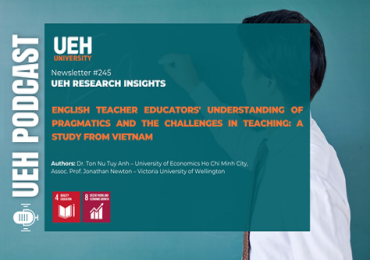
[Research Contribution] Teacher Training Workshops: How to Help English Teachers Recognize and Effectively Teach Pragmatics
20 November, 2025
Keywords: L2 Pragmatics, Second Language Teacher Education, Teacher Beliefs, Teacher Awareness, Teacher Knowledge
In an increasingly globalized educational context, understanding and teaching language within its communicative context is indispensable. A study by an author from the University of Economics Ho Chi Minh City (UEH) has contributed an effective method for helping English teachers recognize and effectively teach pragmatics.

What is Pragmatics and Why is it Important for English Learners?
When learning a foreign language, we are often taught vocabulary, grammar, and pronunciation. But there is an equally important element that is often overlooked: pragmatics—the ability to use language appropriately in specific communicative situations. For example, knowing how to say “Thank you” in a way that is both polite and suitable for the person you are speaking to is a part of pragmatics.
Pragmatics in English (also known as L2 pragmatics) helps learners know what to say, to whom, and when, in a manner that is appropriate for the context and culture. This is a decisive factor that enables learners not only to speak correctly but also to communicate effectively and appropriately, especially in an international environment.
The Problem: Pragmatics is Neglected in English Teacher Training Programs
Although the importance of pragmatics is widely recognized, in many countries—including Vietnam—this content is rarely included in textbooks or teacher training curricula. English teachers, particularly at the high school level, often lack specific guidance on how to teach this skill. As a result, Vietnamese students, despite having good grammatical knowledge, still face difficulties in real-life communication with foreigners because they lack a deep understanding of how to use the language in different situations.
The Solution: Organizing a Professional Development Workshop for Teachers
The author of the study, Dr. Ton Nu Tuy Anh, organized a professional development workshop for 43 high school English teachers in Central Vietnam. The objective was to help them better understand pragmatics and how to teach it in the EFL (English as a Foreign Language) classroom.
The main content of the workshop was designed based on the framework for teacher competence in teaching pragmatics proposed by Ishihara (2022). It consisted of three main parts:
- Foundational Knowledge of Pragmatics: Teachers were introduced to the concept, role, and elements of pragmatics, such as speech acts, politeness norms, and cultural differences between Vietnamese and English.
- Methods for Teaching Pragmatics: This included both explicit and implicit instruction, with concrete examples illustrated through practical classroom activities.
- Lesson Design Practice: Teachers were asked to redesign several lessons from their current textbooks to integrate pragmatic elements into their teaching content.
After the workshop, all participating teachers were able to fully answer questions about the concept of pragmatics—some of whom were not even familiar with the term before. Most teachers understood that pragmatics relates to using language appropriately in social contexts, considering levels of politeness and the relationship with the interlocutor.
The survey results also showed that many teachers realized their current textbooks lack pragmatic content. Previously, they had paid little attention to or appreciated the role of this element, but after the workshop, they clearly saw the deficiency and expressed a desire for improvement.
A special feature of the workshop was the practical session: teachers were divided into groups to redesign lessons from their textbooks, integrating pragmatic elements into speaking and conversation practice activities.
The designed activities included:
- Guiding students on how to politely open and close conversations,
- Recognizing formal or informal contexts to choose appropriate language,
- Learning how to apologize, make requests, refuse, and give advice in specific situations.
For many teachers, this was the first time they had proactively created lessons with pragmatic elements, and they found the activity to be highly practical and easy to apply.
Some teachers shared:
“I had never realized how much textbooks lack content on speaking appropriately in different situations, especially when communicating with foreigners.”
“I now understand why my students, despite knowing English, can still sound ‘out of place’ when they communicate.”
Key Conclusions from the Research
Teachers need systematic training in pragmatics, especially given that current textbooks are deficient in this area. Understanding and teaching pragmatics not only helps students learn correctly but also enables them to communicate effectively and appropriately within the target language culture.
Teachers can be agents of change in classroom practice if they are properly inspired and guided. With just a starting point like this workshop, many have gained the confidence to change their teaching methods.
Vietnam and other countries with limited resources can certainly apply a workshop model like the one in this study to improve the quality of English teaching without requiring large-scale investment.
This research not only demonstrates the importance of training teachers in pragmatics but also proves that we can start with very small steps—like a one-day workshop—to create real change in the English classroom.
Read the full research paper: Teacher Training Workshops: How to Help English Teachers Recognize and Effectively Teach Pragmatics HERE.
Author: Dr. Ton Nu Tuy Anh – University of Economics Ho Chi Minh City
This article is part of the series spreading research and applied knowledge from UEH with the message “Research Contribution For All.” UEH cordially invites readers to look forward to the next UEH Research Insights newsletter.
News, photos: Author, UEH Department of Communications and Partnerships

 Chia sẻ:





[Research Contribution] Co-innovating for a Sustainable Ocean Economy
12 December, 2025






[Podcast] Recommendations for University education development
14 February, 2025


[Podcast] Developing Vung Tau into a World-Class Tourism City
16 January, 2025


[Podcast] Postdigital Design Strategies for Media Art
6 January, 2025


[Podcast] NFTs – Artistic Innovation or Just a New Hype?
27 December, 2024


[Podcast] Boosting Employee Creativity with Constructive Feedback
23 November, 2024


[Podcast] “Dutch Disease” in Remittances and the Case of Vietnam
4 November, 2024


[Podcast] Latest approaches for sustainable universities
11 July, 2024


Data Law – Part 1: Necessity for a New Approach
18 May, 2024

Advertising Evaluation on Tiktok Platform
14 May, 2024

[Podcast] Advertising Evaluation on Tiktok Platform
13 May, 2024





Promoting Learner Autonomy in English Language Learning (Part 1)
24 November, 2023






ArtTech And Sustainable Development
27 October, 2023

Motivation of EFL Vietnamese Students in Economics-related Majors
12 October, 2023

Climate Change And Our Society: The Urgency Of Gender Inequality
12 October, 2023








People Analytics in Vietnam
10 March, 2022




Revolution in Experimental Economics
30 January, 2022

The Sharing Economy: Governance Issues in Vietnam
24 January, 2022

Employment Policy For Ho Chi Minh City in Post-social distancing Period
28 December, 2021

Lifelong learning at UEH: Towards a Sustainable University
28 December, 2021
Building a Decentralized Stock Market based on Blockchain Technology
24 December, 2021



Consumer price index from big data mining perspective (Big data)
17 November, 2021

Overview Of Digital Currency – Part 5: DIEM Private Stabilized Currency
11 November, 2021