[Research Contribution] Health, Prosperity, and the Relationship Between Urban Landscapes and Community: Architectural, Landscape, and Urban Design in Coastal Contexts
6 December, 2025
Keywords: Coastal Cities, Climate Adaptation, Urban Landscape, Sustainable Communities
As coastal cities continue to grow and face the powerful impacts of climate change, the narrative of the relationship between nature, urban spaces, and people has become more urgent than ever. The second session, “Health, Prosperity, and the Relationship Between Urban Landscapes and Community,” part of the Ocean Future 2025 conference in Khanh Hoa organized by the University of Economics Ho Chi Minh City (UEH), has opened up new perspectives on designing with nature—where every space not only nurtures physical life but also supports mental health and social well-being.

Breaking the “Smart City” Mold: Why Coastal Cities Need a More Distinctive and Human-Centric Design Philosophy
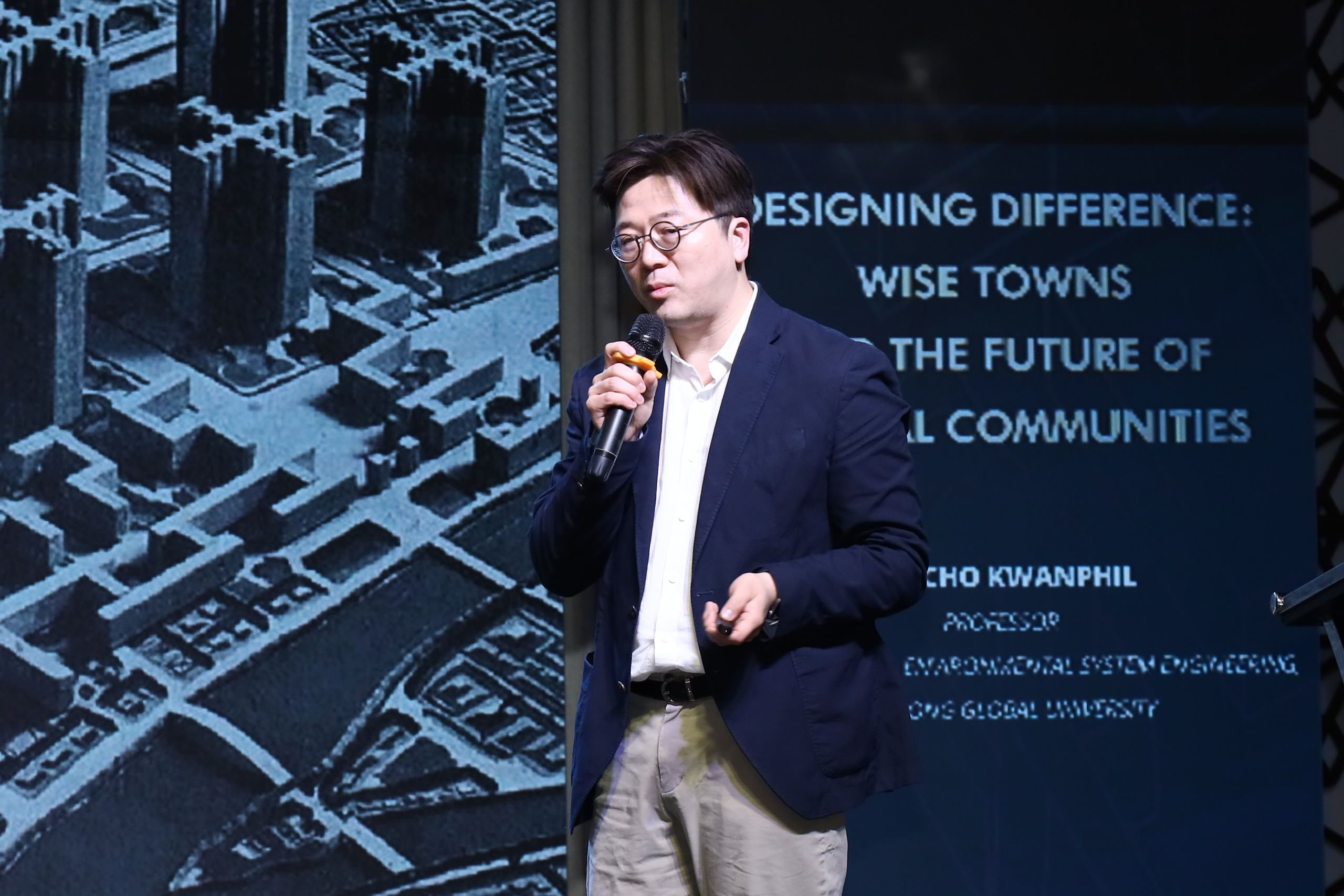
Opening the session, Prof. Cho Kwanphil – a faculty member at the School of Spatial Environment System Engineering, Handong Global University (South Korea) – delivered a presentation on “Distinctive Design: From Smart Cities to Coastal Communities.” Drawing on international experience in sustainable urban design and parametric design, he proposed a new perspective on coastal urban development—one that places local identity, community wisdom, and human factors at the center, rather than technology.
He began by pointing out a noteworthy reality: many cities worldwide are suffering from an “epidemic of sameness.” From London and Seoul to Seattle, cities are gradually taking on similar appearances, causing local identity to fade and urban models to be mechanically replicated. According to him, this trend not only diminishes a locality’s appeal but also contributes to young people leaving their hometowns for the dynamism of major centers, creating an imbalance in urban structure and life.
Wise Town: An Urban Approach Based on Humanistic Values and Cultural Diversity
Prof. Cho proposed a new approach: instead of prioritizing the technology-centric “Smart City,” localities should aim for a “Wise Town” model. While a Smart City focuses on data automation and operational efficiency, a Wise Town places people at the center, emphasizing the unique identity, humanistic values, and distinctiveness of each locality. He argued that this is the “core material” for sustainable urban development, healthy competition, and a thriving community life.
He stressed that a Wise Town is not limited to architecture or urban design but is a comprehensive system linking production, energy, education, and community care. This model aims to increase urban autonomy through a circular economy, reducing dependence on external resources and preserving cultural diversity. He called for global urban cooperation instead of competition—forming a network of “wise towns” that support and complement each other, rather than repeating cookie-cutter urban models.
Turning Tetrapods into Community Spaces: A Human-Centric and Culturally Rich Coastal Design Solution
To illustrate this feasibility, Prof. Cho presented a project on the east coast of Korea, where tetrapods used for coastal protection had inadvertently separated the community from its natural environment. Inspired by basalt rock formations and the local issue of shell waste, he proposed transforming the coastal space into a safe, multifunctional public area that both protects the shoreline and creates a landscape that connects the community. He concluded with a warning that the world is facing an “epidemic of citylessness”—a loss of identity due to cookie-cutter urbanization—and urged planners to shift their thinking toward distinctive design, from systems to spaces, to build sustainable, humane, and truly soulful cities.
Climate Change: Why Do Cities Need to Shift from “Fighting Water” to “Living with Water”?
Adrian Yat Wai Lo (Thammasat University, Thailand) offered a new perspective on how cities should confront climate change. Instead of viewing water merely as a threat, he encouraged harnessing water spaces as an integral part of the urban fabric. Student projects from Thammasat University and UEH’s Institute of Smart City and Management (ISCM-UEH) showcased this thinking through adaptive design models for coastal communities.
He warned that climate change has entered a phase of “direct impact.” According to the WMO, the Earth has already surpassed the safety threshold of the 2015 Paris Agreement. Rising temperatures are causing accelerated sea-level rise—an average of 3.4 mm per year. Nations like Tuvalu are facing the risk of disappearance, forcing their populations to migrate—a clear example of climate migration.
In this context, 136 coastal cities are at risk of flooding (UN-Habitat), affecting hundreds of millions of residents. Yet, most policies still focus on emissions reduction, with less emphasis on adaptation—that is, learning to design cities to coexist sustainably with water.
Water-based Urban Heritage: Historical Evidence of the Human-Water-Community Relationship
According to Dr. Adrian, to build a climate-adaptive urban future, humanity needs to return to the values that once defined its identity: living in harmony with water. This requires a combination of “soft” solutions like green infrastructure, mangrove forests, and natural ecosystems, along with “hard” solutions like floating urbanism and amphibious architecture—aiming for a model where people do not fight against water but proactively coexist with it.
Looking back at history, he pointed out that “living with water” is not a foreign concept but was once a part of East Asian community life. Hong Kong had its floating boat villages, where children were tied with ropes to prevent them from falling into the sea; Bangkok thrived with its bustling floating markets; and old Saigon was defined by its canal culture. Although many of these water-based cultures have faded due to industrialization, models like the floating villages of Ha Long Bay remain a living testament to the vitality of “aquatic” culture—where community, livelihood, and the water environment exist in harmony.

Adrian Yat Wai Lo from Thammasat University, Thailand, sharing insights during his presentation
“Aquatic” Urban Design Thinking for a Climate-Adaptive Future
From these historical snapshots of coexisting with water, Dr. Adrian turned to the present, where adaptive design thinking is being nurtured in academic environments. He showcased floating urban design projects by students from Thammasat University, with professional guidance from ISCM-UEH. These proposals extend the urban structure onto the water’s surface through functional modules for agriculture, aquaculture, and mixed-use housing, aiming to build economically self-sufficient, sustainable, and climate-resilient communities. During this process, students were introduced to the concepts of floating and amphibious architecture—structures capable of rising with water levels—opening up promising design avenues for future cities.
This spirit is not confined to paper models. These projects were developed in international academic forums like the Urban Beyond the Urban Summer Camp and the Transit-Oriented Development workshop, co-organized by Thammasat and UEH along the Saigon River. Here, students practiced integrated thinking, combining transportation, blue-green spaces, and the local economy to create a “hybrid land-water” urban model that is harmonious, adaptive, and culturally rich.
Concluding his presentation, Dr. Adrian emphasized: “Living with water is not just a lesson from the past, but the path to the future—a future where humanity does not fight nature, but adapts, harmonizes, and coexists with it.”
Coastal Landscapes: A Defining Factor for Quality of Life and Urban Identity in the Era of Climate Change
In a session on the relationship between urban landscapes and community, Mr. Ian Ralph – Urban Planning and Design Team Leader at Skidmore, Owings & Merrill (SOM) – highlighted the pivotal role of coastal landscapes in human quality of life and urban development. He argued that Vietnam’s rapid urbanization presents an urgent need: coastal cities must both adapt to climate change and pursue a sustainable, identity-rich development path.
Drawing on practical experience in Hong Kong and other Southeast Asian cities, where over 70% of SOM’s planning projects in the last decade have focused on creating adaptive cities, Mr. Ian pointed out that coastal cities possess immense development potential but also face numerous challenges: flooding, saltwater intrusion, plastic pollution, and ecosystem degradation. In response, he called for a shift from a mindset of “sea exploitation” to a “blue economy”—a development model based on conserving, regenerating, and creating synergistic value with the ocean, rather than depleting its resources.

Mr. Ian Ralph – Urban Planning and Design Team Leader at Skidmore, Owings & Merrill (SOM) – sharing his perspectives and research insights
From Adaptive Solutions to Regenerative Urban Models: Practical Evidence from Asia
Following his call for a mindset shift, Mr. Ian illustrated how this approach is not just theoretical but has been implemented by SOM in many coastal cities. In Thanh Da (HCMC), a “living levee” solution was proposed to control water, filter runoff, and simultaneously create riverside public spaces for the community. In Jakarta, the Pluit City project applied a multi-layered ecological dike model that both prevents flooding and restores mangrove forests to create a “natural shield” instead of purely concrete infrastructure. And in Van Phong – Nha Trang, the planning direction emphasizes the creation of a continuous ecological corridor from the mountains to the sea, helping to maintain water quality and limit the impact of urbanization on the natural environment.
From this evidence, Mr. Ian concluded that the future of coastal cities lies in the “regenerative cities” model—where nature is restored, public spaces are expanded, and urban systems are capable of self-renewal. This is a development path that ensures economic prosperity goes hand-in-hand with ecological sustainability, creating cities where humans and nature coexist in a state of balance and harmony.
Author: Institute of Smart City and Management (ISCM) – University of Economics Ho Chi Minh City.
This article is part of the series spreading research and applied knowledge from UEH with the message “Research Contribution For All.” UEH cordially invites readers to look forward to the next UEH Research Insights newsletter.
News, photos: Authors, UEH Department of Communications and Partnerships
 Chia sẻ:



[Research Contribution] Co-innovating for a Sustainable Ocean Economy
12 December, 2025





[Podcast] Recommendations for University education development
14 February, 2025


[Podcast] Developing Vung Tau into a World-Class Tourism City
16 January, 2025


[Podcast] Postdigital Design Strategies for Media Art
6 January, 2025


[Podcast] NFTs – Artistic Innovation or Just a New Hype?
27 December, 2024


[Podcast] Boosting Employee Creativity with Constructive Feedback
23 November, 2024


[Podcast] “Dutch Disease” in Remittances and the Case of Vietnam
4 November, 2024


[Podcast] Latest approaches for sustainable universities
11 July, 2024


Data Law – Part 1: Necessity for a New Approach
18 May, 2024

Advertising Evaluation on Tiktok Platform
14 May, 2024

[Podcast] Advertising Evaluation on Tiktok Platform
13 May, 2024


Promoting Learner Autonomy in English Language Learning (Part 1)
24 November, 2023



ArtTech And Sustainable Development
27 October, 2023

Motivation of EFL Vietnamese Students in Economics-related Majors
12 October, 2023
Climate Change And Our Society: The Urgency Of Gender Inequality
12 October, 2023




People Analytics in Vietnam
10 March, 2022




Revolution in Experimental Economics
30 January, 2022

The Sharing Economy: Governance Issues in Vietnam
24 January, 2022

Employment Policy For Ho Chi Minh City in Post-social distancing Period
28 December, 2021

Lifelong learning at UEH: Towards a Sustainable University
28 December, 2021
Building a Decentralized Stock Market based on Blockchain Technology
24 December, 2021


Consumer price index from big data mining perspective (Big data)
17 November, 2021

Overview Of Digital Currency – Part 5: DIEM Private Stabilized Currency
11 November, 2021