[Research Contribution] Co-innovating for a Sustainable Ocean Economy
12 December, 2025
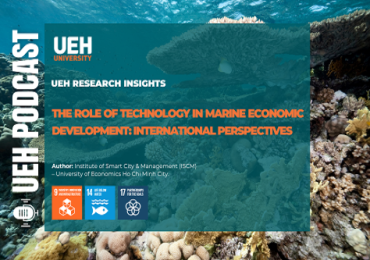
As part of the Ocean Future 2025 conference in Khanh Hoa, the third session focused on innovative, interdisciplinary, and multi-stakeholder approaches to promoting the sustainable development of the Ocean Economy. The discussion emphasized the importance of stakeholder participation, comprehensive governance, and the integration of modern economic models—such as the circular economy, social economy, green finance, and community economy—into marine and coastal development strategies.
Europe and the Lag in Prioritizing Marine Policy: Causes and Accumulated Consequences
Opening the third session, Prof. Giovanni Quaranta and Prof. Rosanna Salvia—two experts from the Department of Mathematics, Computer Science, and Economics at the University of Basilicata (Italy)—shared exemplary European models for promoting a sustainable ocean economy, guided by the principle of “leaving no one behind.”
Although the European Union has been established for nearly 80 years, marine and coastal issues have only been prioritized in the last two decades. This delay stemmed from the fact that coastal areas were not previously considered a policy focus, despite over 40% of Europe’s population living along its 136,000 km coastline. As a result, asymmetries in territorial governance accumulated over time, manifested in increased environmental pressure, undiversified economic structures based on resource extraction, and social challenges for small-scale fishing communities.
Starting with the Community: How the EU is Regenerating a Sustainable Future for its Coastal Regions
Recognizing the long-standing policy gap and its accumulated consequences in coastal areas, the EU has embarked on a journey to regenerate a development future starting from the local communities themselves. The new strategy is built on three core pillars: (1) enhancing the sustainability of the local economy; (2) restoring and conserving marine ecosystems; (3) improving the quality of life for local residents.
In this approach, “innovation” is no longer purely technological but is expanded to include social innovation, emphasizing community participation and centrality. This aligns with the complexity of the marine economic space, where people, livelihoods, and ecosystems are intrinsically linked.
According to the two professors, endogenous development—that is, development based on local resources, values, and knowledge—is the key to long-term sustainable transformation. This requires restoring faith in the community’s capabilities, positioning them as co-creators of solutions rather than mere beneficiaries of policy. The EU’s new direction is a shift towards a neo-endogenous model, where coastal communities are connected in networks to share experiences, support one another, and enhance their resilience to global challenges.

Prof. Giovanni Quaranta and Prof. Rosanna Salvia presenting at the session
From Mediterranean Practices to a New Mindset for Sustainable Marine Development
These analyses were vividly illustrated through practical implementation in Southern Italy, with a project supporting the formation of a social cooperative for local fishermen. The area had previously faced a severe decline in fish stocks, with the average catch dropping from around 200 kg per night to less than 10 kg. The adoption of a co-management model for resources and a shift to sustainable livelihoods marked a clear turning point: the catch recovered to approximately 60 kg per night. This result demonstrates that when communities are empowered to participate in decision-making and co-create solutions, the ecosystem’s recovery capacity can be strongly activated.
The experiences from Mediterranean coastal communities also show that social innovation and strengthened community cohesion only create long-term impact when organically linked to the urban system and inland areas. Multi-stakeholder cooperation mechanisms—between communities, governments, research institutions, and the private sector—are helping the EU gradually bridge its past policy gaps, forming a modern coastal governance model where the sea is viewed not just as a source of livelihood, but also as a space of culture, history, and environmental security.
Overall, the presentation emphasized a new mindset: coastal development can only be sustainable when local communities play a central role throughout the policy cycle of planning, implementation, and monitoring. When this principle is upheld, new solutions can create lasting, widespread, and harmonious value for both coastal communities and the entire marine economic space.
Marine Spatial Planning (MSP) – A Multidisciplinary Tool for Optimizing Resources and Reducing Conflict
In his presentation, Dr. Ho Quoc Thong, Coordinator of the Blue Resources for Development (BlueRforD) Program, provided an overview of Marine Spatial Planning (MSP), a multidisciplinary governance tool being implemented globally. BlueRforD is an international research network of scholars from 9 countries across 3 continents, studying issues related to fisheries and aquaculture, marine spatial structures, and their impacts on poverty reduction, gender equality, and sustainable management of coastal resources.
Dr. Thong emphasized that MSP is a key tool for the efficient use of resources, reducing conflicts of interest, and promoting a green economy, while also shaping the future spatial development of marine areas. This work involves not only resource management but also addressing complex issues such as cross-border cooperation, maritime security, and the “tragedy of the commons.”
Through an analysis of nearly 180 international scientific publications and reports from the World Bank and the United Nations, the research team identified many prominent themes similar to those discussed at the conference, including marine governance, co-creation, policy frameworks, resource management, and technology application. MSP is currently being strongly implemented in Europe, the United States, Australia, and South Africa, while many Asian and African countries still face limitations in data, research capacity, and institutions, highlighting the importance of evidence-based policies tailored to local contexts.
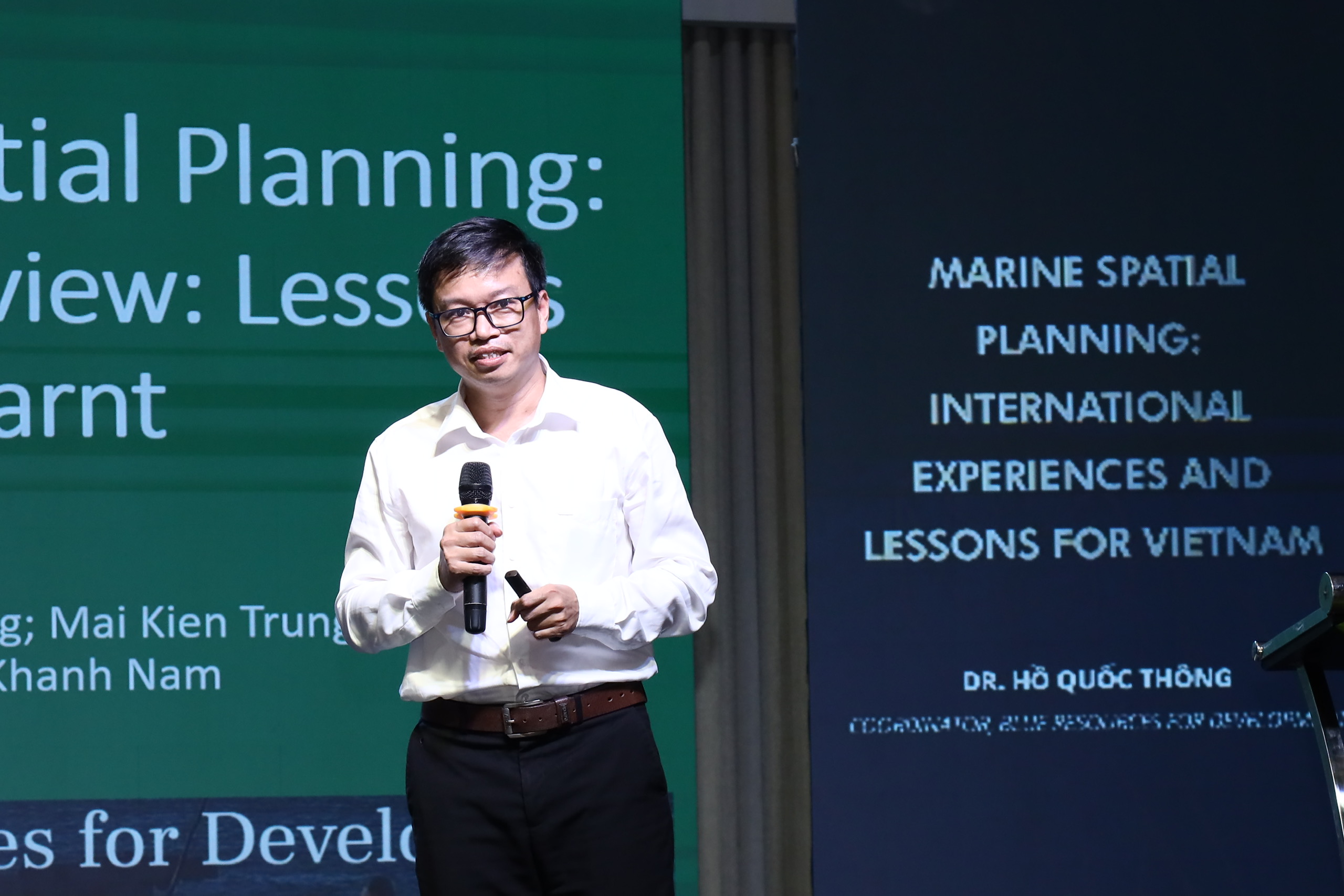
Dr. Ho Quoc Thong, coordinator of the BlueRforD Program, sharing research on MSP
Harnessing Vietnam’s Marine Economic Potential through Strategy and MSP
For Vietnam, Dr. Ho Quoc Thong acknowledged significant progress in refining its policy framework, notably Resolution No. 36 on the Strategy for Sustainable Marine Economic Development. Goals for 2030 include: the marine economy contributing about 10% of GDP, coastal provinces contributing 65–70% of GDP, expanding the area of marine protected areas, reducing conflicts in the use of marine space, protecting ecosystems and cultural-historical values, and strengthening security and sovereignty.
Based on international experience, the team proposed several priority directions for Vietnam and its coastal localities: strengthening early participation and cooperation among stakeholders, valuing indigenous knowledge, developing a unified marine spatial data infrastructure, implementing adaptive planning models, enhancing governance transparency, and training a multidisciplinary workforce in ecology, economics, law, and spatial analysis.
In conclusion, MSP is seen as a dynamic and sustainable governance cycle, operating on scientific evidence and community co-creation. This provides a crucial foundation for Vietnam to effectively harness its marine economic potential and move towards harmonious and sustainable ocean governance in the long term.
From Marine Waste to Green Material: The Potential Application of Seashells
Riley Pham Xuan Quyet, a lecturer at Sunway University (Malaysia) and a Ph.D. in Sustainable Hospitality and Tourism Management from UEH, presented research on the application of seashells in construction and coastal urban development, particularly for hotels and tourism. With approximately 40% of the world’s population living within 100 km of the coast, the demand for coastal infrastructure is rising. However, many “green” constructions still rely on cement and steel—the construction industry accounts for 27% of global CO₂ emissions, with cement alone contributing about 8% (UNEP, 2023).
In this context, seashells—waste from over 10 million tons of seafood annually—emerge as a promising green material. In Vietnam, the large seafood industry provides an abundant source of raw materials for research and application. Seashells are rich in calcium carbonate, mechanically durable, have self-healing properties for cracks, improve thermal insulation, and reduce the need for paint. Models in Japan, the Netherlands, and the Philippines have demonstrated their feasibility in construction and interior design, opening up opportunities to turn marine waste into a sustainable material for coastal development.
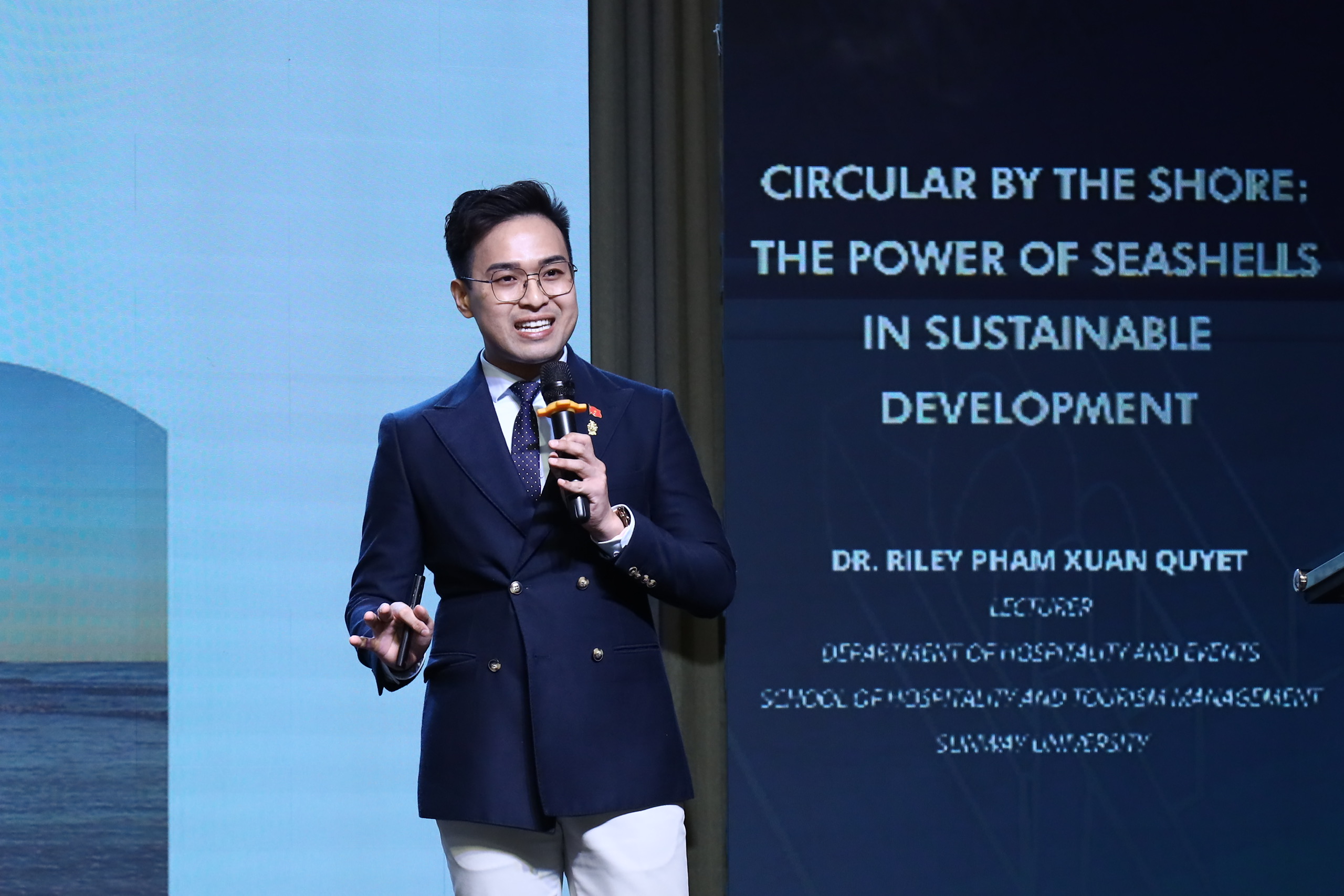
Riley Pham Xuan Quyet discussing the potential of this green material
Seashell Materials in Vietnam: Pilots, Challenges, and a Sustainable Vision
In Vietnam, research proposals are focusing on developing a set of standards for Eco-Hotels using seashell-based materials, along with pilot programs at pioneering coastal hotels and resorts guided by the concept of “smart materials from the ocean.” This approach supports the implementation of the UN’s Sustainable Development Goals: SDG 11, SDG 12, and SDG 14.
However, Dr. Riley also pointed out the challenges Vietnam needs to overcome: issuing technical regulations, developing a collection and processing chain for raw materials, and increasing the construction industry’s readiness to adopt new materials. Multi-stakeholder collaborative projects and interdisciplinary research are key to advancing this application.
In conclusion, Dr. Riley expressed his hope that Vietnam will become a pioneer in recycling seashells for sustainable construction, reducing carbon emissions, and developing an innovative and environmentally friendly coastal tourism model.
Author: Institute of Smart City and Management (ISCM) – University of Economics Ho Chi Minh City.
This article is part of the series spreading research and applied knowledge from UEH with the message “Research Contribution For All.” UEH cordially invites readers to look forward to the next UEH Research Insights newsletter.
News, photos: Authors, UEH Department of Communications and Partnerships
 Chia sẻ:









[Podcast] Recommendations for University education development
14 February, 2025


[Podcast] Developing Vung Tau into a World-Class Tourism City
16 January, 2025


[Podcast] Postdigital Design Strategies for Media Art
6 January, 2025


[Podcast] NFTs – Artistic Innovation or Just a New Hype?
27 December, 2024


[Podcast] Boosting Employee Creativity with Constructive Feedback
23 November, 2024


[Podcast] “Dutch Disease” in Remittances and the Case of Vietnam
4 November, 2024


[Podcast] Latest approaches for sustainable universities
11 July, 2024


Data Law – Part 1: Necessity for a New Approach
18 May, 2024

Advertising Evaluation on Tiktok Platform
14 May, 2024

[Podcast] Advertising Evaluation on Tiktok Platform
13 May, 2024


Promoting Learner Autonomy in English Language Learning (Part 1)
24 November, 2023


ArtTech And Sustainable Development
27 October, 2023

Motivation of EFL Vietnamese Students in Economics-related Majors
12 October, 2023
Climate Change And Our Society: The Urgency Of Gender Inequality
12 October, 2023



People Analytics in Vietnam
10 March, 2022




Revolution in Experimental Economics
30 January, 2022

The Sharing Economy: Governance Issues in Vietnam
24 January, 2022
Employment Policy For Ho Chi Minh City in Post-social distancing Period
28 December, 2021

Lifelong learning at UEH: Towards a Sustainable University
28 December, 2021
Building a Decentralized Stock Market based on Blockchain Technology
24 December, 2021


Consumer price index from big data mining perspective (Big data)
17 November, 2021

Overview Of Digital Currency – Part 5: DIEM Private Stabilized Currency
11 November, 2021