[Research Contribution] 10 Global Career Trends Shaping the 5.0 Era – Part 1
7 July, 2025
“A myriad of careers”, “old careers disappear, new careers arise”, “AI as a companion” – these phrases clearly outline the labor market in the 5.0 era. Live Talk 02 with the theme “10 global career trends shaping the 5.0 era – Part 1” by University of Economics Ho Chi Minh City (UEH) will provide an overview of career shifts in Vietnam and the world, supporting parents and students to better understand the labor market, thus proactively building a sustainable career path in the digital transformation era.
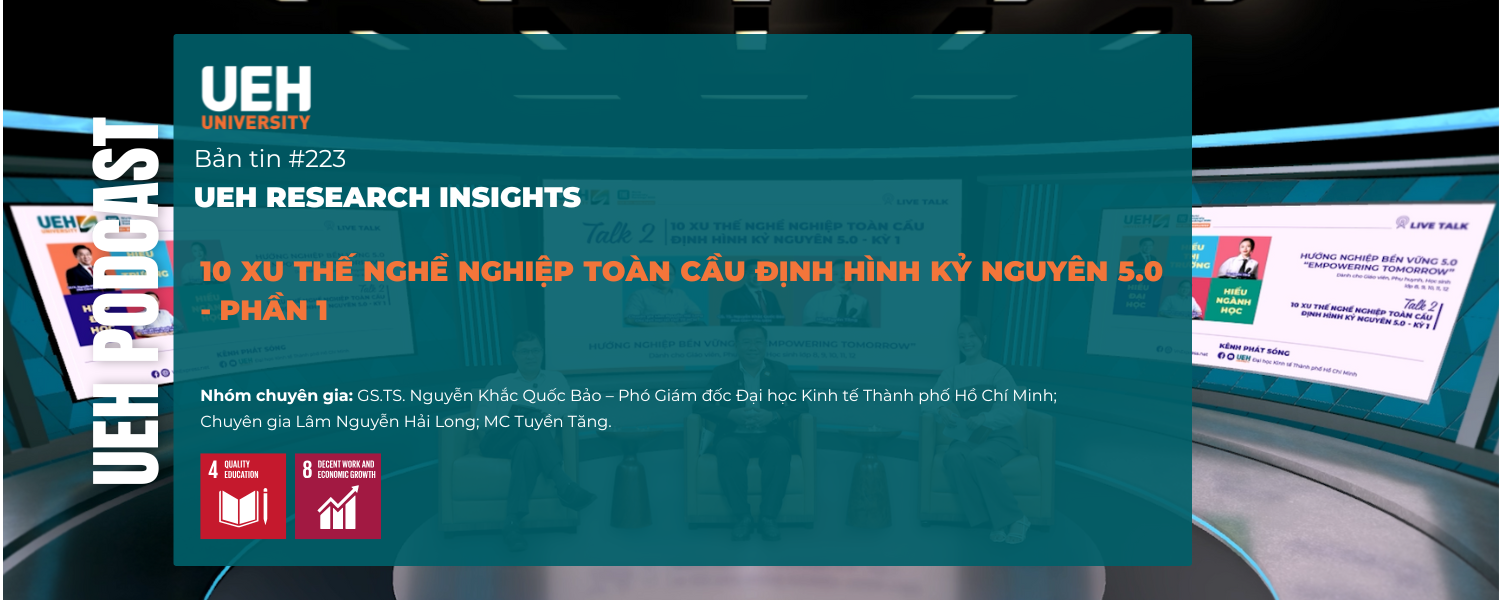
Live Talk 02 features leading experts with rich experience in the fields of education and technology: Prof. Dr. Nguyen Khac Quoc Bao – Vice President of University of Economics Ho Chi Minh City, Mr. Lam Nguyen Hai Long – Chairman of Ho Chi Minh City Information Technology Association, and MC Tuyen Tang.
Thousands of jobs – An overview of jobs in Vietnam & the world
MC Tuyen Tang: Era 5.0 – the era of a super-smart society is something that will happen and the time frame is determined very soon: 2035 or maybe earlier. “The rise of a series of super technologies” – “Enhancing human-machine interaction” – “putting humans at the center” are the “hot” keywords when referring to this period. So how is the big picture of the labor market in the world and in Vietnam – from the past to the present – changing?
Mr. Lam Nguyen Hai Long: If we look back at recent years, we have witnessed a trend of choosing a career in the direction of specialization, that is, developing from a core major, then expanding into related fields. For example, people working in e-commerce will often develop additional skills in digital marketing, image design, or online sales skills.
However, in the current stage, career trends are shifting strongly towards being leaner, more multi-tasking, and requiring faster work implementation speed.
For example, in the agricultural sector, farmers used to focus on production and harvesting. But today, with the support of digital technology, they can actively promote, livestream, and sell products directly to consumers through online platforms. This shows that the links in the professional value chain are being shortened, optimized, and integrated much more effectively than before.
In particular, a new factor that is creating revolutionary changes is artificial intelligence – AI . I call AI a “companion” – a powerful catalyst not only in the labor market, but also spreading deeply into education, health care, finance and many other fields.
In Vietnam, the impact of digital technology in general, and AI in particular, is becoming increasingly evident, promising to bring about fundamental changes to the occupational structure and labor skills in the near future.
Of course, as new technology emerges, there will always be concerns: Will AI eliminate jobs? Are current training programs still relevant?
In fact, if we look back at the history of industrial revolutions, from the first to the fourth, we see similar concerns. However, what has been proven is that while some old careers disappear, many new ones are simultaneously created, and the overall size of employment continues to increase.
I am confident that the number of new job opportunities created by AI will be greater than the number of jobs that will be replaced. After all, AI and digital technology are just supporting tools, while humans are the ones who have the power to decide and create in all fields.
Finally, I would like to share three prominent trends that are and will continue to shape the labor market:
- Green transformation and digital transformation are two irreversible parallel processes. If we do not adapt in time, it is easy to be left behind.
- The rise of new technologies, including artificial intelligence, the Internet of Things (IoT), Big Data, and soon, disruptive technologies like Quantum Computing, will have a profound impact on the workforce, especially young people who are preparing to enter the job market.
- The key to survival and development in the new context is flexibility and adaptability. Whether in a technological or non-technological environment, those who are more flexible and adaptable will have more opportunities in this era of constant change.
Three pillars of career orientation: Understand yourself – Understand the market – Understand university education
MC Tuyen Tang: Prof. Dr. Nguyen Khac Quoc Bao, from the perspective that Mr. Hai Long just shared – especially the story about “active understanding” – what advice do you want to send to parents, students, and new graduates in the context of many changes and predictions about future careers?
Prof. Dr. Nguyen Khac Quoc Bao: First of all, I would like to express my appreciation and respect for the insightful sharing from Mr. Lam Nguyen Hai Long. Indeed, we are living in a world where the structure of occupations is constantly expanding, intertwining and changing in an interdisciplinary and multidisciplinary direction, reflecting the inevitable development trend of the intellectual economy and modern society.
When it comes to career orientation and choosing a major, a popular saying is: “The career chooses the person, not the person chooses the career.” This saying reflects a somewhat passive notion that people should follow nature, let the flow of the labor market lead them, and then find a suitable job themselves.
However, in the modern context – as MC Tuyen Tang has just emphasized – the key word that we need to keep in mind is “proactivity”. When faced with a market with a myriad of careers, if there is a lack of initiative, learners can easily choose the wrong direction. The result is a waste of time, resources, and more importantly, the development potential of each individual.
I really appreciate the core idea of the program – the three “UNDERSTANDINGS”:
(1) Understanding yourself: This includes clearly identifying your strengths, weaknesses, interests and personal values. However, understanding yourself is not always easy. In many cases, parents play an extremely important role in guiding and sharing objective perspectives so that students can identify themselves more clearly. Experience from the admissions consulting process shows that many students initially choose a major based on their temporary interests, but later realize that advice from their parents is the factor that helps them find the right direction.
(2) Understanding the market: In economics, this is the assessment and forecasting of social needs, i.e. the “demand side”. What to study and what to do should not only come from passion, but also need to consider the ability to meet the actual needs of the labor market in the near future.
(3) Understanding training institutions: In other words, the “supply side” – the place where human resources are trained and supplied. Thoroughly understanding the majors, training programs, learning models and business partnerships will help students choose a suitable educational institution that has the ability to connect well with the market.
These are three fundamental pillars that, in my opinion, if parents and students invest time and mind to seriously learn, choosing a career and choosing a school will no longer be an emotional decision, but will become a carefully considered strategy.
| “ Choosing a career is not a test that can be re-done. If you choose wrongly, the lost opportunity cost will be huge. Therefore, I hope that students will really consider, be proactive, and have the right direction to enter a stable and sustainable career journey.”
Prof. Dr. Nguyen Khac Quoc Bao |
Entering the 5.0 Era: Understanding Yourself is the Key to Not Being Left Behind
MC Tuyen Tang: Continuing to discuss in more depth a topic that is currently attracting a lot of attention and debate, which is the super-intelligent era 5.0 Prof. Bao, if we were to summarize that picture in the most concise way to help parents, teachers, and students from middle school to high school easily visualize and access it, what key elements of the era would you emphasize?
Prof. Dr. Nguyen Khac Quoc Bao: First of all, when mentioning the concept of “era 5.0”, I have a rather simple explanation. That is, after the industrial era 4.0 that we are experiencing, the next development will be 5.0 – the next step in the technological evolution chain. People call this the era of “super intelligence” because based on current practical observations, artificial intelligence (AI) is exploding strongly at an unprecedented speed, and especially the extensive application of AI in most areas of life and production. From there, people make predictions that in the future, AI will continue to develop rapidly, forming a period in which super intelligence technology becomes a characteristic.
However, I would like to pose a counter-question for us to ponder: When we were still living in the 3.0 era, could we accurately imagine what the 4.0 era would be like? I think not. Although the Internet has been around for decades, no one at that time could have imagined that the Internet of Things (IoT) would become one of the core pillars of the 4.0 era. Therefore, current predictions about 5.0 are still just predictions – they help us orient ourselves, but they do not necessarily reflect the reality of the future.
The problem is that, in the current context, students – especially grade 12 students – are facing too much pressure: from studying for graduation exams, to choosing a major, choosing a career, and then adding to that are warnings about AI replacing humans, about an uncertain future in the era of super intelligence. In my opinion, the best thing you can do at this time is: prepare as well as you can .
Specifically, study seriously, review carefully, and most importantly, systematically learn from personal interests and abilities to the needs of the labor market and the training capacity of universities, and consulting with parents, teachers, and relatives are extremely important. On that basis, students can make appropriate and correct decisions.
I believe that when a person chooses a job that suits their abilities and passions, that job is no longer simply a means to make a living, but becomes a place for them to express their aspirations, dedication and joy of life. And I always believe that humans will always win over machines, because humans have emotions, feelings, and passions – things that machines cannot replace. It is these qualities that make up a person’s unique identity and are the most powerful weapons to help people avoid being eliminated, regardless of the 4.0, 5.0 era or even beyond.
In other words, if today’s students truly understand themselves, choose the right path, nurture their passion and proactively study and practice, they can completely adapt, develop and succeed in any technological context. Because, ultimately, technological evolution is to serve people, helping people live better, happier at lower costs and with more complete experiences.
In economics, we call such comprehensive fluctuations systemic risk, which means changes that the whole society must adapt to and be affected by. But if you are outstanding individuals in that system, you will certainly not be eliminated. Whether 5.0 or 6.0, capable, proactive and passionate people will always find opportunities to survive, to develop and to succeed.
“Fast and Responsive” – The factor that makes the difference in the era of super intelligence 5.0
MC Tuyen Tang: Back to a topic that is still controversial – “The era of super intelligence 5.0”. As Prof. Bao has commented, this era has not yet really taken shape clearly. We are building many scenarios and hypotheses about it, but most of them are still initial images.
So from the perspective of someone working in the technology field – Mr. Lam Nguyen Hai Long, what personal opinions and advice can you share for students and parents in the context of a diverse and uncertain future like today?
Expert Lam Nguyen Hai Long: I completely agree with the viewpoint that Mr. Bao just shared. Before giving any advice, I would like to share a small true story from my personal experience.
I graduated from university in 1997 – the year the Internet first appeared in Vietnam. At that time, the Internet was still a very vague concept for most students and professionals. People discussed a lot about the future of the Internet, but none of us really had a clear picture of how the Internet would change our lives. Information at that time was both scarce and confusing – people said that the Internet contained both good and bad things. The ability to access and analyze information was limited.
However, if we look back at the development of the Internet to this day, we can see a clear path: initially it was IoP – Internet of People , which connects people to the Internet. Then it was IoT – Internet of Things , when the Internet expanded to connect devices and machines. And now, we are entering a new phase – Internet of Everything – where everything, not just machines but also systems, infrastructure, sensors and data, are connected.
However, we – those working in the industry – have only just begun to imagine it, and cannot say we fully understand it.
Therefore, my first advice is to move from a defensive stance to a proactive stance. If in the past, technology came too quickly, making us passively approach it, now we – especially students – have in our hands a lot of tools, data and knowledge to proactively learn and prepare for the future.
I often emphasize two important keywords for this context, which are: “fast” and “responsive” .
- “ Fast ” reflects the speed of change in the times. Everything is moving at breakneck speed – from learning, working, to the way we receive information. We cannot remain stagnant in a world that is changing every hour.
- But being “fast” is not enough , we also need to be “sensitive” – the ability to adapt, react and transform in a constantly changing environment.
I divide this concept of “sensitivity” into four levels :
(1) Be sensitive to recognize the trends of the times: Knowing what is coming, what is emerging, what is changing.
(2) Sensitive to grasp: Once recognized, we need to quickly approach, understand clearly and evaluate accurately.
(3) Be adaptable: Proactively adjust yourself to new environments. Even I – a member of the previous generation – am learning how to use AI tools to support my work.
(4) Sensitive to change: Not only adapt, but also proactively innovate to better suit the flow of technology and society.
In short, in the era of super intelligence 5.0, the difference no longer comes from who is better, but from who is more agile and adapts faster to changes.
These are some personal shares that I hope will be useful to students and parents who are accompanying their children in the challenging but also full of opportunities period ahead.
This article is part of the series spreading research and applied knowledge from UEH with the message “Research Contribution For All – Research for the Community”. UEH cordially invites readers to the next UEH Research Insights newsletter.
___________________________
The Sustainable Career Orientation 5.0 Live Talk Series “Empowering Tomorrow” organized by University of Economics Ho Chi Minh City – UEH, broadcast on UEH and VnExpress is a project that accompanies parents and students through connecting 3 aspects in the career selection journey of the young generation: (1) Understanding personal career inclinations; (2) Understanding future trends in the 5.0 era; (3) Understanding educational trends of the 5.0 world. With the 3 “Understandings”, students will be able to choose the right major and be “satisfied with their choice”.
News and photos: UEH Department of Communications and Partnerships

 Chia sẻ:



[Research Contribution] Co-innovating for a Sustainable Ocean Economy
12 December, 2025






[Podcast] Recommendations for University education development
14 February, 2025


[Podcast] Developing Vung Tau into a World-Class Tourism City
16 January, 2025


[Podcast] Postdigital Design Strategies for Media Art
6 January, 2025


[Podcast] NFTs – Artistic Innovation or Just a New Hype?
27 December, 2024


[Podcast] Boosting Employee Creativity with Constructive Feedback
23 November, 2024


[Podcast] “Dutch Disease” in Remittances and the Case of Vietnam
4 November, 2024


[Podcast] Latest approaches for sustainable universities
11 July, 2024


Data Law – Part 1: Necessity for a New Approach
18 May, 2024

Advertising Evaluation on Tiktok Platform
14 May, 2024

[Podcast] Advertising Evaluation on Tiktok Platform
13 May, 2024

Promoting Learner Autonomy in English Language Learning (Part 1)
24 November, 2023



ArtTech And Sustainable Development
27 October, 2023

Motivation of EFL Vietnamese Students in Economics-related Majors
12 October, 2023
Climate Change And Our Society: The Urgency Of Gender Inequality
12 October, 2023







People Analytics in Vietnam
10 March, 2022




Revolution in Experimental Economics
30 January, 2022

The Sharing Economy: Governance Issues in Vietnam
24 January, 2022
Employment Policy For Ho Chi Minh City in Post-social distancing Period
28 December, 2021

Lifelong learning at UEH: Towards a Sustainable University
28 December, 2021
Building a Decentralized Stock Market based on Blockchain Technology
24 December, 2021

Consumer price index from big data mining perspective (Big data)
17 November, 2021

Overview Of Digital Currency – Part 5: DIEM Private Stabilized Currency
11 November, 2021