

14.3.3. Maintain ecosystems and their biodiversity (direct work)
Work directly (research and/or engagement with industries) to maintain and extend existing ecosystems and their biodiversity, of both plants and animals, especially ecosystems under threat
UEH advances applied research and community partnerships to conserve and restore coastal ecosystems, mangrove forests and biodiversity.
The University of Economics Ho Chi Minh City (UEH) conducts applied research and works directly with local governments, international organisations, businesses and communities to maintain, restore and enhance natural ecosystems, particularly those under pressure from climate change, environmental degradation and unsustainable resource extraction. Its work focuses on coastal mangroves, riverine landscapes and wetlands, linking biodiversity conservation with community livelihoods and climate resilience.
In 2025, UEH undertook direct research and conservation collaboration through the international Women4Mangrove project in Cu Lao Dung in the Mekong Delta. Beyond serving as the lead institution, UEH and its partners carried out field assessments in Cu Lao Dung and An Thanh, consulted local communities, engaged with authorities and identified environmental safeguards for a mangrove conservation model connected to sustainable livelihoods. These 2025 activities laid the groundwork for the project’s 2025–2026 objectives: restoring five hectares of Sonneratia caseolaris mangroves, establishing a nursery and strengthening community capacity to manage and protect coastal ecosystems. In parallel, UEH worked with Khanh Hoa Province on design research proposing ways to conserve and restore the ecological landscape along the Cai River, contributing scientific evidence for sustainable river ecosystem management.
- Description of direct activities
UEH engages in direct work to maintain and extend existing ecosystems and their biodiversity, particularly in areas vulnerable to degradation.
Two main approaches guide the activities:
- Scientific research and ecosystem restoration: Conducting applied research, developing nature-based solutions, designing mangrove conservation models and proposing the restoration of river and wetland ecosystems.
- Direct collaboration with local authorities and stakeholders: Working with governments, international organisations, communities and development partners to design and implement conservation solutions that link ecological restoration with sustainable livelihoods.
These efforts aim to protect native vegetation, preserve natural habitats, reduce pressures on threatened ecosystems and support biodiversity conservation.
- Objectives and partners
Objectives: Maintain and restore natural ecosystems, particularly mangroves and riverine habitats; advance applied research for biodiversity conservation; strengthen climate resilience; and connect environmental protection with sustainable livelihoods for local communities.
Partners and beneficiaries: Local governments, natural resource and environmental authorities, international organisations, research institutes, universities, businesses, community organisations and residents in areas where ecosystems require protection or restoration.
- Institutional framework and implementation resources
UEH integrates research, ecosystem conservation and community partnerships into its strategy to become a multidisciplinary and sustainable university. This work is supported by the Green Campus Regulations, the university’s research capacity and its established partnerships with local stakeholders.
| Supporting framework | Relevant provisions or activities | Role in indicator 14.3.3 |
| UEH Green Campus Regulations | Guide environmental research, practical environmental solutions and responsibility for ecosystem protection. | Provide an institutional foundation for research and conservation activities. |
| UEH interdisciplinary research | Integrates economics, environmental studies, natural resource management, urban planning and community development. | Supports the investigation of ecosystem degradation and the development of restoration proposals. |
| Partnerships with local governments and international organisations | Enable collaboration on identifying local challenges, conducting applied research and engaging communities. | Help translate research into specific conservation projects and models. |
Sources:
UEH Green Campus Regulations: https://gogreen.ueh.edu.vn/quy-dinh-thuc-hanh-dai-hoc-xanh
UEH research activities: https://future.ueh.edu.vn/nghien-cuu/
- Evidence of direct research and collaborative activities in 2025
4.1. Key projects and activities
| No. | Programme / project | Type of work | Direct activities and contributions | Photographs and captions | Evidence sources | SDGs |
| 1 | Women4Mangrove – Direct work on mangrove ecosystem conservation in Cu Lao Dung (2025–2026) | International applied research; ecosystem restoration; community partnership | Led by UEH and funded through the SEA Grants programme under the GEF/UNEP/UNOPS initiative, Women4Mangrove focuses on conserving and restoring coastal mangroves in Cu Lao Dung, especially Sonneratia caseolaris. Mangroves protect shorelines and provide habitats for aquatic species. In 2025, the project team undertook field assessments in Cu Lao Dung and An Thanh, consulted residents on their needs and willingness to participate, and worked with authorities to identify environmental safeguards and stakeholder responsibilities for community-based conservation and educational agritourism. On 10 December 2025, UEH and local authorities held a project launch and stakeholder consultation, sharing field findings and discussing subsequent conservation activities. The 2025–2026 goals include restoring five hectares of mangroves, establishing a seedling nursery, providing planting training and developing alternative livelihoods. These are planned outcomes, not five hectares already restored in 2025. UEH’s direct contribution in 2025 comprised field investigation, engagement and groundwork for ecosystem conservation. | 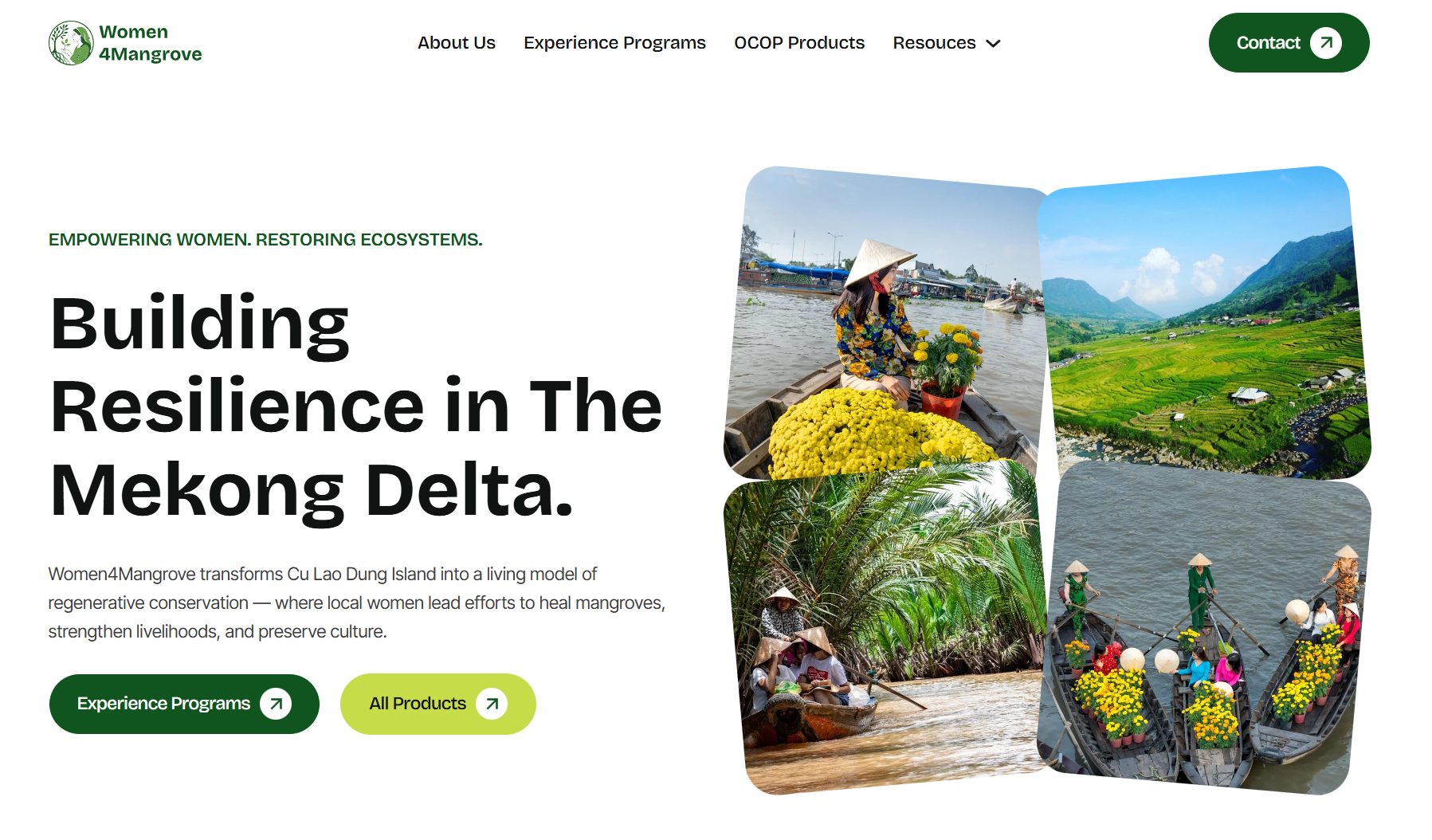 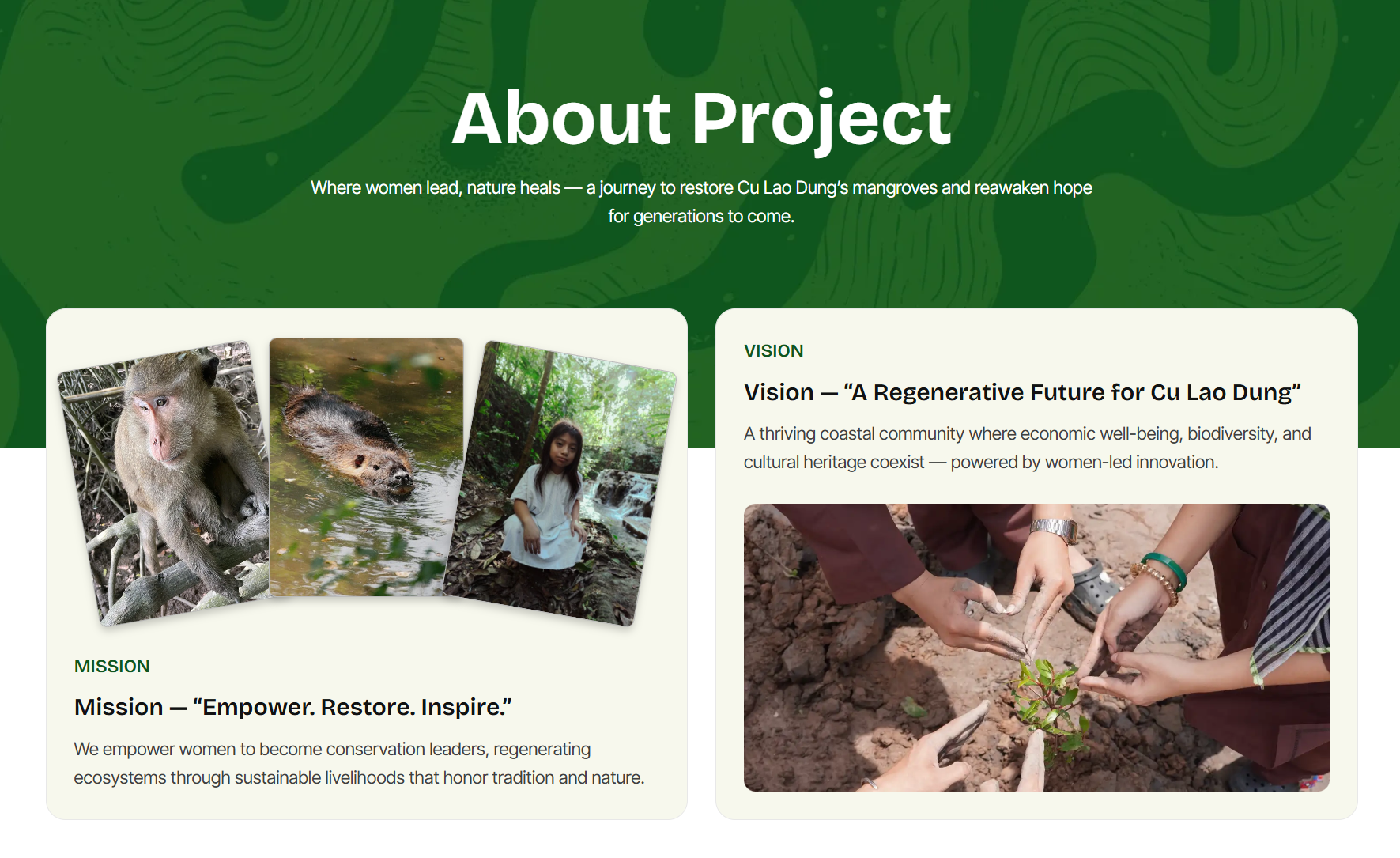 Women4Mangrove project: mangrove landscape and project team representatives. |
UEH, 20 December 2025:
UEH, 30 November 2025: Can Tho Newspaper, 15 December 2025: |
SDGs 5, 13, 14, 15, 17 |
| 2 | Fourth International Design Competition – Cai River Ecosystem Restoration Design, Khanh Hoa (March–October 2025) | Design research; government collaboration; ecological restoration proposals | Through its Institute of Smart City and Management (ISCM) and UEH Nexus Campus Nha Trang, UEH collaborated with the Khanh Hoa provincial authorities on a design competition for the Cai River area. The competition attracted more than 500 participants in 160 teams from 25 countries. Proposals explored restoration of riverside ecosystems, transformation of low-lying areas into ecological spaces, improved green-space connectivity and climate adaptation. The design research offered potential measures to safeguard river habitats and restore ecological functions, informing sustainable river landscape planning. The work comprised research and design proposals in 2025, not completed restoration on the ground. | 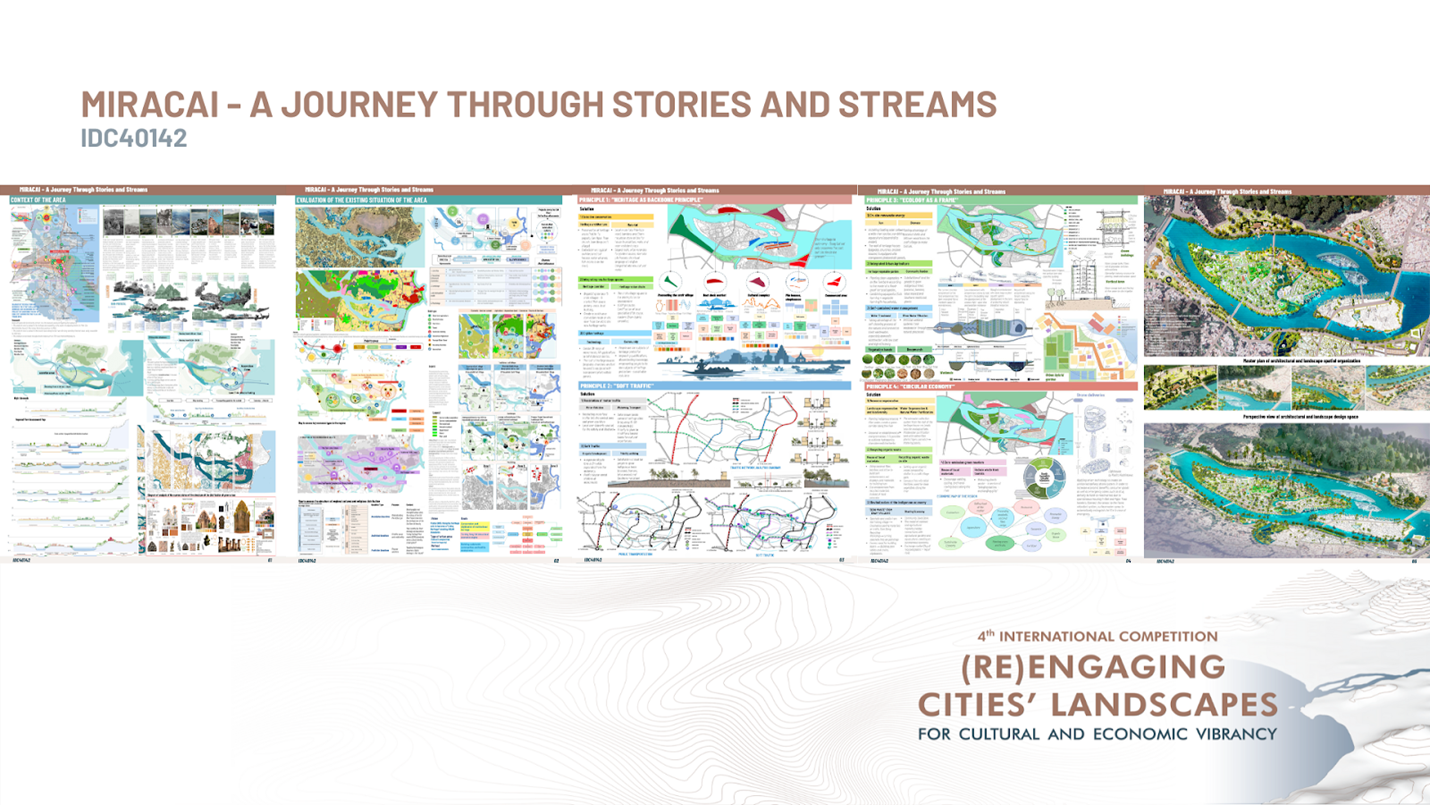
Design proposals for restoration of the Cai River ecosystem. |
https://www.ueh.edu.vn/ueh-nexus-nha-trang/cuoc-thi-thiet-ke-quoc-te-lan-4-cung-duong-di-san-ven-song-cai-tinh-khanh-hoa-5-du-an-thiet-ke-xuat-sac-khang-dinh-lai-vai-tro-cua-song-cai-trong-tuong-lai%C2%A0-75066 | SDGs 11, 13, 14, 15, 17 |
| 3 | Research on fisheries management and regulatory compliance in Tam Giang Lagoon | Scientific research; fisheries management; aquatic resource conservation | Research reported in UEH’s sustainable fisheries evidence examines non-compliance with fisheries regulations, including the use of nets with undersized mesh. Findings provide a scientific basis for considering measures to reduce fishing pressure and sustain the reproductive capacity of aquatic populations in lagoon ecosystems. The source document does not establish a separate 2025 direct biodiversity restoration intervention. | https://future.ueh.edu.vn/1422-ngu-nghiep-ben-vung-tiep-can-cong-dong/ | SDGs 12, 14, 15 | |
| 4 | Blue Resources for Development (BlueRforD) – Sustainable fisheries and marine spatial planning research (2025) | Applied fisheries research; marine resource governance; field research; ecosystem conservation collaboration | In 2025, UEH researchers participating in EfD-Vietnam/EEPSEA contributed to BlueRforD research on fisheries, aquaculture and sustainable use of marine resources. The paper “Understanding Non-compliance with Rights-based Fisheries Management in Vietnam”, published on 2 May 2025, examined non-compliant fishing behaviour using randomised response techniques, direct surveys and logistic regression, identifying factors affecting regulatory compliance. These findings can inform policies reducing pressure on aquatic resources. At Ocean Futures 2025, Dr Ho Quoc Thong (UEH/EfD-Vietnam) presented a marine spatial planning review covering over 110 international studies and 50 policy documents, addressing competing resource uses and the protection of marine and coastal ecosystems. These activities provide research evidence supporting ecosystem management, rather than verified physical restoration. | 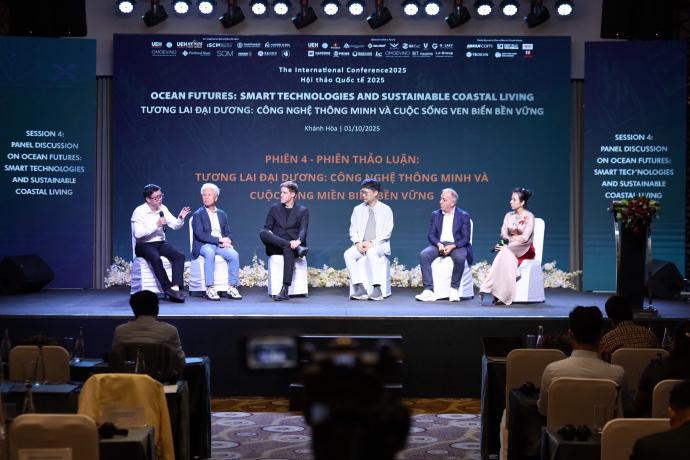
Dr Ho Quoc Thong discusses and presents marine spatial planning research. |
UEH Portal, retrospective published 30 January 2026:
EfD, 2025 discussion paper: EfD-Vietnam, 7 October 2025: UEH Future research contribution: |
SDG 14, SDG 17 and related goals |
| 5 | Research on coastal ecosystems in disaster risk management | Scientific research; ecosystem management; climate adaptation | Research referenced in UEH’s previous sustainable fisheries evidence investigated the protective role of coastal ecosystems in reducing disaster risks and improving community resilience in Vietnam and India. The findings may inform conservation planning. Publication year, authorship and direct work specifically maintaining biodiversity require further verification. | https://future.ueh.edu.vn/1422-ngu-nghiep-ben-vung-tiep-can-cong-dong/ | SDGs 13, 14, 15 | |
| 6 | Research collaboration on sustainable clam ecosystem management in Ben Tre | Applied research; fisheries cooperative collaboration; ecosystem management | UEH previously documented research and direct engagement with Dong Tam Fisheries Cooperative in Ben Tre concerning sustainable clam ecosystem management. This work explored relationships among harvesting, community livelihoods, aquatic resources and climate change. It is retained as historical collaboration; no source provided confirms a specific continuation in 2025. | https://future.ueh.edu.vn/1433-duy-tri-he-sinh-thai-va-da-dang-sinh-hoc-cong-viec-truc-tiep/ | SDGs 8, 12, 14, 17 | |
| 7 | Ocean Futures 2025, Khanh Hoa – Research collaboration on marine conservation technologies | Applied research; local government collaboration; ocean technologies; marine ecosystem management | On 1 October 2025, UEH, through ISCM and UEH Nexus Campus Nha Trang, collaborated with Khanh Hoa Province to organise the international Ocean Futures 2025 conference. Associate Professor Dr Trinh Tu Anh presented findings from the proposal to establish a National Ocean Technology Research Centre, commissioned by the provincial authorities. Discussions covered remote sensing, artificial intelligence, marine robotics, satellite monitoring, marine spatial planning and nature-based solutions. The event supported scientific and technological capacity for marine and coastal ecosystem management; it should not be represented as completed conservation works. | 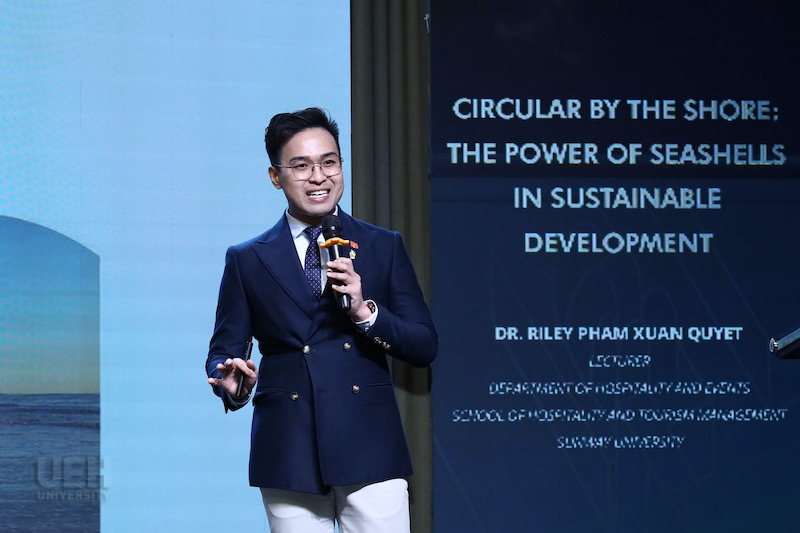 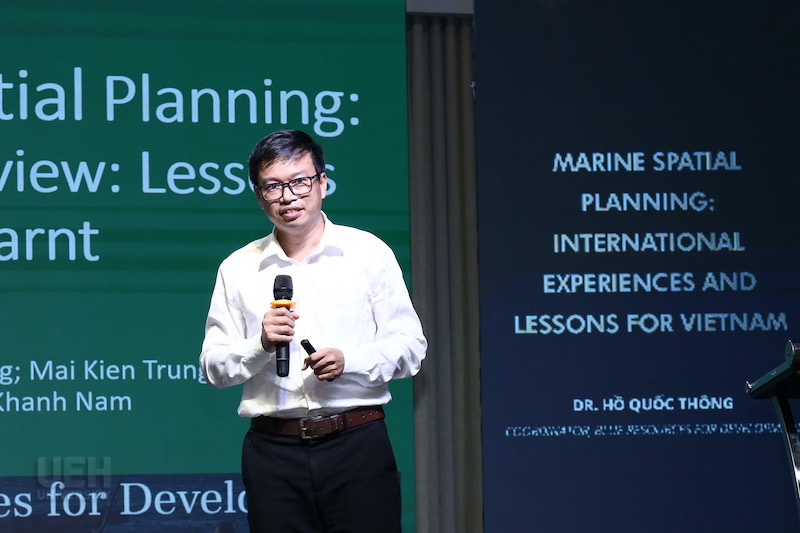 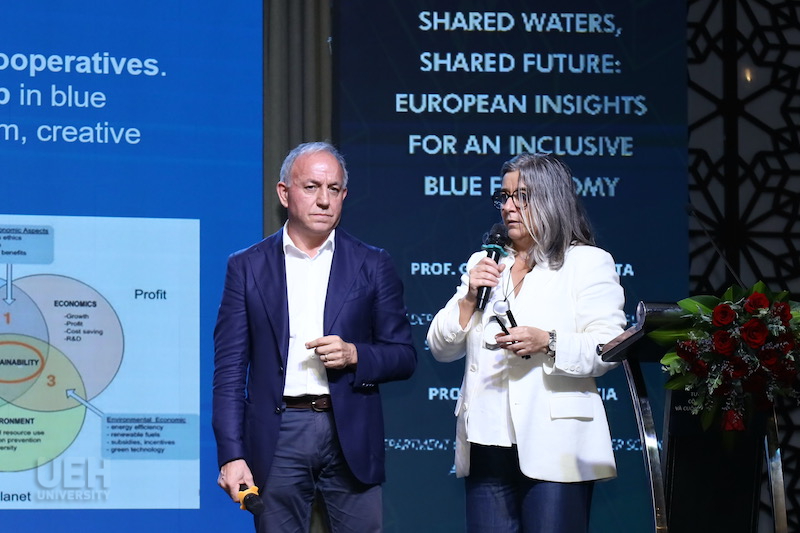
Speakers presenting at the Ocean Futures 2025 conference. |
https://www.ueh.edu.vn/khoa-hoc/hoi-thao-quoc-te-tuong-lai-dai-duong-2025-tai-khanh-hoa-cong-nghe-thong-minh-va-cuoc-song-ven-bien-ben-vung–74916 | SDGs 9, 13, 14, 17 |
| 8 | Ecological-layer development strategies for the northern Cam Ranh Peninsula, Khanh Hoa (2025) | Applied research; field surveys; ecological mapping; sustainable coastal urban planning | In 2025, UEH published the applied research thesis “Development Strategies for Different Ecological Layers in the Northern Cam Ranh Peninsula, Khanh Hoa” by Nguyen Thi Cam Dung, supervised by Dr Nguyen Minh Quang, in its Executive Master’s programme in Smart and Innovative Urban Management. Focusing on Cam Hai Dong, Cam Lam, Khanh Hoa, the study examined coastal ecosystems under urbanisation, climate change and competing land uses. Using ecological mapping methods associated with Ian McHarg and field surveys, it assessed natural conditions and development pressures. Findings inform planning approaches intended to conserve coastal habitats and minimise adverse ecosystem impacts. They do not document completed ecological restoration. | Nguyen Thi Cam Dung, “Development Strategies for Different Ecological Layers in the Northern Cam Ranh Peninsula, Khanh Hoa”, UEH, 158 pages: | Not specified in source |
- Conclusion
In 2025, UEH continued contributing research and direct collaboration to maintain and conserve aquatic ecosystems and biodiversity, particularly in areas exposed to climate change and pressure on natural resources. The Women4Mangrove project stands out for its field assessments, community engagement and preparatory work for mangrove restoration in Cu Lao Dung. Other contributions include BlueRforD research on sustainable fisheries and marine resource governance and ecological landscape design research for the Cai River in Khanh Hoa, which proposed approaches to habitat protection and riverine ecological functions.
By working with governments, communities and international partners, UEH helped build scientific and practical foundations for protecting existing ecosystems, reducing pressure on aquatic resources and sustaining biodiversity. These efforts demonstrate the university’s involvement in direct work to maintain ecosystems and their biodiversity, supporting SDG 14 – Life Below Water.