

14.5.4 – Collaboration for shared aquatic ecosystems
In 2025, the University of Economics Ho Chi Minh City (UEH) continued to foster collaboration with local authorities, communities, and professional partners to protect and sustain shared aquatic ecosystems, linking nature conservation with sustainable livelihoods. Building on the Green Campus Regulations issued under Decision No. 2059/QD-DHKT-CSVC, UEH implemented the Women4Mangrove project in Cu Lao Dung, coordinating field surveys, community consultations, and the development of coastal mangrove conservation approaches. UEH also collaborated with the Khanh Hoa Provincial People’s Committee through the Fourth International Design Competition to develop proposals for restoring the Cai River ecosystem and protecting wetlands. These initiatives demonstrate UEH’s role in connecting knowledge, mobilising local participation, and jointly developing solutions to protect aquatic ecosystems in pursuit of sustainable development.
- Strategic direction
In 2025, UEH promoted collaboration with local governments, communities, and specialist partners to protect, maintain, and sustainably use shared aquatic ecosystems, including rivers, canals, wetlands, estuaries, and coastal mangrove forests. Through field research, community consultations, and the development of conservation solutions, UEH connected scientific knowledge with local needs to support biodiversity protection, climate change adaptation, and sustainable livelihoods.
Collaboration focused on two main areas:
- Community-based ecosystem conservation: Jointly conducting surveys, identifying environmental issues, consulting residents, and developing solutions to protect mangrove forests and water resources alongside local livelihoods.
- Research and development of ecological restoration solutions: Collaboratively developing proposals for wetland protection, river landscape restoration, and climate change adaptation that reflect the ecological conditions of each locality.
Participants included local authorities, residents, women and livelihood groups, social organisations, experts, and research institutions. UEH played a coordinating and technical-support role in organising partnerships, while stakeholders helped identify needs, contribute local knowledge, and co-develop solutions for protecting shared aquatic ecosystems.
- Internal commitments and supporting policies
To institutionalise its Green University development approach, on 5 July 2023 UEH issued Decision No. 2059/QD-DHKT-CSVC on the Green Campus Regulations, applicable across UEH campuses and the Vinh Long branch. The regulations establish responsibilities for UEH, its constituent units, and the university community in resource efficiency, environmental protection, research, and community engagement. Based on the policy introduced in 2023, UEH continued its implementation throughout 2023–2025, while maintaining mechanisms to review and improve the regulations in response to sustainability needs in subsequent phases.
Article 12, Clause 1 – UEH is responsible for organising, implementing, and continuously evaluating the Green Campus Project for 2023–2025 across five pillars: Education; Research; Operations; Governance; and Community Engagement. In addition, Article 12, Clause 9 establishes responsibility for receiving feedback and improving the Green Campus Regulations over time to ensure that activities remain relevant and effective.
Article 13, Clause 7 sets out an approach to piloting direct collaboration programmes between UEH’s specialised units and local communities to maintain shared aquatic ecosystems. It assigns the units responsibility for:
- Organising education, training, and knowledge-transfer programmes for fishers, cooperatives, tourism businesses, and community groups on sustainable fisheries management, aquaculture, and tourism;
- Maintaining documents, photographs, participation figures, and outcome reports to track collaborative activities;
- Periodically reporting on the UEH Green Campus Project to consolidate and evaluate impacts and inform programme improvements.
In addition, Article 13, Clause 6 encourages units to conduct research addressing issues associated with the Green Campus initiative. Article 14, Clauses 3–5 emphasise communication, research participation, and contributions to improvement by the UEH community. Together, these provisions support linking the University’s academic capacity with local conservation and natural-resource management needs.
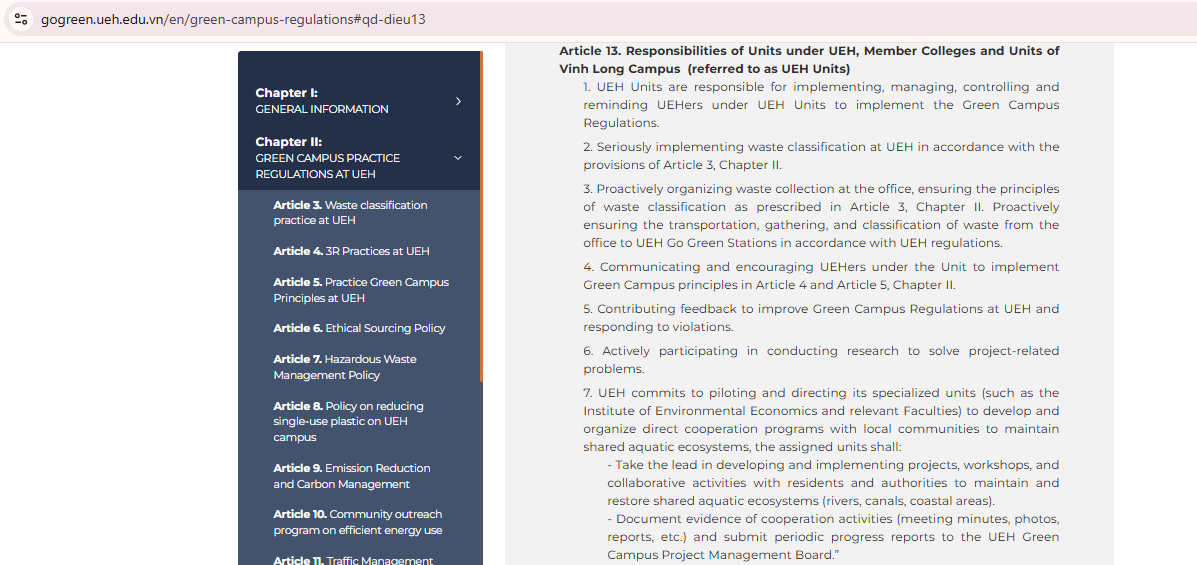
Article 13, Clause 7 of the Green Campus Regulations issued under Decision No. 2059/QD-DHKT-CSVC, concerning the proposed pilot of direct collaboration programmes between specialised UEH units and local communities to maintain shared aquatic ecosystems
Public source: UEH Green Campus website, ‘Green Campus Regulations’
https://gogreen.ueh.edu.vn/en/green-campus-regulations#qd-dieu13
Building on the Green Campus Regulations, in 2025 UEH continued to promote collaboration to protect aquatic ecosystems through research, field surveys, community consultations, and conservation solution development. Key examples included Women4Mangrove in Cu Lao Dung, which worked with local authorities and women to develop mangrove conservation approaches linked to livelihoods, and collaboration with the Khanh Hoa Provincial People’s Committee to develop proposals for restoring the Cai River’s ecological landscape. These activities translated UEH’s community-engagement orientation into practice and are detailed in the 2025 evidence table below.
- Evidence of programmes and events implemented in 2025
| No. | Programme/ Project |
Format/ Category |
Description | Public source |
| 1 | Women4Mangrove – Mangrove conservation linked to community livelihoods | Project launch; Mangrove conservation forum; Community consultations | On 10 December 2025, UEH worked with the People’s Committees of An Thanh and Cu Lao Dung communes, Can Tho City, to launch Women4Mangrove, accompanied by a thematic discussion on mangrove conservation and sustainable livelihood solutions. The event brought together authorities, experts, and community representatives to discuss forest conservation and mangrove ecosystem protection, with an emphasis on women’s empowerment and the development of sustainable educational agritourism in the Mekong Delta. The project aims to establish a women-led nursery and reforestation training centre, with a target of restoring 5 hectares of mangroves over its implementation period. In 2025, the project also expanded international networks and opportunities for learning from experience in Thailand (November 2025) and the Netherlands (December 2025), helping refine the model and its potential for future expansion. 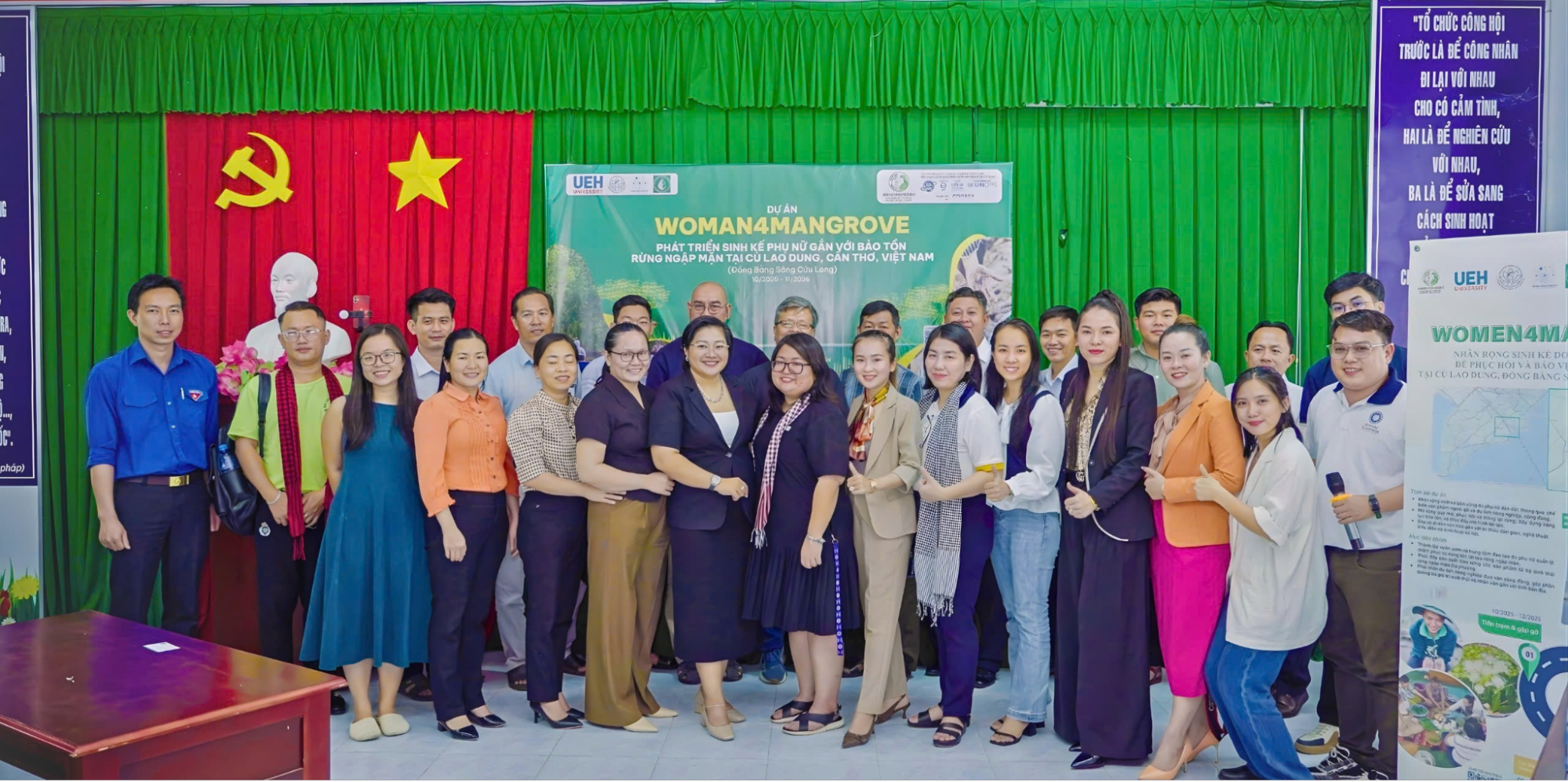 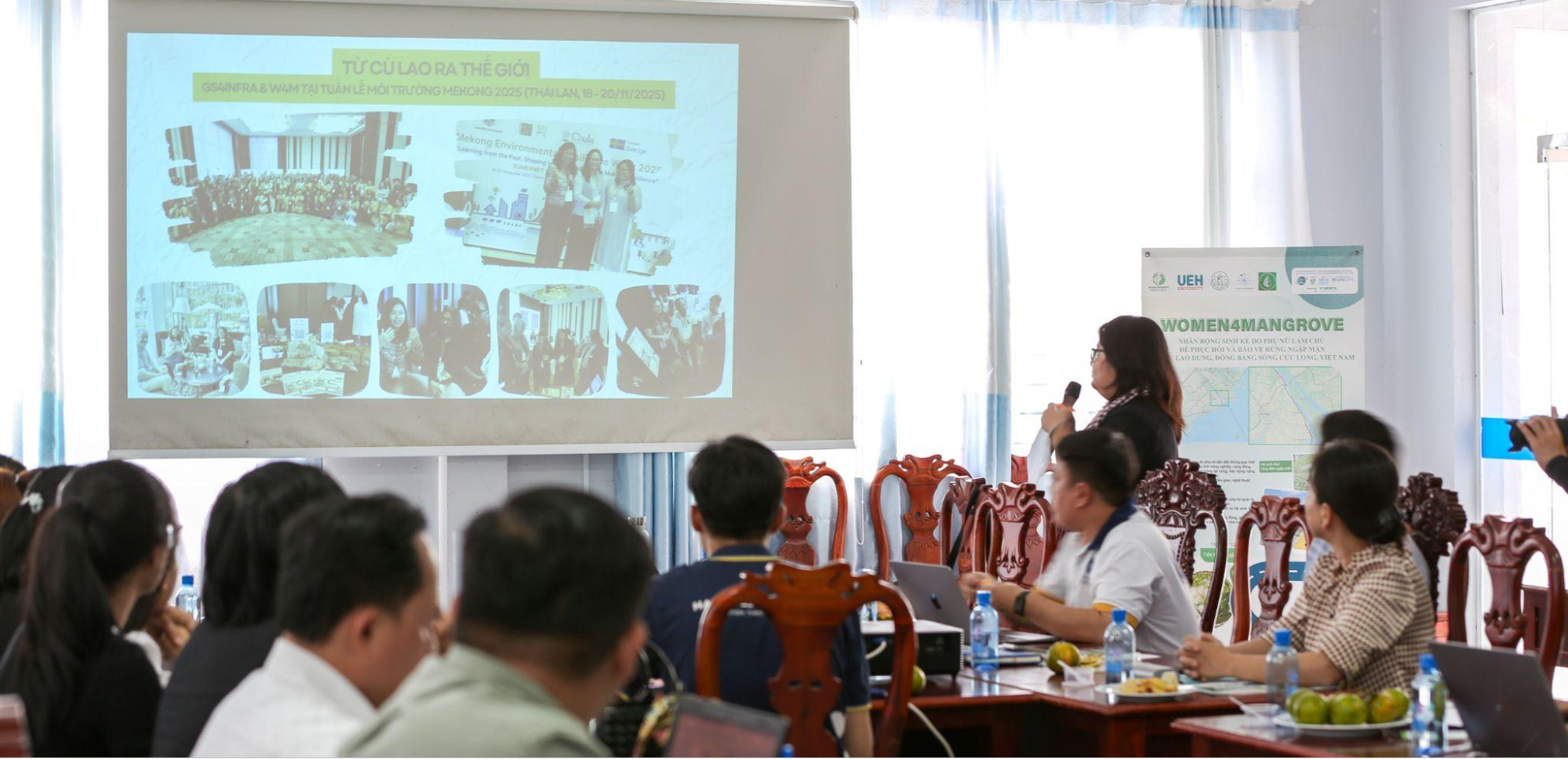
Delegates attending and contributing to the discussion 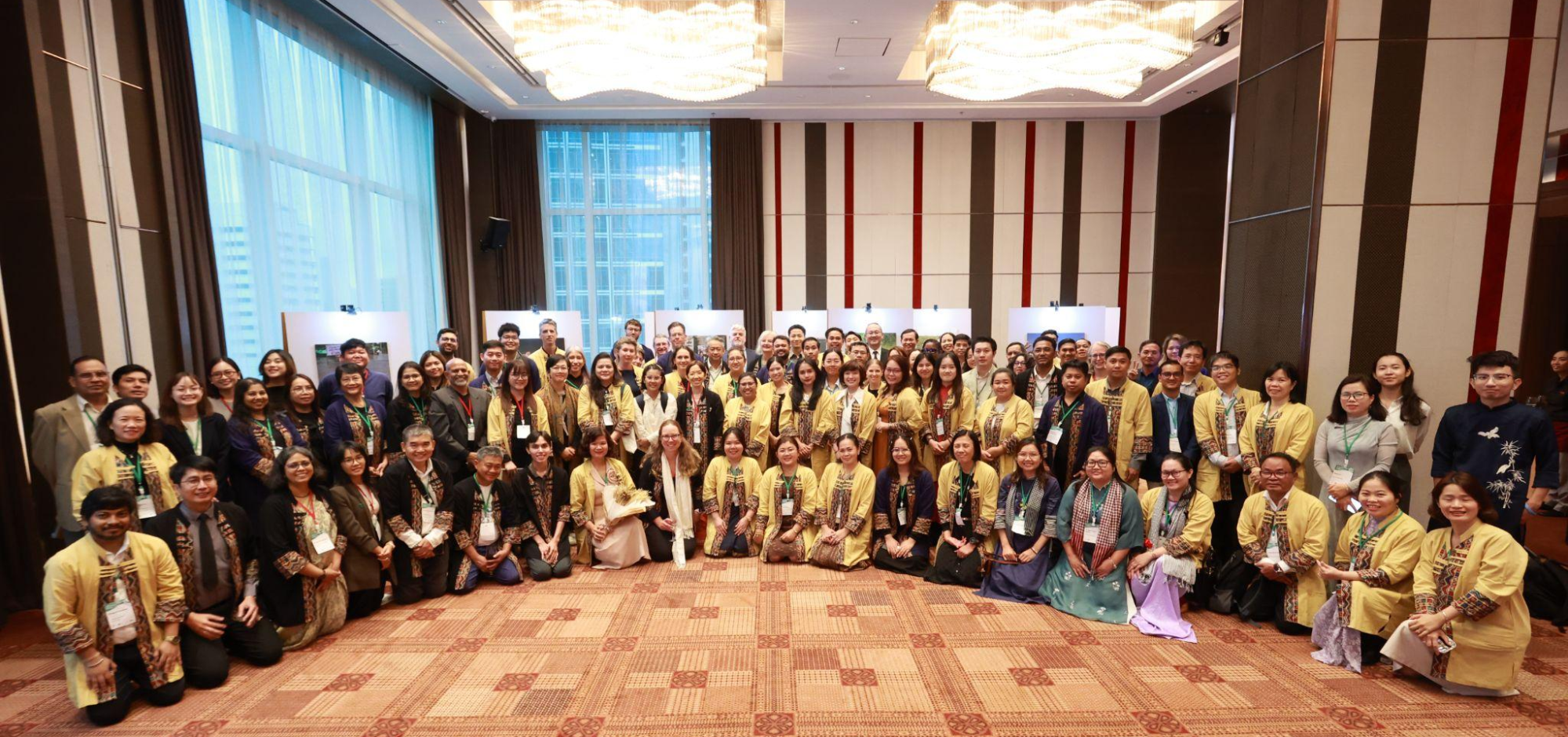
Delegates, partners, and the Women4Mangrove project team at an international professional exchange forum |
UEH Portal and Can Tho Newspaper, December 2025 https://www.ueh.edu.vn/khoa-hoc/du-an-women4mangrove-tang-cuong-bao-ton-dua-vao-cong-dong-va-du-lich-nong-nghiep-giao-duc-gan-voi-trong-rung-tai-dong-bang-song-cuu-long-75589 |
| 2 | Fourth International Design Competition – Sustainable economic and cultural development through the integration of urban landscapes along the Cai River, Khanh Hoa Province | International design competition; Proposals for landscape restoration and sustainable land use | In 2025, UEH’s Institute of Smart City and Management (ISCM), UEH Nexus Campus, and the Khanh Hoa Provincial People’s Committee jointly organised a competition to seek sustainable solutions for urban landscapes along the Cai River in Khanh Hoa Province. Some proposals focused on wetland restoration, greenery, and adaptation to riverside ecological conditions. In particular, ‘Nha Trang Elasticity’ and ‘Threshold – Design within the Pulse of Rising Water’ proposed restoring wetlands, developing systems of native vegetation, and designing public spaces adaptable to rising water levels. These proposals supported natural landscape conservation, river ecosystem restoration, and sustainable use of urban land.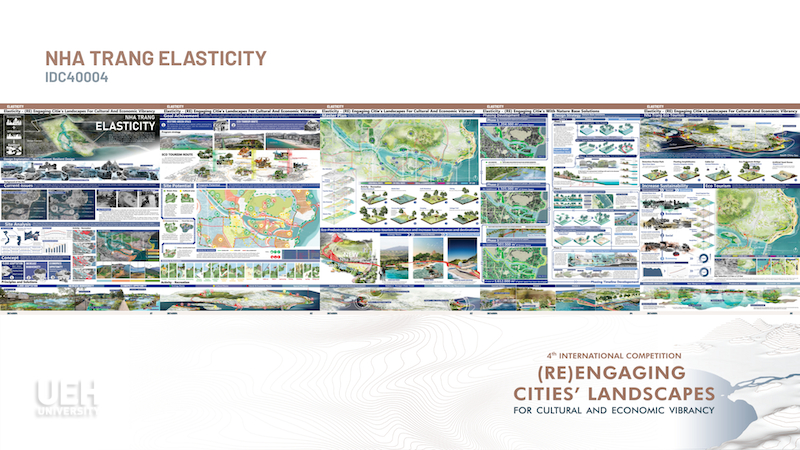 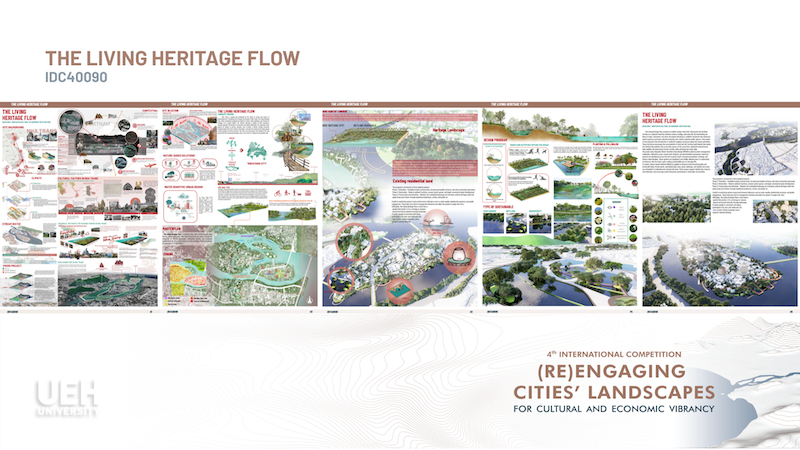 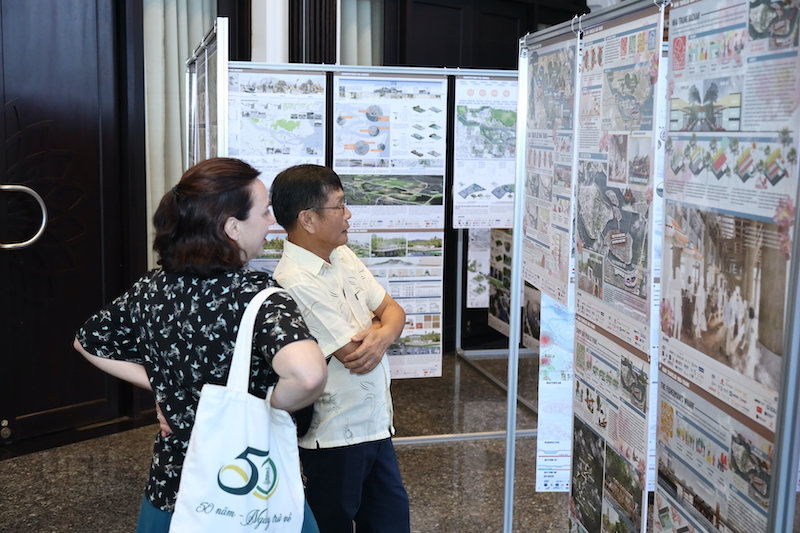
Exhibition of proposals to integrate urban landscapes along the Cai River, Khanh Hoa Province |
UEH Portal, ‘Fourth International Design Competition Awards Ceremony: Bringing Together Knowledge and Co-creating Solutions for Urban Landscape Integration along the Cai River, Khanh Hoa Province’, 29 September 2025 https://www.ueh.edu.vn/cuoc-song-ueh/tin-tuc/le-trao-giai-cuoc-thi-thiet-ke-quoc-te-lan-4-cong-bo-nhung-y-tuong-phat-trien-ben-vung-tu-dong-chay-song-cai-khanh-hoa-74926?app=true&app=true |
| 3 | GS4Infra Project – Building community capacity for water infrastructure management and disaster prevention in Cu Lao Dung, Soc Trang | Applied research; Collaboration with local government; Capacity-building training; Encouraging community participation in water-resource and hydraulic-infrastructure management | On 2 January 2025, as part of the interdisciplinary GS4Infra project, a research team led by Ms Nguyen Thi Thu Thuy (UEH) worked with the Cu Lao Dung District Division of Agriculture and Rural Development to conduct a capacity-building workshop for representatives of government, social organisations, and local residents. The workshop sought to promote equitable community participation in planning, managing, and making decisions about water infrastructure, particularly flood-protection dikes, irrigation canals, and salinity-control sluices. It combined discussion of saltwater intrusion, floods, droughts, and livelihood impacts with three participatory exercises: (1) jointly identifying and mapping key infrastructure in Cu Lao Dung, including challenges and opportunities in its management and use; (2) role-playing vulnerable groups such as women, children, older people, low-income residents, and ethnic minorities to examine barriers to infrastructure access and propose more equitable solutions; and (3) allocating a hypothetical budget among infrastructure priorities, including sluices, canal dredging, and related works, to practise investment prioritisation, planning, and resource allocation. Through these activities, UEH directly supported community capacity to manage water resources in response to local conditions while strengthening the participation of disadvantaged groups in decisions on water infrastructure and climate adaptation.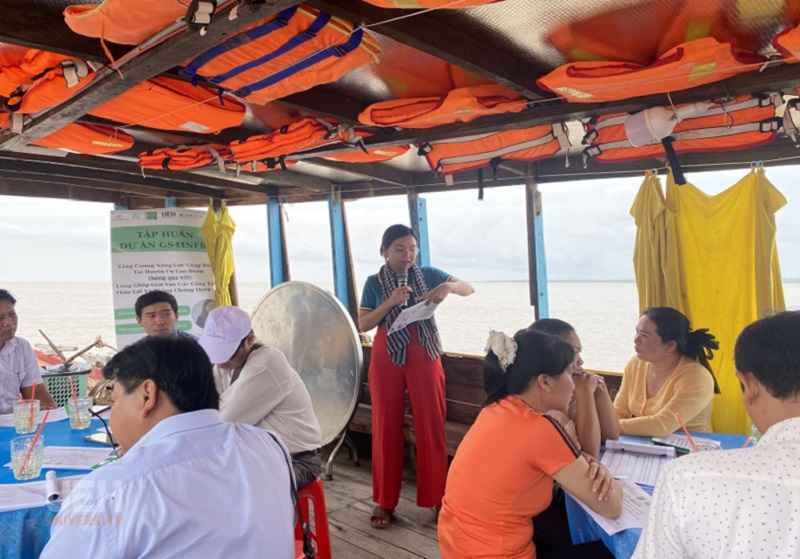 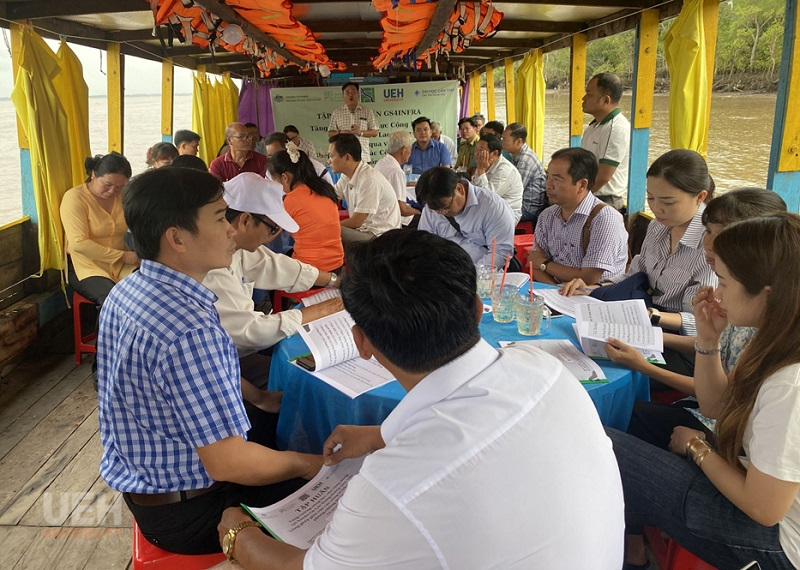
On-board training session attended by local representatives |
UEH Portal, ‘[GS4Infra Research Project] Community Capacity-building Workshop in Cu Lao Dung District, Soc Trang’, 2 January 2025 https://ueh.edu.vn/cuoc-song-ueh/tin-tuc/du-an-nghien-cuu-gs4-infra-buoi-tap-huan-nang-cao-nang-luc-cong-dong-tai-huyen-cu-lao-dung-73128 |
| 4 | HAPRI – Research on adaptive water-resource management in the Mekong Delta | Applied research; Scientific evidence for water-management policy; Recommendations for sustainable water-management practices | On 14 January 2025, UEH published a synthesis of research findings from the Health and Agricultural Policy Research Institute (HAPRI), highlighting studies by Dr Tran Anh Thong, Dr Tran Duc Dung, and Mr Vo Van Oc on water security and adaptive management in the Mekong Delta. These studies examined challenges in managing freshwater and brackish water, particularly the imbalance between policies prioritising freshwater for rice cultivation and the demand for brackish water for aquaculture, which affects ecosystems and farmers’ livelihoods. The researchers proposed several good water-management practices: (1) flexible water governance that balances freshwater and brackish-water needs according to local ecological conditions; (2) improved water-quality management, interprovincial coordination, and production models adapted to saltwater intrusion; (3) multi-stakeholder governance that enables farmers and communities to contribute to policymaking and water-infrastructure management; and (4) water reuse, more efficient irrigation, and nature-based solutions such as mangrove conservation and protection of land and water resources.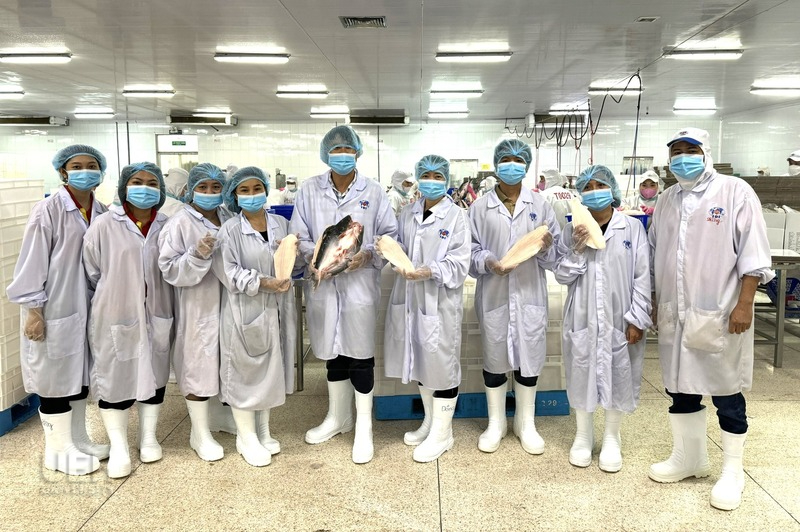 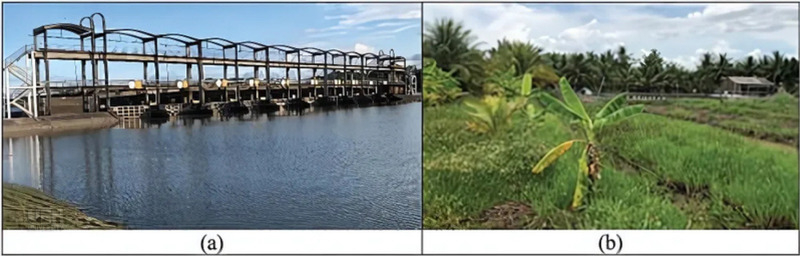
Research projects providing scientific evidence for water-resource protection |
UEH Portal, ‘Food Security and Sustainable Agriculture: From Policy to Practice in the Context of Climate Change’, 14 January 2025 https://ueh.edu.vn/khoa-hoc/an-ninh-luong-thuc-va-nong-nghiep-ben-vung-tu-chinh-sach-den-thuc-tien-trong-boi-canh-bien-doi-khi-hau-73279 |
| 5 | UEH Green Campus 2025 – ‘Protect Water, Nurture Life’ | Programme encouraging water conservation and protection; Behaviour-change communication; Interactive and experiential activities | In September 2025, the Youth Union and Student Association of UEH’s School of Law, together with UEH’s 43–45 Nguyen Chi Thanh Dormitory, organised ‘Protect Water, Nurture Life’ to encourage students to save water, avoid polluting practices, and actively protect water resources. The programme had two phases. Phase 1 – Online Challenge (22–28 September 2025): students were encouraged to post photos of environmental protection actions they had taken, generating 912 story posts and more than 1,500 interactions, indicating engagement with the promoted practices. Phase 2 – Communication Booth (29–30 September 2025): at Lobby B2, Campus B, UEH organised three interactive stations with information on clean water, causes of pollution, and water-saving measures, and guided participants in waste handling through a simulated river-cleaning game. This phase recorded more than 450 student participations. The programme combined interactive encouragement, sharing of real-life actions, simulations, and incentives to help students develop responsible water-use habits.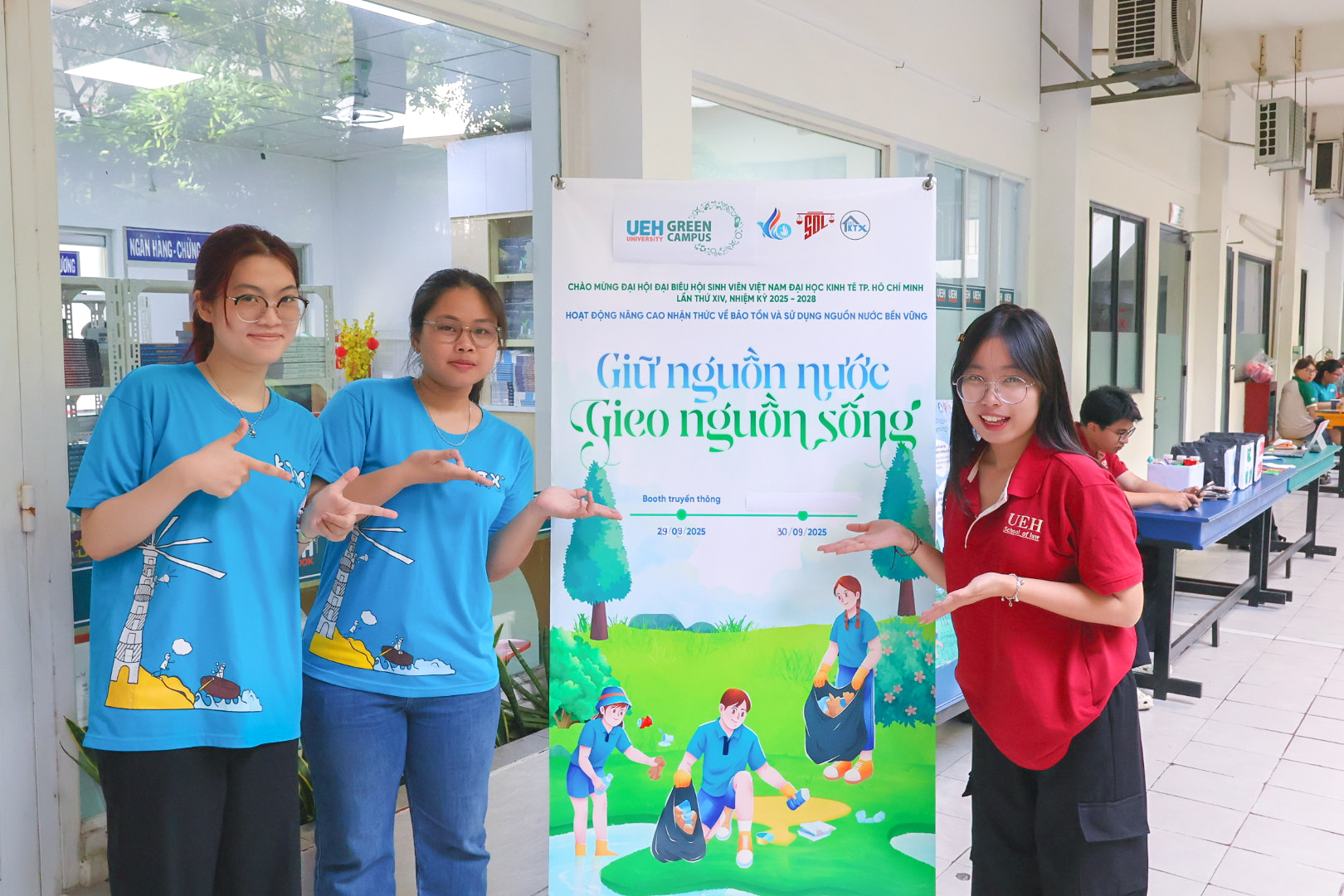 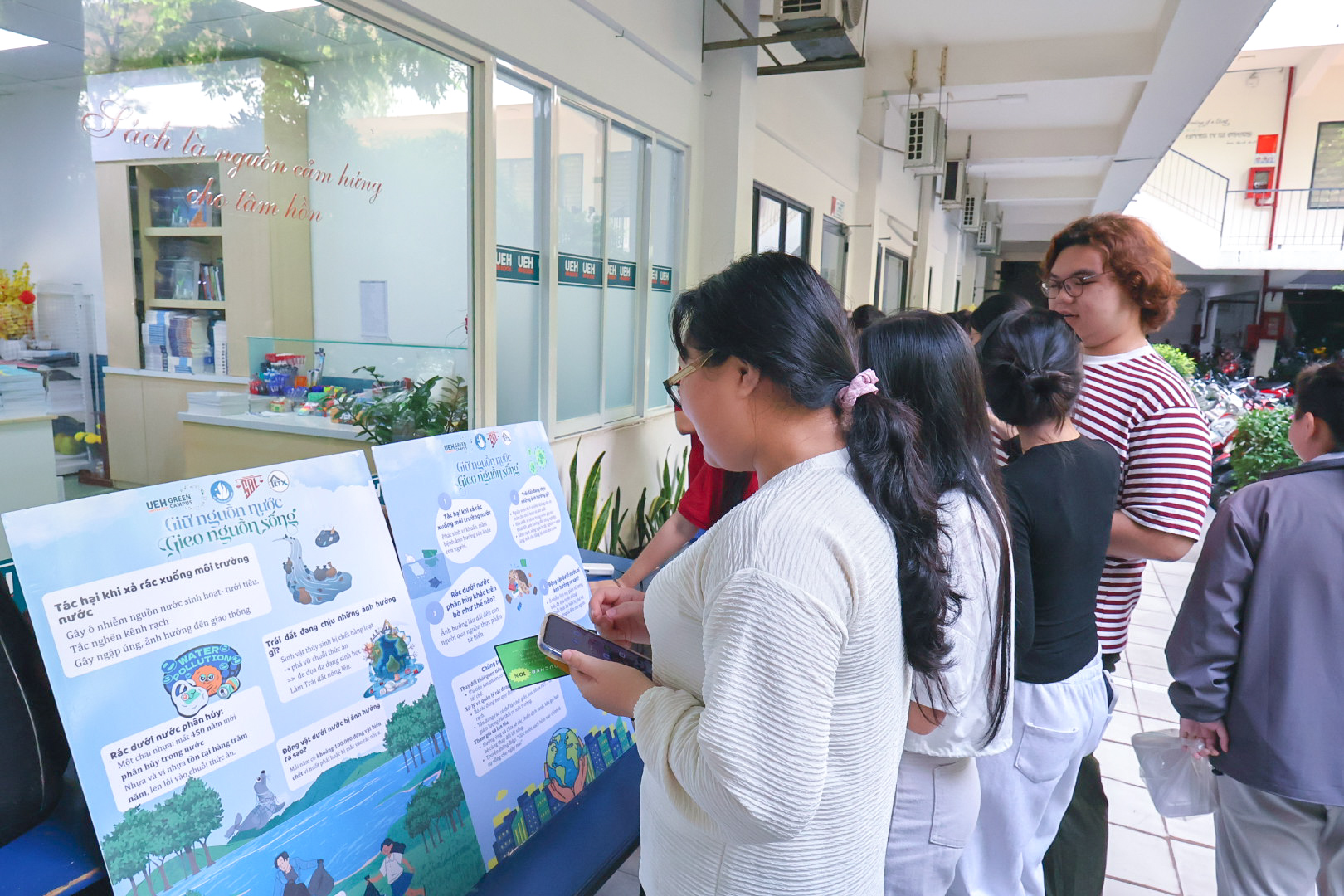 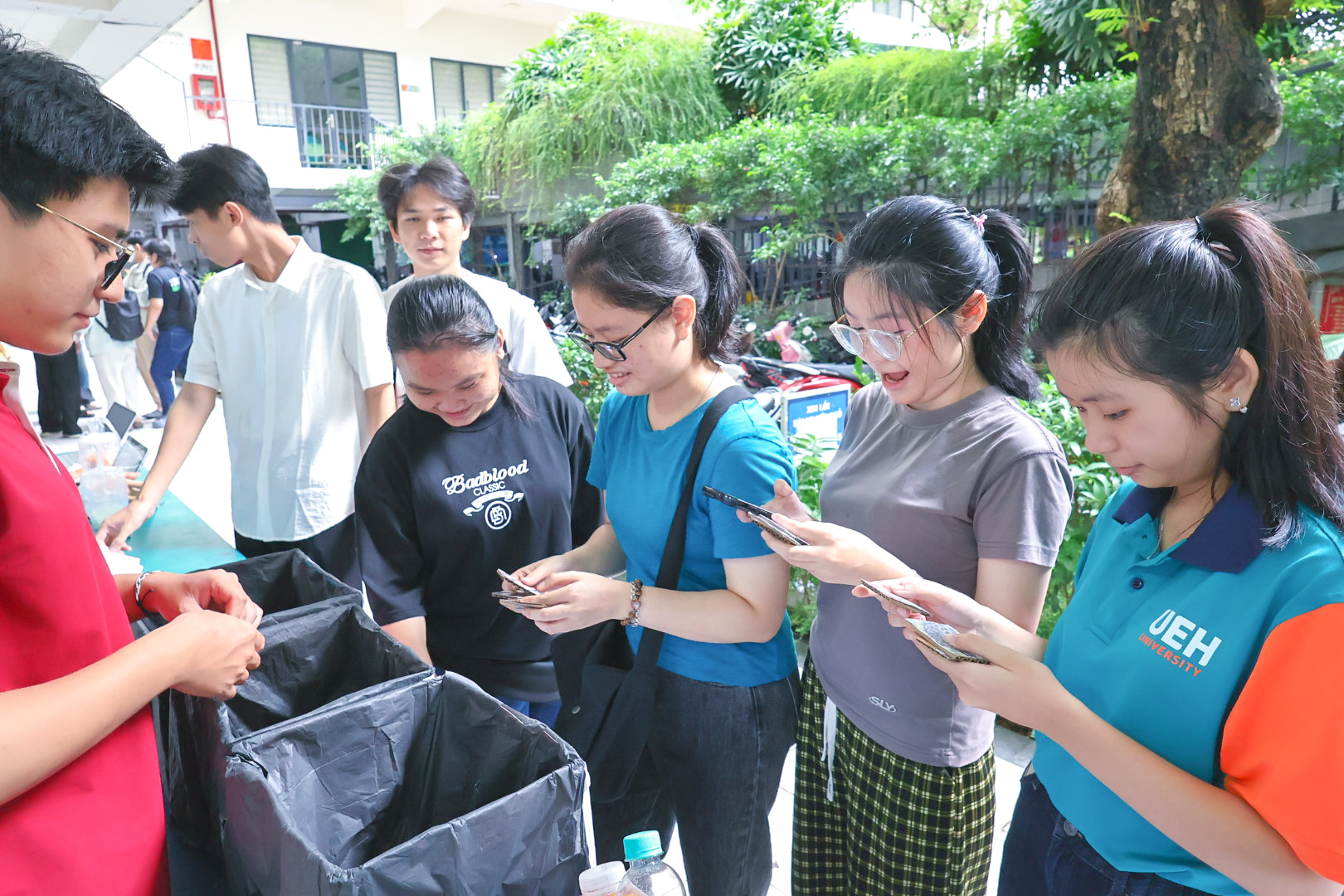
Students learning about water-resource protection and practising waste removal through a simulated river-cleaning activity |
UEH Green Campus website, ‘UEH Green Campus 2025 – School of Law: Protect Water, Nurture Life’, 1 October 2025 https://gogreen.ueh.edu.vn/su-kien/ueh-green-campus-2025-cung-khoa-luat-giu-nguon-nuoc-gieo-nguon-song |
- Conclusion
In 2025, UEH continued to put its commitment to protecting shared aquatic ecosystems into practice through partnerships with authorities, local communities, and specialist organisations. Building on the Green Campus Regulations, UEH combined applied research, field surveys, community consultations, and the development of conservation solutions tailored to local ecological conditions and livelihood needs.
The Women4Mangrove project in Cu Lao Dung demonstrated direct collaboration between UEH, local authorities, and women’s groups to identify needs and develop coastal mangrove conservation approaches linked to sustainable livelihoods. Meanwhile, UEH’s partnership with the Khanh Hoa Provincial People’s Committee through the Fourth International Design Competition contributed proposals for restoring the Cai River ecosystem and protecting wetlands. Research and awareness-raising programmes on water resources complemented these partnerships by providing knowledge, encouraging participation, and supporting environmentally responsible practices.
The outcomes recorded in 2025 show that UEH contributed not only scientific expertise but also direct stakeholder engagement, helping communities identify issues and co-develop aquatic ecosystem conservation solutions. This provides a foundation for longer-term partnerships linking water-resource and biodiversity protection with sustainable livelihoods, contributing to Indicator 14.5.4.