

The University of Economics Ho Chi Minh City (UEH) implements policies to protect individuals who lodge complaints, make denunciations, or report discrimination, with the aim of ensuring that they are not subjected to retaliation, unfair treatment, or disadvantage in their education or employment for speaking up. These protections are supported by the UEH Code of Conduct, confidentiality requirements, and formal mechanisms for receiving and resolving reports. In 2025, UEH further strengthened its reporting and protection framework through Decision No. 2410/QD-DHKT-BDCLKSNB dated 14 August 2025 and two procedures for resolving complaints and denunciations issued on 30 August 2025, contributing to a fair, safe higher education environment that respects the rights of all members.
1. UEH Policies Protecting Those Reporting Discrimination
1.1. Protecting Reporting Individuals from Disadvantage in Education and Employment
UEH publicly communicates its policy of protecting those reporting discrimination, supporting the right to raise concerns about discriminatory conduct, harassment, and unfair treatment without facing adverse consequences in their studies or work.
For students, the policy seeks to safeguard access to education, examinations, assessment, and educational activities, so that reporting discrimination does not lead to retaliation or unfair treatment. For staff and employees, protections are linked to the right to lodge complaints or denunciations and request a review of decisions or conduct affecting their lawful rights and interests at work, in accordance with applicable regulations.
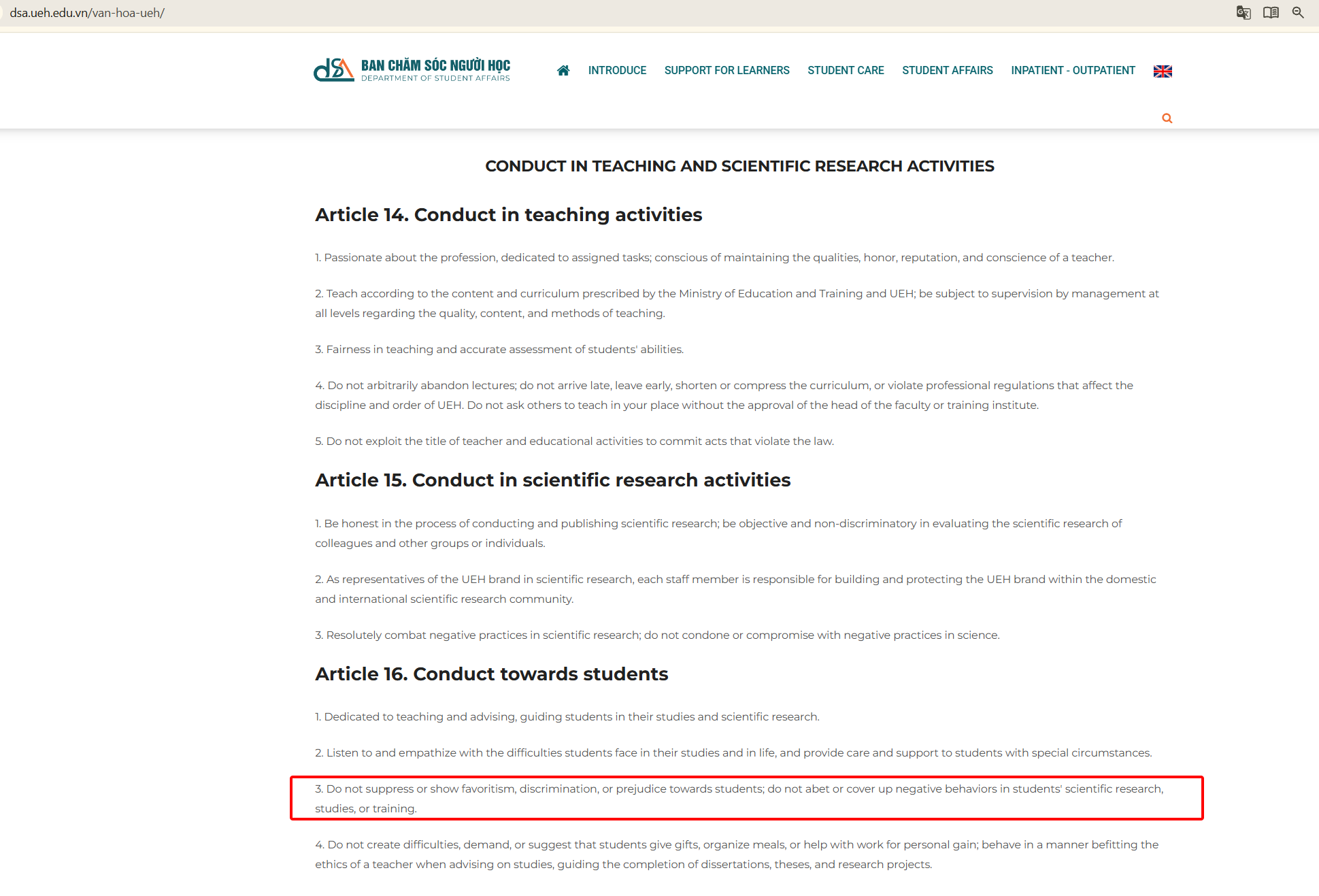
The policy framework includes the UEH Code of Conduct, issued under Decision No. 695/QD-DHKT-CTCT dated 4 April 2017, which provides:
- Article 7, Clause 3: Establishes the principle of non-discrimination on the basis of sex and the other characteristics specified in the Code.
- Article 7, Clause 6: Prohibits harassment of others.
- Article 16, Clause 3: Prohibits retaliation, favouritism, discrimination, or prejudice against students.
- Articles 17–18: Assign responsibilities for monitoring compliance with the Code of Conduct and addressing violations.
Together, these provisions help protect students against retaliation, discrimination, and harassment, while providing a basis for reviewing and addressing misconduct within UEH.
Sources:
- UEH Future – 5.6.8. Policies protecting those reporting discrimination (5 November 2025) – opening statement on protection from disadvantage in education and employment.
- UEH Department of Student Affairs (DSA) – UEH Culture and Code of Conduct – Articles 7, 16, 17 and 18.
1.2. Confidentiality and Protection of Complainants’ and Whistleblowers’ Information in 2025
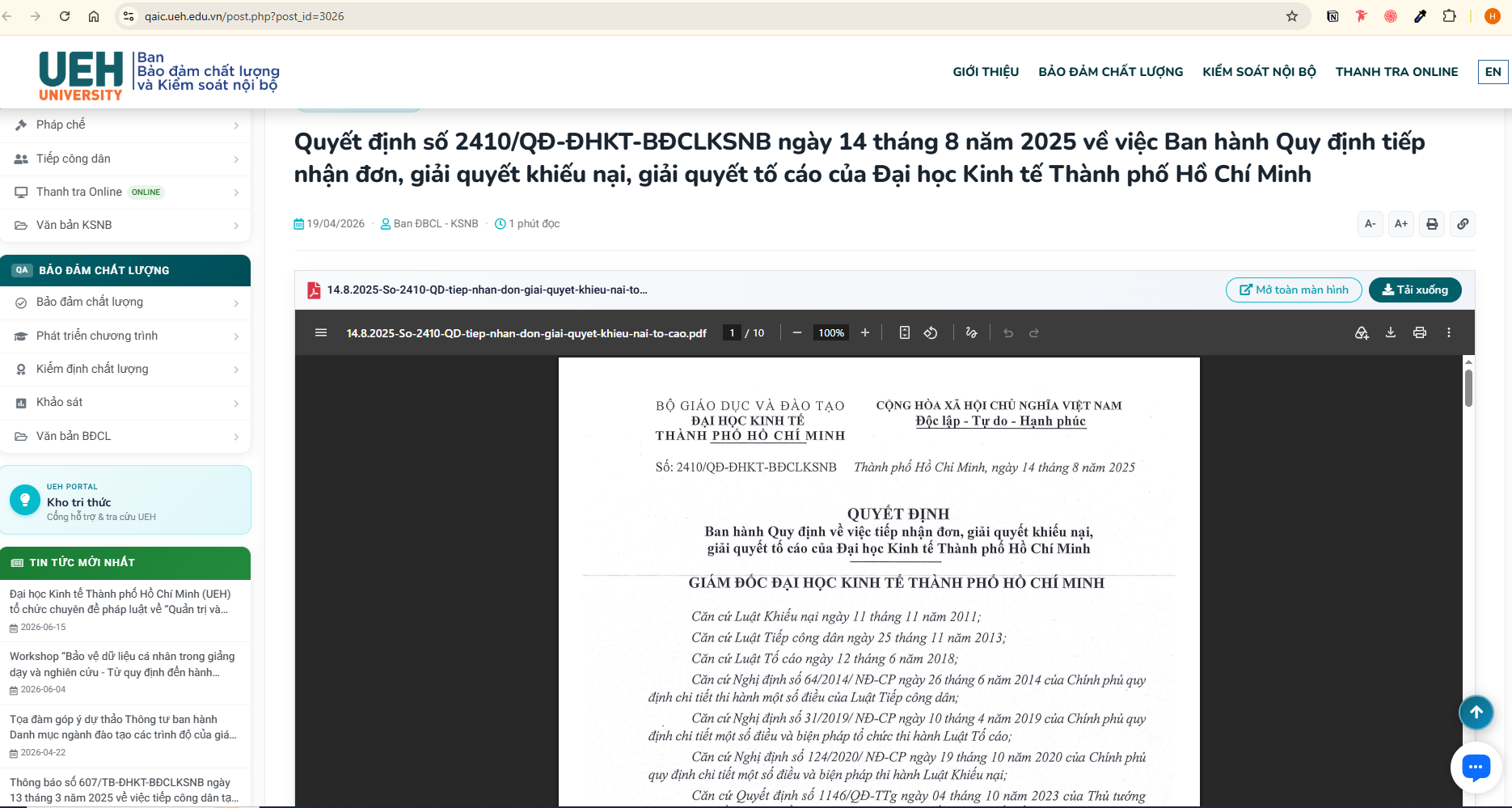
On 14 August 2025, UEH issued Decision No. 2410/QD-DHKT-BDCLKSNB, together with its Regulations on the Receipt of Petitions and the Resolution of Complaints and Denunciations at the University of Economics Ho Chi Minh City.
Under Article 1, the Regulations govern the receipt and resolution of complaints and denunciations falling within the authority of the UEH Director, covering civil servants, public employees, and students.
In particular, Article 2, Clause 6 prohibits unauthorised disclosure or provision of information and documents concerning complainants, persons making denunciations, and the verification, conclusions or handling of cases before approval or signing by the competent authority. It also prohibits abuse of official positions to interfere unlawfully with proceedings or falsify case files during complaint and denunciation handling.
Article 10, Clause 2 further requires the confidentiality of information relating to complaints and denunciations in accordance with applicable regulations.
These provisions on confidentiality, competent authority, and case handling help reduce the risks of identity disclosure, improper interference, or pressure on reporting individuals, thereby supporting the lawful rights and interests of the parties concerned.
Sources:
- UEH Department of Quality Assurance and Internal Control (QAIC) – Decision No. 2410/QD-DHKT-BDCLKSNB dated 14 August 2025, issuing the Regulations on the Receipt of Petitions and Resolution of Complaints and Denunciations.
- Original Regulations accompanying Decision No. 2410: Article 1; Article 2, Clause 6; Article 10, Clause 2.
1.3. Mechanisms for Receiving and Resolving Reports and Safeguarding Rights in Education and Employment
In addition to confidentiality requirements, UEH has established complaint and denunciation resolution procedures to ensure that reports are received, verified, and handled by the competent authority.
In 2025, UEH issued two procedures:
- Decision No. 2616/QD-DHKT-BDCLKSNB dated 30 August 2025 promulgated the Denunciation Resolution Procedure, code KSNB.QT.06, third issuance. It specifies the steps for receiving reports, determining admissibility, verifying allegations, working with the person making the denunciation and the person concerned, concluding the case, and taking action within the relevant authority.
- Decision No. 2617/QD-DHKT-BDCLKSNB dated 30 August 2025 promulgated the Complaint Resolution Procedure, code KSNB.QT.01, third issuance. It covers receipt, classification, verification, dialogue, and the issuance of a complaint resolution decision.
Under Article 2, Clause 4, of the Regulations accompanying Decision No. 2410, staff may lodge complaints concerning professional duties, management matters, performance assessment and recognition, teaching assignments, and violations of the Code of Conduct. Where the initial decision is contested, complainants may submit a further complaint to the competent authority.
For students, Article 2, Clause 5 provides for complaints relating to examination and assessment results and requests for reassessment.
Article 4, Clause 1 provides for the receipt of submissions by postal service, in person at the Citizen Reception Office of the Department of Quality Assurance and Internal Control (Room A214), or through referral by an agency or organisation as prescribed.
Through these formal channels, students and staff can raise concerns about decisions or conduct affecting their lawful rights and interests, with reports subject to receipt, verification, and resolution through accountable procedures. These processes help address unfair treatment in education and employment.
Sources:
- UEH QAIC – Decision No. 2616/QD-DHKT-BDCLKSNB dated 30 August 2025 – Denunciation Resolution Procedure KSNB.QT.06, Sections II and V.
- UEH QAIC – Decision No. 2617/QD-DHKT-BDCLKSNB dated 30 August 2025 – Complaint Resolution Procedure KSNB.QT.01, Sections II and V.
- Decision No. 2410/QD-DHKT-BDCLKSNB – Article 2, Clauses 4–5, and Article 4, Clause 1.
2. Implementation Results and Strengthened Protection Mechanisms for Reporting Individuals in 2025
In 2025, UEH continued to strengthen protections for students and staff through updated institutional regulations, publicly accessible reporting channels, and dissemination of complaint and denunciation resolution procedures.
Summary of Key Supporting Evidence in 2025
| Policy / Activity | Scope and Beneficiaries | Implementation | Results and Impact |
|---|---|---|---|
| 1. Confidentiality provisions for complainants and persons making denunciations – 14 August 2025 | Civil servants, public employees, and students within the scope of the Regulations | Decision No. 2410 was issued, prohibiting unauthorised information disclosure and requiring confidentiality of case files under Articles 2 and 10. | Strengthened information protection for reporting individuals and reduced the risk of identity disclosure or improper interference. Source: Decision No. 2410 – UEH QAIC |
| 2. Standardisation of the denunciation resolution procedure – 30 August 2025 | Persons falling within UEH’s authority to resolve denunciations | Decision No. 2616 issued Procedure KSNB.QT.06, specifying receipt, verification, conclusions, and handling of denunciations. | Strengthened transparency and accountability in resolving denunciations. Source: Decision No. 2616 – UEH QAIC |
| 3. Standardisation of the complaint resolution procedure – 30 August 2025 | Complainants covered by the procedure | Decision No. 2617 issued Procedure KSNB.QT.01, covering acceptance, verification, dialogue, and complaint resolution. | Established a formal mechanism to review decisions and conduct affecting education or employment rights, within the relevant authority. Source: Decision No. 2617 – UEH QAIC |
| 4. Dissemination of citizen reception and petition-handling regulations – 19 September 2025 | UEH unit leaders, staff, and employees | A conference was held in Room A.205 and online, covering coordination in citizen reception, petition handling, and compliance with the Code of Conduct. | Raised awareness and strengthened unit-level responsibilities for receiving and resolving reports and protecting lawful rights. Source: UEH QAIC – Legal Briefing Conference, published 23 September 2025 |
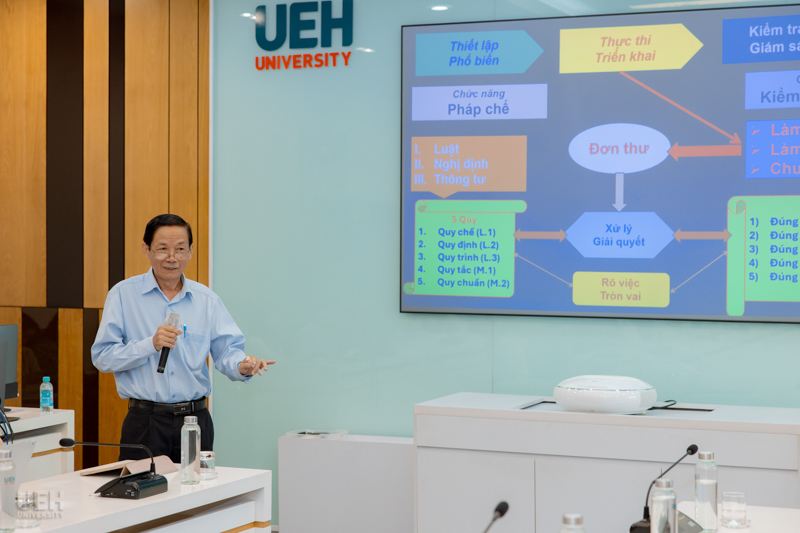
UEH disseminated regulations on citizen reception, petition handling, and the Code of Conduct, strengthening unit-level responsibilities for receiving and resolving reports. Source: UEH Department of Quality Assurance and Internal Control, 23 September 2025.
3. Implementation Results and Conclusion
Compared with 2024, UEH continued its policy of protecting reporting individuals through its Code of Conduct and student support mechanisms, while strengthening its complaint and denunciation handling framework through three decisions issued in August 2025. These regulations clarify confidentiality responsibilities, the authority to receive submissions, and procedures for verification, dialogue, and case resolution. The September 2025 legal briefing supported the application of these procedures in university governance.
By combining non-discrimination principles, confidentiality safeguards, and formal reporting and case-resolution mechanisms, UEH continues to promote a fair and safe learning and working environment where students and staff are encouraged to report discriminatory conduct and have their lawful rights and interests protected in accordance with applicable regulations, contributing to SDG 5 – Gender Equality.