

Committed to fostering an equitable, inclusive and family-friendly working environment, the University of Economics Ho Chi Minh City (UEH) maintains a paternity leave policy for male employees whose wives give birth, enabling fathers to care for newborn children and share family responsibilities. In 2025, UEH continued to administer paternity leave through its human resources management system and social insurance procedures. According to the personnel statistics compiled for UEH’s maternity and paternity policy evidence, two male employees took paternity leave following the birth of their children in 2025. These cases demonstrate the policy’s implementation in practice and its contribution to encouraging fathers to share childcare responsibilities.
1. Paternity Leave Policy at UEH
UEH implements a Paternity Leave Policy for male staff and employees whose wives give birth, in accordance with the Law on Social Insurance and the University’s human resources procedures. The policy applies to staff and employees directly contracted by UEH who participate in compulsory social insurance and satisfy the statutory eligibility conditions for maternity benefits.
Under Point (e), Clause 1, Section I – Introduction of UEH’s “Maternity Leave” guidance, male staff and employees who are currently contributing to social insurance and whose wives give birth are eligible for maternity benefits. This leave enables fathers to care for newborns, support mothers following childbirth and share family responsibilities.
From 1 July 2025, paternity leave for male employees is governed by Law on Social Insurance No. 41/2024/QH15. Clauses 2 and 3 of Article 53 specify the duration of leave and the period within which it may be taken, as follows:
| Circumstances of childbirth | Paternity leave entitlement for male employees |
|---|---|
| Birth of one child without special circumstances | 5 working days |
| Childbirth by caesarean section or birth before 32 weeks of gestation | 7 working days |
| Birth of twins | 10 working days |
| Birth of triplets or more, without surgery | 10 working days, plus 3 working days for each child from the third onwards |
| Birth of twins by caesarean section | 14 working days |
| Birth of triplets or more by caesarean section | 14 working days, plus 3 working days for each child from the third onwards |
Under Clause 3 of Article 53, a male employee may take paternity leave in one or several periods; the first day of leave and the final leave period must fall within 60 days of the birth, and the total number of leave days must not exceed the statutory entitlement. Compared with the rules in force before 1 July 2025, the window for taking leave has been extended from 30 to 60 days, allowing fathers greater flexibility in arranging work and caring for their newborn children.
In special circumstances where the mother dies or is unable to care for the child due to health reasons, the 2024 Law on Social Insurance also provides for maternity leave entitlements for the father or the person directly caring for the child, subject to the relevant conditions under Article 53, to ensure continuity of care.
Implementing this policy enables male employees to take an active role in childcare and helps redistribute unpaid care responsibilities that often fall disproportionately on women, thereby supporting women’s continued participation in employment and public life.
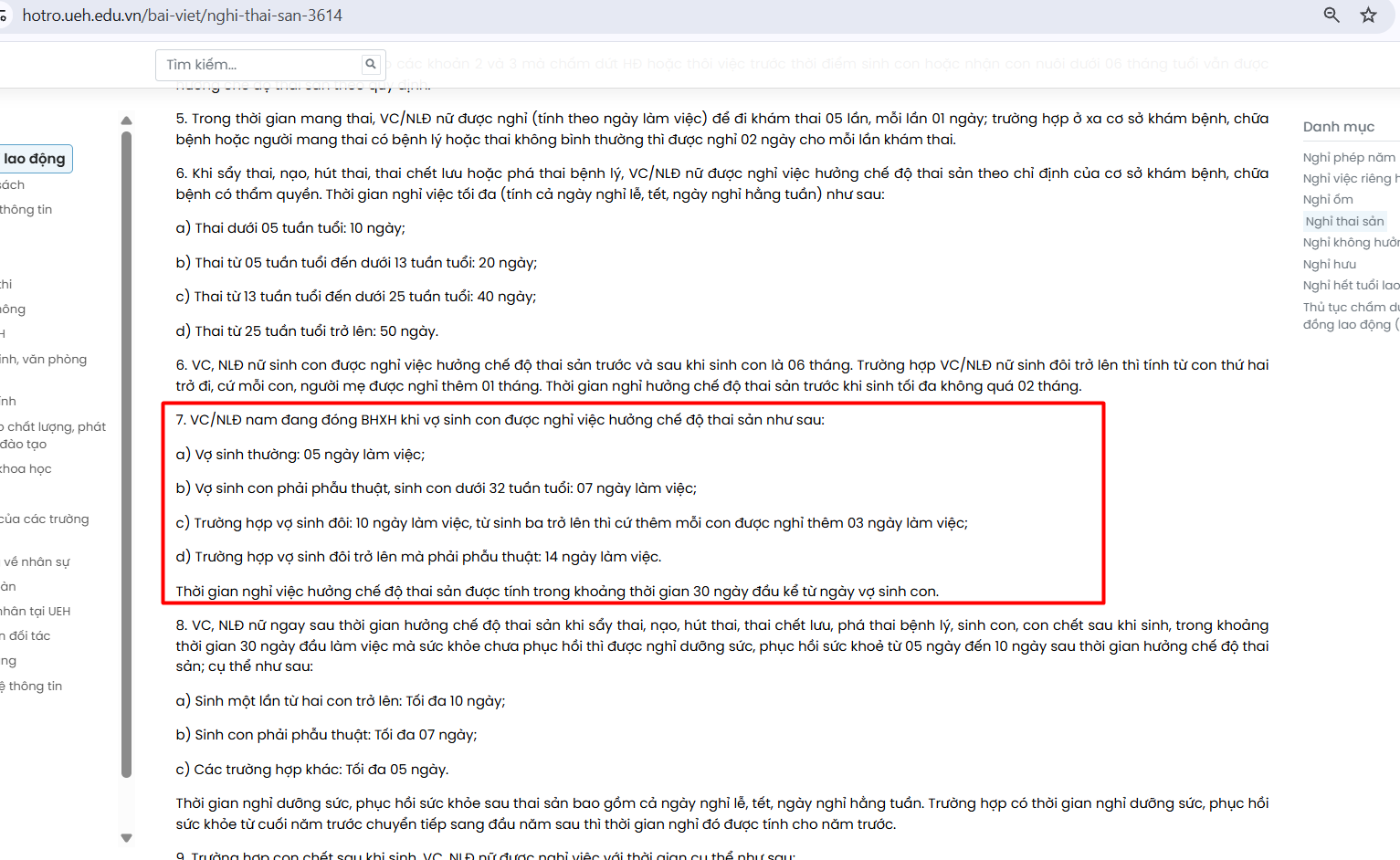
Information on paternity leave for UEH male staff and employees
Source: https://hotro.ueh.edu.vn/bai-viet/nghi-thai-san-3614
2. Procedures for Taking Paternity Leave at UEH
UEH administers paternity leave applications and benefits through its human resources management system, providing staff and employees with access to guidance, application procedures and statutory entitlements.
Employees submit their leave applications through UEH SmartOffice under the long-term leave procedure, using the required forms and supporting documents. Once approved by the head of their unit, applications are forwarded to the Department of Organisational and Human Resource Development for review, in coordination with the Department of Finance and Investment Planning for the relevant benefits.
For leave taken when an employee’s wife gives birth, the documentation requirements are specified in Section IV of UEH’s “Maternity Leave” procedure and include a leave application, birth notification or an extract of the birth certificate, and additional documentation where special circumstances apply.
Through this administrative process, UEH enables male employees to exercise their statutory leave entitlements while ensuring coordination among employees, their employing units and human resources departments when work arrangements are made.
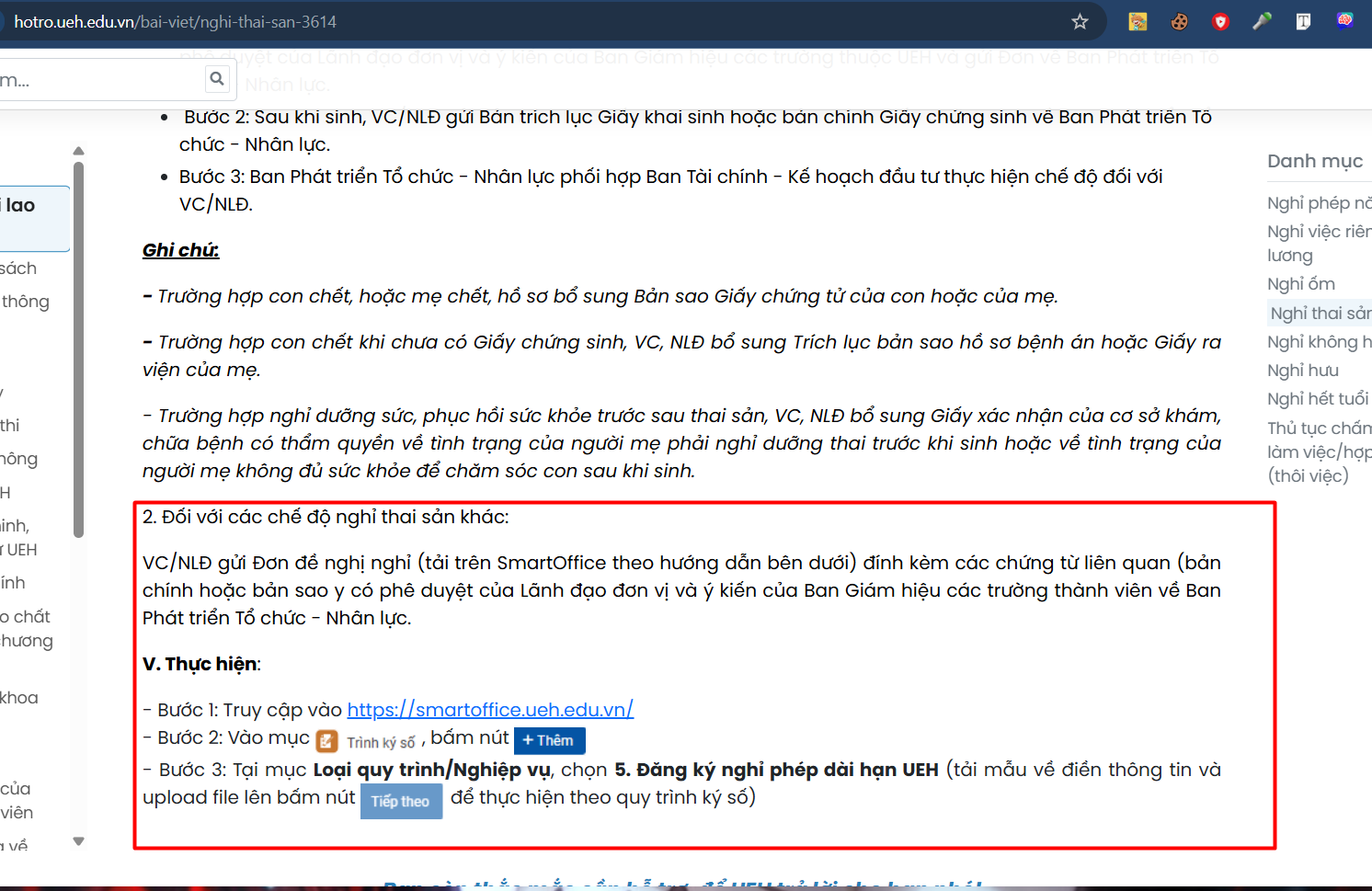
UEH administers paternity leave applications through SmartOffice, in coordination with the employing unit, the Department of Organisational and Human Resource Development and the Department of Finance and Investment Planning.
Source: https://hotro.ueh.edu.vn/bai-viet/nghi-thai-san-3614
3. Practical Implementation and Continuation of the Policy in 2025
In 2025, UEH continued to implement paternity leave for male employees through its leave management system, social insurance procedures and gender-equality-oriented human resources policies. These arrangements support fathers in undertaking childcare responsibilities and help women balance family responsibilities with their professional work.
| Policy / Activity | Beneficiaries | Implementation in 2025 | Results and Contribution to Supporting Women |
|---|---|---|---|
| Maintaining paternity leave entitlements for male employees | Male staff and employees contributing to social insurance whose wives give birth | UEH continued applying paternity leave entitlements according to the circumstances of childbirth, starting from 5 working days and increasing where statutory conditions are met. | Allows fathers time to care for their children and support mothers after childbirth. https://hotro.ueh.edu.vn/bai-viet/nghi-thai-san-3614 |
| Implementing changes under the 2024 Law on Social Insurance from 1 July 2025 | Eligible male employees | The law permits paternity leave to be taken within the first 60 days after childbirth, including in multiple periods within the statutory entitlement. | Provides greater flexibility in balancing work arrangements and care for newborn children. https://xaydungchinhsach.chinhphu.vn/toan-van-luat-so-41-2024-qh15-bao-hiem-xa-hoi-119240723163650489.htm |
| Guidance on applying for and receiving paternity leave benefits | Eligible staff and employees | UEH publicly provides guidance on supporting documents, approval procedures and applications through SmartOffice. The Department of Organisational and Human Resource Development coordinates with relevant units to process benefits. | Helps employees access leave procedures and exercise their statutory family-care rights. https://hotro.ueh.edu.vn/bai-viet/nghi-thai-san-3614 |
| Providing paternity leave to male employees in 2025 | Male staff and employees whose wives give birth | UEH received, reviewed and processed paternity leave applications under its human resources and social insurance procedures. | Two male employees were recorded as having taken paternity leave following childbirth in 2025, enabling fathers to support mothers after childbirth and participate in childcare. |
| Maintaining gender-equal human resources policies | UEH lecturers, staff and employees | UEH continued to publish its principles of equality in employment, pay, social insurance and welfare benefits, including family-support responsibilities. | Supports an equitable workplace in which both men and women have responsibilities and opportunities to contribute to family care. https://ueh.edu.vn/en/news/the-implementation-of-human-resource-policies-linked-to-the-17-sdgs-in-terms-of-intellectual-contribution-to-sustainable-development-73372 |
By combining paternity leave entitlements with the procedures for processing benefits in its human resources system, UEH establishes a basis for sustained family support rather than relying solely on short-term welfare activities.
4. Implementation Results and Policy Continuity, 2024–2025
In 2025, UEH continued to maintain and implement paternity leave for male staff and employees whose wives gave birth, in accordance with statutory requirements and the University’s human resources management procedures.
According to the 2025 maternity and paternity benefits summary, two male employees at UEH were granted paternity leave following the birth of their children. This demonstrates that the policy was implemented in practice, allowing fathers to care for newborns and support mothers in the postnatal period.
From 1 July 2025, UEH also implemented Law on Social Insurance No. 41/2024/QH15, under which the period in which a male employee may take paternity leave was extended to the first 60 days after childbirth. This change provides greater flexibility for fathers to arrange their work, care for their newborn children and share family responsibilities.
By combining statutory leave entitlements with application, approval and benefit-processing procedures within the human resources system, UEH continues to strengthen its family-friendly working environment, encourage men’s involvement in childcare and support women’s opportunities for career development.
5. Conclusion
In 2025, the University of Economics Ho Chi Minh City (UEH) continued to implement its paternity leave policy for male employees, safeguarding their entitlements under social insurance law and the University’s human resources procedures.
The recorded cases of male employees taking leave following the birth of their children, together with the introduction of more flexible leave scheduling from 1 July 2025, help encourage fathers to care for newborns and share family responsibilities.
Through this policy, UEH continues to promote an equitable, family-friendly working environment that enables both men and women to participate in childcare and supports women’s continued engagement in professional, research and academic activities, contributing to SDG 5 – Gender Equality.