

The University of Economics Ho Chi Minh City (UEH) implements a non-discrimination policyfor transgender people, ensuring the principleof respect for diversity in gender, gender identity,and sexualorientation in thestudy, work,and career development environment. The policy is directly reflected in UEH’s regulations on recruitment, planning, appointment, and human resource management; reinforced by the Code of Conduct, principles of non-discrimination against learners, mechanisms for receiving and resolving complaints and denunciations, and measures to prevent sexual harassment.
In 2025, UEH continued to publicly disclose its policy protecting transgender people on the UEH Portal, promoted a culture of Diversity, Equity and Inclusion (DEI), and implemented gender equality education programs, elimination of stereotypes, and raising awareness of the right to protection from harassment for learners. Through this, UEH has gradually consolidated a safe, difference-respecting, and equal-opportunity higher education environment for all members, including transgender people.
1. UEH’s policy of non-discrimination against transgender people
1.1. Recruitment, planning, appointment, and human resource development policies without discrimination against transgender people
UEH identifies equal opportunity and non-discrimination as fundamental principles of human resource governance. The policy was explicitly made public in the UEH Portal article “Implementing Human Resource Policies Linked to the 17 SDGs to Contribute Intellectual Resources to Sustainable Development,”published on 5 August 2025, following an earlier policy announcement on 27 January 2025.
Accordingly, UEH bases recruitment, succession planning, appointments and staff development on individual achievements, professional competence and job requirements, without discrimination based on gender, age, skin colour, marital status, ethnicity, race, religion, sexual orientation, culture, beliefs, social status or other personal characteristics specified in the policy.
Notably, UEH’s human resource policy explicitly includes transgender people within its non-discrimination principle. This confirms the University’s commitment not to exclude transgender people from recruitment, succession planning, appointment or career opportunities.
In relation to remuneration and benefits, UEH determines income on the basis of qualifications, experience, positions and job responsibilities. The University publicly affirms its principle of non-discrimination on the basis of gender and gender-related characteristics stated in the human resource policy and monitors and reviews income to limit unfairness or irregularities in remuneration practices.
In 2025, UEH continued to review its remuneration and benefits policies according to principles of fairness, openness and transparency, including consulting staff and employees on amendments to the Internal Expenditure Regulations.
These policies provide a basis for transgender applicants, lecturers, public employees and other workers covered by the relevant provisions to be assessed on competence and merit rather than excluded on the basis of gender identity.
Sources:
- UEH Portal, 5 August 2025, article 79041: section “UEH Talent Recruitment Policy and Gender-Equal Benefits.”
- UEH Portal, 27 January 2025, article 73312: section on talent recruitment policy and gender-equal benefits.
- UEH Department of Student Affairs (DSA) – “Non-Discrimination Regulations at UEH”: affirms fair treatment of all individuals, including transgender people, without discrimination based on gender identity.
1.2. UEH Code of Conduct – Internal Policy Basis for Non-Discrimination and Prevention of Harassment
In addition to its human resource policies, UEH implements its Code of Conduct for Staff, issued under Decision No. 695/QD-DHKT-CTCT dated4 April 2017. This document establishes standards of conduct and responsibilities for UEH members in working and educational settings.
Under Article 7,Clause 3, the Code of Conduct requires staff to respect non-discrimination with regard to race, gender, class, beliefs, religion and disability.
Under Article 7,Clause 6, the Code strictly prohibits harassment of others in all circumstances.
Article 2defines the scope of persons governed by the Code, including staff and other personnel categories specified therein, such as contract workers and visiting lecturers, subject to the relevant conditions.
Together, the two provisions in Article 7 directly support a safe, respectful and non-stigmatising workplace. Applied alongside the human resource policy that explicitly identifies transgender people, they establish a basis for fair recruitment, employment, collaboration and career development.
Policy implementation is also linked to the following legal provisions:
- Law on Gender Equality No. 73/2006/QH11, dated 29 November 2006: Article 13 on equality in employment and Article 14 on equality in education and training.
- Labour Code No. 45/2019/QH14, dated 20 November 2019: Article 8 prohibits employment discrimination and sexual harassment in the workplace.
The foregoing legislation provides a general foundation. Direct confirmation that transgender people fall within UEH’s non-discrimination protections derives from the publicly stated human resource policy in 2025 and the policy statement issued by the Department of Student Affairs,rather than solely from statutory provisions on equality between men and women.
Sources:
- Decision No. 695/QD-DHKT-CTCT dated 4 April 2017, UEH Code of Conduct, Articles 2 and 7.
- UEH Portal, 5 August 2025, article 79041.
- UEH DSA, “Non-Discrimination Regulations at UEH.”
- UEH Future, “5.6.2. Having a Non-Discrimination Policy for Transgender People,” 1 November 2025, sections on policy and the Code of Conduct.
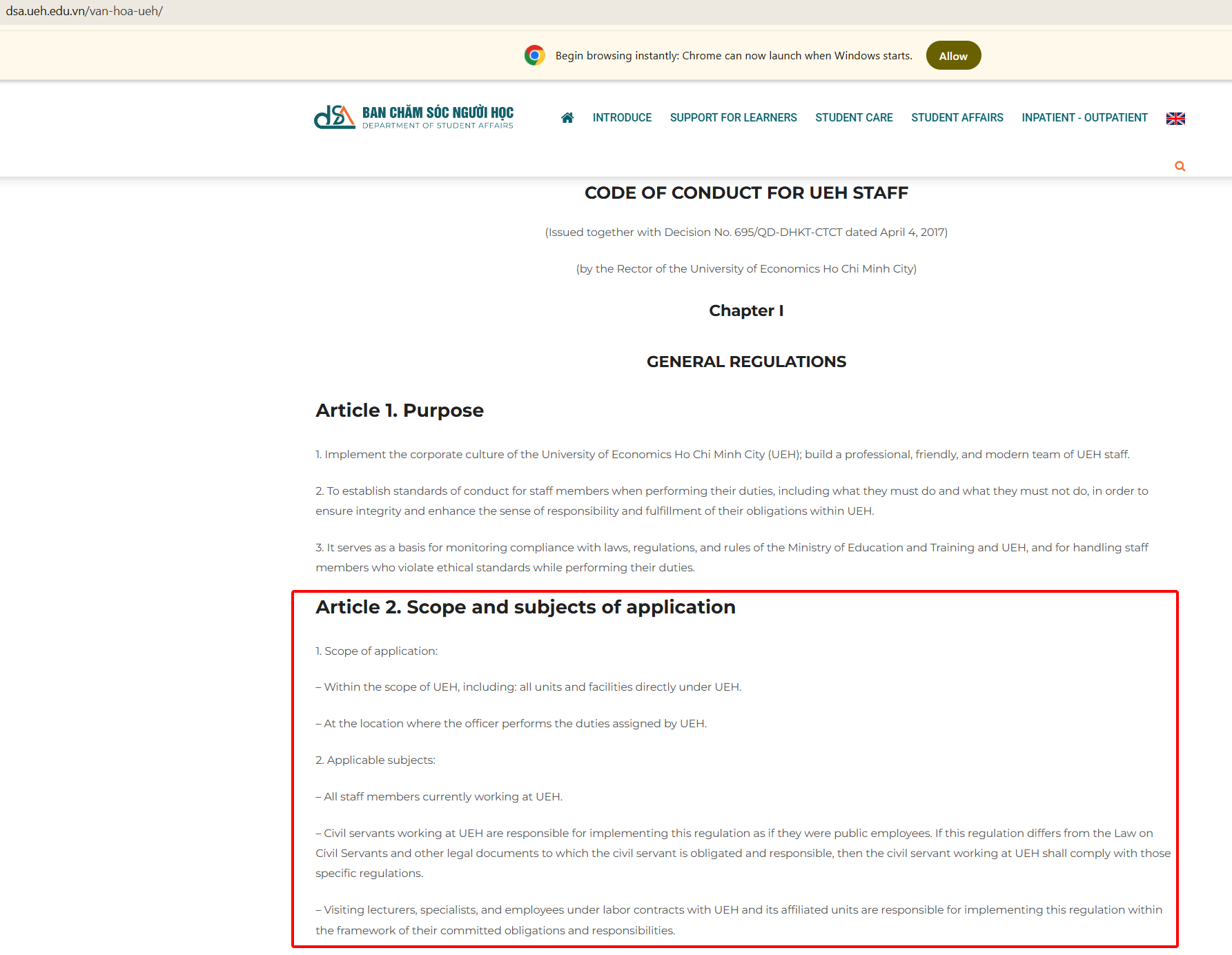
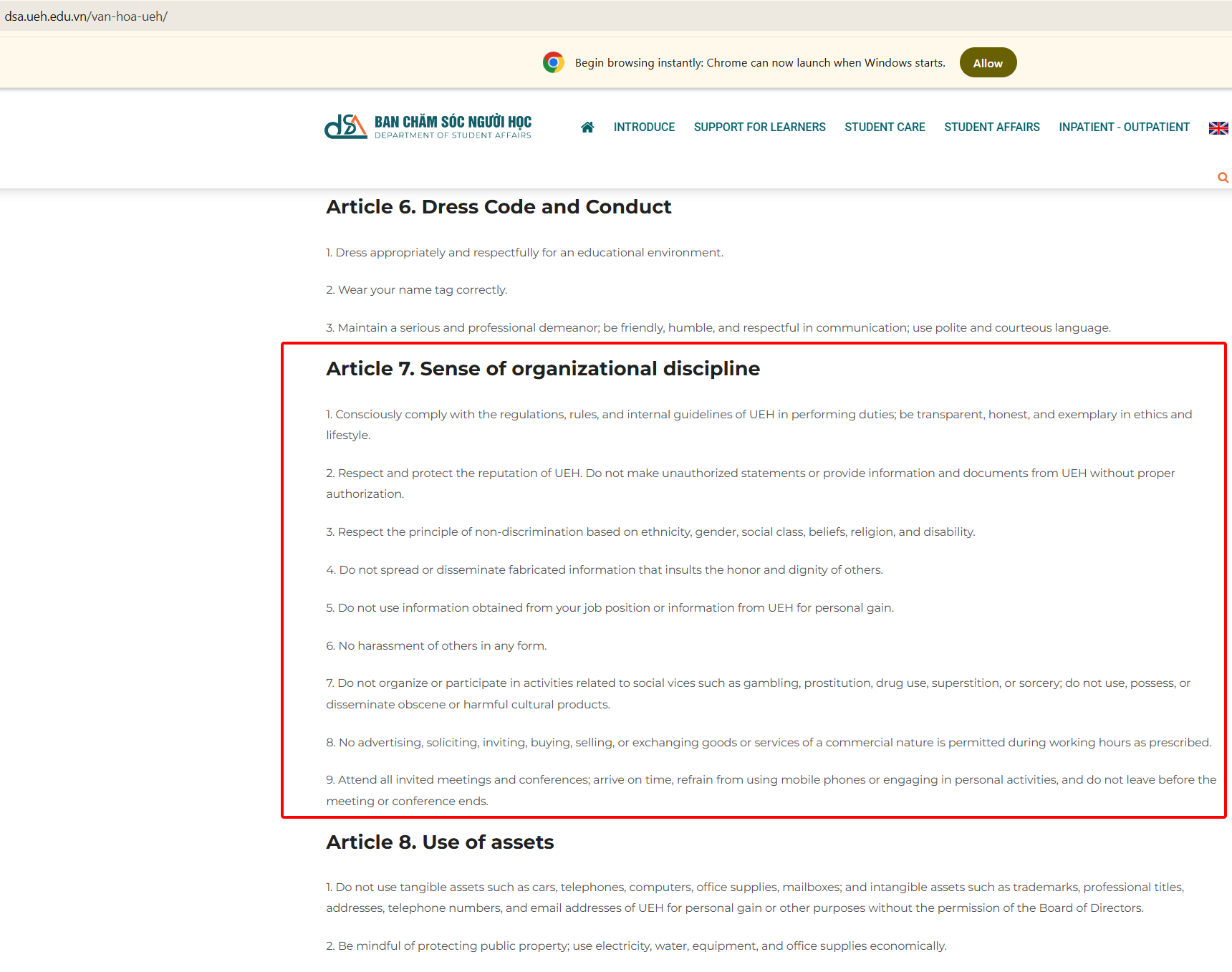
UEH’s Code of Conduct establishes non-discrimination principles and prohibits harassment within the scope of persons governed by the Code.
1.3. Non-Discrimination Policy for Learners, Including Transgender Students
UEH does not limit its non-discrimination principle to employment relationships, but also applies standards of fairness, respect and non-stigmatisation in its educational environment.
Under Article 16, Clause 3, of the UEH Codeof Conduct for Staff, staff members must not suppress, favour, discriminate against or show prejudice toward learners.
This provision establishes responsibilities for UEH lecturers and personnel in teaching, assessment, supervision, counselling and student interaction. The protected group includes transgender learners, regardless of gender identity or other personal characteristics.
UEH also publicly provides principles of conduct for learners aimed at fostering a culture of respect, fairness and non-discrimination in academic and campus life.
In the “Non-Discrimination Regulations at UEH,” published by the Department of Student Affairs, the University states that everyone, including transgender people, is entitled to fair treatment and development opportunities based on competence and merit, without discrimination based on gender identity.
These provisions demonstrate that the non-discrimination principle applies to both those working at UEH and those studying at the University.
Sources:
- UEH Code of Conduct, Article 16, Clause 3.
- UEH DSA, “UEH Promotes Equality and Women’s Empowerment in the Academic Environment,” section “Non-Discrimination Regulations at UEH.”
- UEH Future 5.6.2,sections on the Learner Code of Conduct and UEH Culture.
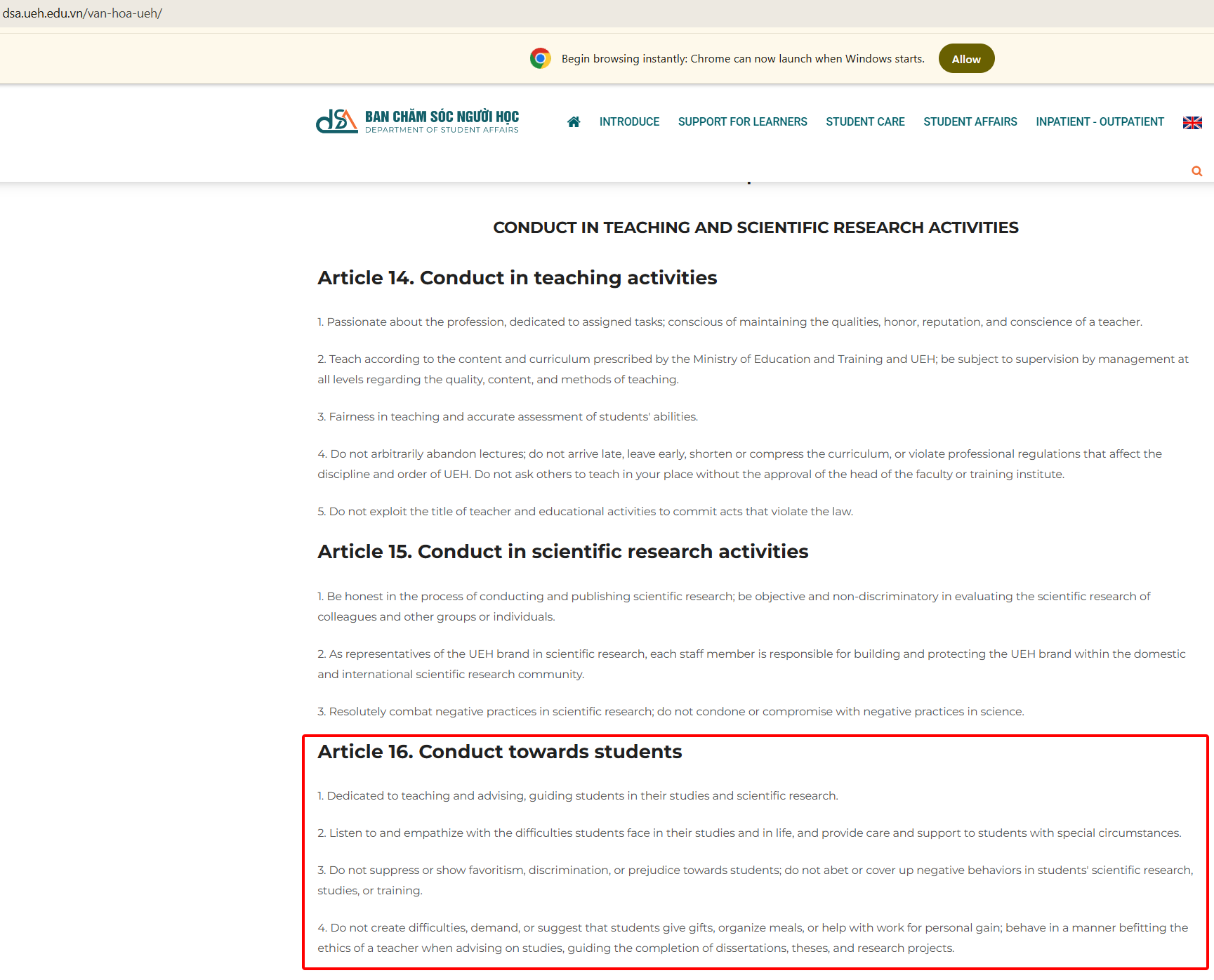
UEH prohibits discrimination against learners; DSA publicly affirms equal development opportunities for transgender people, regardless of gender identity.
1.4. UEH Culture and the Commitment to Diversity, Equity and Inclusion (DEI)
UEH regards respect for differences and equal opportunities for all individuals as important values in creating an academic and working environment. This direction is reflected in UEH Culture, the Code of Conduct and human resource development policies, with an emphasis on respect for diversity, equitable access to opportunities and an inclusive community.
For transgender people, equality means not only the absence of exclusion from recruitment but also respect for gender identity in day-to-day interactions, education and access to the University’s rights-protection mechanisms.
In its publicly available 2025 policy, UEH explicitly identifies transgender people among the groups entitled to fair treatment. UEH DSA likewise confirms that gender identity must not be used as a basis for discrimination.
These commitments provide a foundation for an environment in which transgender people are respected and can study, work and develop according to their individual abilities.
Sources:
- UEH Portal, 5 August 2025, article 79041.
- UEH DSA, “UEH Promotes Equality and Women’s Empowerment in the Academic Environment” , section “Non-Discrimination Regulations at UEH.”
- UEH Future 5.6.2,sections on UEH Culture, respect for diversity and inclusion.
1.5. Responsibilities for Monitoring, Addressing Violations and Protecting Rights through the UEH Trade Union
To ensure adherence to non-discrimination principles, UEH assigns responsibilities for inspection, monitoring and handling violations under its Code of Conduct.
Under Article 17 – Responsibilities of Organisationsand Individuals, unit leaders are responsible for implementing, communicating, inspecting and monitoring compliance with the Code of Conduct. Relevant units receive and respond to feedback from learners and other stakeholders within their respective mandates.
Under Article 18 – Criticism andDiscipline, violations of the Code of Conduct may result in reminders, criticism or proposals for disciplinary review depending on the nature and severity of the violation.
Beyond internal management, the UEH Trade Union represents and protects the lawful rights and interests of union members, staff and employees. In its 2025–2026 academic-year activity report, the Trade Union recorded its participation in consultations and critical reviews of labour policies, commendation and disciplinary committees, salary increase reviews, legal counselling, inspections, monitoring and support in resolving petitions, complaints and denunciations.
This mechanism provides an additional channel for representing and monitoring the rights of employees of different gender identities. However, the report does not provide separate figures on transgender people supported by the Trade Union.

Article 17 addresses implementation monitoring, while Article 18 concerns the handling of violations.
Supporting sources:
- UEH Code of Conduct,Articles 17 and 18.
- UEH Trade Union Report No. 26/BC-CD, 2025–2026, Sections II.1.2, II.1.3, II.1.7 and II.1.8, pages 3–4.
- Articles on UEH Trade Union activities in 2025 on the UEH Portal and UEH Trade Union website.
1.6. Mechanisms for Receiving and Resolving Complaints and Denunciations and Protecting Complainants in 2025
In 2025, UEH strengthened its framework for receiving and resolving complaints and denunciations, providing a basis for staff, employees and learners to report matters affecting their lawful rights and interests.
The following documents were issued:
|
Document |
Issue date shown in the image of the original document |
Content |
|
Decision No. 2410/QD-DHKT-BDCLKSNB |
14 August 2025 |
Issuing UEH Regulations on Receiving Petitions, Resolving Complaints and Resolving Denunciations |
|
Decision No. 2616/QD-DHKT-BDCLKSNB |
30 August 2025 |
Issuing the Procedure for Resolving Denunciations |
|
Decision No. 2617/QD-DHKT-BDCLKSNB |
30 August 2025 |
Issuing the Procedure for Resolving Complaints |
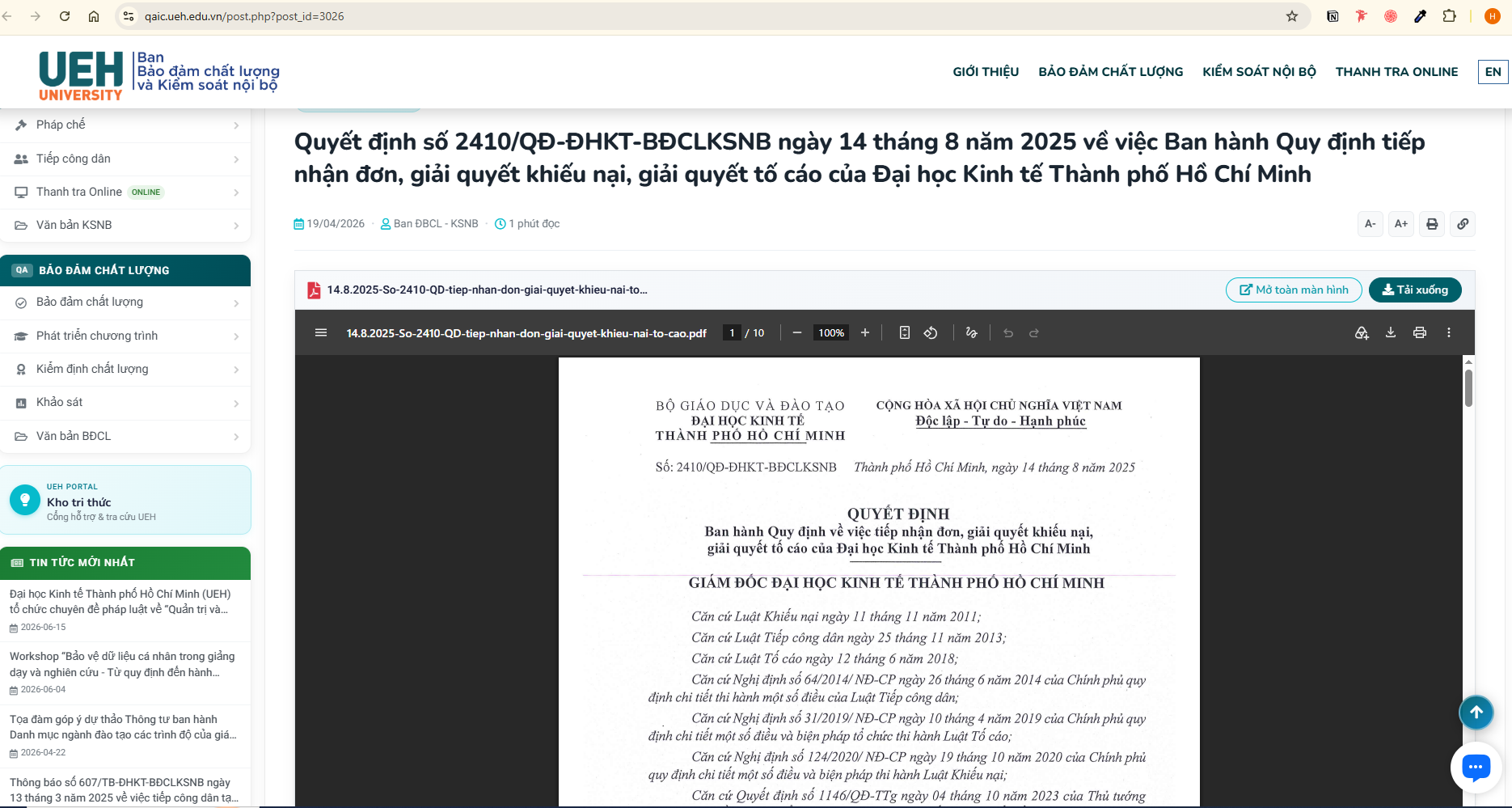
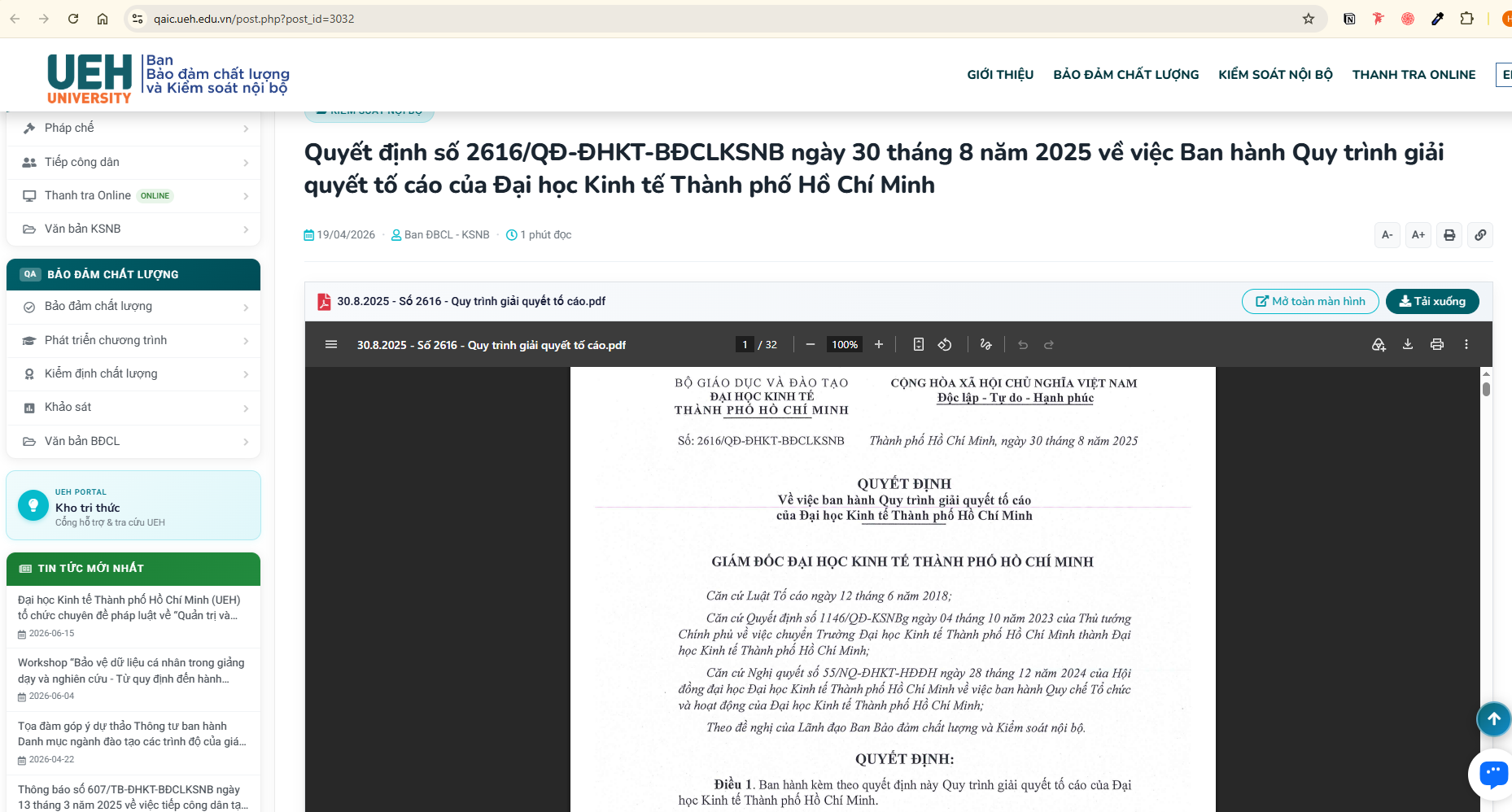
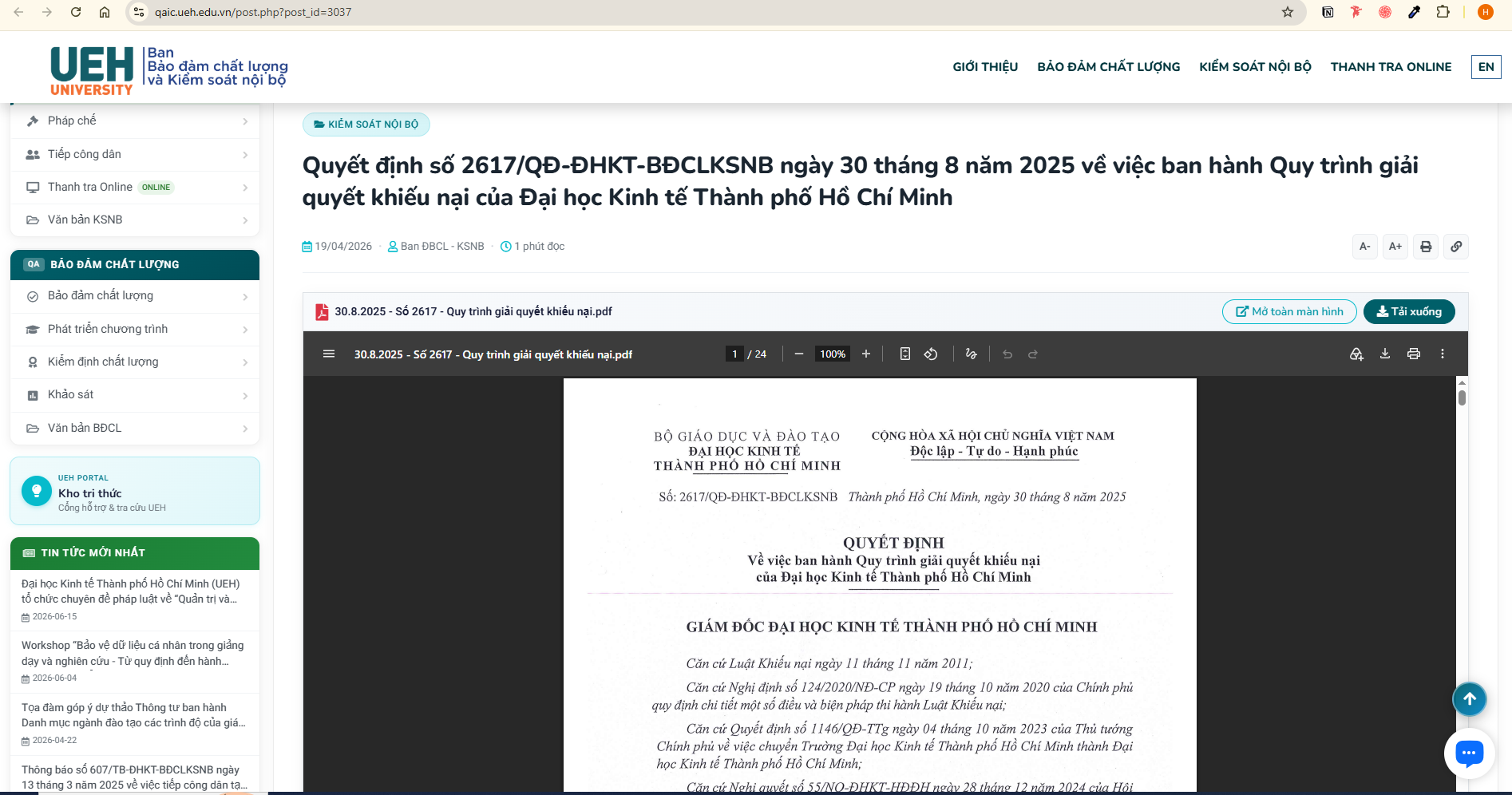
Source: UEH Quality Assurance and Internal Control Department website.
These regulations and procedures define responsibilities for receiving, processing, verifying and resolving matters within the relevant authority, while protecting the lawful rights and interests of complainants and persons making denunciations. Within their scope, the mechanisms may be used to report conduct, decisions or treatment contrary to regulations, including potential breaches of the non-discrimination principle.
For transgender people, these general mechanisms can support reporting and requesting reviews of acts affecting lawful rights. UEH also publicly states principles of information confidentiality and privacy protection for those submitting discrimination-related complaints or denunciations.
The 2025 updates to complaint and denunciation procedures helped strengthen implementation mechanisms for UEH’s non-discrimination policy.
Sources:
- UEH Decisions Nos. 2410, 2616 and 2617, published on the Quality Assurance and Internal Control Department website.
1.7. Preventing Sexual Harassment and Protecting Learners Regardless of Gender or Gender Identity
UEH combines its non-discrimination policy with measures to prevent sexual harassment and ensure a safe learning and working environment for all members.
Under Article 7, Clause 6, ofthe Code of Conduct, the University strictly prohibits harassment of others in all circumstances.
Under Article 8 of Labour CodeNo. 45/2019/QH14, sexual harassment in the workplace is prohibited.
Inappropriate sexual behaviour can include unwanted sexual remarks, comments or content; offensive gestures; inappropriate physical contact; sending sensitive images; violations of personal boundaries; and other forms of harassment.
These risks may affect learners and employees of any gender, including transgender people. UEH therefore implements preventive, counselling and support measures without assuming that only one gender can experience harassment.
UEH publishes Procedure CSHTNH.QT.009 for Receiving Information and Supporting Learners Experiencing Sexual Harassment, effective from 21 June 2021.
The support procedure comprises five elements:
- Receiving information and requests for support from learners.
- Verifying and assessing the information and nature of the incident.
- Providing support, counselling and guidance to learners.
- Coordinating with competent units to address violations.
- Monitoring support and the outcomes of case resolution.
The Department of Student Affairs (DSA) provides support and connects learners with relevant units within its remit.
In 2025, UEH continued communication activities, training sessions and discussions on recognising sexual harassment, respecting consent and seeking help when personal rights are violated.
Notably, the communication article published on 29 May 2025, “Gender Equity in Understanding Sexual Harassment: When Victims Are Not Only Women ,” emphasised the need to protect victims regardless of gender and addressed the impact of stereotypes and doubts concerning a victim’s gender identity.
This provides evidence of an approach to harassment prevention grounded in respect for the rights and dignity of all individuals, consistent with UEH’s non-discrimination policy for transgender people.
Sources:
- UEH Code of Conduct, Article 7, Clause 6.
- Procedure CSHTNH.QT.009, effective 21 June 2021 .
- UEH Portal, “Gender Equity in Understanding Sexual Harassment: When Victims Are Not Only Women,” 29 May 2025, article 74220.
- UEH DSA, “Sexual Harassment– Stay Silent or Speak Up?” programme,15 October 2025.
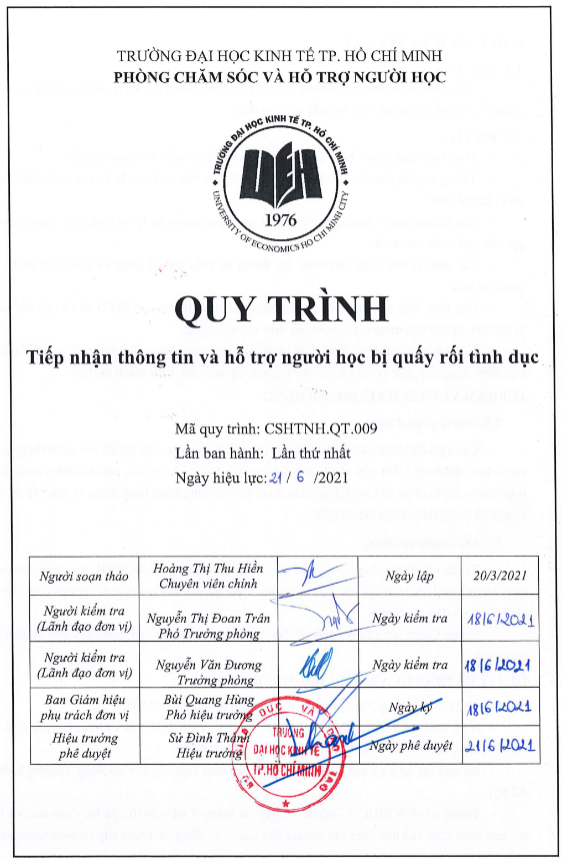

UEH implements anti-harassment policies and learner-support mechanisms and activities, aiming to protect all individuals against inappropriate sexual behaviour.
2. Activities and Implementation Results in 2025
2.1. Summary Table of Policies, Activities and Results in 2025
|
Policy / Activity |
Implementation scope |
Beneficiaries |
Implementation details |
Results and impact |
|
1. Public Disclosure of Non-Discriminatory Recruitment and Human Resource Development Policies for Transgender People – 27 January 2025 |
UEH-wide, within the scope of the policy |
Applicants, lecturers, staff and employees, including transgender people |
UEH publicly disclosed merit-based recruitment, succession planning and appointment policies without discrimination based on personal characteristics, explicitly including transgender people. |
The policy was published in early 2025 and confirmed that transgender people were not excluded from its protections. Source: UEH Portal 73312 – “The Implementation of Human Resource Policies Linked to the 17 SDGs in Terms of Intellectual Contribution to Sustainable Development.”
|
|
2. Continued Publication and Implementation of Non-Discrimination in Human Resource Governance – 5 August 2025 |
UEH-wide |
Employees, existing personnel and applicants, including transgender people |
Reaffirmed equal recruitment and appointment, prohibition of sexual harassment and remuneration based on competence, qualifications, position and responsibilities. |
Reinforced policy continuity throughout 2025. Source: UEH Portal 79041. |
|
3. Public Disclosure of Protections for Transgender People and Non-Discrimination Based on Gender Identity in Academia – 2025 |
Department of Student Affairs and the UEH community |
Learners and UEH members, including transgender people |
Publicly affirmed fair treatment and merit-based development opportunities without gender-identity discrimination, as well as confidentiality of complainants’ information. |
An explicit policy statement refers directly to “gender identity” and “transgender ” Source: UEH DSA, “Non-Discrimination Regulations at UEH.” |
|
4. Updated Mechanisms for Receiving and Resolving Complaints and Denunciations – August 2025 |
UEH-wide, within the scope of each document |
Staff, employees and learners within the relevant scope |
Issued Decisions Nos. 2410, 2616 and 2617 on receiving, verifying and resolving complaints and denunciations. |
Strengthened channels for reporting and protecting lawful interests, potentially applicable to discriminatory conduct under UEH’s authority. Source: 2025 Decisions of the Quality Assurance and Internal Control Department. |
|
5. Training Programme “Gender Equality: Where Are the ‘Gender’ Boundaries?” – March 2025 |
UEH student community |
Students attending the programme |
Discussed gender roles, stereotypes, equality awareness and creating a diverse and inclusive environment. |
Contributed to awareness and reducing prejudices that can lead to gender-based discrimination. No separate statistics on transgender participants are available. Source: UEH Portal, “Exploring ‘Gender’ Boundaries – What Do UEH Students Say About Gender Equality?”, 20 March 2025.
Speaker Bich Phuong discusses gender equality with UEH students. |
|
6. Communication Campaign “Gender Equity in Understanding Sexual Harassment: When Victims Are Not Only Women” – 29 May 2025 |
UEH Portal, learners and the general public |
People of all genders, including groups that may face gender-identity stereotypes |
Examined stereotypes about harassment victims, the right to protection regardless of gender and how victims may face doubts about their gender identity. |
Strengthened awareness of victim protection and reducing stigma; the number of transgender people reached was not established. Source: UEH Portal 74220, lines 25–42. |
|
7. UEH Trade Union Mid-Year Review Conference – 22 July 2025 |
UEH Trade Union |
Union members, staff and employees |
Reviewed representation, welfare activities and the development of a workplace culture of solidarity and fairness. |
Supplementary evidence of organisational mechanisms and an inclusive working environment. Source: UEH Portal 74499. Professor
Prof.Su Dinh Thanh and Assoc. Prof. Bui Quang Hung presented commendation certificates from the UEH President and UEH Trade Union mementos to recognised trade union officers. |
|
8. Talk Show “Sexual Harassment – Stay Silent or Speak Up?” – 15 October 2025 |
Auditorium B1.302, UEH Campus B |
Nearly 400 students |
Discussed identifying harassment, consent, personal boundaries, the right to self-protection and relevant legal provisions. |
Nearly 400 students participated and gained knowledge about preventing harassment and seeking support. Source: UEH DSA website, report on the talk show dated 15 October 2025. The programme addressed three main topics: Understanding Sexuality for Fulfilling Relationships; Understanding Sexual Harassment – Affection or a Trap?; and How Does the Law Address Sexual Harassment? |
|
9. Communication on Consent in Love and Sexual Relationships – 18 November 2025 |
UEH Portal and the student community |
Learners of all genders |
Explained consent, respect for personal boundaries and how to identify behaviours that may constitute harassment. |
Contributed to awareness of preventing inappropriate sexual behaviour. Source: UEH Portal 75323, 18 November 2025. |
|
10. Continuing Counselling, Monitoring and Protection of Staff and Employee Rights |
UEH Trade Union |
Union members, staff and employees within the applicable scope |
Consulted on policy, provided legal advice, participated in disciplinary and salary review committees, monitored compliance and helped resolve feedback. |
Strengthened general rights-protection mechanisms; no separate statistics are available for transgender people. Source: Trade Union Report No. 26/BC-CD, Sections II.1.2, II.1.3, II.1.7 and II.1.8, academic year 2025–2026. |


2.2. Results and Impact
Policy and career opportunities: UEH publicly disclosed recruitment, succession planning and appointment policies that explicitly include transgender people within the non-discrimination principle. The policy establishes a basis for evaluating applicants and personnel on competence and merit rather than gender identity or personal characteristics unrelated to the job.
Respect in the educational environment: UEH’s Code of Conduct and DSA’s published policy establish non-stigmatization and non-discrimination principles for learners, including transgender students, demonstrating that policy coverage is not limited to staff and employees.
Rights-protection mechanisms: UEH updated its complaint and denunciation framework in 2025, while procedures for receiving and supporting learners affected by harassment provide channels for reporting violations of lawful rights and interests.
Preventing discrimination and harassment: Training, discussions and communication activities in 2025 helped raise awareness of gender stereotypes, consent, gender identity and the right to protection against inappropriate sexual conduct.
Monitoring policy implementation: The UEH Trade Union’s role in consultation, monitoring and protecting employee rights provides an additional channel for representation and feedback in the workplace.
The compiled sources do not disclose the number of transgender people recruited, receiving benefits or obtaining individual support in 2025. The results above are therefore assessed in terms of policy publication and organisational activities, rather than inferred numbers of transgender beneficiaries.
3. Comparison of Policy Implementation in 2024 and 2025
|
Category |
2024 |
2025 |
Results and impact |
|
Non-discrimination policy for transgender people |
UEH maintained the foundations of its human resource policy, Code of Conduct and DEI direction. |
UEH continued publicly disclosing human resource policies in January and August 2025, explicitly naming transgender people. |
Strengthened policy continuity and transparency. |
|
Policy for transgender learners |
Maintained non-stigmatisation and equality principles in education. |
DSA publicly affirmed protections for everyone, including transgender people, regardless of gender identity. |
Clarified policy coverage and the explicit reference to gender identity. |
|
Monitoring and rights-protection mechanisms |
The Code of Conduct established monitoring responsibilities and the handling of violations. |
UEH updated three documents on complaints and denunciations in August 2025. |
Strengthened channels for receiving, verifying and addressing reports. |
|
Sexual harassment prevention |
Maintained the prohibition of harassment and learner-support procedures. |
Continued gender-inclusive victim-protection communications and a talk show attended by nearly 400 students. |
Improved awareness and knowledge of where to seek support. |
|
Gender equality communications and education |
UEH maintained communication activities addressing gender issues and inclusion. |
Held training in March 2025 and communication activities in May and November 2025. |
Expanded awareness of stereotypes, respect for differences and personal boundaries. |
|
Trade Union participation in rights protection |
The Trade Union fulfilled its representative and labour-relations monitoring roles. |
The Trade Union continued consulting on policy, monitoring implementation and helping address reports. |
Maintained worker rights-protection mechanisms; no separate figures for transgender people are available. |
|
Data on transgender policy beneficiaries |
No separately verified data. |
No separately verified data. |
No basis for determining changes in beneficiary numbers. |
4. Conclusion
In 2025, the University of Economics Ho Chi Minh City continued implementing its non-discrimination policy for transgender people through its human resource governance, Code of Conduct, protections for learners, monitoring mechanisms and complaint-handling processes. Notably, recruitment, succession planning and appointment policies published by UEH in 2025 expressly identified transgender people as included in the non-discrimination principle. In addition, the policy published by the Department of Student Affairs affirmed equal opportunities irrespective of gender identity.
Alongside maintaining internal policies, UEH updated its complaint and denunciation procedures and implemented gender equality education and activities to prevent prejudice and sexual harassment in 2025. These initiatives helped strengthen a safe learning and working environment where individuals can be respected, access opportunities and report violations of their lawful rights.
By integrating non-discrimination policies, implementation mechanisms and preventive educational activities, UEH continues to promote aculture of diversity, equity and inclusion and to include transgender people in its commitment to sustainable, people-centred higher education, contributing to SDG 5 – Gender Equality.