

14.5.2. Monitoring the Health of Aquatic Ecosystems
Monitoring the health of aquatic ecosystems
The University of Economics Ho Chi Minh City (UEH) promotes the monitoring and assessment of water quality and aquatic ecosystem conditions through its Green Campus Regulations, water quality monitoring at its campuses, and research and collaborative programmes concerning aquatic environments, aquaculture, and estuarine and coastal ecosystems. This approach combines environmental parameter monitoring with scientific research, field surveys, and assessments of pressures on aquatic ecosystems, providing evidence to support the management and conservation of aquatic resources.
In 2025, UEH continued monitoring treated wastewater quality at its Nguyen Van Linh Campus, conducting research on environmental performance in aquaculture and advancing research and collaborative programmes concerning estuarine and mangrove ecosystems in the Mekong Delta. Key activities included a study applying Aquaculture Performance Indicators (API) to assess the environmental performance of shrimp farming systems in Vietnam; the GS4Infra project examining water conditions, hydraulic infrastructure, and adaptation to saltwater intrusion in Cu Lao Dung; and the development of marine environmental monitoring technologies proposed under the National Research Centre for Ocean Technology initiative in Khanh Hoa.
These activities helped develop datasets and scientific evidence for identifying pollution risks, assessing pressures on aquatic habitats, and proposing measures for managing and protecting aquatic ecosystems.
- Policy Framework and Strategic Direction for Monitoring Aquatic Ecosystem Health at UEH
1.1. Regulatory Framework and Action Plan
UEH monitors and manages water quality through two interrelated components: on-campus environmental management and off-campus research and collaborative programmes assessing aquatic environments.
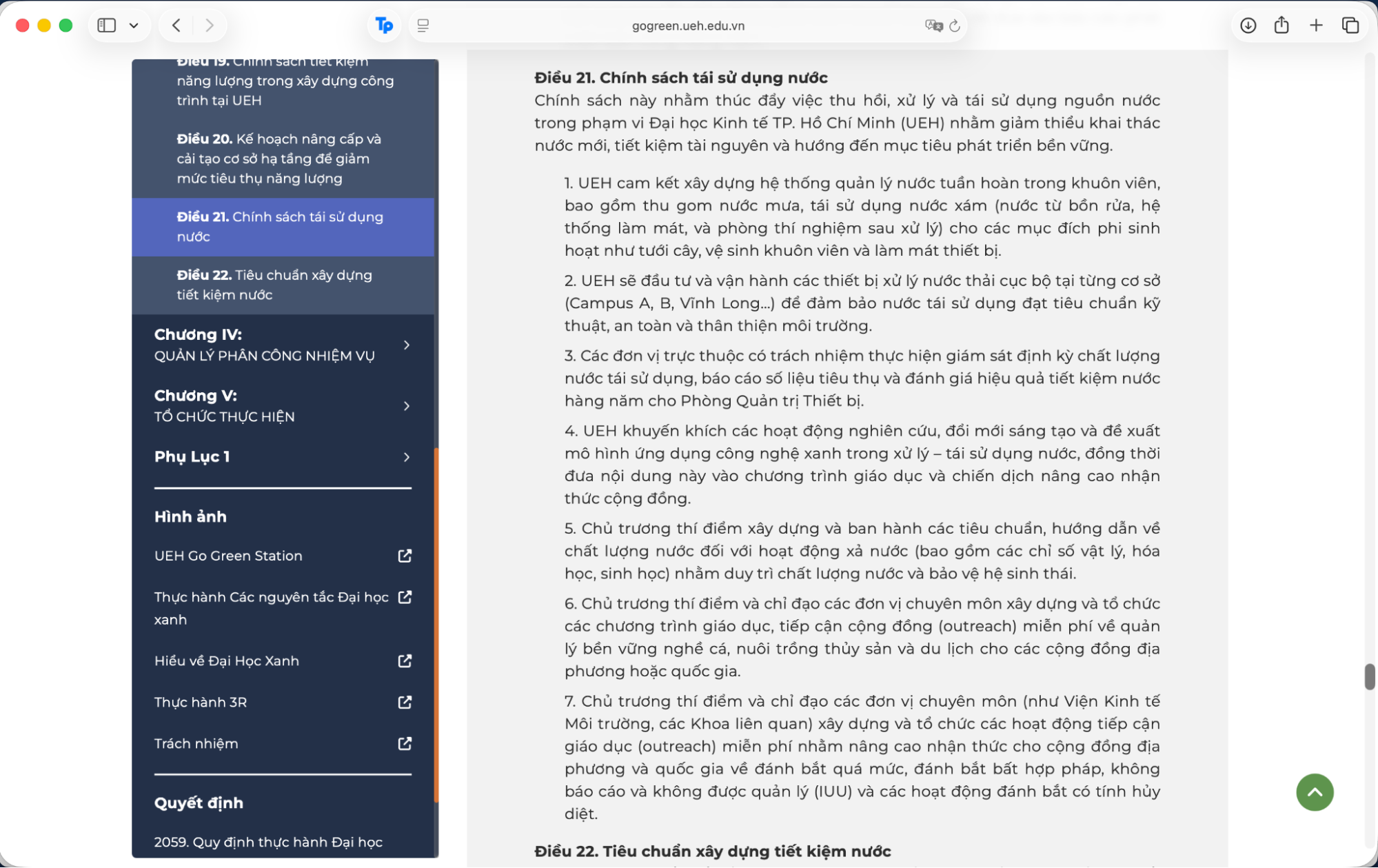
First, the Green Campus Regulations, issued under Decision No. 2059/QD-DHKT-CSVC in 2022, establish directions for water resource management, waste control, and responsibilities for monitoring water quality throughout university operations.
Specifically, Article 21, Clauses 1–3, address water management, treatment, reuse, and quality monitoring. Clause 5 establishes a direction for developing wastewater discharge standards and guidelines based on physical, chemical, and biological indicators to maintain water quality and protect ecosystems. These provisions provide a policy basis for monitoring water parameters, identifying pollution risks, and improving water management practices.
Second, the 2025 UEH Green Campus Project implementation plan translates environmental management directions into operational reviews of wastewater treatment systems, compilation of water quality data, and assessment of operating conditions across campuses.
At the Nguyen Van Linh Campus, UEH compiled information on wastewater treatment procedures, water quality testing results produced by specialist service providers, and relevant infrastructure data. This information supported the monitoring of water conditions, control of pollution sources, and continued refinement of water management criteria within the Green Campus framework.
Beyond on-campus management, UEH promotes scientific research on aquatic environments, aquatic resource management, aquaculture impacts, and the resilience of estuarine and coastal ecosystems. These studies extend the scope of assessment beyond campus water quality to environmental challenges in localities where aquatic ecosystems are sensitive to climate change and economic activity.
Sources:
- UEH Green Campus, Green Campus Regulations: https://gogreen.ueh.edu.vn/quy-dinh-thuc-hanh-dai-hoc-xanh
- 2025 Environmental Protection Report – Nguyen Van Linh Campus
- UEH Portal, New Developments in the UEH Green Campus Project in 2025: https://gogreen.ueh.edu.vn/tin-moi-noi-bat/nhung-buoc-tien-moi-cua-du-an-ueh-green-campus-nam-2025-hanh-trinh-van-hanh-va-lan-toa-mo-hinh-dai-hoc-xanh-ueh-den-cong-dong
1.2. Monitoring Objectives and Scope
UEH’s water environment monitoring and assessment activities pursue three interconnected objectives.
Monitoring water quality: Through physical, chemical, and microbiological parameters, UEH assesses treated wastewater quality, identifies pollution indicators, and monitors potential impacts on receiving water environments.
Assessing pressures on aquatic ecosystems: Through scientific research and field surveys, UEH examines water resource use, wastewater management in aquaculture, saltwater intrusion, changing water conditions, and the effects of infrastructure on natural environments.
Supporting ecosystem management and conservation: Monitoring, research, and assessment findings provide scientific evidence for improving water management, guiding habitat conservation, and developing models adapted to environmental conditions.
The scope includes water quality monitoring within UEH operations and research and collaborative programmes with academic partners, local authorities, and communities in areas involving freshwater, brackish-water, estuarine, and coastal ecosystems.
2. Water Environment Monitoring and Assessment Activities in 2025
2.1. Water Quality Monitoring and Pollution Risk Control at UEH Campuses
One activity supported by direct monitoring data in 2025 was the assessment of treated wastewater quality at the Nguyen Van Linh Campus.
According to the 2025 Environmental Protection Report, the campus has a centralised wastewater treatment plant with a design capacity of 550 m³/day. The system integrates collection, oil separation, equalisation, physicochemical treatment, biological treatment, sedimentation, and disinfection before treated water enters the receiving drainage system.
Water quality monitoring was conducted to evaluate treatment performance, track pollution parameters, and identify potential anomalies affecting the aquatic environment.
Parameters assessed in wastewater testing records include pH, biochemical oxygen demand (BOD₅), total suspended solids (TSS), nitrogen compounds, phosphate, and Coliform. These provide information on chemical characteristics, organic loading, solids, and microbiological contamination, supporting assessments of potential degradation of receiving water quality.
In 2025, UEH maintained an Environmental Protection Report documenting wastewater sampling and analysis, together with individual monitoring records for the Nguyen Van Linh Campus. These records show the involvement of an external specialist organisation in sampling and water quality testing, providing independent operational management data.
By combining treatment systems with wastewater sampling and analysis, UEH monitored one source of potential pressure on receiving waters. However, these results describe wastewater quality at the sampling points; they do not constitute direct measurement of biodiversity conditions or the overall health of the receiving aquatic ecosystem.
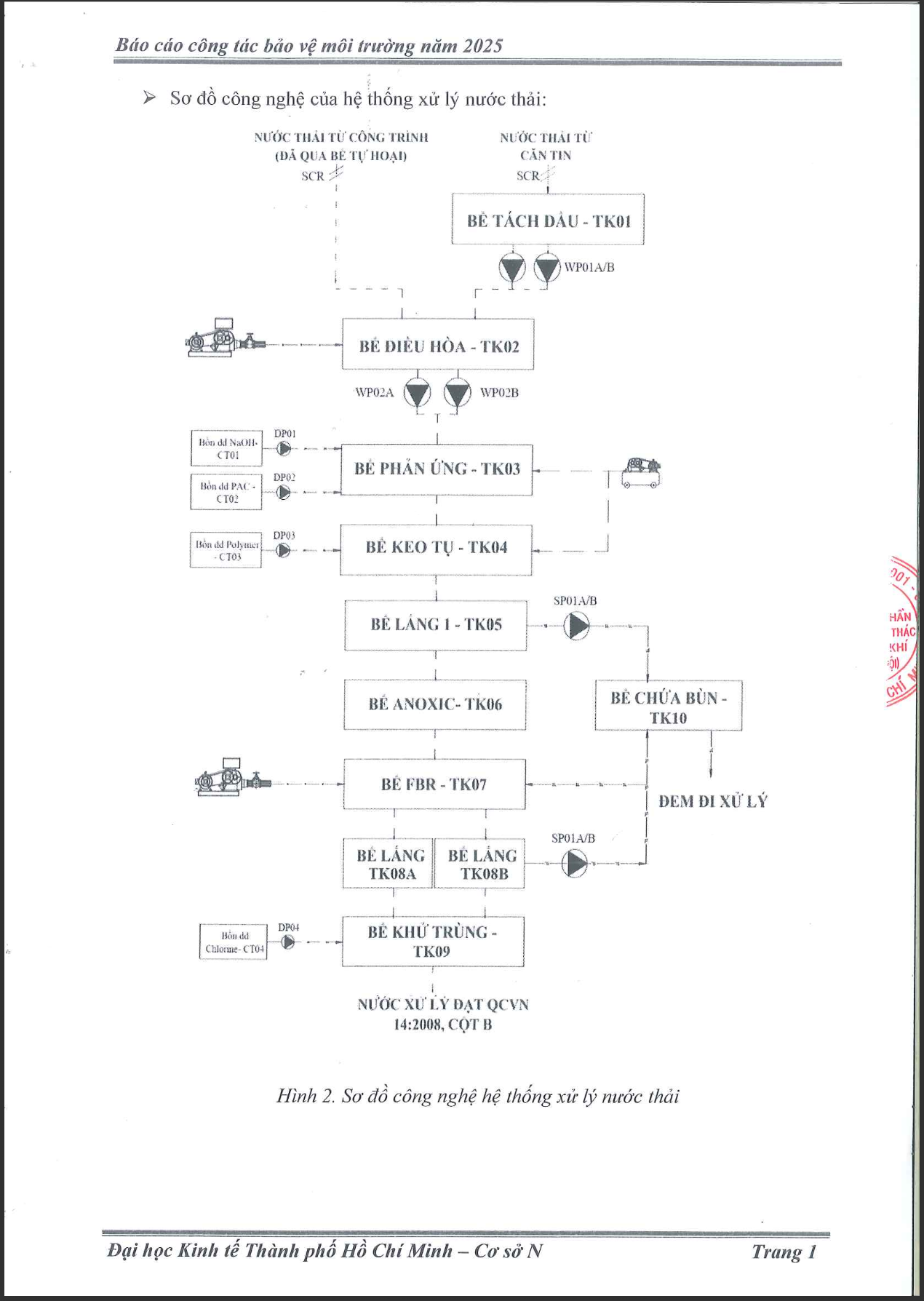
Wastewater treatment process flow diagram

Source:
2.2. Research Assessing the Environmental Performance of Aquaculture Systems in Vietnam
In addition to monitoring campus water quality, UEH contributes directly to the assessment of environmental conditions and pressures on aquatic ecosystems through scientific research in aquaculture.
In 2025, Dr. Ho Quoc Thong and Dr. Do Huu Luat, UEH lecturers and researchers affiliated with the EfD Vietnam/EEPSEA network, co-authored a study with Professor Håkan Eggert entitled Shrimp farming industry in Vietnam: An aquaculture performance indicators approach in the journal Aquaculture Economics & Management.
The study applied Aquaculture Performance Indicators (API) together with a Triple Bottom Line approach to assess the economic, social, and environmental performance of four shrimp production systems in Vietnam: extensive, semi-intensive, intensive, and super-intensive farming.
Using these indicators, the researchers examined differences in environmental performance across production systems, particularly water management, wastewater treatment, disease risks, and impacts on surrounding ecosystems.
The findings identified significant environmental performance challenges in intensive shrimp farming, particularly regarding water use, wastewater management, and disease risks. The study also noted biodiversity concerns associated with changes in mangrove ecosystems.
The API framework offers a structured method for comparing environmental pressures across aquaculture models. Its findings help identify risks to water quality and aquatic habitats and provide scientific evidence for selecting more sustainable aquaculture management practices.
This is direct evidence of UEH research evaluating environmental performance in systems that utilise aquatic resources. Indicator-based evaluation must be distinguished from continuous field-based biological monitoring, although it is valuable for identifying, comparing, and tracking pressures on ecosystems.
Source:
Ho, T. Q., Do, H.-L., & Eggert, H. (2025). Shrimp farming industry in Vietnam: An aquaculture performance indicators approach. Aquaculture Economics & Management.
https://doi.org/10.1080/13657305.2024.2449410
2.3. Research and Field Surveys on Water Conditions and Hydraulic Infrastructure in the Cu Lao Dung Estuary
UEH continues to advance research on climate change impacts, water conditions, and infrastructure management in the Mekong Delta, providing information on pressures affecting aquatic environments and estuarine habitats.
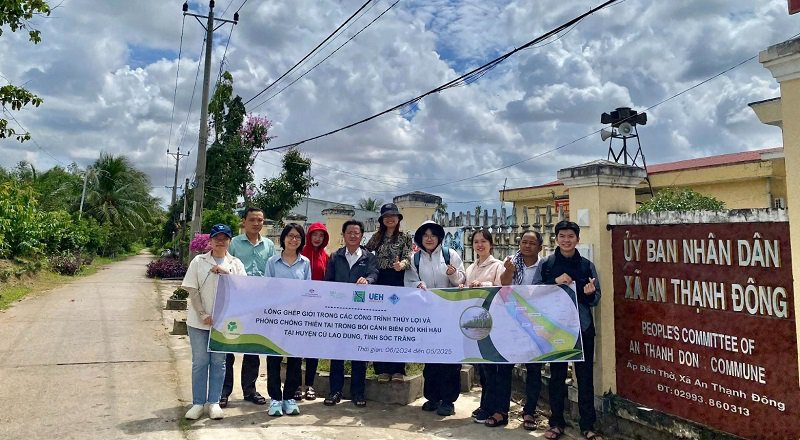
During 2024–2025, the GS4Infra project – Gender-sensitizing for Design and Operation of Water-Energy-Climate Change Infrastructures in Soc Trang Province, Mekong Delta, Vietnam – investigated the design and operation of water infrastructure and adaptation to climate change in Cu Lao Dung.
The project focused on infrastructure directly affecting local water and environmental conditions, including flood embankments, water control sluices, canals, and green infrastructure solutions such as mangroves.
Through field surveys, community interviews, and stakeholder consultations, the researchers gathered information on water use, saltwater intrusion, tidal flooding, and the effects of infrastructure on production and livelihoods.
The project final report documented 66 interviews completed during fieldwork ending on 29 September 2024. These survey data were compiled and used in subsequent analysis, dissemination of research findings, and policy dialogue during the project period.
The findings identified saltwater intrusion as a substantial challenge to local agriculture and aquaculture. The effectiveness and impacts of embankments, sluices, and canals also depended on water use conditions, livelihood characteristics, and community involvement in infrastructure management.
These findings provide information on interactions among water conditions, infrastructure, and economic activities in the estuary, supporting environmental pressure assessments, adaptive infrastructure management, and the protection of relevant habitats.
GS4Infra illustrates an approach to assessing water conditions using surveys, community information, and infrastructure impact analysis. Its findings are not evidence of a network that periodically measures biological ecosystem indicators.
Sources:
- GS4Infra Project Final Report, sections Executive Summary, Fieldtrip and Data Collection, and Results and Key Insights.
- Project final report: https://drive.google.com/file/d/1MI_bL0j5z4nHN4BA17S-f96xg_x6cufA/view
2.4. Research and Collaboration on Mangrove and Estuarine Habitat Conservation
Beyond assessing water quality and pressures from production activities, UEH promotes research and collaboration on mangrove conservation, helping protect important habitats at the interface between terrestrial and aquatic environments.
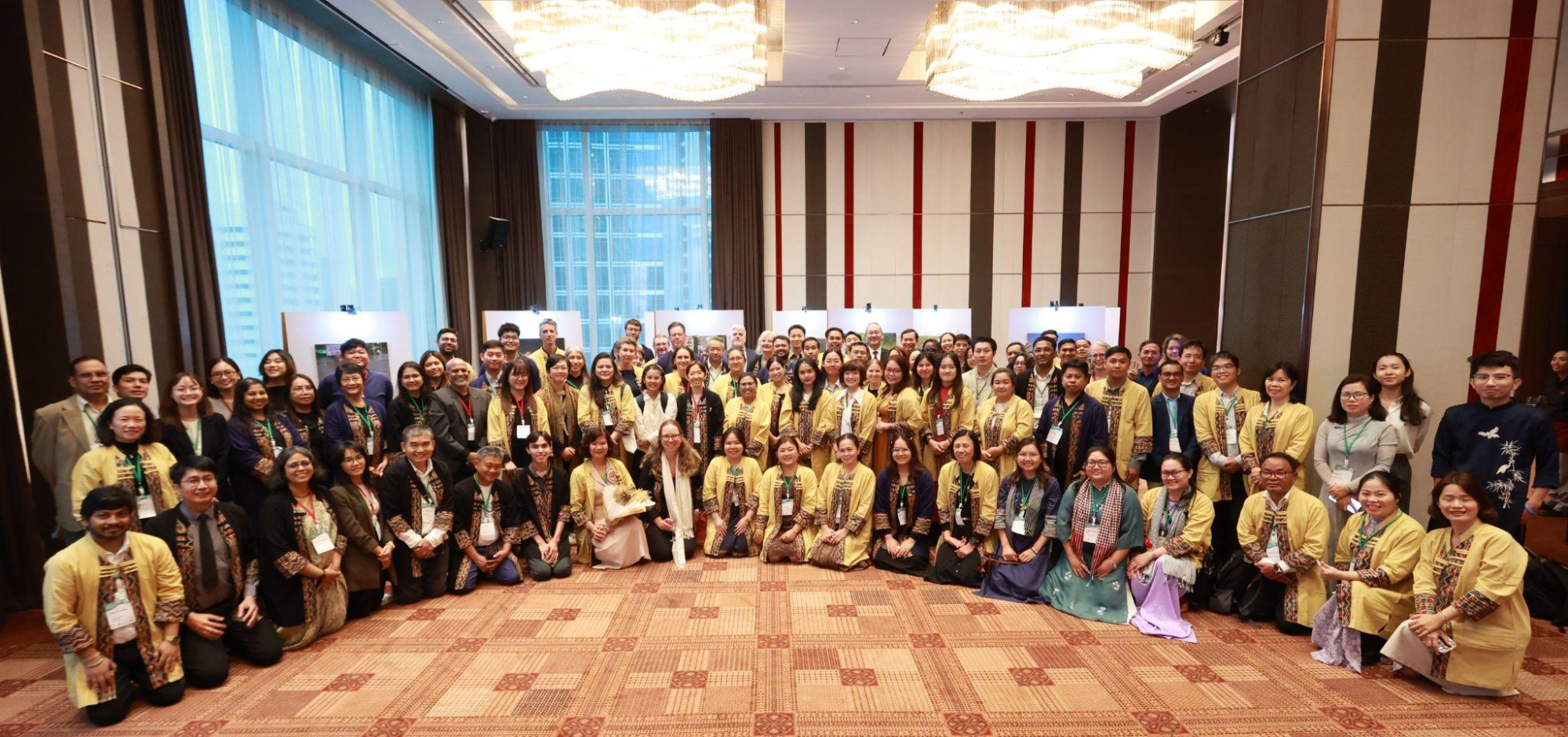
In 2025, UEH became the lead institution for the international Women4Mangrove project in Cu Lao Dung, focusing on community-based conservation and climate-resilient livelihoods linked to mangrove ecosystems.
The project aims to restore five hectares of Sonneratia caseolaris mangroves, establish a community nursery, and develop an educational agritourism model linked to nature conservation.
During the preparatory phase in 2025, the project team conducted field surveys, community consultations, and meetings with local authorities to understand natural conditions, livelihood needs, and habitat conservation requirements.
These surveys and consultations provided baseline information to help define the implementation scope, select conservation measures, and plan mangrove restoration in subsequent stages.
In relation to aquatic ecosystem health monitoring, these activities demonstrate UEH’s efforts to gather information and assess estuarine and coastal habitat conditions. However, the five-hectare restoration target is a planned project outcome, not a completed restoration result in 2025.
Source:
UEH Portal (20 December 2025), Women4Mangrove Project – Strengthening Community-Based Conservation and Educational Agritourism Linked to Afforestation in the Mekong Delta.
2.5. Developing Technological Approaches for Marine Environmental Monitoring
Alongside environmental surveys and assessments, UEH advances technology research to strengthen the collection, analysis, and use of data on marine resources and environments.
In 2025, through its Institute of Smart City and Management (ISCM), UEH continued studying a proposal to establish the National Research Centre for Ocean Technology, commissioned by Khanh Hoa Province.
The proposal identified technologies with potential applications in marine environmental research and monitoring, including underwater robots and autonomous vehicles, ocean observation systems, data management and analytics, ocean modelling, and marine biotechnology.
UEH publicised these research directions in 2025 and continued discussions at specialised ocean technology events, including the Ocean Futures 2025 International Conference in Khanh Hoa.
Research into ocean data collection and analysis technologies provides a foundation for developing marine environmental monitoring capacity, detecting changes in natural conditions, and supporting sustainable marine resource management.
This is evidence of research and planning for monitoring technologies in 2025, not evidence that UEH had operated an automated ocean monitoring system in the field.
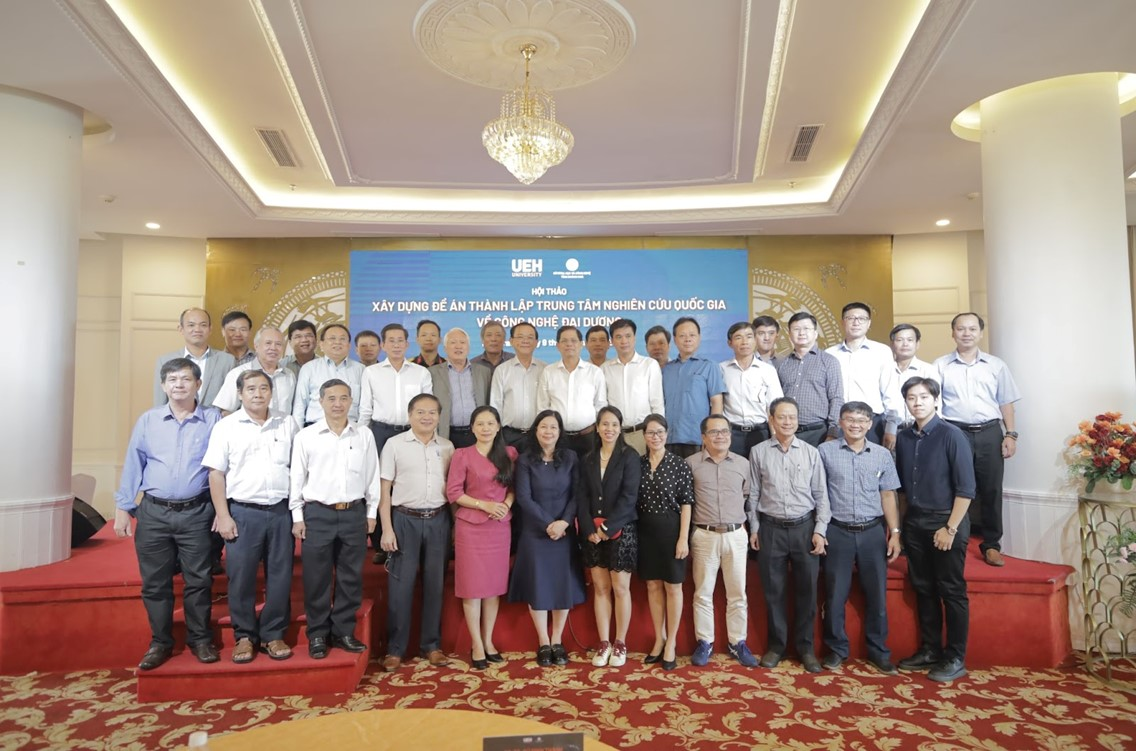
Establishing the National Research Centre for Ocean Technology: Building a Marine Technology Ecosystem for a Sustainable Future
Sources:
- UEH Future, Research on Establishing the National Research Centre for Ocean Technology: https://future.ueh.edu.vn/chi-tiet-knowlege/research-contribution-xay-dung-trung-tam-nghien-cuu-quoc-gia-ve-cong-nghe-dai-duong-khoi-tao-he-sinh-thai-cong-nghe-bien-vi-tuong-lai-ben-vung/
- UEH Portal, Ocean Futures 2025 International Conference in Khanh Hoa: https://ueh.edu.vn/khoa-hoc/hoi-thao-quoc-te-tuong-lai-dai-duong-2025-tai-khanh-hoa-cong-nghe-thong-minh-va-cuoc-song-ven-bien-ben-vung-74916
3. Implementation, Monitoring, and Evaluation
UEH organises water environment monitoring and assessment through coordination among its Green Campus management system, facilities management units, specialist research teams, and domestic and international partners.
For campus operations, the facilities management unit works with operating teams and environmental specialists to inspect wastewater treatment systems, collect samples, and compile water quality analysis results.
According to the 2025 Environmental Protection Report, monitoring at the Nguyen Van Linh Campus involved a specialist environmental organisation. Analysis results were used to assess treated wastewater quality against applicable technical limits and to inform discharge management and operational requirements.
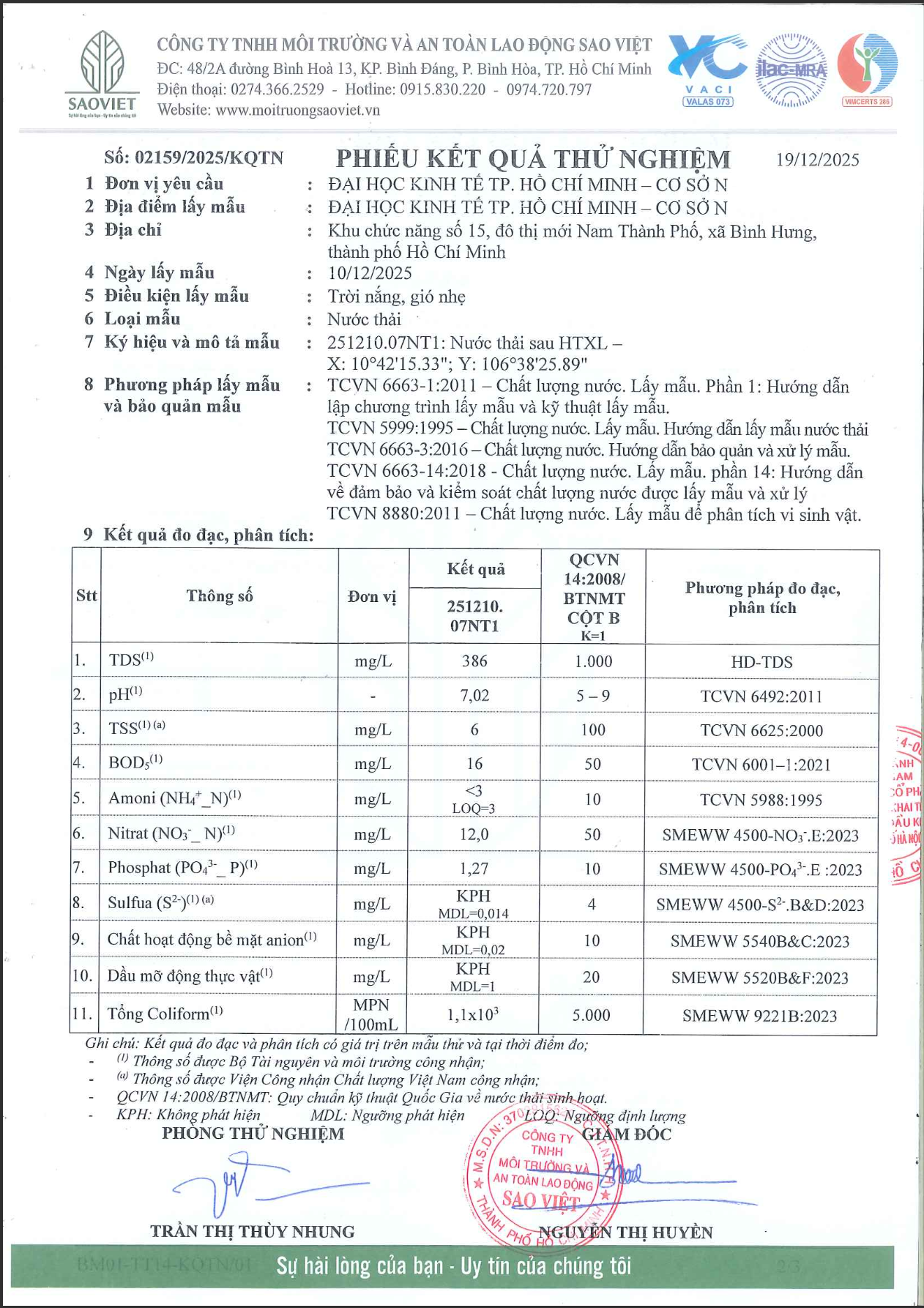 Sample test results dated 10 December 2025
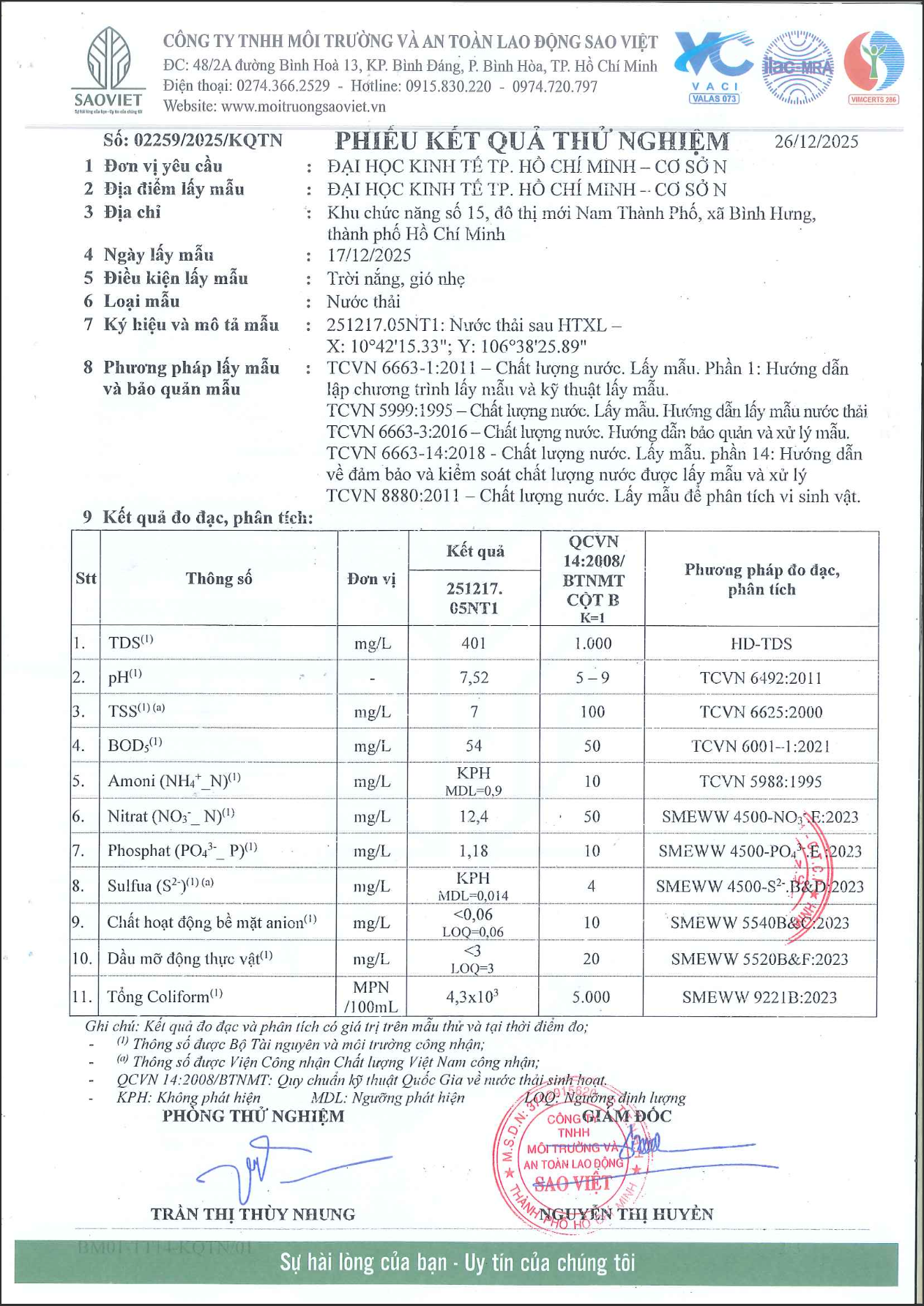 Sample test results dated 17 December 2025
For off-campus research, UEH research groups apply methods appropriate to each subject. The shrimp farming study used API to compare environmental performance across production systems; GS4Infra combined field surveys, interviews, and community data analysis to examine water conditions, infrastructure, and adaptive capacity; and mangrove conservation collaborations conducted preliminary surveys and stakeholder consultations to inform conservation planning.
These activities reflect three complementary methods of monitoring and assessment: measuring water quality parameters; assessing environmental pressures through research and indicators; and surveying habitat conditions and infrastructure impacts in research areas.
The information collected helps UEH and its partners identify environmental concerns, formulate management recommendations, and guide further research and collaboration on aquatic ecosystem conservation.
Sources:
- 2025 Environmental Protection Report, Nguyen Van Linh Campus.
- 2025 wastewater monitoring records, Nguyen Van Linh Campus.
- Ho, T. Q., Do, H.-L., & Eggert, H. (2025), study applying Aquaculture Performance Indicators.
- GS4Infra Project Final Report.
- UEH Portal, Women4Mangrove Project, 2025.
4. Results of Monitoring and Assessment Activities in 2025
| Monitoring and assessment area | Activities and results recorded in 2025 | Contribution to aquatic ecosystems |
| Wastewater quality monitoring | Continued sampling and analysis of treated wastewater at Nguyen Van Linh Campus, with a 2025 environmental report and separate monitoring records | Provided data for controlling pollution sources potentially affecting receiving water quality |
| Assessment of environmental performance in aquaculture | Published research applying API to evaluate the environmental performance of four shrimp farming systems in Vietnam | Identified pressures related to water management, wastewater, disease risks, and biodiversity |
| Research on estuarine water conditions and infrastructure | GS4Infra compiled survey data and analysed saltwater intrusion, tidal flooding, and infrastructure impacts in Cu Lao Dung; research and dissemination continued during the project period | Provided scientific evidence for assessing water conditions and guiding adaptive infrastructure management |
| Habitat surveys and conservation planning | Women4Mangrove carried out surveys and community consultations and developed directions for mangrove conservation in Cu Lao Dung | Helped establish baseline conditions and conservation requirements for estuarine and coastal habitats |
| Research on marine environmental monitoring technology | Studied the proposal for the National Research Centre for Ocean Technology, identifying technologies for observation, data analysis, and ocean modelling | Provided a foundation for developing technological capacity for marine resource monitoring and management |
The recorded results show that UEH undertook a range of activities in 2025, from monitoring environmental parameters and researching ecological pressures to field surveys and the development of technological directions.
Wastewater monitoring at Nguyen Van Linh Campus provides evidence of measurement and water quality testing; API research adds a systematic approach to assessing environmental factors in aquaculture. GS4Infra and Women4Mangrove extend research to estuarine water conditions, infrastructure, and habitats, while ocean technology research contributes to planning future monitoring capacity.
These activities differ in how directly they monitor aquatic ecosystem health. Taken together, they provide information and research foundations for UEH to further improve water quality monitoring, ecological pressure assessments, and ecosystem management and conservation.
5. Conclusion
In 2025, UEH continued promoting water environment monitoring and assessment through the implementation of its Green Campus Regulations, campus wastewater quality monitoring, and scientific research and collaborative programmes concerning aquatic ecosystems.
Water quality monitoring at Nguyen Van Linh Campus generated data to help manage pollution risks; research applying Aquaculture Performance Indicators evaluated the environmental performance of shrimp farming systems; and GS4Infra and Women4Mangrove contributed insights into water conditions, infrastructure impacts, and the conservation of estuarine and mangrove habitats. In addition, ocean technology research in Khanh Hoa laid the groundwork for future marine environmental monitoring methods and tools.
By combining environmental management, water quality monitoring, research into ecological pressures, and community partnerships, UEH progressively strengthened the scientific basis for monitoring, managing, and protecting aquatic ecosystems, contributing to SDG 14 – Life Below Water.