

14.4.2. Action Plan to Reduce Plastic Waste on UEH Campuses
In 2025, the University of Economics Ho Chi Minh City (UEH) continued implementing its campus plastic waste reduction action plan, building on the Green Campus Regulations, the “Towards No Single-use Plastic Future” campaign, and the “No Single-use Plastic Campus System” initiative. Through policies to reduce single-use plastics, encourage alternatives, segregate waste at source, collect and recycle materials using technology, and strengthen the responsibilities of service providers, UEH gradually developed a circular-economy approach to waste management. During 2025, the University continued activities across several campuses, recorded actual plastic bottle collection results, and secured a USD 10,000 grant to develop plastic waste management solutions. These efforts contributed to SDG 14 – Life Below Water by reducing plastic waste generation and the risk of leakage into the environment.
1. Plastic Waste Reduction Policy and Action Plan
Reducing plastic waste is an important component of the UEH Green Campus model, aligned with its multidisciplinary and sustainable university development strategy and the UEH Green Campus Living Lab. The University addresses plastic waste comprehensively, from preventing waste generation and changing consumption habits to waste segregation, collection and recycling.
1.1. Policy Framework and Scope of Application
UEH issued its Green Campus Regulations under Decision No. 2059/QĐ-ĐHKT-CSVC in 2022, applicable to university officials, employees, students and relevant organisations supplying goods and services to the University. These Regulations provide the policy basis for organising and maintaining plastic waste reduction activities across UEH campuses.
According to the publicly available Regulations, the provisions directly relevant to the plastic waste reduction plan include:
Table. Provisions of the Green Campus Regulations Relevant to UEH’s Plastic Waste Reduction Plan
| Provision | Policy Content | Relevance to the Plastic Reduction Plan |
| Article 2, Clause 2 | Establishes the 3R principles – Reduce, Reuse and Recycle – for waste management and reduction. | Provides the basis for preventing plastic waste generation and encouraging reuse and recycling. |
| Article 2, Clause 4 | Defines the UEH Go Green Station model, with segregation into three or seven waste categories, including recyclable plastics. | Establishes source-segregation infrastructure suited to each UEH campus. |
| Article 3, Clauses 1 and 2 | Requires waste segregation at UEH Go Green Stations and connections with partners for the processing and recycling of recoverable materials. | Ensures plastic waste is segregated, collected and transferred to recycling organisations. |
| Article 4, Clauses 1, 2 and 3 | Encourages reduced consumption, repeated use of shopping bags, water bottles and food containers, and proactive waste segregation and recycling. | Reduces demand for single-use plastics and promotes sustainable consumption. |
| Article 5, Clause 10 | Encourages practices that reduce single-use plastic waste on campus. | Integrates single-use plastic reduction into Green Campus practices across the UEH community. |
| Article 8, Clauses 1, 2 and 3 | Encourages reusable items, limits plastic packaging in canteens, dining areas and shops, and requires suppliers to progressively reduce single-use plastic products. | Controls plastic waste generation from consumption and campus services. |
| Article 8, Clauses 4 and 5 | Restricts single-use plastics at conferences and events and requires suppliers and partners to commit to their gradual reduction and elimination. | Extends plastic reduction responsibilities to events, procurement and partnerships. |
| Article 8, Clauses 6, 7 and 8 | Introduces source segregation of plastics, encourages recycling and reuse, and requires units to monitor, inspect and report implementation results. | Creates an operational, monitoring and improvement mechanism for the plastic waste reduction plan. |
| Article 12, Clause 5 | Restricts plastic bag use and establishes a roadmap towards eliminating plastic bags at UEH by 2025. | Sets a specific target and deadline for reducing single-use plastics. |
| Article 12, Clauses 8 and 9 | Provides for communication, enforcement monitoring, feedback collection and improvement of the Green Campus Regulations. | Strengthens monitoring and adjustment during implementation. |
| Article 15, Clauses 1 and 3 | Assigns responsibilities for source segregation, waste collection and transfer to partners in accordance with UEH Green Campus guidelines. | Clarifies management units’ responsibilities for operating waste segregation and collection systems across campuses. |
| Article 17, Clauses 3, 4 and 6 | Prioritises refill facilities, promotes reusable items and requires suppliers to commit to progressively reducing disposable products. | Limits plastic waste from canteens, convenience stores and other service providers at UEH. |
| Article 18, Clauses 1, 2, 3 and 4 | Requires source segregation, prohibits free distribution of hard-to-degrade plastic packaging, promotes reusable serving utensils and calls for environmental monitoring during events. | Reduces plastic waste generated by conferences, seminars and events and supports policy implementation across UEH activities. |
Policy source: Green Campus Regulations – UEH Green Campus.
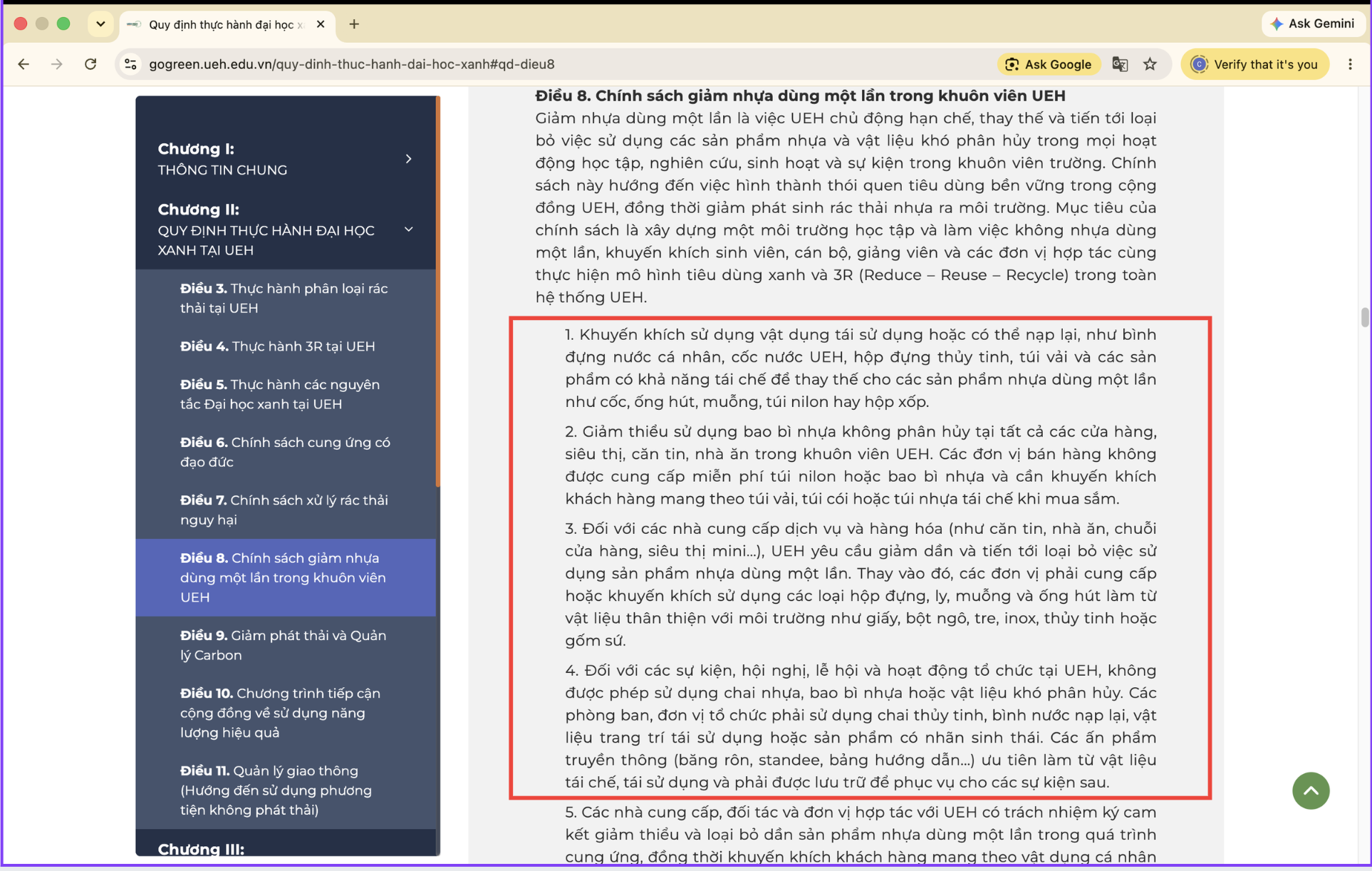
Article 8, Clauses 1–4
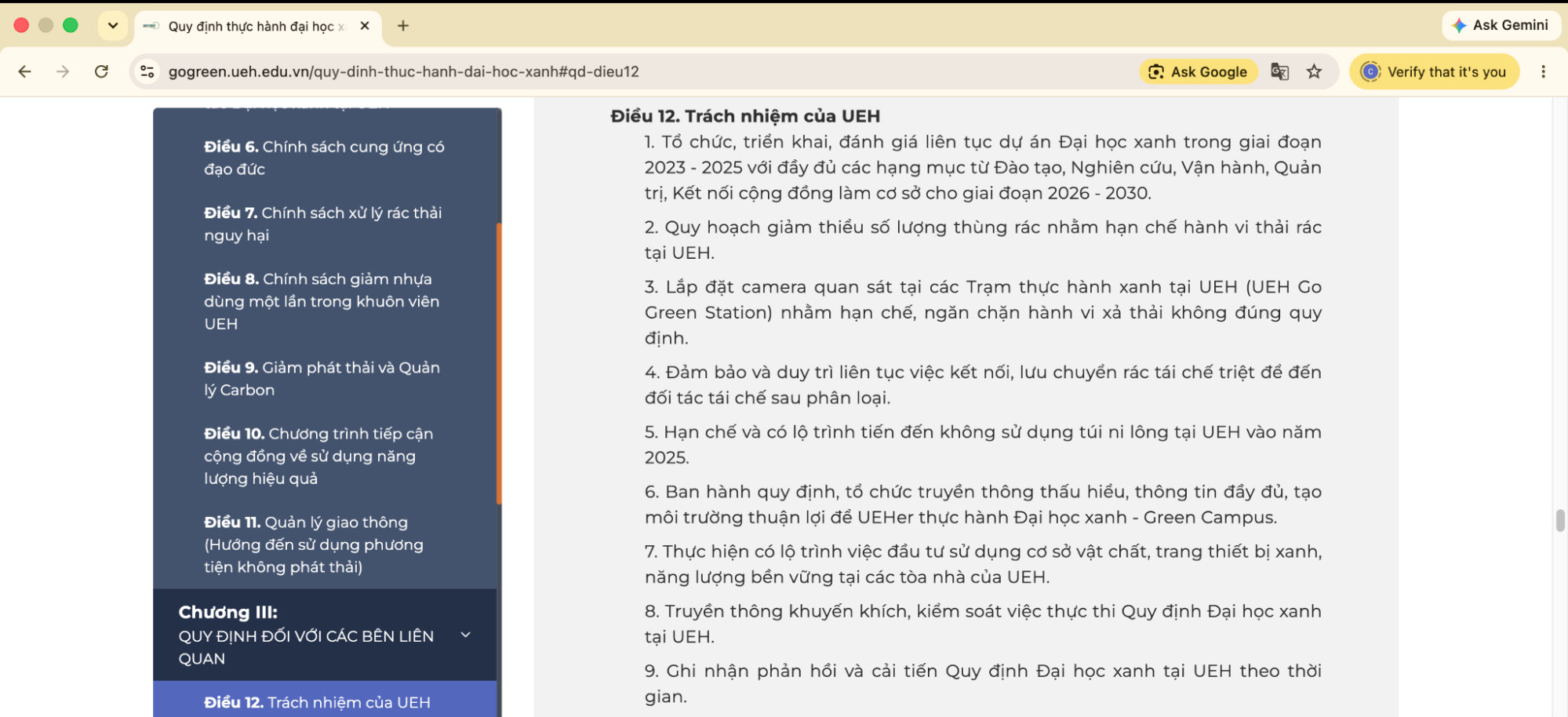
Article 12, Clauses 1–9
Policy source: Green Campus Regulations – UEH Green Campus.
1.2. Towards No Single-use Plastic Future Campaign and Plastic Reduction Targets
On 19 October 2024, UEH launched the Towards No Single-use Plastic Future campaign at the Vo Thi Sau Campus, aiming to reduce single-use plastics and promote sustainable consumption habits within the university community.
The campaign established four targets:
- Achieve correct segregation of 90% of waste.
- Achieve a 60% reduction in single-use plastic waste.
- Establish and sustain a green and sustainable living culture.
- Integrate emissions-reduction projects and scientific research supporting sustainable development.
Two action streams were defined: #SortingForChange, focused on improving segregation at source, and #ReduceForMore, prioritising the reduction of single-use plastics at the consumption stage.
To operationalise these targets, UEH introduced nine plastic reduction actions: carry reusable shopping bags; use fewer plastic bags; bring reusable food containers; use personal cups and water bottles; prepare waste-free lunches; choose to dine in; avoid single-use plastic straws and utensils; limit products with excessive layers of packaging; and share these practices with the wider community.
A recurring campaign activity is No Single-use Plastic Day, held on the last Wednesday of each month to encourage lecturers, staff and students to adopt plastic-reduction practices.
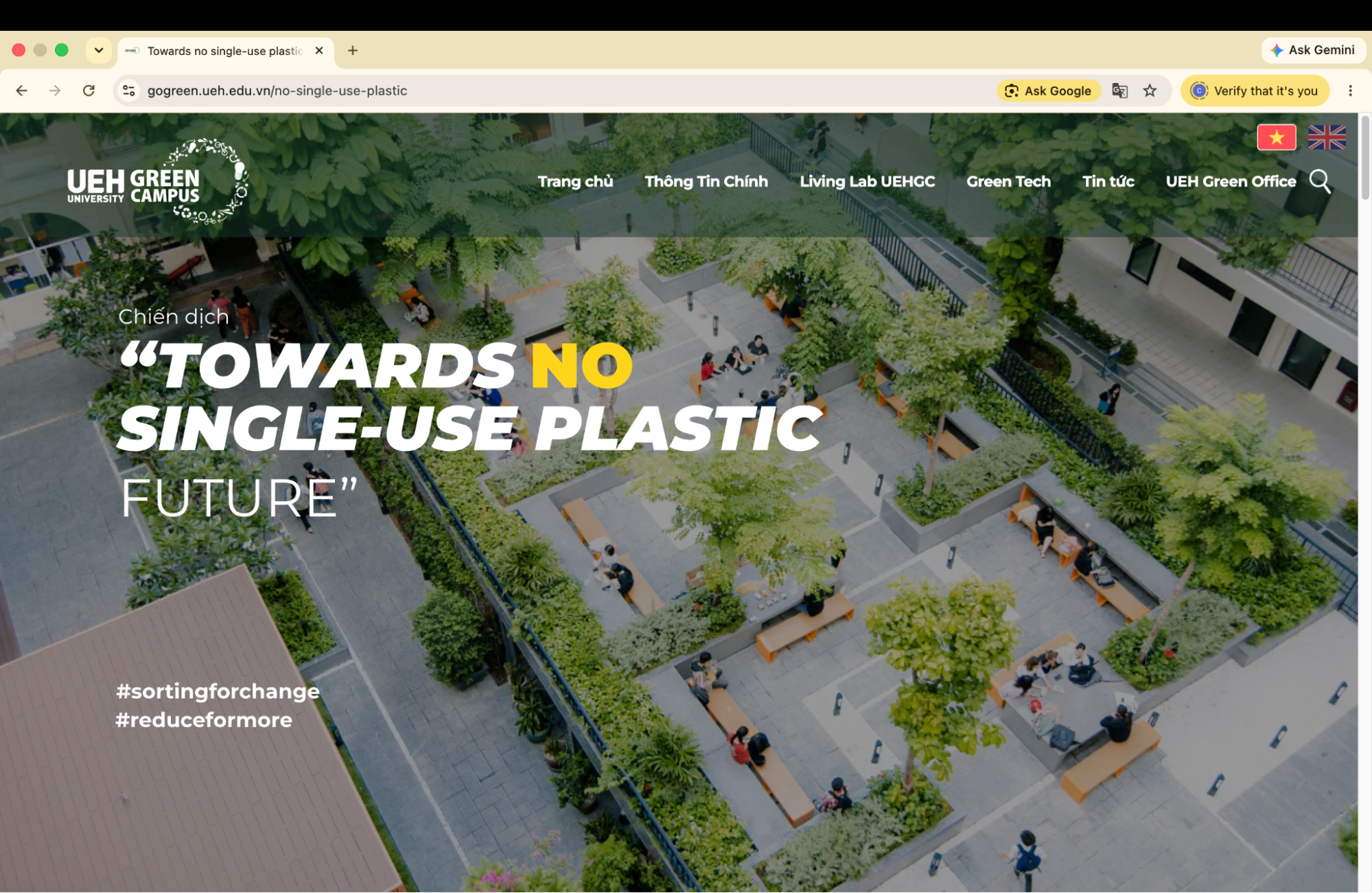
Public source: Towards No Single-use Plastic Future – UEH Green Campus.
1.3. Development of the No Single-use Plastic Campus System in 2025
Building on its policy framework and green practices, UEH continued developing the No Single-use Plastic Campus System in 2025 to manage plastic waste throughout the consumption and disposal process.
The initiative was structured around three groups of interventions:
| Stage | Action Measures | Tools and Approaches |
| Demand generation | Raise awareness, change behaviour and reduce demand for plastics | Sustainability education activities, Green Campus Game and communications |
| Purchasing and use | Limit single-use plastics and encourage alternatives | Green Campus Regulations, nine plastic reduction actions and 3R practices |
| Disposal | Segregate at source, recover materials and connect with recycling partners | Go Green Station, Zeen AI Bot, I Ve Chai Machine and collection and recycling partners |
On 25 June 2025, UEH’s solution was selected among the ten outstanding proposals in the 2025 Plastic Innovation Programme and received a USD 10,000 grant.
The grant was intended to support further development of a circular plastic waste model, improvement of technological solutions, stronger partner collaboration and the planned extension of the system across 13 UEH campuses.
This marked an important advance in the resources and implementation capacity of the plan. However, the intended expansion to 13 campuses does not mean that the entire system was completed at all locations in 2025.
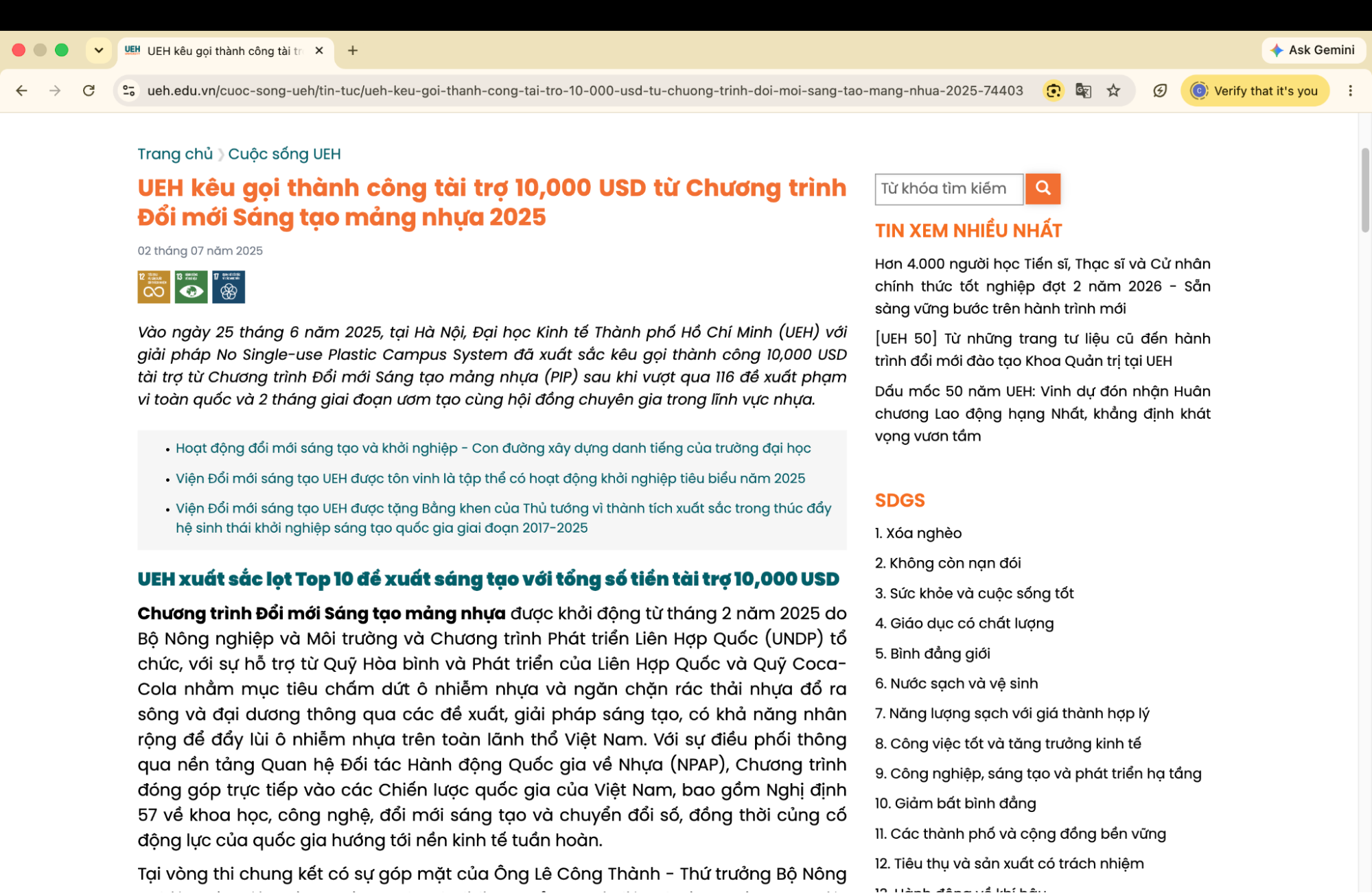
Public source UEH Secures USD 10,000 Grant from the 2025 Plastic Innovation Programme – UEH Portal, 2 July 2025.
2. Implementation of the Plastic Waste Reduction Plan in 2025
In 2025, UEH further implemented the plan through campus-based practices, smart collection equipment, communication and education activities, and collaboration with recycling organisations.
2.1. Plastic Reduction Activities at the Vo Thi Sau Campus
The Vo Thi Sau Campus continued to host activities under the Towards No Single-use Plastic Future campaign.
On 8 May 2025, UEH published information about an activity combining art and sustainability at the Vo Thi Sau Campus, reinforcing the message of moving towards the elimination of single-use plastics. Combining artistic experiences with green practices brought plastic-reduction objectives closer to everyday academic life.
In July and August 2025, No Single-use Plastic Day continued to be promoted and organised, encouraging the UEH community to bring personal water bottles, reusable bags and food containers, and to avoid single-use plastic products.
These activities demonstrated continuity from 2024 to 2025 and encouraged the development of plastic-reduction habits in learning and working environments.
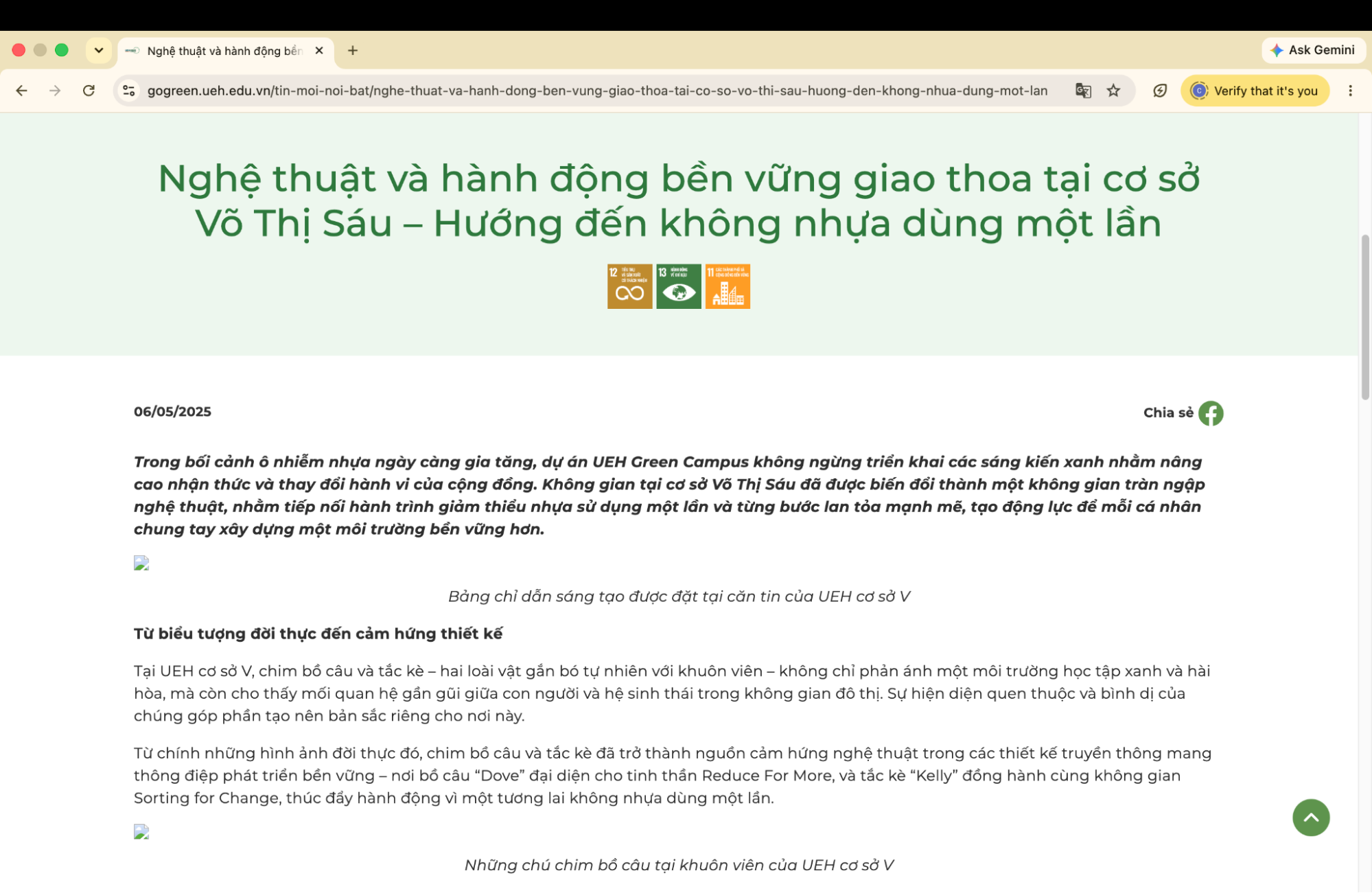
Public source: Art Meets Sustainable Action at the Vo Thi Sau Campus – Towards a Single-use Plastic-Free Future
2.2. Technology-Based Collection and Recycling of Materials on Campus
One notable activity in 2025 was UEH’s collaboration with BOTOL to deploy the I Ve Chai Machine, a device facilitating the collection of plastic bottles and aluminium cans.
From 5 to 13 March 2025, the “Smart Recycling – Rewards Are Coming” activity was held at Campuses N, B and A. According to the announcement published on 4 April 2025, the programme collected 482 plastic bottles and aluminium cans over six days, with the participation of more than 250 students.
Subsequently, in August 2025, the BOTOL x Nopa Move challenge at Campus B recorded 1,996 plastic bottles collected, more than 200 participations and 30 personal water bottles awarded.
The activity combined post-consumer material recovery with incentives to use reusable water bottles, while enabling students to experience waste segregation and recycling directly.
Alongside collection equipment, UEH developed its Go Green Station system, which segregates waste into three or seven categories depending on each campus’s size and characteristics. Technology-based segregation tools, including Zeen AI Scan and Zeen AI Bot, were also part of the UEH Green Campus ecosystem.
These solutions helped establish an organised mechanism for segregation, recovery and recycling partnerships on campus, supporting the plan to prevent plastic waste from leaking into the environment.
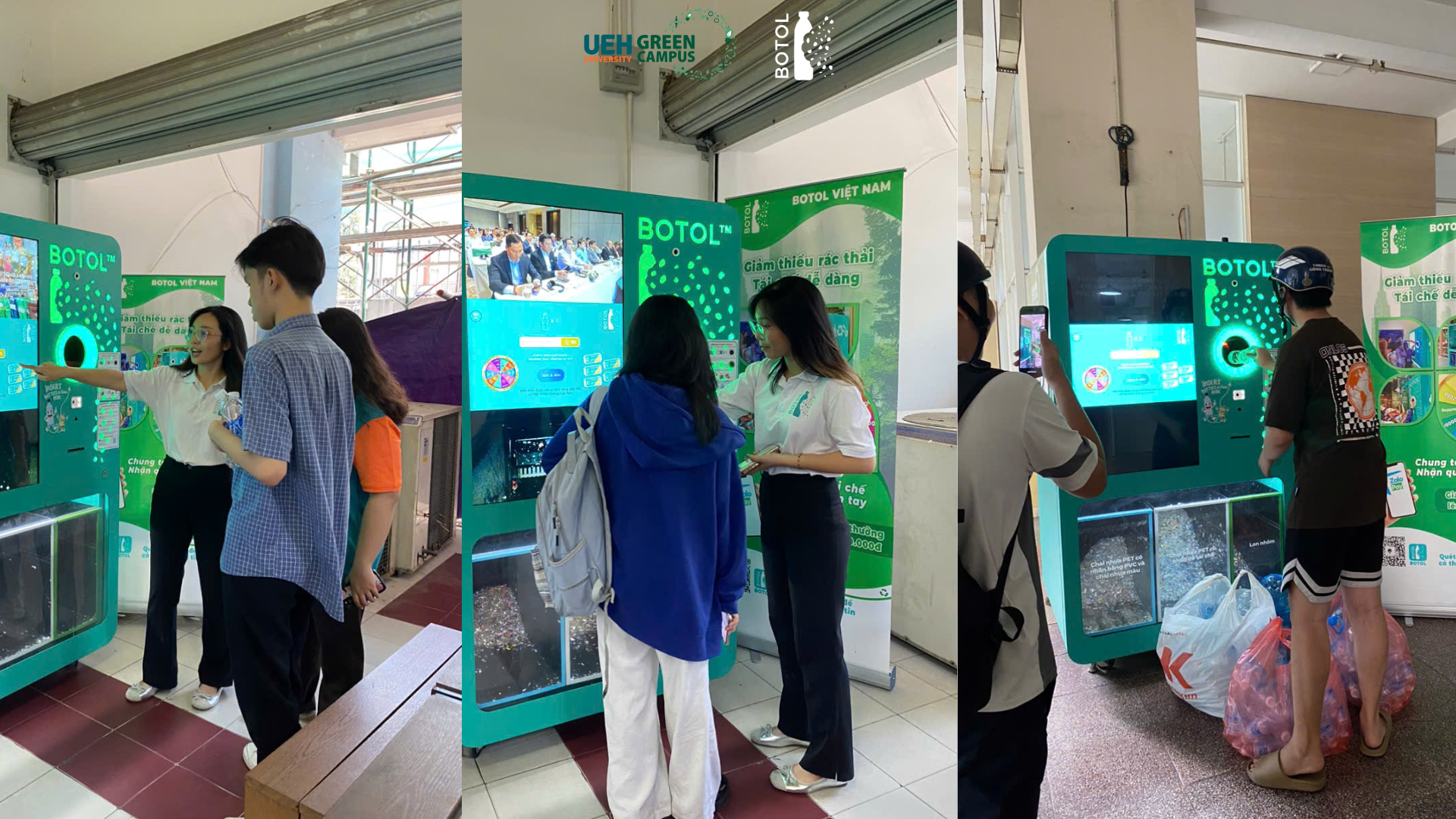
Public source: Recycling Plastic Bottles and Aluminium Cans with the I Ve Chai Machine – UEH Green Campus, 4 April 2025.
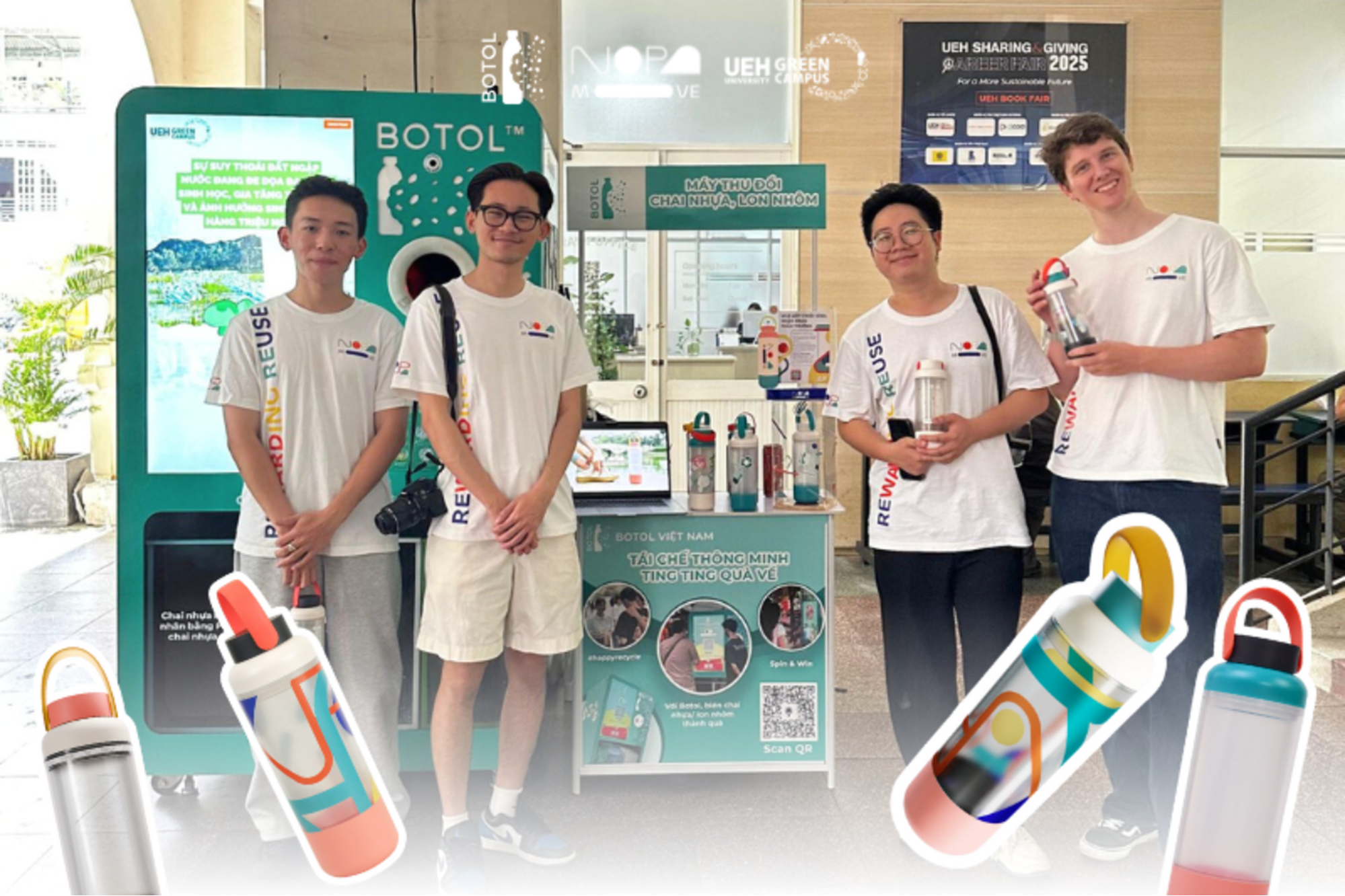 Public source: BOTOL x Nopa Move Recycling Challenge – UEH Green Campus, 20 October 2025.
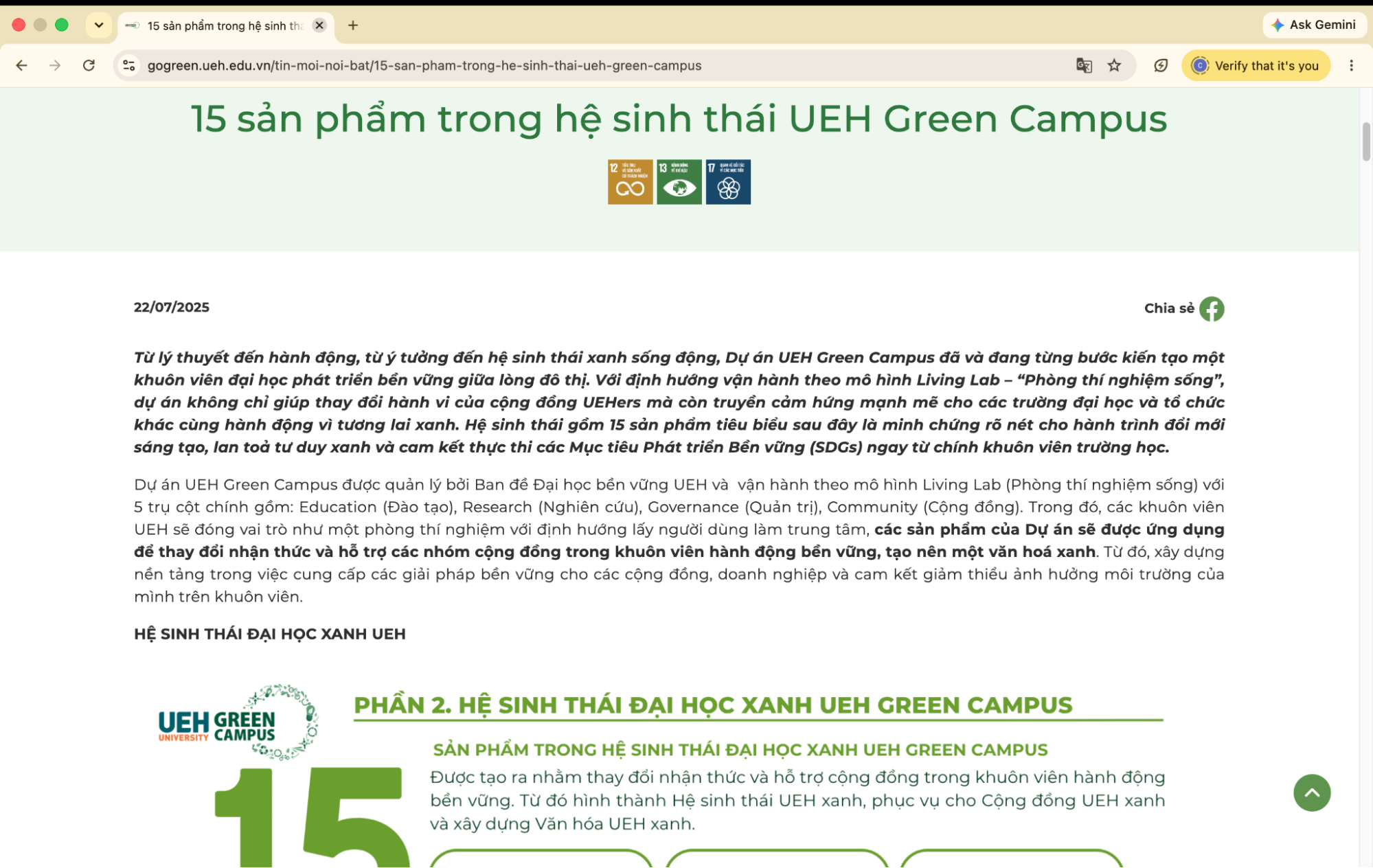
Public source: 15 Products in the UEH Green Campus Ecosystem – 22 July 2025.
2.3. Education, Research and Behaviour Change
In addition to investment in technology and infrastructure, UEH promoted awareness and responsible consumption to support implementation of the plastic reduction plan.
In 2025, Green Campus Game was incorporated into student orientation and Green Campus education. Through Reduce, Reuse and Recycle content and experiences with technology-assisted waste segregation, students acquired knowledge and were encouraged to apply it in their daily lives.
According to the UEH Green Campus project summary published in early 2026, Green Campus Game recorded approximately 6,752 participations in 2025. This figure measures educational reach; it does not represent the number of people whose behaviour was verified to have changed or whose plastic consumption was reduced.
Alongside educational activities, UEH published research on students’ awareness and use of single-use plastics and on factors influencing choices to use reusable shopping bags instead of plastic bags. These studies provided knowledge to inform communications and propose sustainable consumption solutions.
The “Exchange a Lanyard – Sow Good Fortune” activity, held as part of a CELG academic meeting in 2025, also encouraged resource reuse and promoted waste reduction practices within the academic community.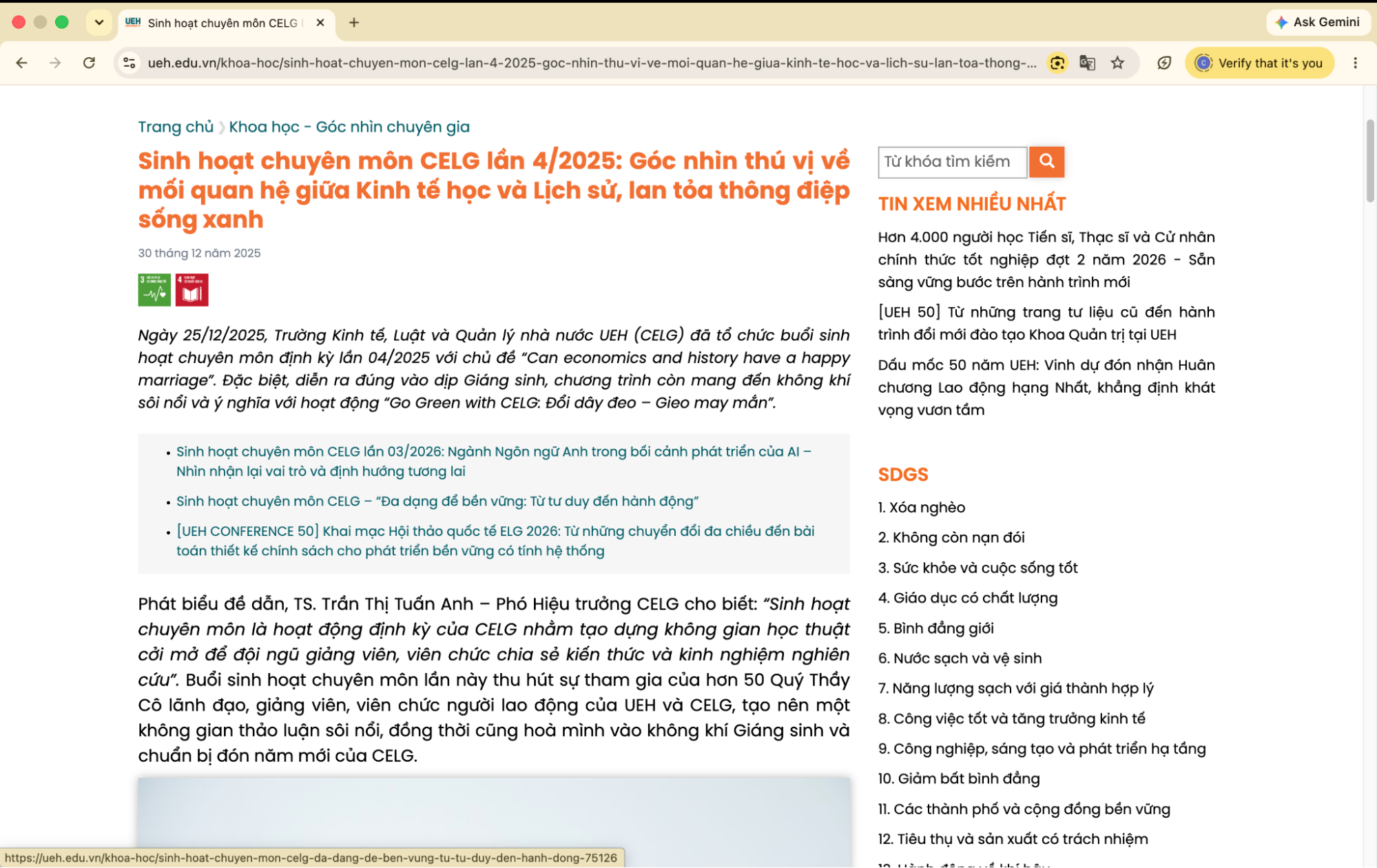
Public source: CELG Academic Meeting No. 4/2025: Interesting Perspectives on the Relationship Between Economics and History, Promoting Green Living
3. Monitoring and Evaluation Results for the 2025 Plan
3.1. Results of Recyclable Material Collection
The deployment of I Ve Chai Machines provided UEH with additional records of plastic bottles and aluminium cans collected by location and reporting period.
| Location | Period | Plastic Bottles | Aluminium Cans | Total Weight |
| Campus B | April 2025 | 2,626 | 2,755 | 68.1 kg |
| Campus A | July 2025 | 102 | 147 | 3.14 kg |
| Campus A | August 2025 | 364 | 80 | 6.27 kg |
Official data sources:
The figures above reflect material collection results at the reported locations and times. Total weight includes both plastic and aluminium, rather than plastic alone.
Likewise, the number of plastic bottles collected is not equivalent to the amount of plastic waste prevented. Effectiveness in reducing plastic consumption must be assessed using data on single-use product consumption, plastic waste generated and monitoring results before and after implementation.
3.2. Comparison of Implementation Progress, 2024–2025
| Item | 2024 | 2025 |
| Policy and action plan | Maintained the Green Campus Regulations and launched Towards No Single-use Plastic Future | Continued the campaign and developed the No Single-use Plastic Campus System |
| Behaviour change | Introduced nine plastic reduction actions and awareness campaigns | Maintained No Single-use Plastic Day and expanded communication and practical education |
| Collection and segregation | Established the Go Green Station infrastructure and promoted 3R practices | Recorded quantitative results from I Ve Chai Machines and recycling challenges |
| Technology | Developed tools to support waste segregation | Continued applying technology for collection, identification and recycling support |
| Partnerships and resources | Connected partner organisations supporting Green Campus activities | Secured a USD 10,000 grant to further develop and expand the solution |
| Results monitoring | Focused on building operational foundations and encouraging green practices | Added reports of collected materials by location and reporting period |
Compared with 2024, implementation in 2025 showed that UEH had developed additional solutions capable of documenting and monitoring measurable outcomes. By coordinating policies, technology, education and environmental partners, plastic waste management became more closely integrated into campus operations.
However, the publicly available sources do not yet provide sufficient data to establish achievement of the 60% single-use plastic waste reduction target, the 90% correct waste segregation target or the campus-wide roadmap for eliminating plastic bags by the end of 2025.
4. Conclusion
UEH’s plastic waste reduction action plan is based on its Green Campus policy and translated into specific objectives, measures, action programmes and technological solutions across its campuses. From preventing single-use plastics at source to strengthening segregation, collection and recycling partnerships, UEH aims to manage resources according to reduction, reuse and circularity principles.
In 2025, the University made further progress in connecting plastic-reduction activities with technology and innovation partnerships. Recorded plastic bottle collection results across UEH campuses, together with educational and communications activities and funding to develop the plastic management system, strengthened practical implementation of the plan.
By maintaining and developing these activities, UEH continued contributing to SDG 14 – Life Below Water and advancing SDG 12 – Responsible Consumption and Production, towards a university environment that reduces plastic waste, uses resources efficiently and supports sustainable development.