

14.3.4. Technologies towards aquatic ecosystem damage prevention (direct work)
Work directly (research and/or engagement with industries) on technologies or practices that enable marine industry to minimise or prevent damage to aquatic ecosystems
UEH advances ocean technology research and water resource management practices to minimise damage to marine, coastal and aquatic ecosystems.
The University of Economics Ho Chi Minh City (UEH) undertakes applied research and collaboration with local governments, scientific organisations, industries and communities to develop technologies and sustainable management practices that can minimise or prevent damage to aquatic ecosystems. Its work covers ocean technologies, water management, climate-resilient irrigation infrastructure and environmentally appropriate production practices in coastal areas and the Mekong Delta.
In 2025, UEH contributed direct research on technologies and practices to reduce damage to marine ecosystems. This included studies on biodegradable fishing gear to address the harm caused by abandoned, lost or otherwise discarded gear and the application of Aquaculture Performance Indicators (API) to assess environmental impacts in Vietnam’s shrimp farming systems. UEH also collaborated with Khanh Hoa Province on a proposed National Ocean Technology Research Centre to strengthen monitoring, data management and technological capabilities for sustainable ocean-based development.
These interdisciplinary research and collaborative activities provide a scientific basis for responsible technology adoption and resource management in marine industries, with the aim of preventing aquatic environmental degradation.
- Description of direct work
UEH undertakes research and direct collaboration on technologies and practices that enable marine industries and water-dependent sectors to minimise or prevent damage to aquatic ecosystems.
This work follows two principal approaches:
- Research and technological development: Investigating ocean technologies, marine environmental monitoring, water resource management and nature-based approaches that can help identify and manage risks of ecosystem degradation.
- Collaboration with authorities, industries and communities: Working with development partners, regulators and resource users to research and propose management, design and infrastructure operating practices suited to local ecological conditions.
- These activities seek to strengthen environmental monitoring, support resource management decisions, reduce competing pressures on water resources and encourage sustainable ocean-based economic development.
- Core areas and collaborating stakeholders
UEH focuses on three groups of solutions:
- Ocean technologies and marine environmental monitoring: Investigating potential uses of remote sensing, artificial intelligence, marine robotics, autonomous underwater vehicles and satellite data for marine monitoring and resource governance.
- Adaptive water management and production practices: Studying freshwater and brackish-water management, water needs for agriculture and aquaculture, and approaches to avoiding ecological damage arising from unsuitable water allocation policies.
- Responsible irrigation infrastructure design and operation: Studying the effects of dykes, canals, sluices and disaster prevention infrastructure, and incorporating community input into infrastructure assessment and operational recommendations.
Partners include local authorities, science and technology agencies, research organisations, marine industries, irrigation management bodies, aquaculture communities and international collaborators.
- Institutional support for research and collaboration
UEH carries out aquatic ecosystem protection research and collaboration as part of its multidisciplinary, sustainable university development strategy and engagement with local communities.
Its Green Campus Regulations provide a foundation for environmental research, community collaboration and responsible operational practices. Relevant research is undertaken by UEH faculty and through its research networks, including EfD-Vietnam/EEPSEA and the Institute of Smart City and Management (ISCM). In 2025, this work included international publications on biodegradable fishing gear, environmental performance assessment in Vietnamese shrimp farming and a proposed National Ocean Technology Research Centre commissioned by Khanh Hoa Province. Together, these activities link scientific investigation with environmental risks associated with fisheries, aquaculture and other marine industries.
Source: UEH Green Campus Regulations.
https://gogreen.ueh.edu.vn/quy-dinh-thuc-hanh-dai-hoc-xanh
- Evidence of research and collaborative programmes
4.1. Key programmes and projects
| No. | Programme / project | Type / classification | Summary of direct work and contributions | Photographs / captions | Evidence sources | SDGs |
| 1 | Research on biodegradable fishing gear to prevent damage to marine ecosystems (2025) | International research; environmentally responsible fishing technology; fishers’ technology adoption and behaviour. | In 2025, UEH lecturer and EEPSEA/EfD-Vietnam researcher Dr Do Huu Luat and Claire W. Armstrong published “Navigating transition: Understanding fishers’ perceptions of biodegradable fishing gear adoption” in the Journal of Environmental Economics and Policy. Biodegradable gear is a potential way to reduce harm from abandoned, lost or otherwise discarded fishing gear (ALDFG), which can cause ghost fishing and marine plastic pollution. Based on interviews with Norwegian fishers, the study assessed economic incentives and behavioural factors influencing adoption, finding that both matter, with behavioural influences particularly important. Also in 2025, Do Huu Luat and Todd L. Cherry published “Ghost fishing and the voluntary adoption of biodegradable gear” in Resource and Energy Economics. Their survey experiment with Norwegian fishers examined catch efficiency, economic incentives and peer behaviour. The findings suggest fishers are more willing to adopt biodegradable gear when its efficiency matches conventional gear; otherwise, peer behaviour and policy incentives become more influential. These are direct 2025 research outputs informing industry adoption strategies, not evidence of completed deployment or measured reductions in ghost fishing. | 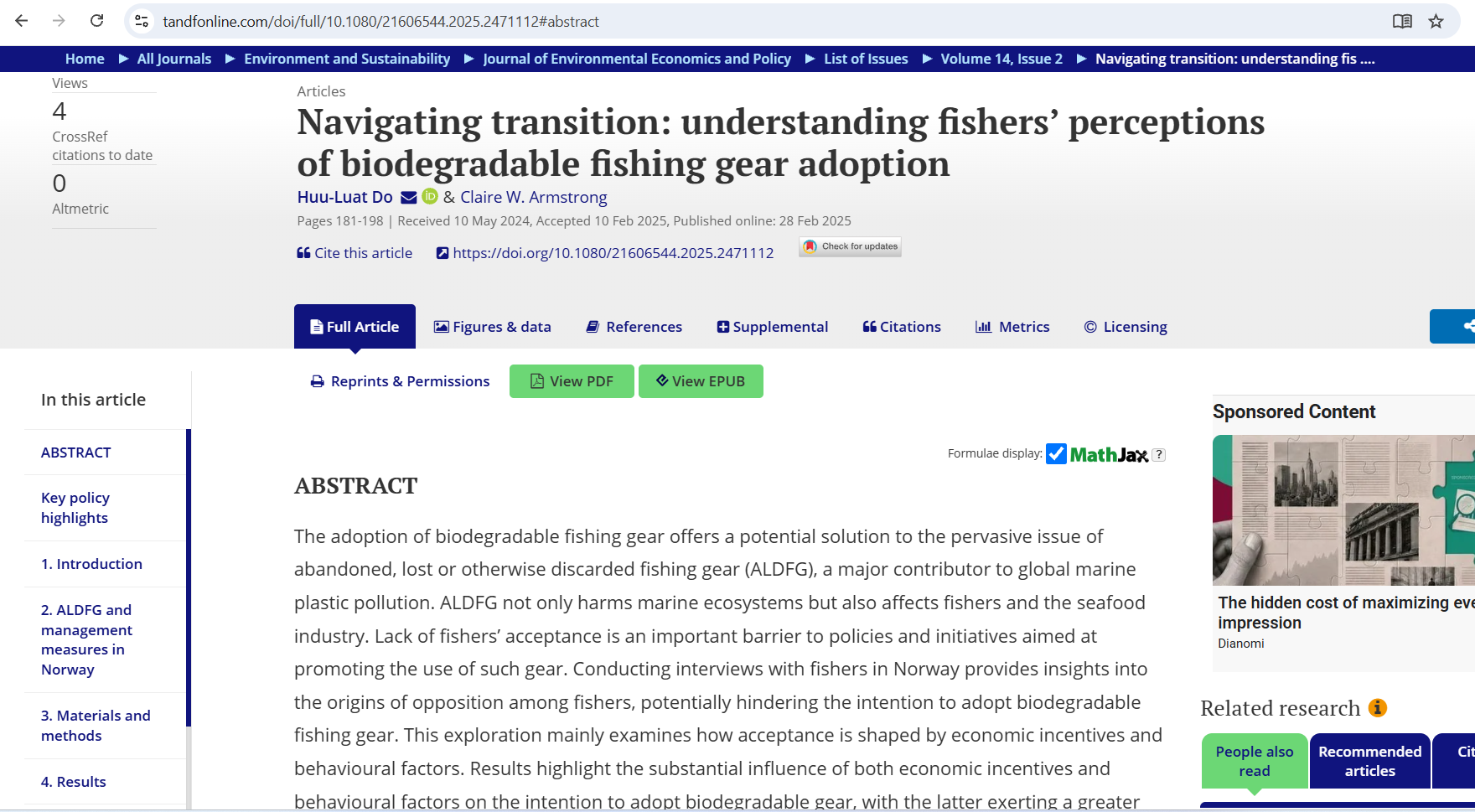 Research Study Information |
Do, H.-L. & Armstrong, C. W. (2025), “Navigating transition: Understanding fishers’ perceptions of biodegradable fishing gear adoption”, published 27 February 2025:
https://doi.org/10.1080/21606544.2025.2471112 Do, H.-L. & Cherry, T. L. (2025), “Ghost fishing and the voluntary adoption of biodegradable gear”: https://doi.org/10.1016/j.reseneeco.2025.101534 |
SDGs 9, 12, 14, 17 |
| 2 | Applying Aquaculture Performance Indicators (API) to evaluate environmental performance and sustainable management practices in Vietnamese shrimp farming (2025) | Applied research; environmental performance assessment; water and effluent management; international research collaboration. | In 2025, UEH researchers Dr Ho Quoc Thong and Dr Do Huu Luat, with Professor Håkan Eggert, published “Shrimp farming industry in Vietnam: An aquaculture performance indicators approach” in Aquaculture Economics & Management. The study combined Aquaculture Performance Indicators (API) and the Triple Bottom Line framework to evaluate the economic, social and environmental performance of extensive, semi-intensive, intensive and super-intensive shrimp farming systems. It identified environmental weaknesses in intensive systems, particularly water use, effluent management and disease risks, as well as biodiversity impacts associated with mangrove conversion. Comparing production systems using API provides a practical assessment method for prioritising better water management and environmental practices. This is evidence of direct applied research, not verification that subsequent interventions have already reduced pollution. | 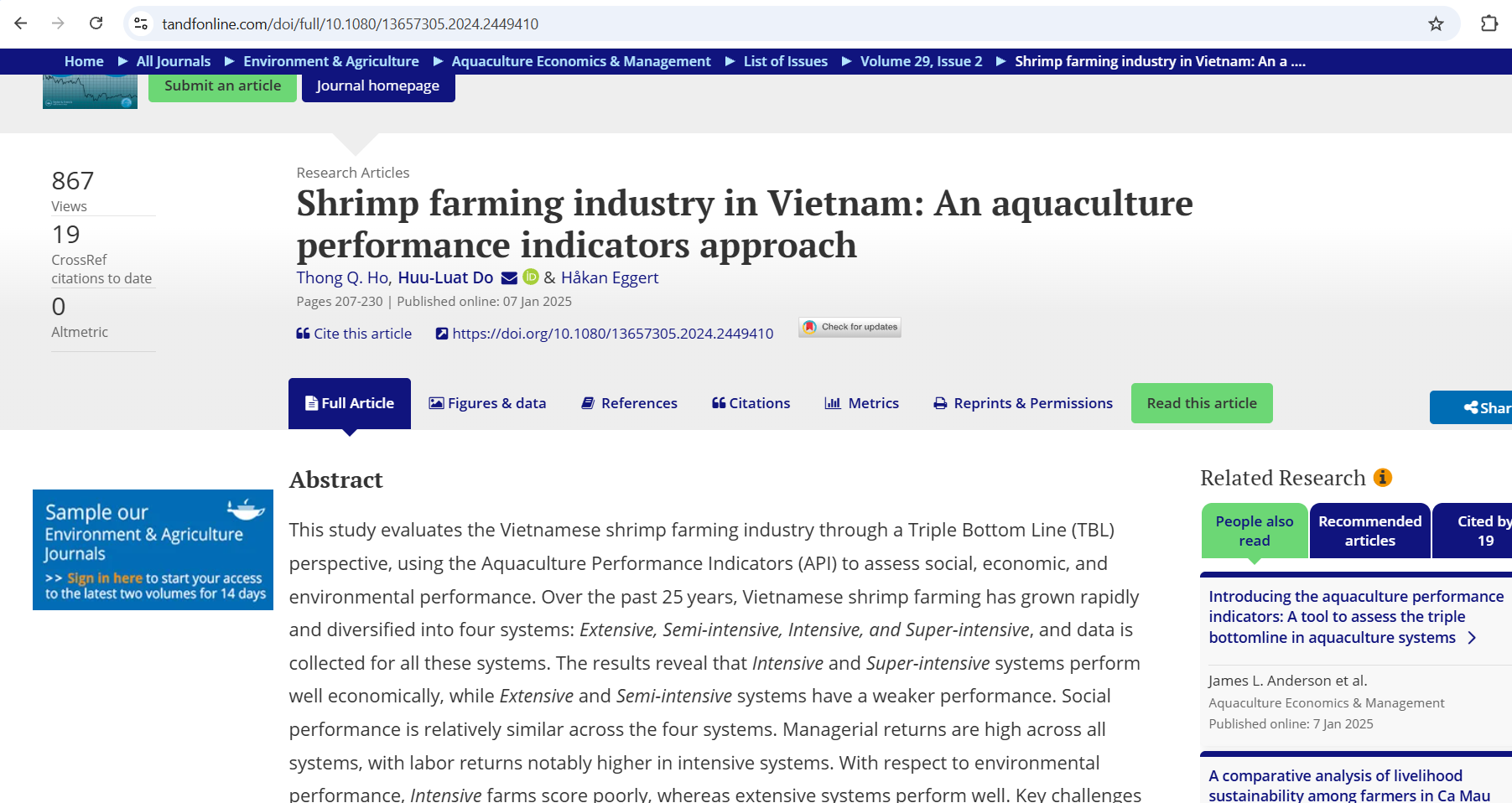
Research Study Information |
Ho, T. Q., Do, H.-L. & Eggert, H. (2025), “Shrimp farming industry in Vietnam: An aquaculture performance indicators approach”, published online January 2025:
https://doi.org/10.1080/13657305.2024.2449410 |
SDGs 6, 12, 13, 14 |
| 3 | Ocean Futures 2025 – Ocean technology research in Khanh Hoa (1 October 2025) | Applied research; ocean technologies; local government collaboration. | Through the Institute of Smart City and Management (ISCM), UEH continued research in 2025 on a proposal for a National Ocean Technology Research Centre commissioned by Khanh Hoa Province. Related findings were published by UEH Future on 16 July 2025 and presented at the international Ocean Futures conference on 1 October 2025. The proposal identified priority technologies including marine robotics, autonomous underwater vehicles, ocean observation systems, data analytics, ocean modelling, marine biotechnology and conservation technologies. These research directions could strengthen environmental monitoring and early detection of risks to marine ecosystems. The evidence establishes a research proposal and discussions with provincial stakeholders, but does not confirm installation or operational deployment of those technologies. | 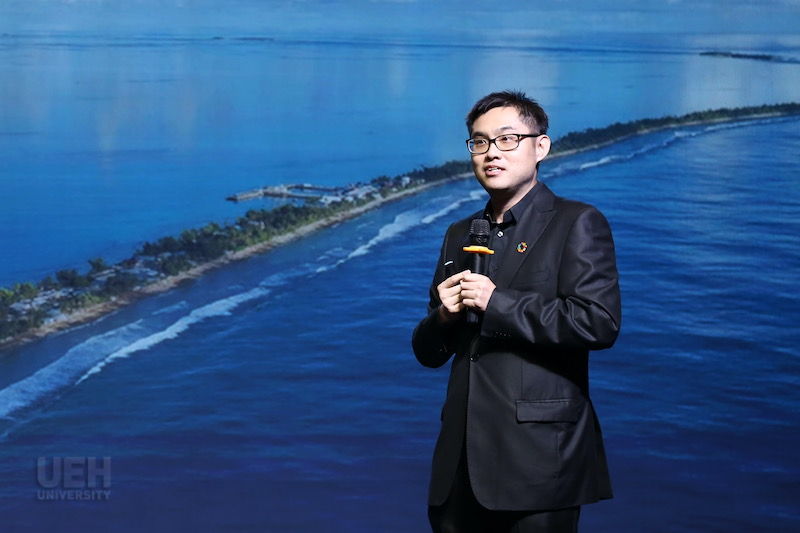
|
UEH Portal – Ocean Futures 2025:
https://ueh.edu.vn/khoa-hoc/hoi-thao-quoc-te-tuong-lai-dai-duong-2025-tai-khanh-hoa-cong-nghe-thong-minh-va-cuoc-song-ven-bien-ben-vung-74916 UEH Portal – Conference discussions: https://www.ueh.edu.vn/khoa-hoc/hoi-thao-quoc-te-cong-nghe-thong-minh-va-cuoc-song-vung-bien-ben-vung-2025-hoi-tu-hoc-gia-va-chuyen-gia-thao-luan-dua-kinh-te-dai-duong-tro-thanh-dong-luc-phat-trien-ben-vung-cua-tinh-khanh-hoa-74878 UEH Future – National Ocean Technology Research Centre proposal: https://future.ueh.edu.vn/chi-tiet-knowlege/research-contribution-xay-dung-trung-tam-nghien-cuu-quoc-gia-ve-cong-nghe-dai-duong-khoi-tao-he-sinh-thai-cong-nghe-bien-vi-tuong-lai-ben-vung/ |
SDGs 9, 13, 14, 17 |
| 4 | HAPRI research on adaptive water management and aquaculture livelihoods in the Mekong Delta | Scientific research; freshwater and brackish-water governance; adaptive production practices. | HAPRI research examines the limitations of policies prioritising freshwater for rice cultivation where aquaculture requires brackish water. The research proposes adaptive water governance, coordinated use of freshwater and brackish water, water quality monitoring and production practices suited to local ecological conditions. Its findings help identify ways to minimise adverse impacts of inappropriate water management on aquaculture and estuarine environments. The supplied evidence does not identify a distinct 2025 industry technology implementation. | 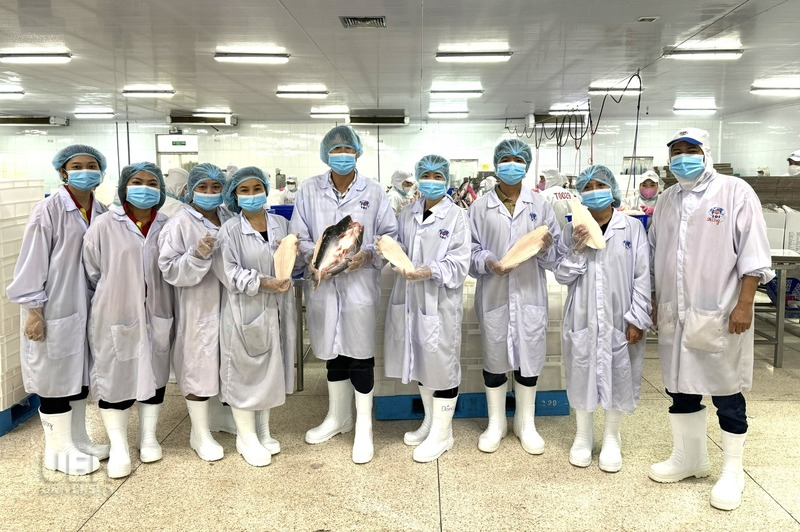 Project on food losses in the Mekong catfish value chain. |
https://ueh.edu.vn/khoa-hoc/an-ninh-luong-thuc-va-nong-nghiep-ben-vung-tu-chinh-sach-den-thuc-tien-trong-boi-canh-bien-doi-khi-hau-73279 | SDGs 2, 6, 13, 14 |
| 5 | EEPSEA research and partnerships on the circular economy, resource management and environmental solutions | Policy research; business collaboration; circular economy. | UEH’s Economy and Environment Partnership for Southeast Asia (EEPSEA) investigates circular economy practices, natural resource management and climate adaptation, while connecting businesses, public authorities and communities to evidence-based solutions. These activities support research capacity and partnerships for waste prevention, resource efficiency and reduced environmental pressures. However, the general EEPSEA activity does not independently demonstrate the development or application of a specific technology preventing aquatic ecosystem damage. | 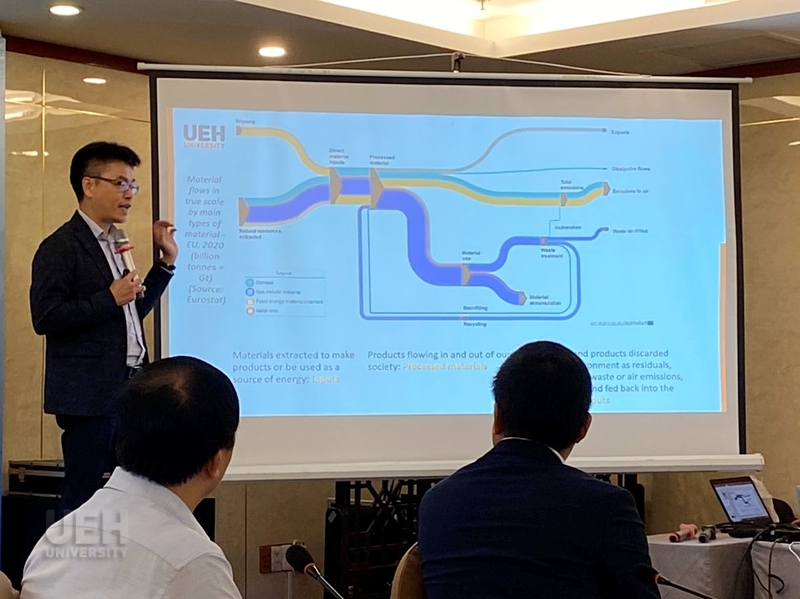
EEPSEA representative presenting research on the circular economy. |
https://ueh.edu.vn/cuoc-song-ueh/tin-tuc/vien-kinh-te-moi-truong-dong-nam-a-dong-hanh-cung-dai-hoc-kinh-te-tp-ho-chi-minh-tren-hanh-trinh-gieo-mam-xanh-73278 | SDGs 9, 12, 13, 14, 17 |
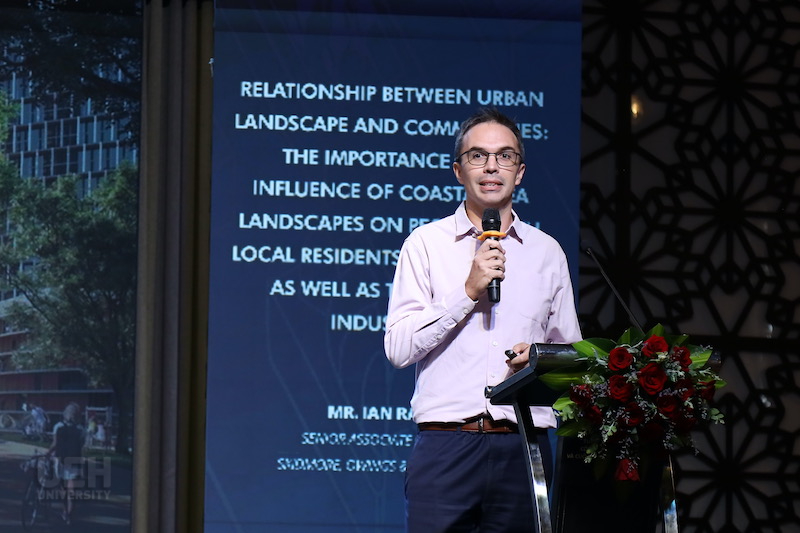
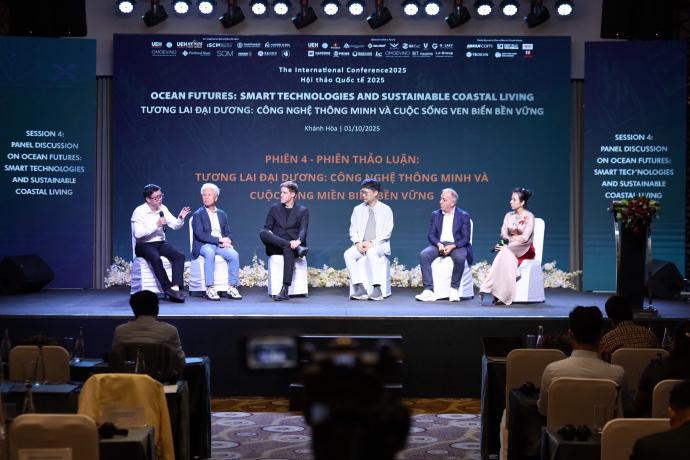 Technical discussion session on ocean technologies. Speakers participating in the ocean technology session.
- Conclusion
In 2025, UEH contributed research on technologies and management practices designed to help marine industries minimise or prevent aquatic ecosystem damage. Notable studies examined the adoption of biodegradable fishing gear to reduce the impacts of lost gear on marine organisms and the use of Aquaculture Performance Indicators to identify environmental weaknesses and improvement priorities in shrimp farming. UEH also worked on the proposed National Ocean Technology Research Centre in Khanh Hoa, outlining technological capabilities for marine monitoring and resource governance.
These outputs constitute direct research contributions to technological options, environmental risk assessment and more responsible fisheries and aquaculture practices. They provide evidence to inform pollution prevention and aquatic ecosystem protection, supporting SDG 14 – Life Below Water. They do not, on their own, establish that a particular technology was deployed at industry scale or that measurable ecosystem damage was already prevented.