

14.2.3. Overfishing (community outreach)
Offer educational outreach activities for local or national communities to raise awareness about overfishing, illegal, unreported and unregulated fishing and destructive fishing practices
UEH promotes community awareness of overfishing, illegal fishing and the protection of fisheries resources.
The University of Economics Ho Chi Minh City (UEH) has established a community education and outreach direction to raise awareness of the impacts of overfishing, illegal, unreported and unregulated (IUU) fishing, and destructive fishing practices. This commitment is reflected in Articles 13(8) and 21(7) of the Green Campus Regulations, which assign relevant units responsibility for developing education, communications and outreach activities targeting fishing communities, industry associations and businesses.
In 2025, UEH reported community-facing knowledge exchange on overfishing, illegal fishing and non-compliant fishing gear in connection with field research and engagement with fishers, with no participation fee. Through the Economy and Environment Partnership for Southeast Asia (EEPSEA) and the Environment for Development (EfD) network in Vietnam, related research findings were also made publicly available through scientific publications and recommendations on awareness, compliance with fisheries regulations and the conservation of fisheries resources.
- Description of the community outreach programme
UEH seeks to implement education, awareness-raising and knowledge-sharing activities that increase understanding among local and national communities of the consequences of unsustainable fishing.
The principal topics include:
- Overfishing: Raising awareness of declining fish stocks, the effects of excessive harvesting and the need to protect and restore fisheries resources.
- IUU fishing: Explaining illegal, unreported and unregulated fishing practices and encouraging compliance with fisheries management requirements.
- Destructive fishing methods: Highlighting the impacts of prohibited fishing gear, non-compliant mesh sizes and practices that damage aquatic ecosystems.
- Community participation: Encouraging fishers, fisheries associations and regulatory authorities to participate in designing, monitoring and implementing responsible fishing solutions.
The intended beneficiaries include fishers, coastal communities, fisheries associations, seafood businesses and local public authorities.
Direct educational engagement with fishing communities
UEH combines field surveys, face-to-face interviews and knowledge exchange with fishing communities in research on small-scale fisheries management. These interactions aim to understand fishers’ awareness, compliance behaviours and barriers to observing fishing regulations, while providing opportunities to discuss the impacts of illegal fishing, non-compliant gear and the depletion of fisheries resources.
Such exchanges allow fishers to share their experiences and challenges. When accompanied by substantive educational content, this research-based approach can also disseminate knowledge of sustainable fisheries management and encourage responsible practices and awareness of aquatic ecosystem protection.
- Internal commitments and supporting policies
UEH’s approach to community education and responsible resource use is guided by its Green Campus Regulations, issued under Decision No. 2059/QD-DHKT-CSVC in 2022 and published on the UEH Green Campus website.
The regulations establish responsibilities for developing and organising free educational and awareness-raising outreach for local or national communities concerning overfishing, IUU fishing and destructive fishing methods.
Source – Green Campus Regulations, Articles 13, 16 and 21:
https://gogreen.ueh.edu.vn/quy-dinh-thuc-hanh-dai-hoc-xanh
| Provision | Policy content | Relevance to indicator 14.2.3 | Supporting image |
| Article 21(7) – Water Reuse Policy | UEH sets out a pilot approach to free educational outreach for local and national communities to raise awareness of overfishing, IUU fishing and destructive fishing practices. | Establishes an institutional commitment to free public education on overfishing, IUU fishing and destructive methods; provides policy support for outreach. | 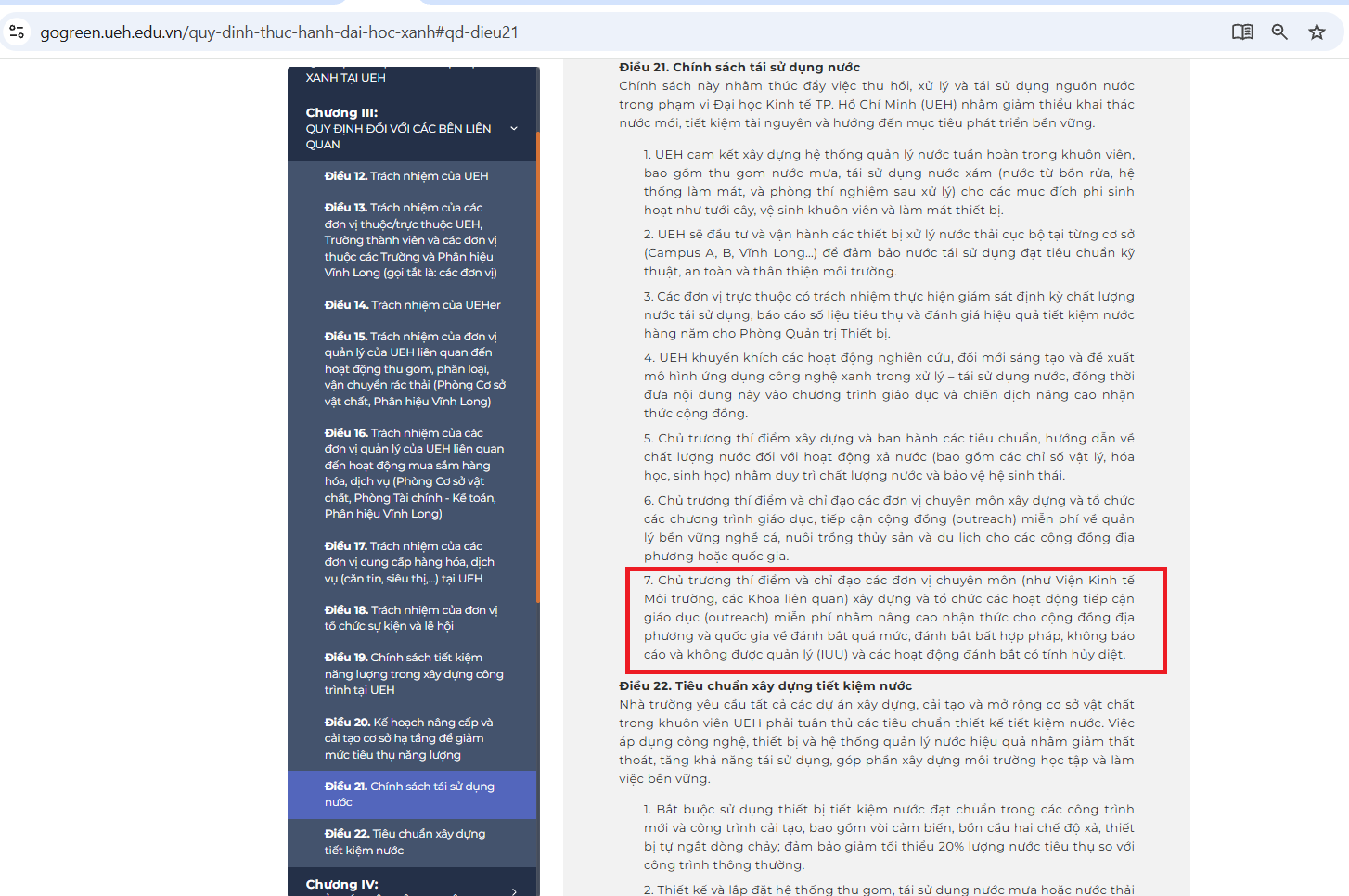 |
| Article 13(8) – Responsibilities of UEH units | University units are assigned to organise education and awareness activities for communities, including fishers, industry associations and businesses, on overfishing impacts and risks of IUU violations, and to retain supporting evidence and report outcomes. | Identifies responsibility for reaching external communities through education and awareness activities. | 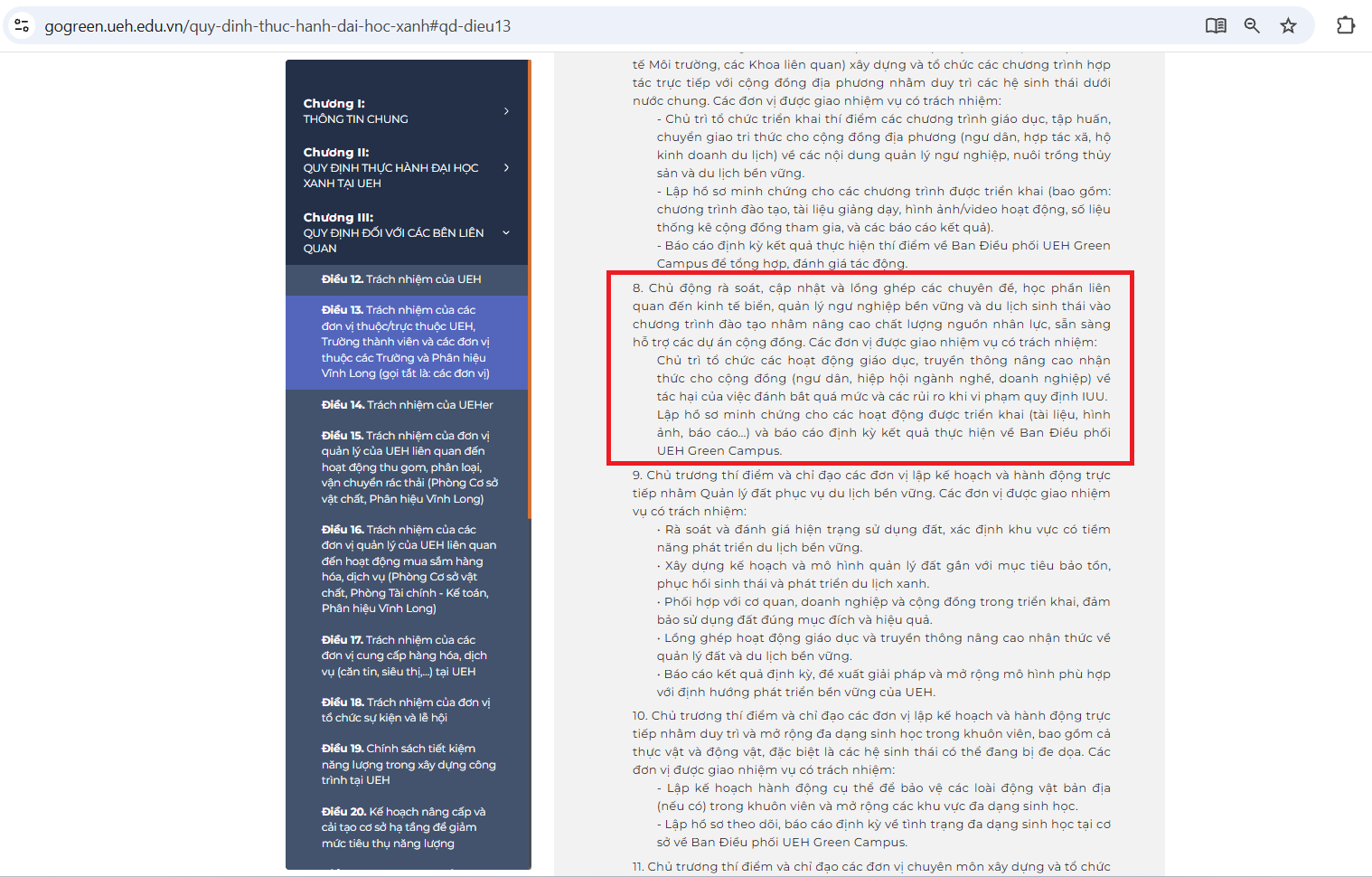 |
| Article 16(6) – Goods and services procurement | UEH commits not to purchase or use seafood products subject to fishing bans, originating from destructive fishing or violating IUU requirements. | Reinforces educational activities through responsible consumption and the prevention of illegal fishing. | 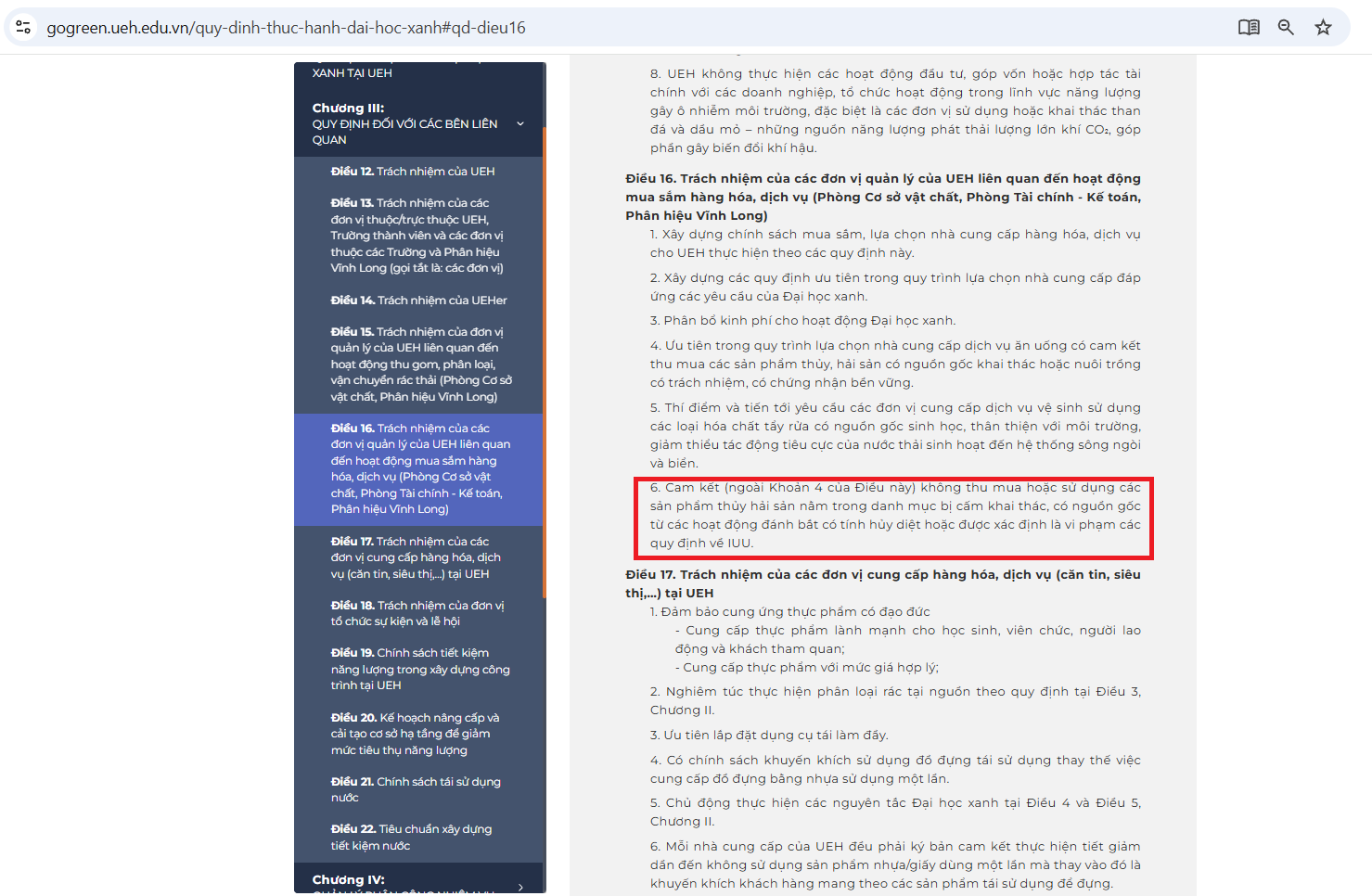 |
Source: https://gogreen.ueh.edu.vn/quy-dinh-thuc-hanh-dai-hoc-xanh
- Related supporting evidence
| No. | Programme / project | Format / classification | Participation | Summary and outcomes | Supporting image / caption | Evidence links |
| 1 | EEPSEA – Blue Resources for Development (BlueRforD): Research supporting sustainable fisheries and marine resource governance | Applied research; dissemination of findings; international collaboration; sharing sustainable management practices; science–policy dialogue. | Free of charge. | BlueRforD, involving researchers affiliated with UEH and EfD-Vietnam, links marine resource governance research with field engagement and knowledge exchange involving fisheries stakeholders. In 2025, UEH, through EEPSEA and EfD-Vietnam, continued to disseminate findings on marine resource governance and fisheries regulatory compliance via scientific publications, expert exchanges and policy dialogue. The work provides an evidence base for community education on overfishing prevention, illegal fishing and fisheries conservation. | 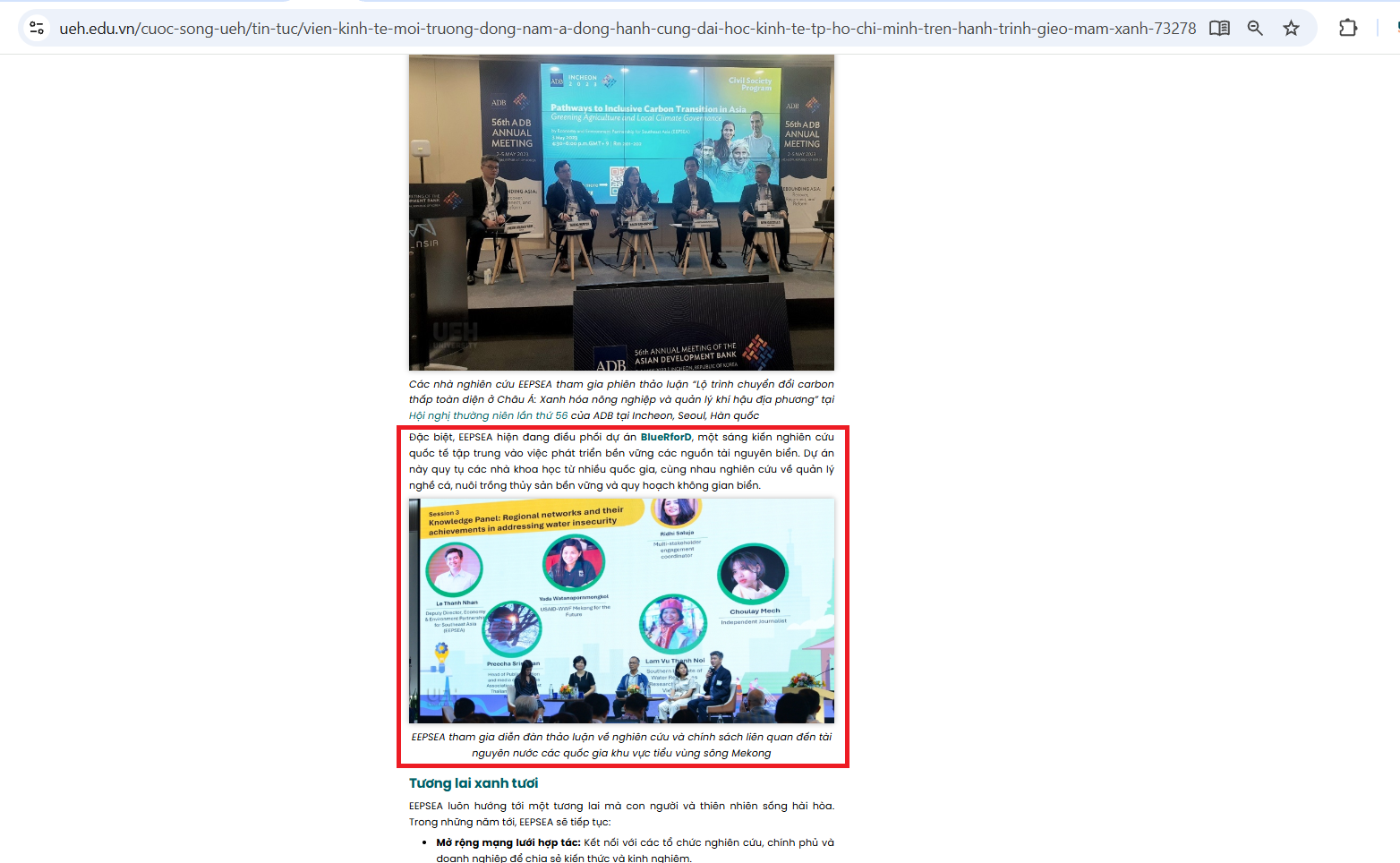
BlueRforD international research project focused on the sustainable development of marine resources. |
Source 1 – UEH Portal, EEPSEA 2025 overview:
Source 2 – EfD fisheries compliance research, 2025: Source 3 – EfD discussion paper, 2 May 2025: |
| 2 | EfD-Vietnam/BlueRforD – Sharing marine spatial planning research at Ocean Futures 2025 | Knowledge dissemination; scientific and policy conference; marine resource governance. | Experts, delegates and relevant stakeholders; described as free to attend. | On 7 October 2025, EfD-Vietnam reported that UEH researcher Dr Ho Quoc Thong had presented at Ocean Futures 2025. His marine spatial planning presentation reviewed more than 110 international studies and 50 policy documents and analysed how spatial planning can help mitigate competing marine resource uses, safeguard ecosystems and govern blue-economy industries, including fisheries. This constitutes professional knowledge-sharing in 2025, but is not presented as direct outreach to fishing communities. | 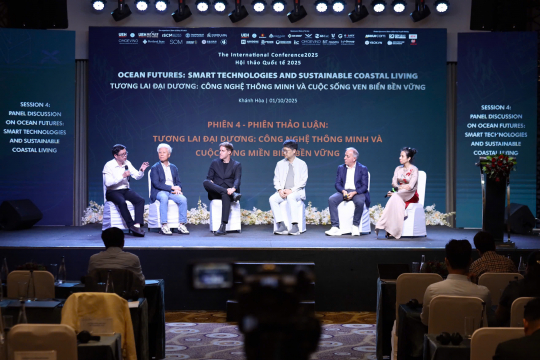
Marine Spatial Planning Research at Ocean Futures 2025 |
EfD-Vietnam, 7 October 2025: |
| 3 | Regulatory Compliance in Small-Scale Fisheries in Vietnam and Ghana – Research and knowledge exchange on fisheries regulatory compliance | Field research combined with free knowledge exchange and awareness-raising for fishing communities. Direct engagement through surveys, interviews and discussions about compliance; fishers were not charged to participate. | Direct interviews, surveys and field engagement with fishers in Phu Yen, Khanh Hoa and Binh Thuan. | Under the Blue Resources for Development (BlueRforD) programme, the UEH-affiliated research team worked with fishing communities in Phu Yen, Khanh Hoa and Binh Thuan. Interviews, surveys and field exchanges explored fishing practices and barriers to regulatory compliance. The evidence text describes accompanying knowledge-sharing on the impacts of illegal harvesting, non-compliant gear and fish-stock depletion. Fishers could share experiences and discuss responsible practices. Related findings were disseminated in a research brief on 1 February 2025 and a discussion paper on 2 May 2025. The dates of the original fieldwork are not specified. | Source 1 – EfD project:
Source 2 – EfD 2025 research brief: Source 3 – EfD 2025 discussion paper: |
- Community engagement and dissemination outcomes concerning overfishing prevention in 2025
Through researchers involved in the Environment for Development (EfD) network and the Blue Resources for Development (BlueRforD) programme, UEH has linked field research with exchanges and knowledge-sharing concerning responsible fisheries management.
In the study “Regulatory Compliance in Small-Scale Fisheries in Vietnam and Ghana”, researchers engaged directly with fishers in Phu Yen, Khanh Hoa and Binh Thuan through interviews, surveys and field discussions. The Vietnamese evidence text describes these interactions as free to participating fishers and as opportunities to discuss the impacts of illegal fishing, non-compliant gear and the responsibilities associated with protecting fish stocks. The precise dates of these field engagements are not specified in the supplied evidence.
In 2025, related research findings on overfishing prevention and compliance with fisheries management regulations were publicly disseminated through two publications:
1 February 2025: The research brief “Factors affecting compliance with rights-based fisheries management in Vietnam” analysed non-compliance in the Tam Giang Lagoon. More than 50% of fishers in the research sample reportedly used nets with non-compliant mesh sizes. The brief emphasised the importance of understanding the consequences of illegal harvesting and involving fishers in fisheries governance, and recommended improved communication about the risks of harvesting juvenile fish using non-compliant nets.
2 May 2025: The discussion paper “Understanding non-compliance with rights-based fisheries management in Vietnam” further examined how environmental awareness, perceived regulatory legitimacy, and socioeconomic factors influence compliance in small-scale fisheries.
Both publications are publicly accessible and provide knowledge and policy recommendations concerning illegal fishing prevention, non-compliant fishing gear and greater community involvement in conserving fisheries resources.
CONCLUSION
UEH’s work connects field research, exchanges with fishing communities and the public dissemination of knowledge about responsible fisheries management. Interviews and field interactions with fishers provide opportunities to address illegal fishing, non-compliant gear and the protection of fish stocks without charging participants.
In 2025, related findings were disseminated publicly through the research brief dated 1 February and the discussion paper dated 2 May, supporting evidence-based awareness, compliance with fisheries regulations and the prevention of practices that harm aquatic ecosystems.
These activities align with UEH’s institutional direction for community education and fisheries conservation under Articles 13(8) and 21(7) of the Green Campus Regulations and contribute to SDG 14 – Life Below Water.