


12.2.4. Policy on Measuring and Reducing Landfill Waste and Increasing Recycling
Since 2022, the University of Economics Ho Chi Minh City (UEH) has developed and implemented a waste management and measurement policy to reduce the amount of waste sent to landfill and increase reuse and recycling through the Green Campus Regulations issued under Decision No. 2059/QD-DHKT-CSVC. The policy established a foundation for waste segregation at source, collection, transfer to waste treatment providers, annual waste audits and data reporting, supporting transparent management and the monitoring and evaluation of waste treatment performance across the university. In 2024, UEH continued operating three-compartment and seven-compartment waste segregation systems at UEH Go Green Stations, promoting the 3R model (Reduce – Reuse – Recycle), applying smart segregation technology, cooperating with collection and recycling partners, and conducting communication and community education programmes to reduce single-use plastic waste. These priorities were reflected in Article 15 of the Green Campus Regulations, particularly the requirements for annual waste audits, data reporting, reduced landfilling and increased recycling.
In 2025, UEH further developed its policy by updating the provisions from Article 15 to Article 18, expanding and clarifying the responsibilities of management units, service providers, and waste collection and treatment partners. The update strengthened requirements for recording waste quantities, handovers, monitoring and periodic reporting. Alongside policy improvements, UEH expanded source segregation, technology applications, recycling partnerships, awareness campaigns, reuse and recycling activities, and community innovation. According to results published in 2025, UEH Green Campus initiatives had diverted approximately 8 tonnes of waste from landfill by the reporting date; a single-use plastic reduction initiative also secured USD 10,000 in funding to develop and scale its model. UEH thereby continued to strengthen a waste management system based on policy, measurement data and practical initiatives, with the aim of controlling landfill disposal, increasing recycling and improving circular, sustainable resource management.
1. Waste Management Policies and Strategies at UEH
Since 2022, UEH has implemented the Green Campus Regulations under Decision No. 2059/QD-DHKT-CSVC, establishing a university-wide framework for waste management, segregation, collection and treatment. Article 15 – Responsibilities of UEH management units for waste collection, segregation and transportation – requires segregation at source, collection and transfer of waste at UEH Go Green Stations, separate management of hazardous waste and preference for environmentally friendly products. Clause 6 specifically requires annual waste audits and data reporting, while Clause 7 prioritizes partners with transparent, legally compliant treatment processes, minimizes landfilling and promotes recycling and reuse. These provisions form an important policy basis for monitoring generated waste, assessing treatment performance and progressively reducing landfill disposal.
 |
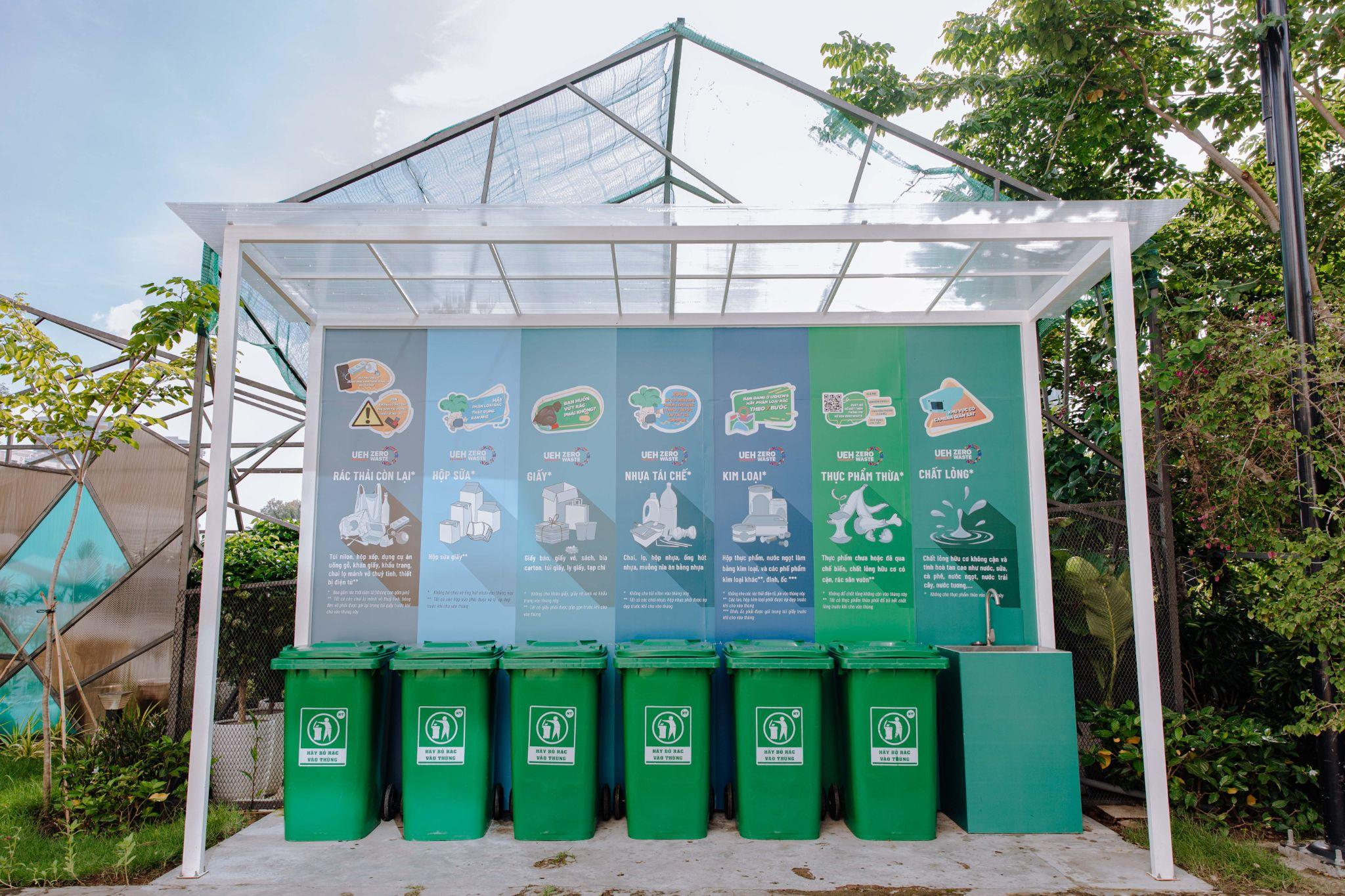 |
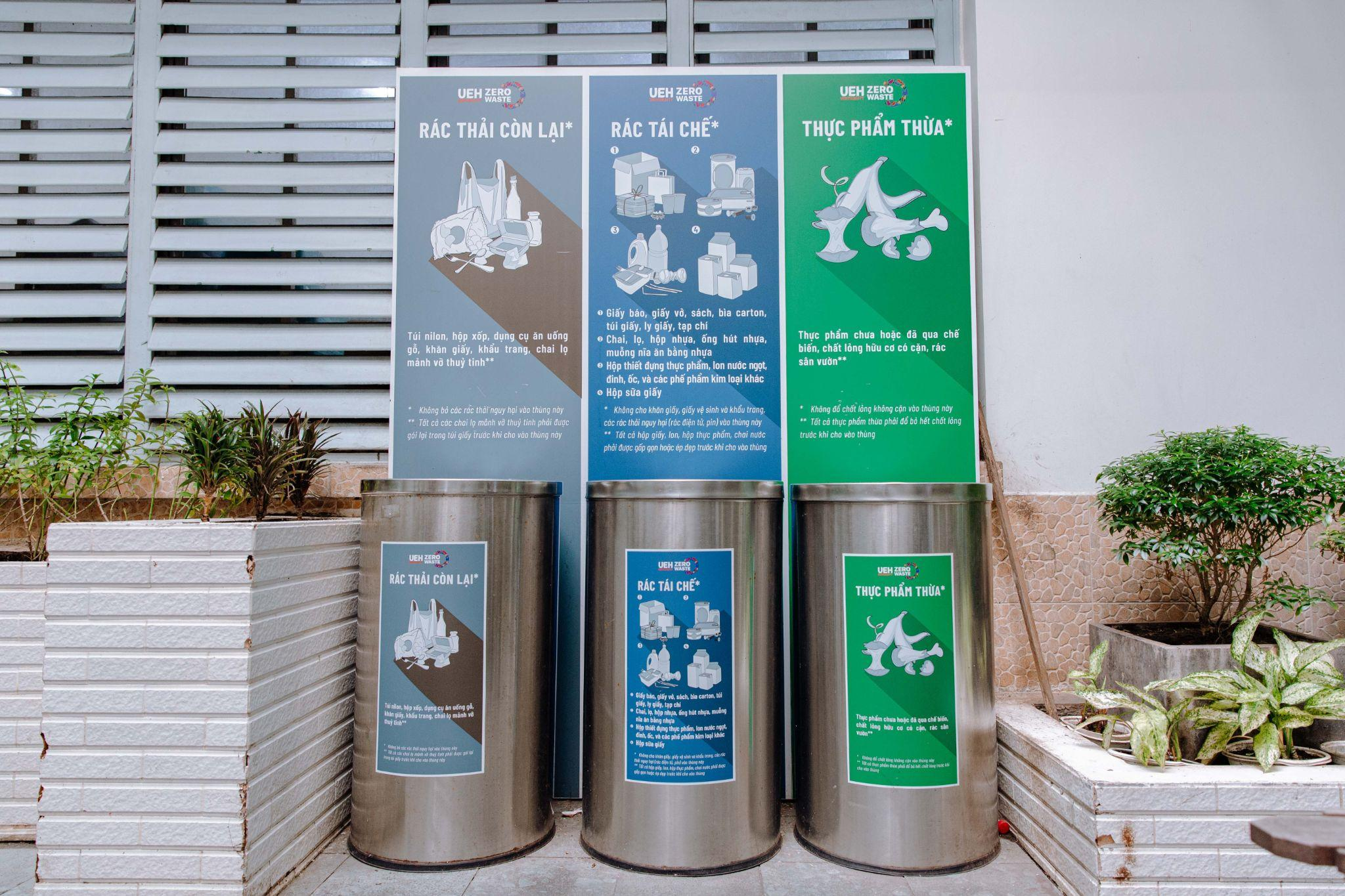
UEH Go Green Station segregation bins facilitate the separation and recycling of plastic waste, helping reduce plastic pollution.
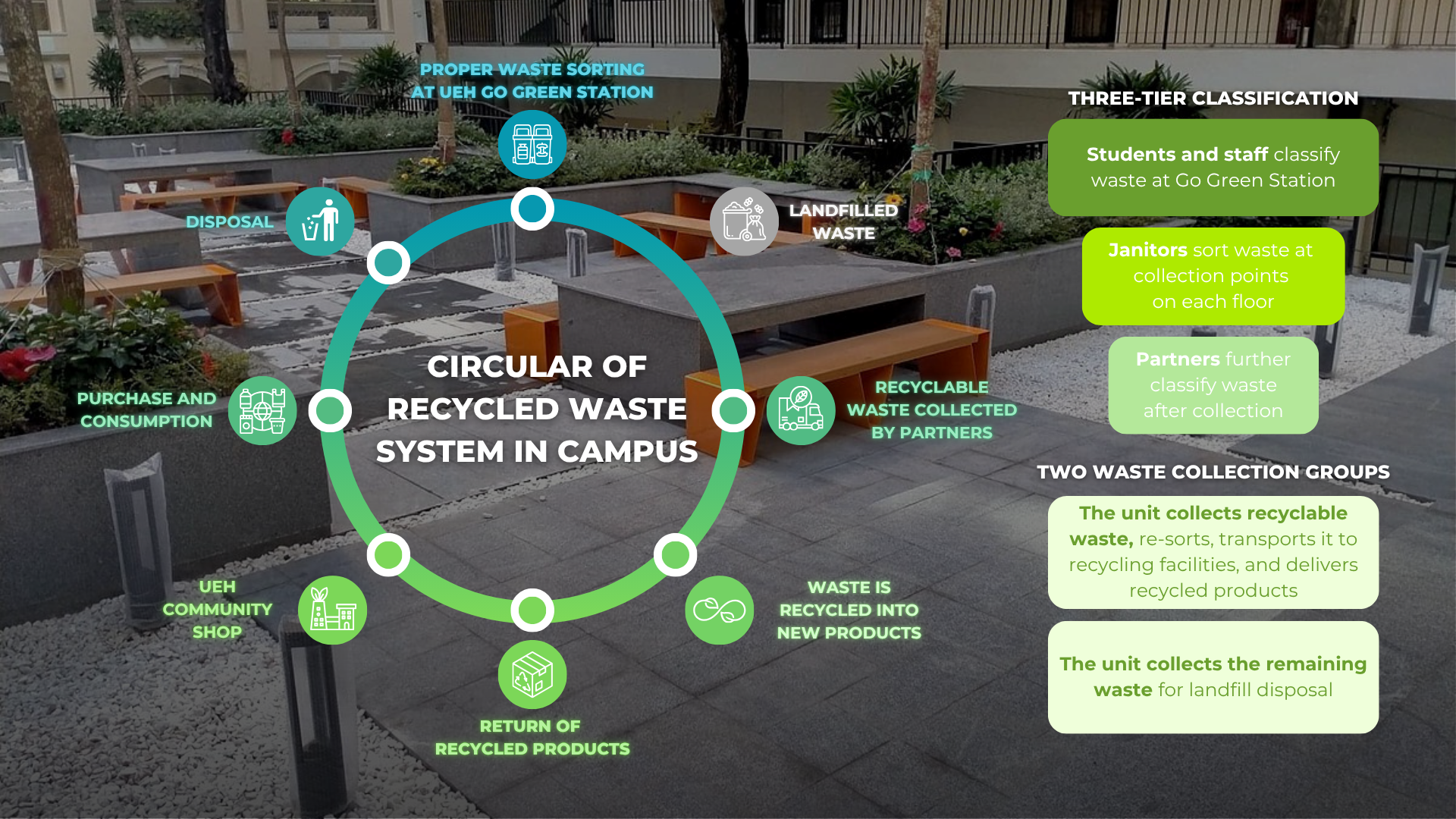
The circular recycling system on UEH campuses supports proper waste collection, separation and recycling, including plastic waste.
Article 8, Clauses 1–4 – Policy on Reducing Single-Use Plastics on UEH Campuses sets objectives to restrict, replace and progressively eliminate single-use plastic products and hard-to-degrade materials in learning, research, daily activities and events. It promotes personal water bottles and reusable materials, reductions in plastic packaging in canteens and services, plastic reduction criteria for procurement and events, recycling, and assigned responsibilities for monitoring and evaluation.
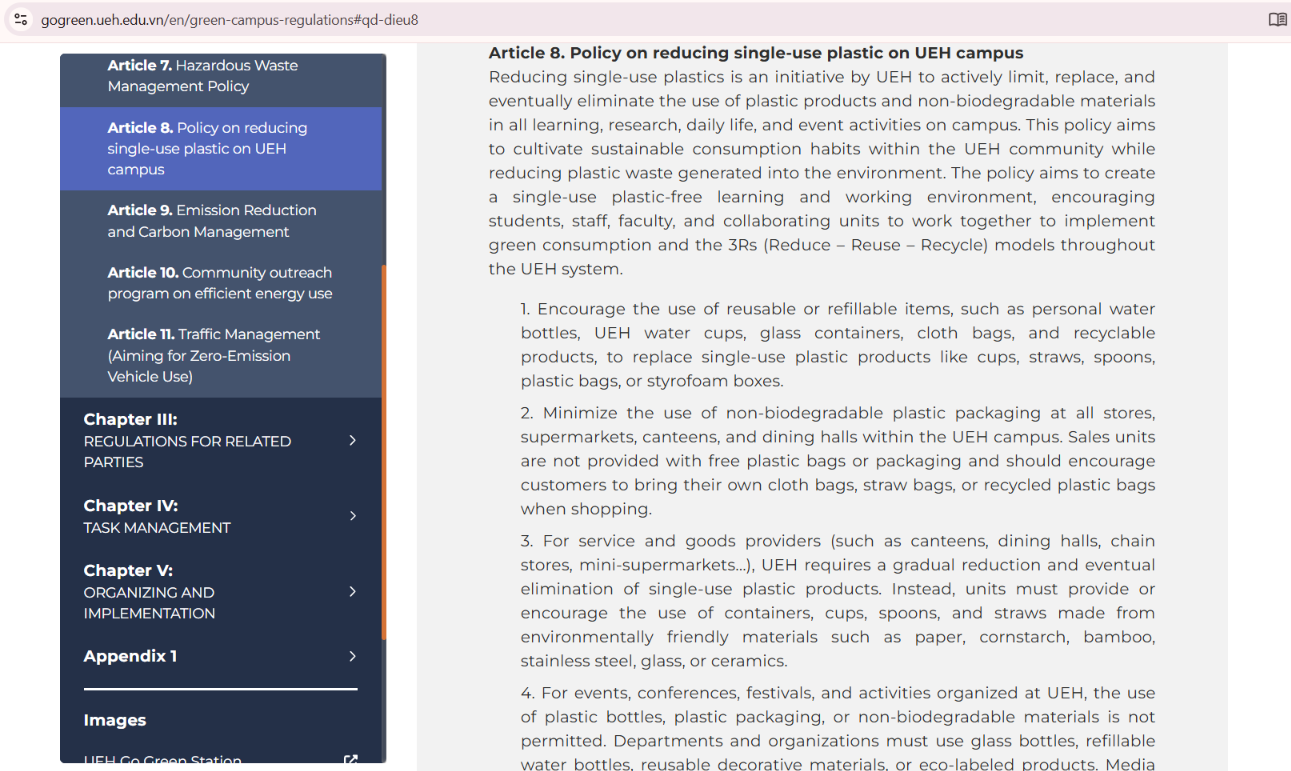
Article 8, Clauses 1–4 – Policy on Reducing Single-Use Plastics on UEH Campuses under the Green Campus Regulations issued pursuant to Decision No. 2059/QD-DHKT-CSVC
Public source: UEH Green Campus Website, ‘Green Campus Regulations’
https://gogreen.ueh.edu.vn/en/green-campus-regulations
“Article 15. Responsibilities of UEH management units for waste collection, segregation and transportation (Facilities Department, Vinh Long Campus) (Appendix 1)
- Strictly implement waste segregation at source in accordance with Article 3, Chapter II.
- Proactively implement the Green Campus principles in Articles 4 and 5, Chapter II.
- Organize collection, segregation and transfer of waste to segregation partners at UEH Go Green Stations and waste gathering points at each campus, under the guidance of the UEH Green Campus Project Team of the Sustainable University Programme.
- Collect hazardous waste and temporarily store it in technical areas before transfer to licensed treatment partners.
- Replace cleaning materials and chemicals with safe, organic and environmentally friendly products.
- Conduct annual waste audits and report waste data.
- Prioritize partners with clear, transparent and legally compliant hazardous waste treatment processes that minimize landfilling and favor recycling, reuse, or safe and environmentally responsible disposal.
- UEH shall not invest in, contribute capital to, or enter financial partnerships with enterprises or organizations engaged in environmentally polluting energy, particularly coal and petroleum use or extraction, which cause substantial CO₂ emissions and contribute to climate change.”
Building on this foundation, in 2025 UEH further developed its policy through Article 18 – Responsibilities of Units Undertaking Waste Collection, Transportation and Treatment (Appendix 1). Compared with Article 15, the updated provisions broaden and clarify the responsibilities of the Facilities Department, Vinh Long Campus, units managing campuses and dormitories, providers of cleaning, collection, transportation and treatment services, and other relevant units across UEH. In particular, Article 18 specifies the recording of waste quantities, periodic handovers, inspections, monitoring and consolidated data reporting, strengthening transparency and the ability to measure and evaluate waste management performance.
“Article 18: Responsibilities of Units Undertaking Waste Collection, Transportation and Treatment (Appendix 1)
- Units undertaking waste collection, transportation and treatment include the Facilities Department, Vinh Long Campus, units managing buildings, campuses and dormitories, providers of cleaning, waste collection, transportation and treatment services, and other relevant units across all UEH campuses.
- These units are responsible for:
- Collecting, segregating, storing, transporting and treating waste in compliance with applicable law and the principles stipulated in Appendix 1 and Article 3.
- Providing, maintaining and managing source-segregation and collection systems; ensuring appropriate collection points and waste containers in learning, working, campus, service and public areas.
- Separately sorting and storing waste, recording quantities and periodically transferring waste streams to duly authorized collectors, transporters and treatment providers; hazardous waste must be separately collected and stored and transferred to legally licensed treatment providers.
- Implementing waste prevention measures, promoting the 3R model (Reduce, Reuse, Recycle), reducing plastic and single-use products, and giving preference to environmentally friendly products, supplies and cleaning chemicals where technical requirements are met.
- Inspecting and monitoring compliance with waste segregation, single-use plastic reduction and waste management requirements within their areas of responsibility, and promptly correcting or reporting non-compliance.
- Periodically compiling data on waste generated, recyclable waste, hazardous waste and waste management outcomes, and reporting to the UEH Green Campus Coordination Board for monitoring, evaluation and UEH sustainability reporting.”
Through these updated provisions, UEH seeks to achieve the following objectives:
Waste management and segregation at source, Clauses 1 and 2 of Article 18 require units to undertake collection, sorting, storage, transportation and treatment in accordance with the law and to provide and maintain suitable containers and collection points in learning, working, campus, service and public areas. Segregation at the point of generation helps UEH control different waste streams, improve recyclable material recovery and limit the amount requiring final disposal.
Waste quantity measurement and control of waste handovers, Clause 3 of Article 18 requires units to segregate and store each waste stream, record its quantity and arrange periodic handovers to authorized collectors, transporters and treatment providers. Hazardous waste must be stored separately and transferred to appropriately licensed providers. This is one of the most important improvements to the policy, providing a basis for recording data by waste category and reconciling it with handover and treatment documents. Accordingly, UEH can monitor waste sent for recycling and, where confirmed by the receiving provider, determine the quantity sent to landfill or other treatment methods. This directly supports the measurement requirement of THE indicator 12.2.4.
Waste reduction and the promotion of recycling, Clause 4 of Article 18 calls for measures to prevent waste generation, implement the 3R model (Reduce – Reuse – Recycle), reduce plastic and single-use items, and favor environmentally friendly supplies and cleaning chemicals. This allows UEH to combine downstream waste management with prevention, increasing opportunities for reuse and recycling and reducing waste requiring final disposal, in line with the landfill-reduction direction established in Article 15.
Inspection and monitoring of policy implementation, Clause 5 of Article 18 assigns responsibility for monitoring compliance with waste segregation, single-use plastic reduction and waste management requirements at each campus, and for promptly correcting or reporting violations. This mechanism helps maintain effective segregation at source, prevent recyclable waste from being mixed with other waste and improve implementation consistency.
Data consolidation and periodic reporting, Clause 6 of Article 18 requires units to compile data on generated waste, recyclable waste, hazardous waste and waste management outcomes, and to report to the UEH Green Campus Coordination Board for monitoring, evaluation and sustainability reporting. This provision is particularly relevant to THE 12.2.4 because it establishes regular data collection, compilation and reporting rather than relying solely on segregation and disposal requirements. When combined with transfer records and treatment-method confirmations from partners, these data can support assessments of recycled and landfilled quantities and track improvements over time.
UEH also organizes on-campus waste segregation and collection under Article 3 – Waste Segregation Practices at UEH through the UEH Green Campus – Go Green Station model. The seven-stream system separates liquids, food waste, metals, recyclable plastics, paper, beverage cartons and residual waste; the three-stream system separates food waste, recyclables and residual waste for smaller locations. Recyclable plastics are separated at source and transferred to collection partners through the On-Campus Circular Recycling System to support recycling, avoid contamination with other waste streams and improve material recovery.
Article 8, Clauses 6–8 further clarify plastic waste segregation, encourage reuse and recycling, and establish the responsibilities of UEH units for inspection and monitoring. Article 12, Clauses 4, 5, 8 and 9 outline continued engagement with recycling partners, reduced use of plastic bags and ongoing improvements in Green Campus practices.
In summary, the development from Article 15 to Article 18 reflects a transition from requirements for segregation, collection, annual waste audits and landfill reduction toward clearly assigned responsibilities, quantity records, monitoring and periodic data reporting. Clauses 3 and 6 of Article 18 are particularly significant in strengthening waste measurement and recycling performance monitoring. Together with the requirement to minimize landfilling under Clause 7 of Article 15, these provisions support UEH’s continued improvement of data on waste landfilled and recycled, consistent with THE indicator 12.2.4 – Policy Waste Disposal: Landfill Policy.
2. Implementation Activities and Programmes
In 2025, UEH continued implementing waste management activities under its Green Campus framework, combining source segregation, technology applications, recycling partnerships and awareness communication.
| No. | Activity/Programme | Implementation | Results and Contribution to Indicator 12.2.4 | Public Evidence Source |
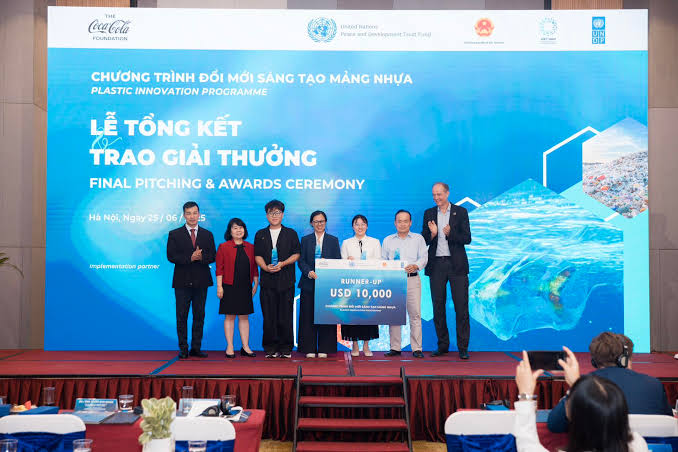
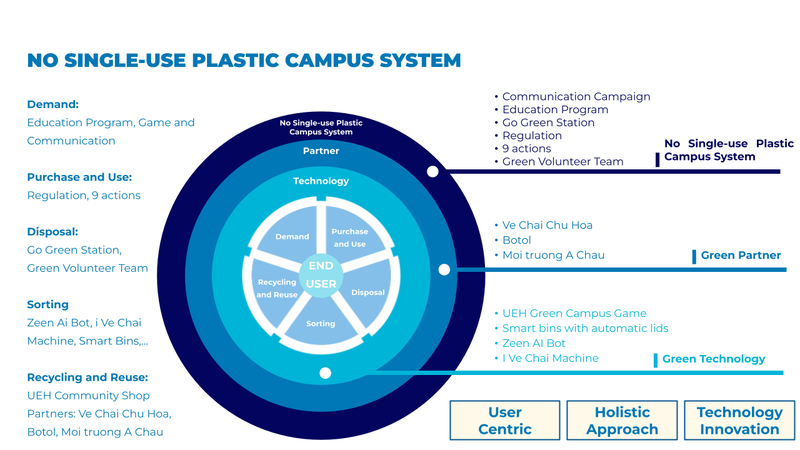
| 1 | No Single-use Plastic Campus System Initiative – Plastic Innovation Programme 2025 | In 2025, building on the ‘Towards No Single-use Plastic Campus Future’ initiative launched in 2024, UEH developed the ‘No Single-use Plastic Campus System’, integrating behavioral education, practice regulations, technology and stakeholder engagement to address all stages of single-use plastic consumption behavior.
UEH identified students as the main target group, given the convenience, accessibility and low cost of single-use plastic products. It therefore developed corresponding plastic-reduction solutions for five stages of user behavior.
|
Secured funding of USD 10,000; the published report recorded 8 tonnes of waste diverted from landfill by the reporting date, without confirming that this was an outcome achieved solely in 2025. | UEH received an award under the Plastic Innovation Programme 2025
Public source: UEH Portal, ‘UEH Successfully Secures USD 10,000 in Funding from the Plastic Innovation Programme 2025’, 02/07/2025 |
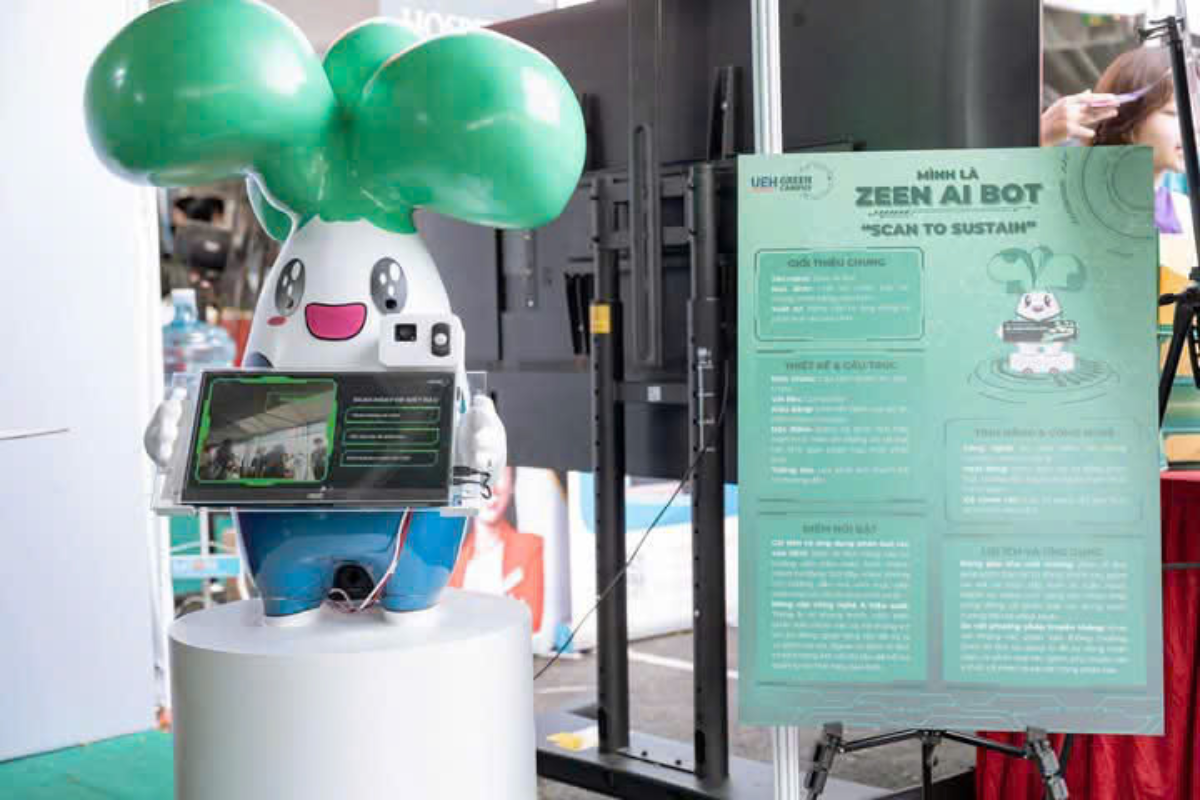
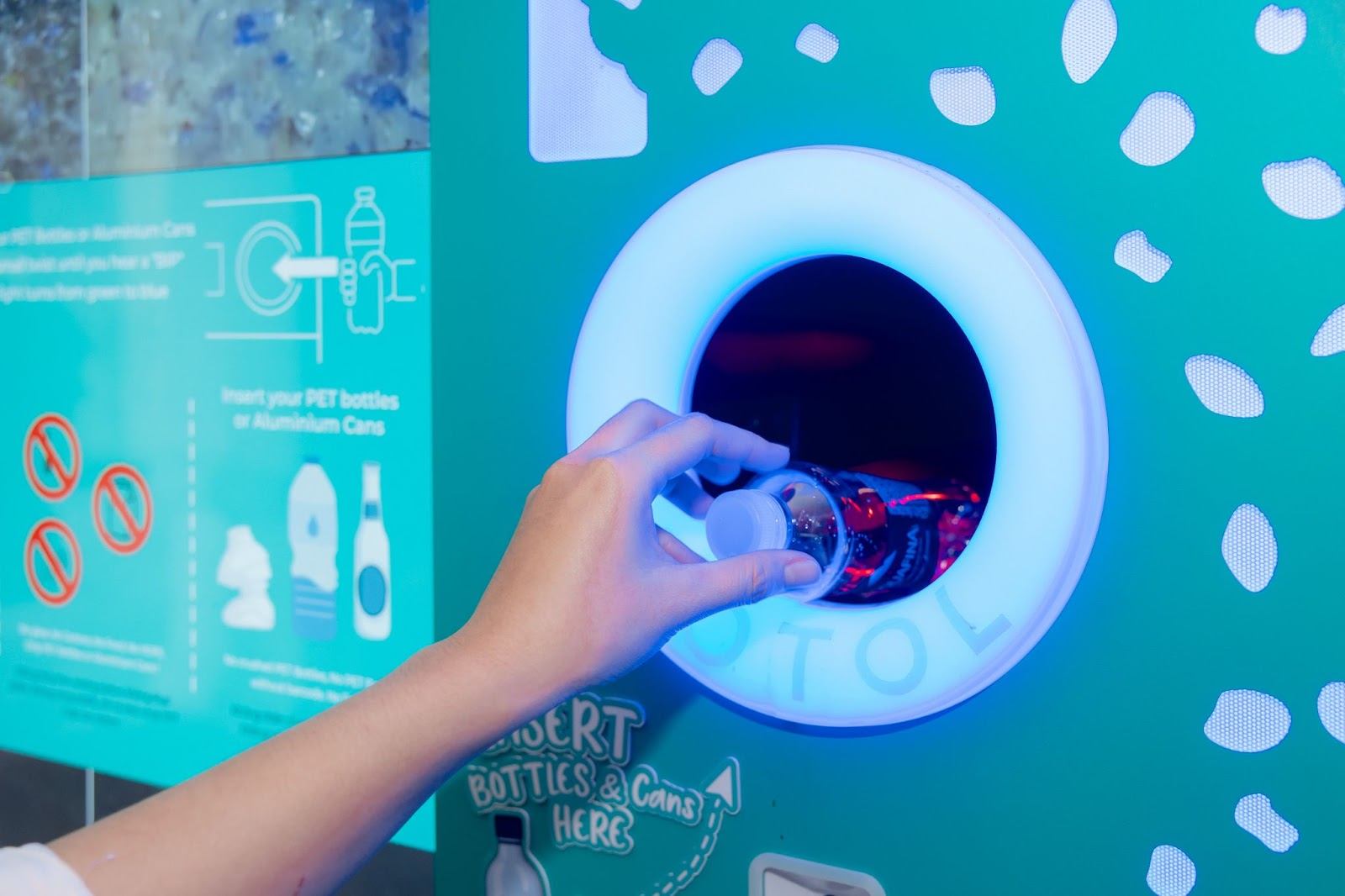
| 2 | UEH101 Series – Zeen AI Bot and I Ve Chai Machine | Introduced technologies to support the identification, segregation and recovery of recyclable materials within the UEH Green Campus ecosystem.
|
Supported correct segregation at source and improved opportunities for recyclable material recovery. No separate verified quantity was available. | UEH Green Campus Website, ‘[UEH101 SERIES] Zeen AI Bot and I Ve Chai Machine – Smart Waste Segregation and Recycling Technologies Promoting Environmental Action at UEH’, 05/03/2025 |
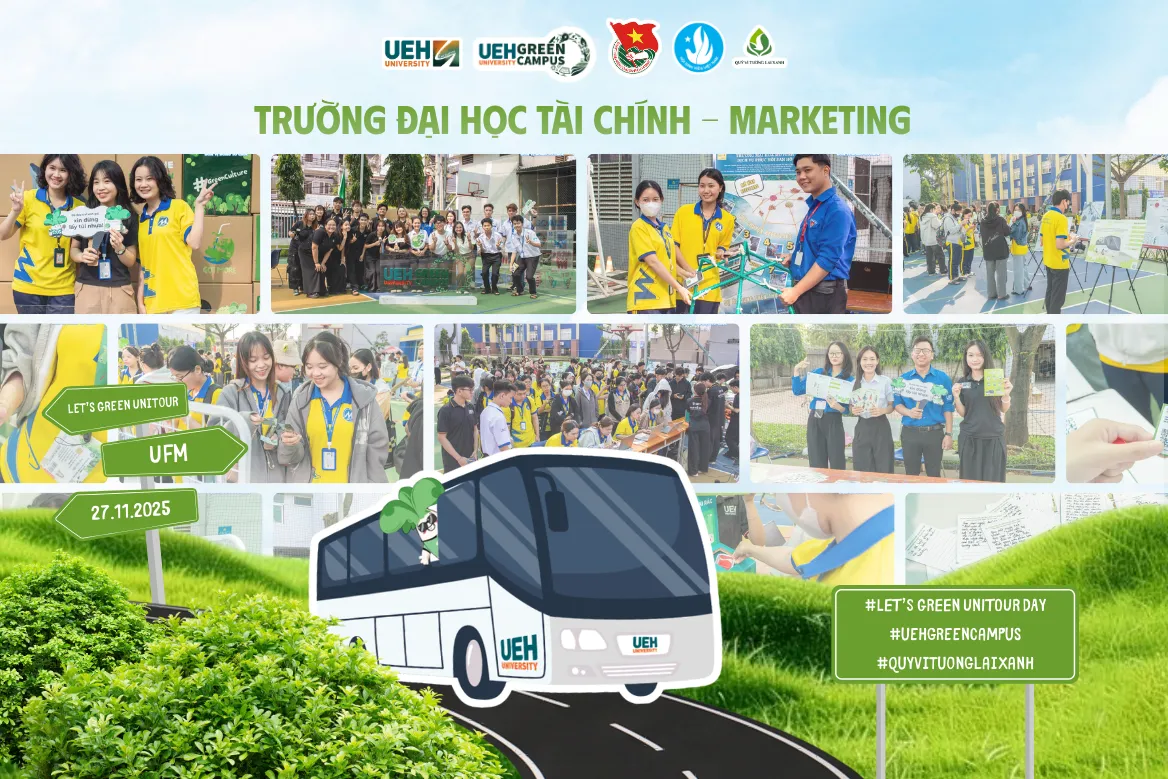
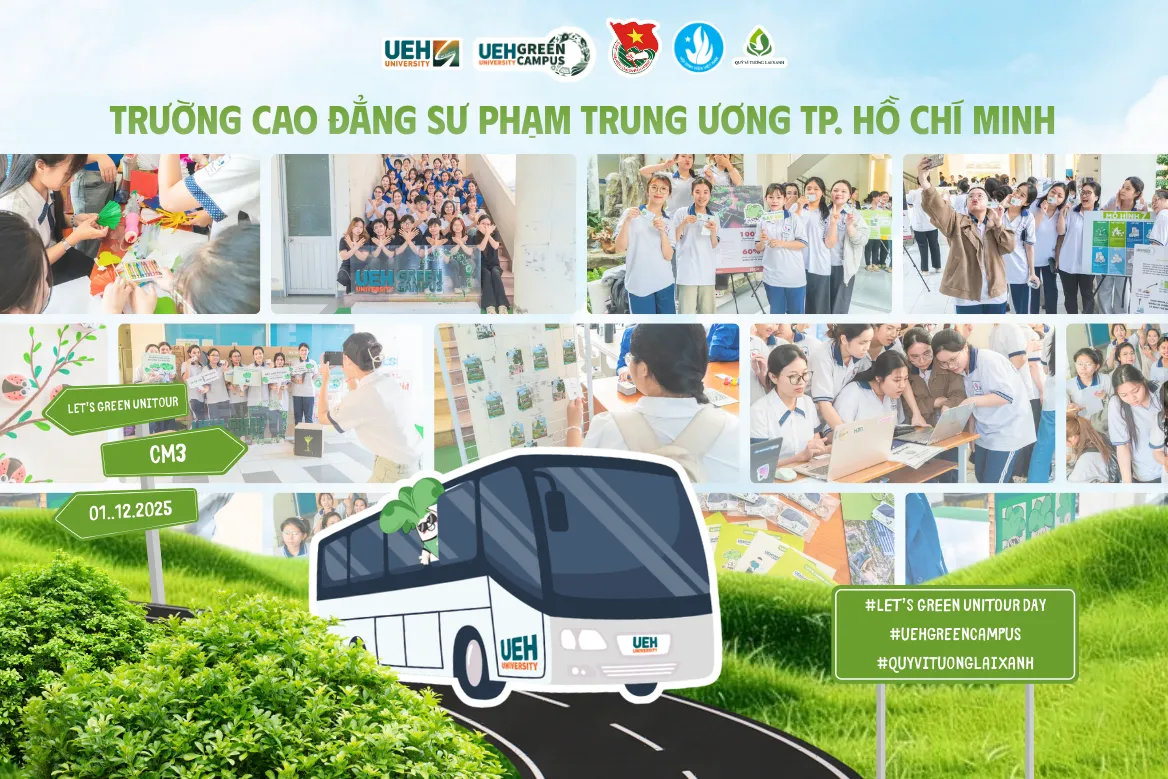
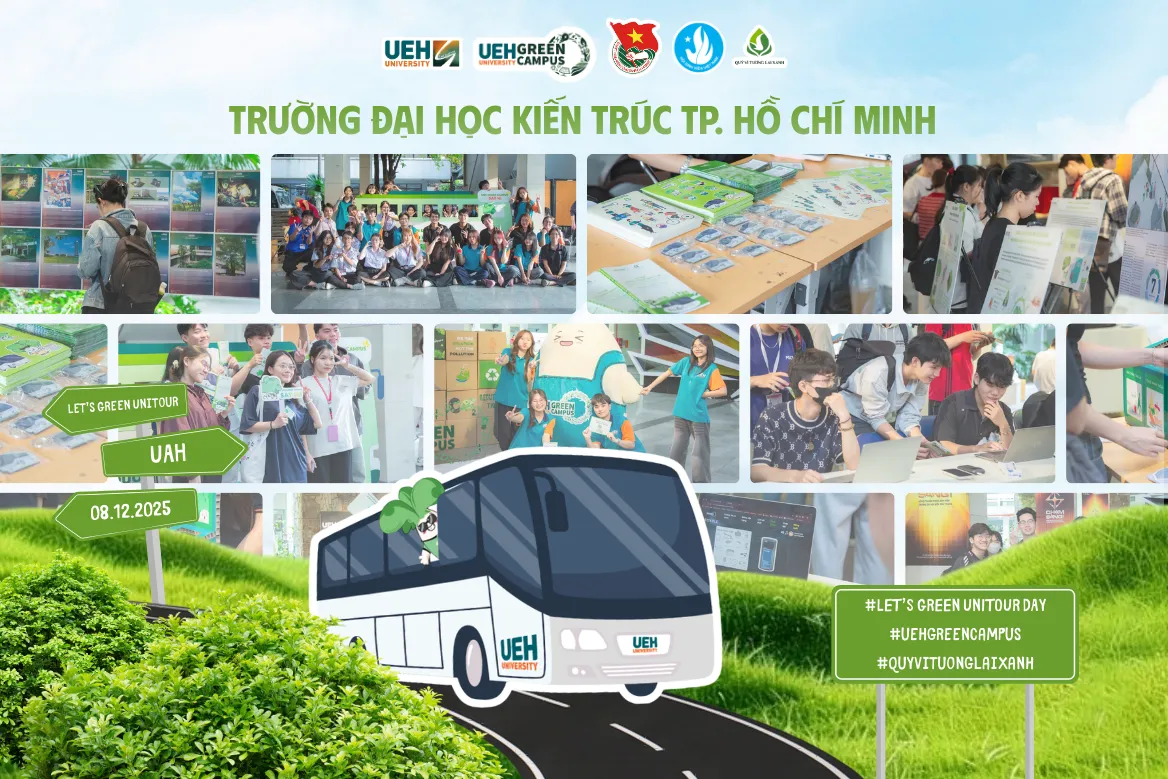
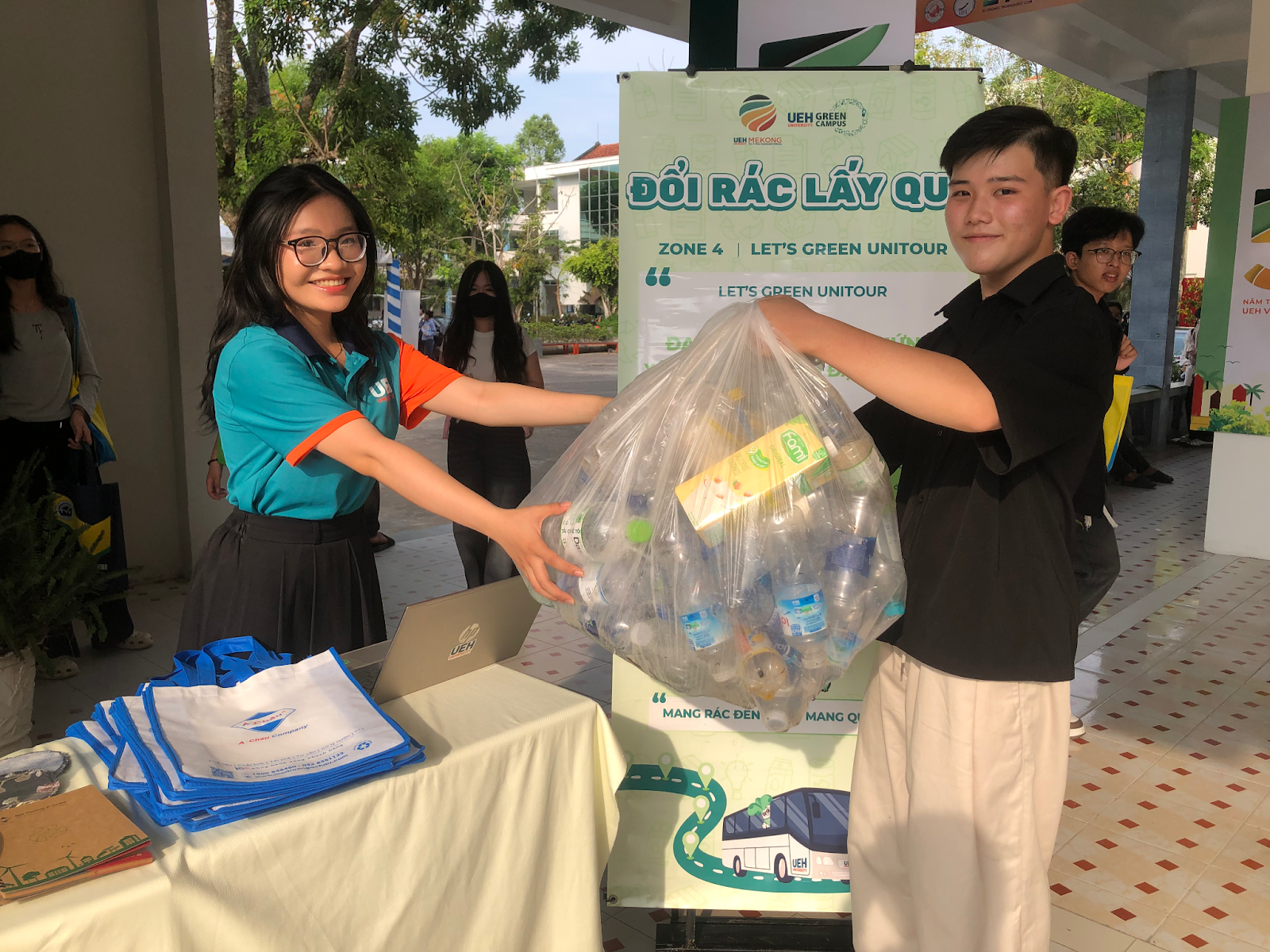
| 3 | Partnership with the For a Green Future Foundation to Extend the UEH Green Campus Model to Nine Schools in Ho Chi Minh City through Let’s Green Unitour | From November 2025 to January 2026, the Let’s Green Unitour Day series, ‘Experience a Day as a Green University Student’, attracted more than 1,615 students across nine schools. Each event offered a diverse range of interactive and experiential activities.
Regarding intended behavior changes following participation, students most frequently reported plans to sort waste into the correct bins (75%), reduce single-use plastics (65.3%), use buses instead of private vehicles (48%), and participate more in environmental programmes (47.7%). In addition, 67.2% wanted their own schools to adopt the Green Campus model.
|
Supported wider adoption of segregation and recycling practices. The programme’s collection targets were not counted as achieved results. | UEH Green Campus Website, ‘Looking Back on the Proud Journey of Let’s Green Unitour 2025: Bringing the UEH Green Campus Model to the Community’, https://gogreen.ueh.edu.vn/tin-moi-noi-bat/nhin-lai-hanh-trinh-day-tu-hao-cua-lets-green-unitour-2025-buoc-lan-toa-mo-hinh-dai-hoc-xanh-ueh-den-cong-dong |
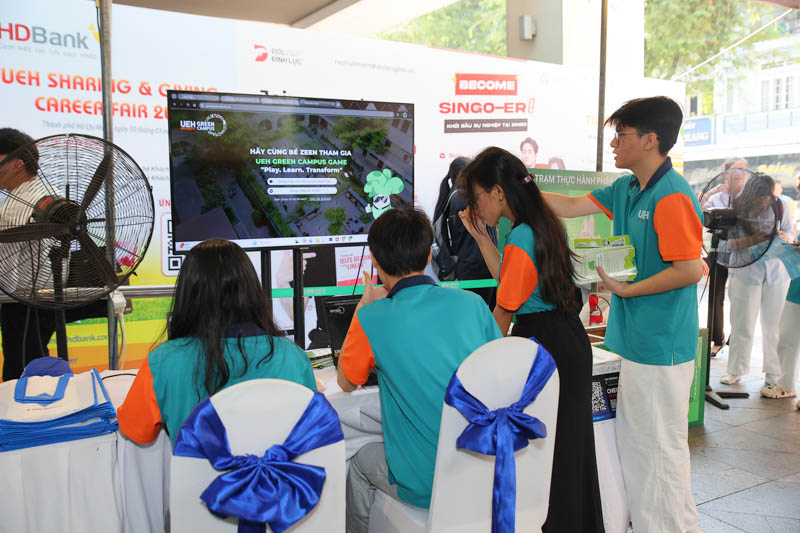
| 4 | UEH Sharing & Giving – Career Fair 2025 | Introduced the circular recycling model, provided segregation guidance and communicated green practices.
|
Raised awareness and encouraged segregation at source; not quantitative evidence of recycled waste volumes. | UEH Portal, ‘Success of UEH Sharing & Giving – Career Fair 2025: Over VND 7.5 Billion Contributed to Future Generations and More Than 5,000 Job Opportunities Connected’, 31/03/2025 |
| 5 | UEH101 Series – Waste Segregation in 9 Seconds | Communicated guidance on waste segregation at source under the Green Campus model.
|
Helped the UEH community follow segregation requirements and reduce contamination in recyclable waste streams. | UEH Green Campus Website, ‘[UEH101 SERIES] Waste Segregation in 9 Seconds: Small Actions Spreading the Green Campus Model at UEH’, 05/02/2025 |
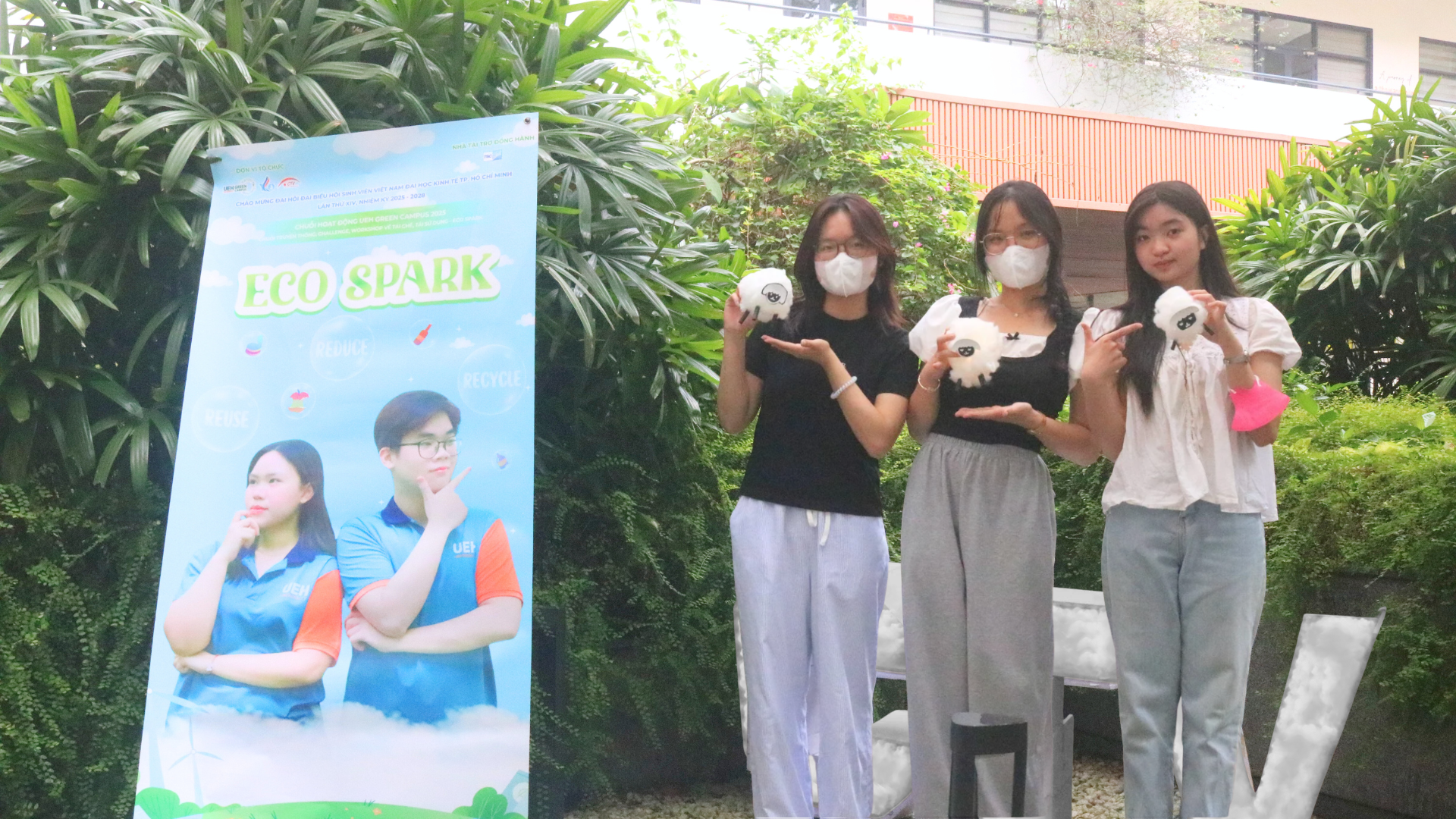
| 6 | Eco Spark 2025 – Reuse and Recycling Activity Series | Organized hands-on reuse and recycling experiences, including activities involving plastic bottles.
After participating in the workshop, students received the sheep-shaped night lamps they had made themselves. |
Encouraged waste prevention, reuse and recycling; served as supplementary evidence. | UEH Green Campus Website, ‘Eco Spark 2025 – Reuse and Recycling Activity Series’, |
| 7 | Operation of the 3R Model and Go Green Stations under UEH Green Campus 2025 | Continued three-stream and seven-stream waste segregation and campus waste reduction activities.
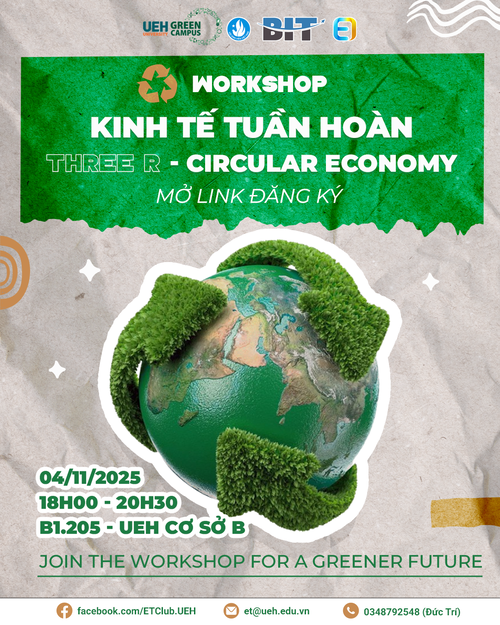
Poster for the ‘Three R – Circular Economy’ workshop |
Demonstrated that the policy remained in operation during the 2025 reporting year. | Operation of the 3R Model and Go Green Stations under UEH Green Campus 2025 |
These activities show that UEH continued implementing its policy both at management level and at waste generation points. Technology and innovation programmes strengthened segregation and recyclable material recovery, while communication activities encouraged changes in behavior within the UEH community.
3. Results and Impact of the Waste Management Policy
3.1. Continued Operation of Waste Management and Source Segregation Systems
In 2025, UEH continued operating three-stream and seven-stream segregation models, promoting single-use plastic reduction measures and developing initiatives to improve collection and recycling. Through UEH Green Campus, the university progressively combined management policies with operations, supporting technologies and community participation to improve material recovery and reduce residual waste.
Published results related to Green Campus activities included:
– The No Single-use Plastic Campus System initiative received USD 10,000 in funding in 2025.
– A source published in 2025 reported 8 tonnes of waste diverted from landfill by the reporting date.
– A Living Lab summary published in 2026 reported 8.2 tonnes of waste recycled by 2025.
3.2. Tracking Waste Quantities and Landfill Reduction Performance
Under the waste management policy, units are responsible for recording waste quantities, documenting handovers and submitting periodic consolidated reports. This provides a basis for tracking waste streams, assessing recycling performance and evaluating reliance on landfilling.
To ensure consistent data, the following indicators must be distinguished:
Total waste generated: The mass of waste generated during the reporting period.
Recycled waste: The mass confirmed as entering recycling processes.
Landfilled waste: The mass confirmed as sent to landfill.
Waste treated by other methods: The mass treated by methods other than recycling or landfilling.
Hazardous waste: Monitored and transferred separately in accordance with applicable regulations.
4. Conclusion
UEH implements its waste management policy through the Green Campus Regulations, which assign responsibilities for source segregation, collection, quantity recording, waste handovers and consolidated reporting. The policy seeks to reduce landfill disposal, increase reuse and recycling, and improve campus resource management performance.
In 2025, UEH continued operating UEH Go Green Stations, promoting the 3R model, applying segregation support technologies and developing initiatives to reduce single-use plastics. These activities contributed to SDG 12, particularly Target 12.5 on reducing waste generation through prevention, reduction, recycling and reuse.
Continuing to strengthen the policy and reconcile 2025 waste measurement data will help UEH improve transparency, verifiability and waste management performance in subsequent sustainability reporting periods.