

12.2.1. Ethical Sourcing Policy
The University of Economics Ho Chi Minh City (UEH) maintained and continuously improved its ethical sourcing policy for food, stationery, supplies, equipment and services, seeking a transparent and safe supply chain that is responsible towards people and the environment. This policy was grounded in the Green Campus Regulations under Decision No. 2059/QD-DHKT-CSVC, implemented since 2022. In 2025, UEH continued updating its policy towards responsible procurement, extending its criteria beyond origin, quality, food safety and environmental protection to human rights, working conditions, business ethics and social responsibility. UEH also specified responsibilities for supplier evaluation, selection, document verification and monitoring, alongside food provision, supply and equipment management, and sustainable consumption initiatives during 2025.
1. Policy Framework
In 2024, UEH continued to apply Article 6 – Ethical Sourcing Policy, governing the selection, purchase and use of food, stationery, supplies and equipment from suppliers meeting safety, transparency, social responsibility and environmental protection criteria. In particular, food products were required to meet food safety certification and traceability requirements; eco-labelled and recycled materials were preferred for stationery and supplies; and energy-efficient equipment meeting environmental standards was prioritized.
In addition, Article 16 – Responsibilities of UEH Management Units concerning the procurement of goods and services established the responsibilities of relevant units for supplier selection, product origin management and compliance with Green Campus principles. This policy framework provided a basis for integrating quality, environmental and social responsibility requirements into UEH procurement.
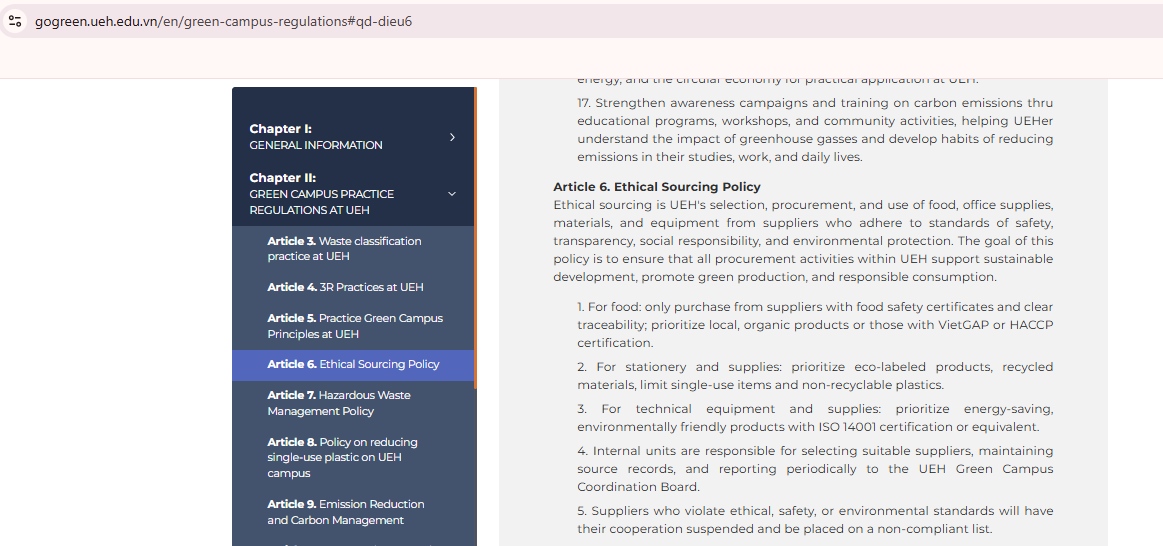
Article 6 – Ethical Sourcing Policy, as set out in the UEH Green Campus Regulations issued under Decision No. 2059/QD-DHKT-CSVC in 2022
Public source: UEH Green Campus website, ‘Green Campus Regulations’
https://gogreen.ueh.edu.vn/en/green-campus-regulations
In 2025, UEH continued refining the policy by revising ‘Article 6 – Ethical Sourcing Policy’ into ‘Article 6 – Responsible Procurement Policy’. Compared with the earlier regulations, the revised provisions extended coverage from supplier selection to the full process of planning, selecting, purchasing and using goods and services, while considering production conditions, supply practices and impacts throughout the product life cycle. Alongside existing requirements on origin, food safety, quality and the environment, the policy more explicitly addressed business ethics, human rights, safe and equitable working conditions, the prohibition of forced and child labour, and social responsibility.
The improvements to Article 6 were specified by product category and procurement activity.
For food, UEH continued to require clear product origins and compliance with food safety regulations, while encouraging local, seasonal and organic foods and products certified under VietGAP, GlobalGAP, HACCP or equivalent standards. Compared with the previous policy, the update clarified the preference for safe, responsibly sourced food supporting sustainable agricultural production.
For stationery and supplies, the policy prioritized eco-labelled products and recycled or recyclable materials, while limiting plastic and single-use products. A further improvement was the consideration of product lifespan, potential for reuse and repair, and end-of-life recycling to reduce resource consumption and procurement-related waste.
For equipment, machinery and technical supplies, UEH prioritized products with high energy and water efficiency, long service lives and ease of maintenance, upgrading and recycling; products meeting environmental standards such as ISO 14001, Energy Star or equivalent were encouraged. The policy also introduced an approach considering lifetime value and costs, including resource consumption, emissions, operation, maintenance and end-of-life disposal, rather than initial purchase price alone.
For business ethics and social responsibility, the 2025 policy more clearly prioritized goods and services produced and provided under conditions respecting human rights, occupational safety, equality and the prohibition of forced or child labour. This was a particularly significant improvement for THE indicator 12.2.1, as the policy addressed not only product quality and environmental impacts but also ethical conduct throughout production, business operations and supply.
Alongside the Article 6 update, UEH revised ‘Article 16 – Responsibilities of UEH Management Units for the Procurement of Goods and Services’ to ‘Article 17 – Responsibilities of Units Conducting Procurement and Internal Supply’. The revised scope of responsibility included the Infrastructure Management Board, Finance and Investment Planning Board, the Vinh Long Campus, Dormitory Management Board, and units assigned to manage, procure or supply goods, food, materials, equipment and services across UEH campuses.
In particular, Article 17 specified implementation mechanisms requiring supplier assessment and selection against quality, environmental, social responsibility and business ethics criteria; verification and retention of records on origin, quality and environmental certifications; monitoring of contractual compliance; prompt reporting of violations; and periodic consolidation of results for the UEH Green Campus Project. These provisions clarified accountability and established a basis for monitoring, evaluation and continuous improvement of procurement and supply across UEH.
Compared with 2024, the 2025 policy incorporated three major improvements: extending the scope from ethical sourcing to responsible procurement throughout the product life cycle; explicitly incorporating human rights, labour conditions and business ethics; and clarifying responsibilities for supplier evaluation, document verification, monitoring and reporting. Together, Articles 6 and 17 established a framework for managing food and material supply chains transparently and responsibly, addressing the central purpose of indicator 12.2.1.
“Article 6: Responsible Procurement Policy
Responsible procurement refers to UEH’s planning, selection, purchase and use of goods and services by balancing economic efficiency, quality and operational needs with environmental, social, ethical and governance considerations. This policy aimed to ensure that procurement not only met educational, research and operational requirements but also promoted responsible consumption, efficient resource use, reduced environmental impacts and sustainable development values. Ethical sourcing principles were integrated throughout procurement by prioritizing goods and services with traceable origins, produced and supplied in accordance with business ethics, social responsibility and environmental protection standards.
UEH implemented the Responsible Procurement Policy according to the following principles:
For food: prioritize food with clear origins and compliance with food safety requirements; encourage local, seasonal and organic foods, or those certified to VietGAP, GlobalGAP, HACCP or equivalent standards, to protect consumers’ health and support sustainable agriculture.
For stationery and supplies: prioritize eco-labelled products and those made from recycled or recyclable materials; limit plastic and single-use items; and favour durable products generating less waste and suitable for reuse, repair or recycling at the end of their service lives.
For equipment, machinery and technical supplies: prioritize energy- and water-efficient products with long service lives that are easy to maintain, upgrade and recycle; encourage products meeting environmental certifications such as ISO 14001, Energy Star or equivalent standards.
For procurement activities: prioritize the assessment of goods and services based on their value throughout the life cycle as well as initial purchase price; consider quality, durability, repairability, energy and water consumption, waste generation, greenhouse gas emissions, operating and maintenance costs, and end-of-life disposal; ensure procurement is open, transparent, fair and compliant with applicable laws and UEH regulations.
For the environment and social responsibility: prioritize goods and services that reduce natural resource consumption, save energy and water, and increase the use of recycled materials and renewable energy where appropriate; encourage the selection of products made under conditions safeguarding human rights, safe and equitable working conditions, prohibiting forced or child labour and fulfilling social responsibilities.
For innovation and sustainable development: UEH encouraged investment in, procurement of and replacement with products, equipment, technologies and solutions offering strong environmental performance. Products with higher initial investment costs could be considered where they demonstrated superior long-term energy and water savings, greenhouse gas reductions, lower operating costs or other life-cycle benefits. Pilot programmes for new green products, technologies and solutions were also encouraged before system-wide adoption.
Article 17: Responsibilities of Units Conducting Procurement and Internal Supply
Units conducting procurement and internal supply include the Facilities Department, Finance and Accounting Department, Vinh Long Campus, Dormitory Management Board, and other units assigned to manage, procure or supply goods, equipment, materials, assets, plants, food, chemicals, services and other resources for education, research, management and operations at all UEH campuses.
These units are responsible for:
– Conducting procurement in accordance with the principles stipulated in Article 6.
– Assessing and selecting suppliers that meet quality, environmental, social responsibility and business ethics criteria.
– Checking and retaining documentation of supplier origins, quality certificates, environmental certifications and other relevant records as required.
– Giving preference, where appropriate to operational requirements, to environmentally friendly, energy-efficient, reusable or recyclable products.
– Monitoring supplier compliance during contract implementation and promptly reporting violations.
Periodically compiling and reporting the implementation results of the Responsible Procurement Policy to the UEH Green Campus Coordination Board and proposing improvements where necessary.”
2. Implementation of the Ethical Sourcing Policy in 2025
In 2025, UEH continued implementing ethical sourcing principles in food supply management, procurement of goods, materials and equipment, and programmes promoting responsible consumption. Activities are summarized by category, distinguishing policy evidence, actual implementation and supporting awareness initiatives.
| No. | Activity/Programme | Implementation Details | Results and Contribution to Indicator 12.2.1 | Public Source |
| 1 | Management of Food Supply at UEH Canteens and Convenience Stores | UEH provided food and beverage services through canteens and convenience stores for students and staff. Its policy prioritized food products with identifiable origins, compliance with food safety requirements and relevant quality standards.
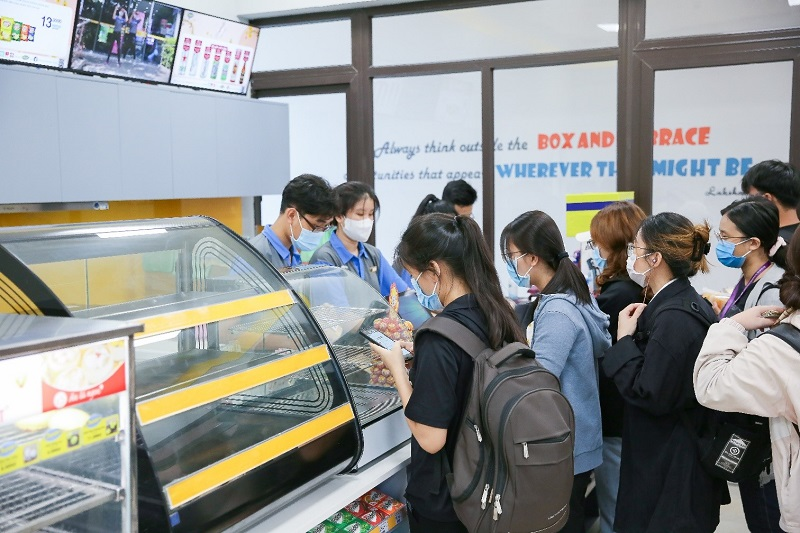
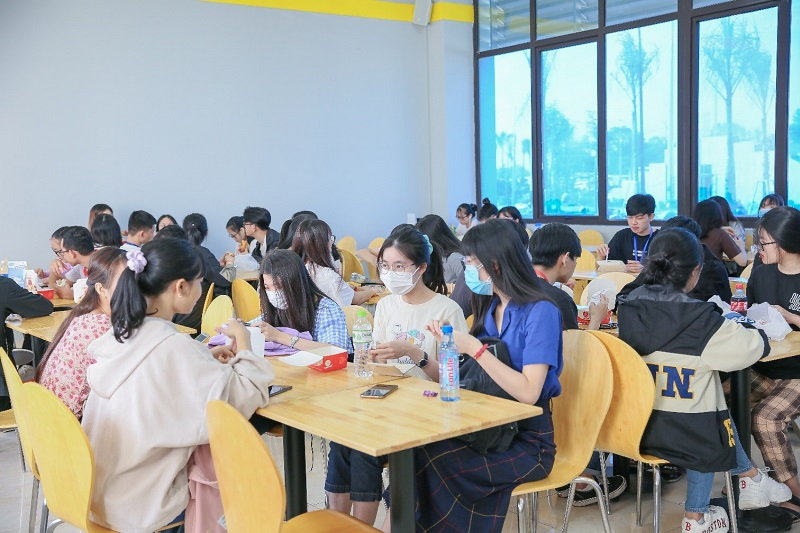
Across UEH learning facilities and dormitories, the university cooperated with the Cheers convenience-store chain to provide students with food services at affordable prices while ensuring food safety. |
This established the scope for applying ethical sourcing principles to food in the university’s regular operations, providing a basis for monitoring product quality, origins and supplier responsibilities. | UEH Admissions Portal
https://nhaphoc.ueh.edu.vn/lt-vb2-chinh-quy/ho-tro-cham-soc/dich-vu-2/ |
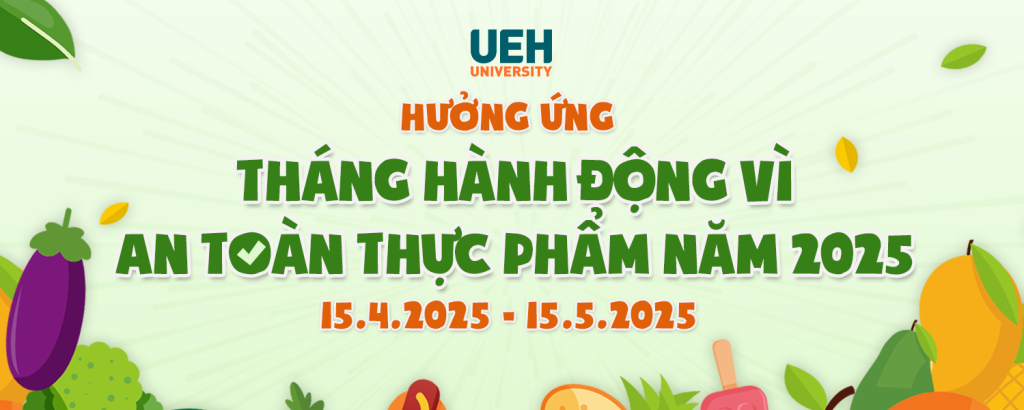
| 2 | Food Safety Action Month 2025 | From 15 April to 15 May 2025, UEH conducted communications on food safety in collective kitchens, food services and street-food settings, guiding participants on identifying traceable foods and selecting, preparing and storing food safely.
|
This raised awareness of food safety, origins and quality across the UEH community, encouraging responsible food choices and supporting ethical sourcing policy implementation. | UEH Portal, ‘Food Safety Action Month 2025’, 15 April 2025
https://ueh.edu.vn/cuoc-song-ueh/tin-tuc/thang-hanh-dong-vi-an-toan-thuc-pham-2025-73823 |
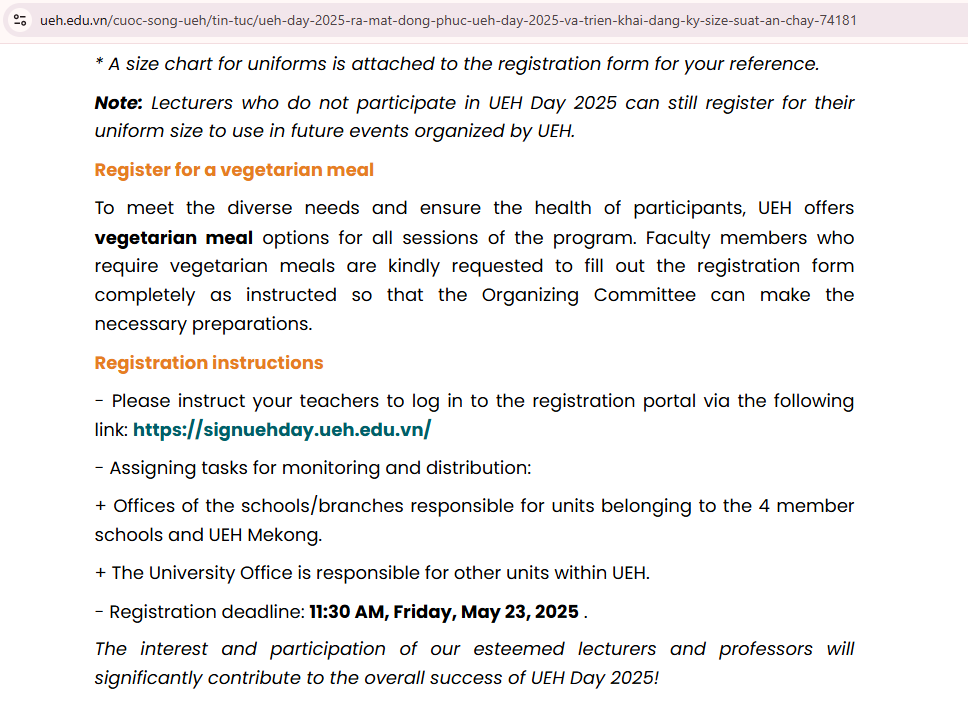
| 3 | UEH Day 2025 – Diversifying Food Choices at Events | UEH offered vegetarian meal registration for every UEH Day 2025 session, enabling nearly 900 participating employees and staff to select meals suited to their individual needs.
|
This expanded food choices at university events, supported responsible consumption and accommodated diverse participant needs. | UEH Portal, ‘[UEH Day 2025] Launch of UEH Day 2025 Uniforms and Registration for Sizes and Vegetarian Meals’, 21 May 2025 |
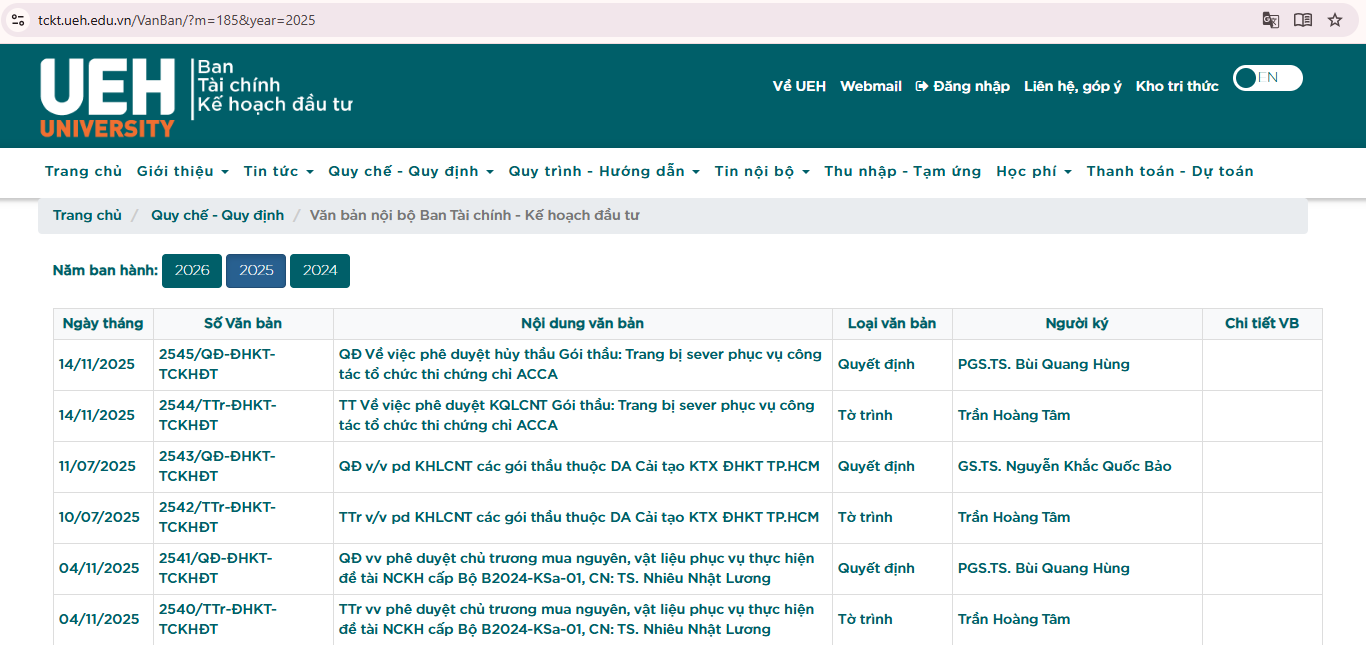
| 6 | Publication of 2025 Procurement Plans and Contractor Selection Results | UEH published documents relating to contractor selection plans, contractor selection results, and procurement of goods and equipment for educational, research, administrative and operational activities.
|
This improved transparency in procurement and provided a basis for tracing supplier documentation. Tender documents still need to be reviewed to confirm whether business ethics, environmental and social responsibility requirements were included. | Finance and Investment Planning Board website, ‘Internal Documents of the Finance and Investment Planning Board’ |
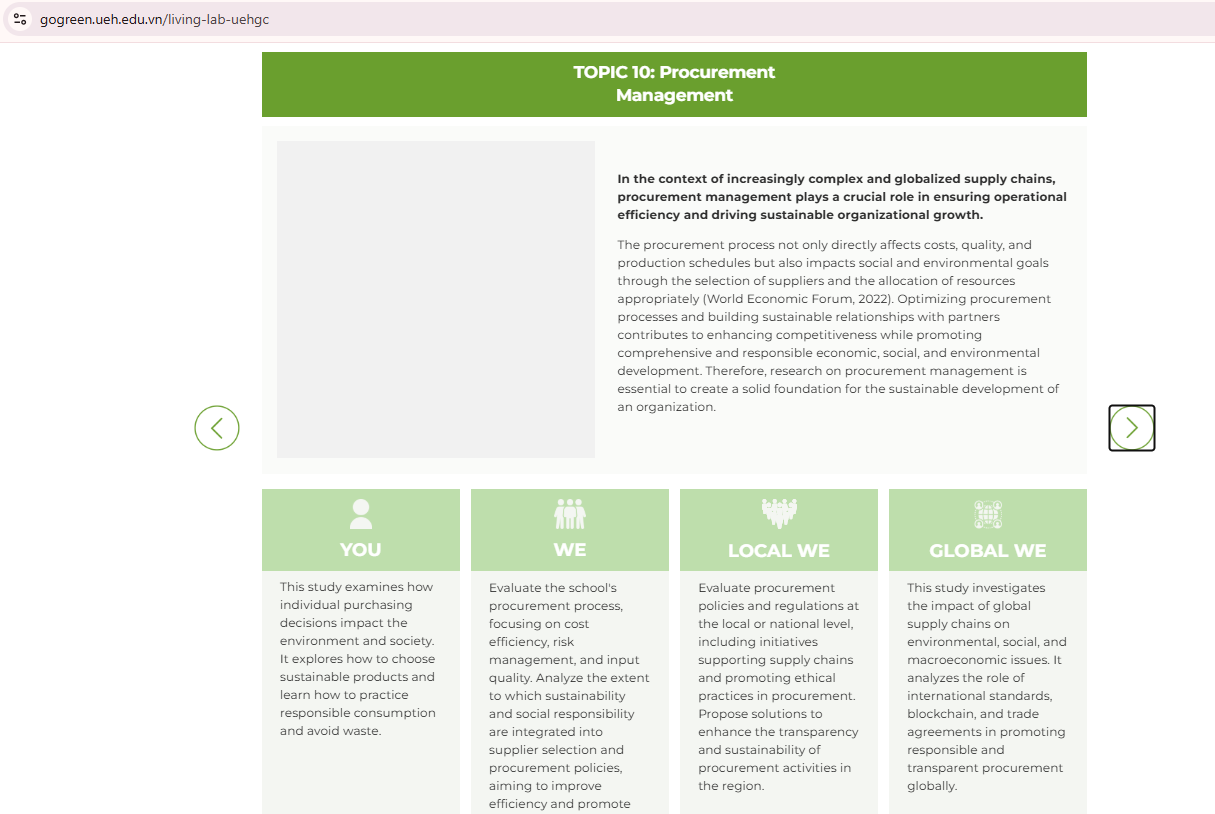
| 7 | UEH Green Campus Living Lab – Procurement Management | UEH presented a research area on procurement management, focusing on evaluating purchasing procedures and integrating sustainability, environmental and social responsibility criteria into supplier selection.
|
This contributed to a research foundation for improving responsible procurement processes and supplier evaluation and selection. Specific implementation results for 2025 have not yet been confirmed. | UEH Green Campus website, ‘UEH Green Campus Living Lab’ |

In 2025, the food supply records of DNH Development Investment Joint Stock Company, a food-service operator at UEH’s Nguyen Van Linh Campus (Campus N), documented the use of a food safety eligibility certificate and the retention of supplier purchase invoices. Specifically, Food Safety Eligibility Certificate No. 808/2025/ATTP-CNDK, issued by the Ho Chi Minh City Food Safety Department in August 2025, certified that the company’s business location met the applicable food safety conditions for food-service operations.
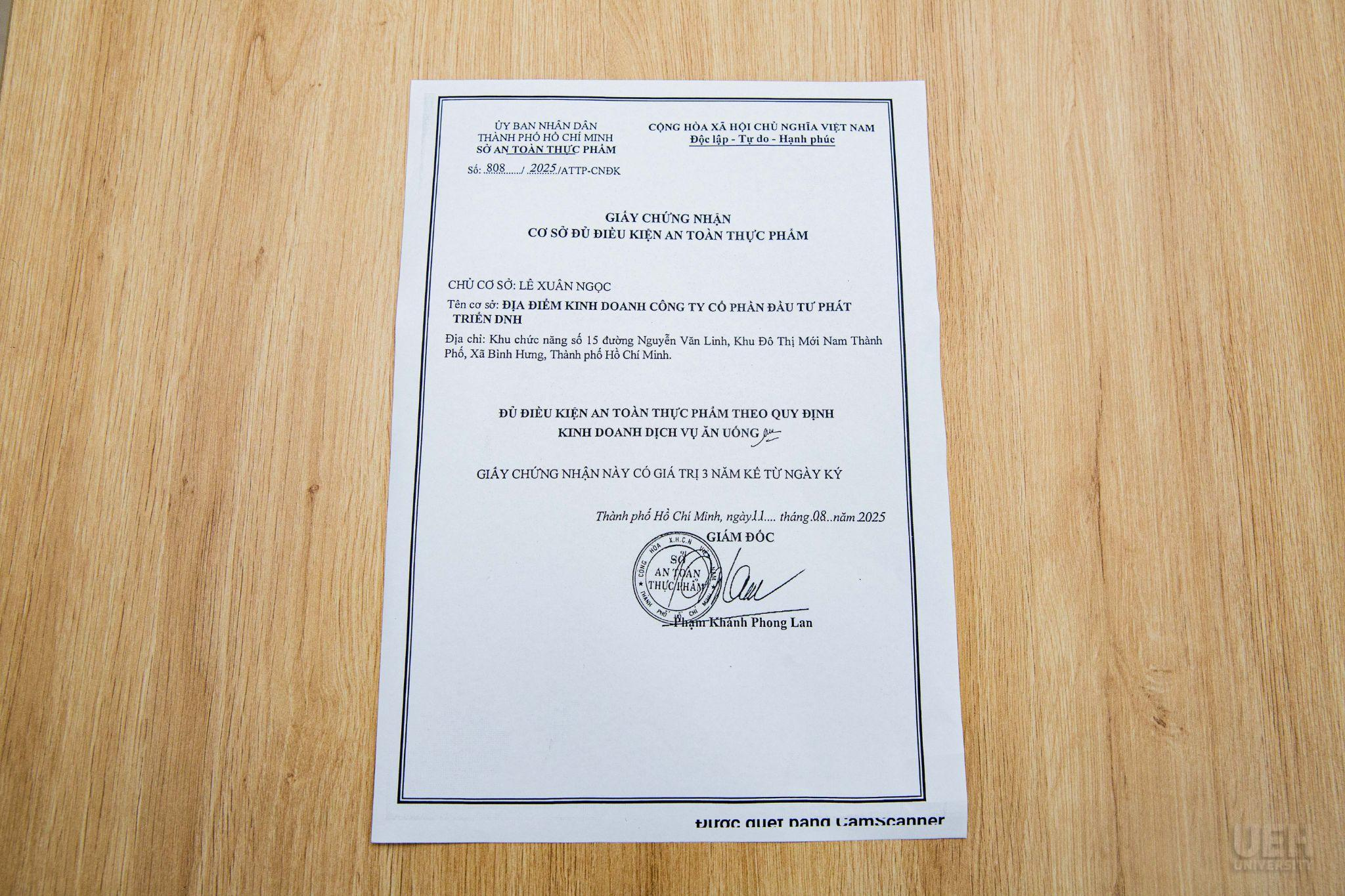
Food Safety Eligibility Certificate No. 808/2025/ATTP-CNDK, issued by the Ho Chi Minh City Food Safety Department in August 2025 for UEH Campus N
3. Results, Impact and Areas for Further Improvement
In 2025, UEH continued maintaining its ethical sourcing policy for food, stationery, supplies, equipment and services, while further developing provisions for comprehensive management of product origins, quality, environmental impacts, working conditions and social responsibility. Food safety communications, food services at university events and procurement management activities supported responsible consumption and sourcing practices across the UEH community.
Compared with 2024, the policy content was refined to broaden supplier selection criteria, strengthen business ethics and social responsibility requirements, and specify procedures for supplier evaluation, document verification, monitoring and reporting. This provided a basis for improving transparency, accountability and supply-chain management across university education, research and operations.
By combining the policy, supplier management mechanisms and practical activities, UEH continued promoting ethical procurement of food and materials, consistent with indicator 12.2.1 – Ethical Sourcing Policy, while contributing to SDG 12 – Responsible Consumption and Production.