

The University of Economics Ho Chi Minh City (UEH) remains committed to fair, transparent and inclusive admissions, ensuring that all eligible applicants have opportunities to access higher education. In 2025, UEH admissions were governed by its Regulations on Undergraduate Admissions (Decision No. 584/QĐ-ĐHKT-ĐT) and the Ministry of Education and Training’s Admissions Regulations (Circular No. 08/2022/TT-BGDĐT, as amended and supplemented by Circular No. 06/2025/TT-BGDĐT). These instruments specify priority policies by geographical area and applicant category, together with the required supporting documentation, enabling UEH to identify and track applicants from underrepresented groups across three stages: application, admission and enrolment.
The entire process has been digitalised through the UEH Admissions System (xettuyen.ueh.edu.vn), Enrolment System (nhaphoc.ueh.edu.vn) and Student Portal (student.ueh.edu.vn). Each applicant’s record includes sex, ethnicity, permanent residence, priority geographical area and priority applicant category, with supporting documents uploaded under the Instructions for Submitting Evidence for Cohort 51 Applications (2 June 2025) and the Admissions Department’s 2025 Guidance on Selecting Geographical and Applicant-Category Priorities. In 2025, Cohort 51 enrolment procedures moved entirely online, allowing records to remain linked from application submission through formal enrolment. According to consolidated data from the UEH Admissions and Training Department, 7,621 learners commenced degree programmes across levels and modes of study in 2025, including 4,724 first-generation university students (61.99%, compared with 57.75% in 2024).
In 2025, UEH monitored applicants and learners from underrepresented groups through the following admissions, document-verification and post-enrolment management mechanisms:
1. Ethnic minorities: Ethnic-minority applicants are identified through ethnicity recorded in their applications and documents establishing priority status under the 2025 guidance, such as birth certificates, school records or confirmation of attendance at an ethnic-minority boarding school. In addition to priority points, UEH maintained a dedicated direct-admission pathway for applicants from very small ethnic-minority populations, announced on 27 May 2025. Successful applicants under this pathway complete one year of supplementary study before entering their main programme. Direct-admission results were announced on 11 July 2025.
2. Particularly disadvantaged areas and low-income groups: Applicants from poor or near-poor households and those permanently resident in particularly disadvantaged communes are eligible for geographical-area and applicant-category priority points under applicable rules, without a numerical cap; applicants from 20 poor border and island districts in the south-western region may qualify for direct admission. UEH recorded 402 new students admitted under admissions priority categories in 2025, compared with 169 in 2024. This figure covers all priority categories, not only poor or near-poor households or particularly disadvantaged areas. Following enrolment, records are further cross-checked through Study Support Scholarship and tuition-fee waiver/reduction applications on the Student Portal. A decision dated 22 September 2025 awarded scholarships to 94 disadvantaged Cohort 51 entrants; at the Cohort 51 opening ceremony on 26 September 2025, UEH awarded more than VND 11.2 billion in admissions and study-support scholarships.
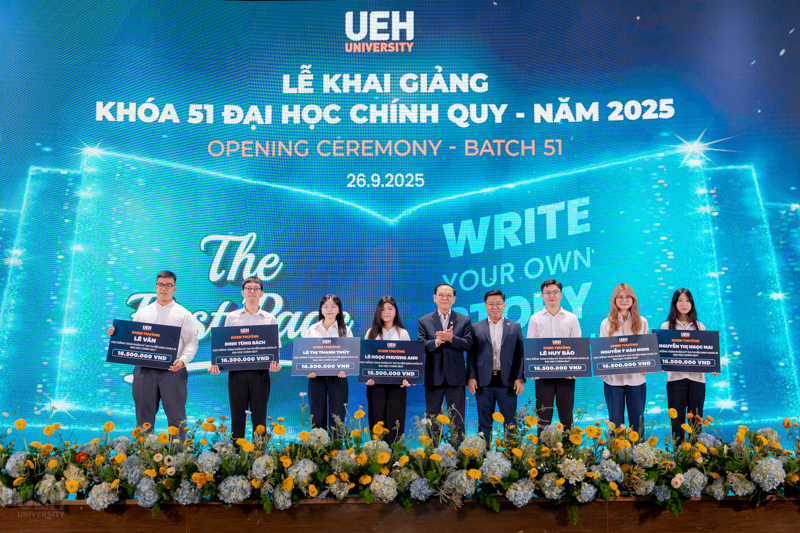
UEH awarded more than VND 11.2 billion in admissions and study-support scholarships at the opening ceremony for Cohort 51 full-time undergraduate students in 2025.
3. Persons with disabilities: Applicants with severe disabilities who hold certification from the competent authority may be considered for direct admission to an appropriate programme under the Cohort 51 admissions notice. Information is verified during application and subsequently maintained to support enrolled students. In 2025, UEH recorded 11 students with disabilities currently enrolled across levels and modes of study (2024: 9); a separate undergraduate table recorded six currently enrolled students. These distinct reporting scopes inform the identification of needs and provision of appropriate learning support.
4. Women: UEH records sex in its application, enrolment and student management systems to track access to university by sex and programme. According to 2025 new-entrant statistics, 8,946 of the 13,324 newly admitted learners across undergraduate, master’s and doctoral levels were women. At undergraduate level, 7,846 of 11,535 new entrants were women. The figures demonstrate sex-disaggregated reporting at both university-wide and level-specific scales.
5. Non-traditional learners: UEH accepts, assesses and maintains separate records for part-time/in-service programmes, second degrees and transfer pathways, allowing working adults and holders of prior qualifications to pursue university study. In 2025, UEH enrolled 1,703 new part-time/in-service learners; within full-time programmes, new entrants included 548 second-degree and 1,067 transfer students. These indicators are tracked by study mode and should not be added together where categories overlap. For applicants with prior education abroad, UEH maintained admissions and qualification-verification arrangements under the guidance dated 25 June 2025.
6. LGBT communities and refugees: Within the current legal framework, UEH does not separately collect applicants’ sexual orientation, gender identity or refugee status. UEH admissions policies and counselling tools are designed to be neutral and non-exclusionary; students’ personal information is protected under UEH’s Personal Data Protection Policy.
In addition to these groups, UEH continued to track first-generation university students. In 2025, 4,724 of the 7,621 learners commencing degree programmes (61.99%) were first-generation students. UEH also recorded 254 currently enrolled international students from developing countries (2024: 240), maintaining data to assess educational access and student support needs.
The 2025 results below show how UEH identifies groups in application records, verifies admissions eligibility and continues to manage information after enrolment. Indicators retain the reporting scope of each original source, distinguishing new entrants from currently enrolled students.
| Group | Application stage | Admission stage | Enrolment and post-enrolment | Evidence of implementation in 2025 |
|---|---|---|---|---|
| Ethnic minorities | Declare ethnicity and priority category in the Admissions System; submit supporting documents (birth certificate, school records, ethnic-minority boarding school confirmation) under guidance dated 30 May and 2 June 2025. | Documents are verified before priority points are awarded; applicants from very small ethnic-minority populations have a dedicated direct-admission route. | Priority documentation is reconfirmed in the Enrolment System (guidance dated 22 August 2025) and retained in the Student Portal. | Cohort 51 direct-admission results announced 11 July 2025; group data are maintained continuously from application to student record. |
| Poor and near-poor households and disadvantaged areas | Declare priority area, permanent residence and poor/near-poor household status, with supporting documents. | Documents are checked for area- and category-based priority points; applicants from 20 poor border and island districts in the south-western region are eligible for direct admission. | New students apply for Study Support Scholarships and tuition-fee waivers/reductions through the Student Portal, with poor/near-poor household certification. | Admissions priority guidance dated 30 May 2025 and the Study Support Scholarship decision dated 22 September 2025. |
| Persons with disabilities | Submit certification of severe disability from a competent authority when seeking direct admission (notice dated 27 May 2025). | Direct admission is considered for programmes appropriate to the applicant’s health condition. | The Admissions and Training Department and Department of Student Affairs monitor students with disabilities across levels and modes of study to arrange support. | Disability records are cross-referenced between admissions and student management/support data in 2025. |
| Women | Sex is recorded in the Admissions System. | Sex is cross-referenced against admissions data and programme-level admissions statistics. | Sex is confirmed through the Enrolment System and Student Portal. | 2025 new-entrant statistics disaggregated by sex and level of study. |
| Non-traditional learners | Applications for part-time/in-service study, second degrees and college-to-university transfer pathways are accepted separately by mode and intake, without age limits. | Admission results are processed and announced separately by mode and intake. | Learners are managed by study mode throughout their programmes. | UEH organised four admissions rounds for its K2025 intakes across study modes. |
| Applicants with foreign educational backgrounds and international learners | Admissions Method 2 applies to applicants who graduated from overseas secondary schools or hold international certificates (supporting-document guidance dated 25 June 2025). | International qualifications are checked before assessment; foreign applicants are admitted under Ministry of Education and Training regulations. | International students are tracked separately in student records. | Guidance on foreign qualifications and certificates dated 25 June 2025; nationality data maintained in student records. |
| LGBT communities and refugees | UEH does not collect separate sexual-orientation, gender-identity or refugee-status data across the three stages, within the applicable legal framework. | Admissions rules are neutral and non-exclusionary; personal information is protected under UEH’s Personal Data Protection Policy. | No separate group-level tracking data are collected. | No group-specific counts are reported in the supplied evidence. |
RECORDED RESULTS BY LEARNER GROUP IN 2025
| Monitored learner group | Recorded 2025 indicator | Statistical scope and supporting source |
|---|---|---|
| New entrants receiving Study Support Scholarships | 94 Cohort 51 new students received Study Support Scholarships. | Study Support Scholarship award decision dated 22 September 2025; post-enrolment beneficiary statistics. |
| New entrants in admissions priority categories | 402 new students benefited from admissions priority policies. | 2025 Cohort 51 admissions compilation covering geographical and applicant-category priorities. |
| Students with disabilities | 11 currently enrolled students with disabilities across levels and modes of study; separate undergraduate statistics record six students. | Currently enrolled learners in 2025; consolidated student management data and the separate undergraduate statistics. |
| Women | 8,946 of 13,324 new entrants were women; at undergraduate level, 7,846 of 11,535. | 2025 new-entrant counts by sex and level of study; source: 2025 statistics. |
| Non-traditional learners | 1,703 new part-time/in-service learners; 548 full-time second-degree entrants; 1,067 full-time transfer entrants. | 2025 new entrants by study mode; modes are reported separately. |
| First-generation university students | 4,724 of 7,621 learners commencing degree programmes (61.99%) were first-generation students. | 2025 degree-programme starters; source as stated in the original: UEH THE Impact 2026 (2025 data). |
| International students from developing countries | 254 currently enrolled students in 2025 (2024: 240). | 2025 student data by country and enrolment status; currently enrolled international students. |
In 2025, UEH recorded 402 new students in admissions priority categories (169 in 2024), 94 Cohort 51 entrants receiving Study Support Scholarships, 4,724 first-generation university students among 7,621 learners starting degree programmes, 11 currently enrolled students with disabilities in the consolidated statistics across levels and study modes, and 254 currently enrolled students from developing countries. New-entrant figures by sex and mode of study are reported separately in the 2025 statistics. These indicators use different measurement populations and are cross-referenced against admissions, enrolment and student management data.
Through its application, enrolment and student management systems, UEH continues to identify, verify and track underrepresented groups at successive admissions stages. The 2025 evidence is linked to admissions-priority policies, Study Support Scholarships and post-enrolment student support, strengthening equitable and accountable access to higher education.
Publicly available regulations and announcements
- 26 September 2025. Cohort 51 Full-time Undergraduate Opening Ceremony: The First Page – Write Your Own Story at UEH. UEH Portal.
- 2 February 2023. Regulations on Undergraduate Admissions of the University of Economics Ho Chi Minh City (Decision No. 584/QĐ-ĐHKT-ĐT). UEH Admissions and Training Department.
- 24 May 2025. Public Disclosure Information for 2025. UEH Portal.
- 27 May 2025. UEH Notice on Direct Admissions under Ministry of Education and Training and UEH Regulations for Cohort 51 Full-time Undergraduate Admissions (institution codes KSA and KSV). UEH Portal.
- 30 May 2025. Guidance on Selecting Geographical-Area and Applicant-Category Priorities in Undergraduate Admissions 2025. UEH Admissions and Training Department.
- 2 June 2025. Instructions for Submitting Supporting Documents for Cohort 51 Full-time Undergraduate Applications (KSA and KSV). UEH Portal.
- 25 June 2025. Guidance for Applicants with Overseas Upper-secondary Qualifications and International Certificates (Admissions Method 2), Cohort 51, 2025. UEH Portal.
- 11 July 2025. Announcement of Cohort 51 Admissions Method 1 Results (Direct Admission under Ministry of Education and Training and UEH Regulations). UEH Portal.
- 23 July 2025. Fourth-round 2025 Undergraduate Admissions Notice for Full-time Second-degree and College-to-university Transfer Programmes, and Part-time/In-service First-degree, Second-degree and Transfer Programmes. UEH Admissions Portal.
- 14 August 2025. Notice of UEH Study Support Scholarships for the Final Semester of 2025, Cohort 51 Full-time Undergraduate New Entrants. UEH Department of Student Affairs.
- 22 August 2025. Guidance on Cohort 51 Enrolment Procedures. UEH Admissions Portal.
- 22 September 2025. Decision Awarding UEH Study Support Scholarships for the Final Semester of 2025 to Cohort 51 Full-time Undergraduate New Entrants. UEH Department of Student Affairs.