

The University of Economics Ho Chi Minh City (UEH) recognises the prevention and prohibition of harassment as an essential requirement for building a safe and equitable higher education environment that respects human dignity. Drawing on its Code of Conduct for Staff Members, regulations on the prevention of sexual harassment in the workplace, its Procedure for Receiving and Supporting Learners Experiencing Sexual Harassment, and mechanisms for handling complaints and denunciations, UEH has established measures to prevent and address harassment in teaching, administration and employment. In 2025, the University continued to make its anti-harassment principles publicly available, strengthened procedures for receiving and addressing reports, and delivered educational initiatives concerning personal safety, consent and the right to respectful treatment, contributing to SDG 10 – Reduced Inequalities.
1. Anti-Harassment Policies in UEH’s Learning and Working Environment
1.1. Prohibition of Harassment under the UEH Code of Conduct
UEH implements its anti-harassment policy through the Code of Conduct for Staff Members, issued under Decision No. 695/QĐ-ĐHKT-CTCT dated 4 April 2017. The Code establishes standards for professional duties, communication and workplace relations, including explicit prohibitions intended to protect the dignity, honour and reputation of others.
In particular, Article 7, Clause 6 states:
“Do not engage in any form of harassment of others.”
This is a central provision of UEH’s anti-harassment policy. It is not restricted to sexual conduct; rather, it prohibits harassment in any form within the scope of the Code.
Article 7 also includes related requirements:
| Provision | Policy requirement | Relevance to preventing harassment |
|---|---|---|
| Article 7, Clause 3 | Respect the principle of non-discrimination on grounds of ethnicity, gender, social background, beliefs, religion and disability. | Promotes respect and equality in professional relations. |
| Article 7, Clause 4 | Do not disseminate fabricated information or statements that insult another person’s honour or dignity. | Helps prevent verbal and information-based attacks on a person’s reputation and dignity. |
| Article 7, Clause 6 | Do not engage in any form of harassment of others. | Establishes UEH’s explicit prohibition of harassment. |
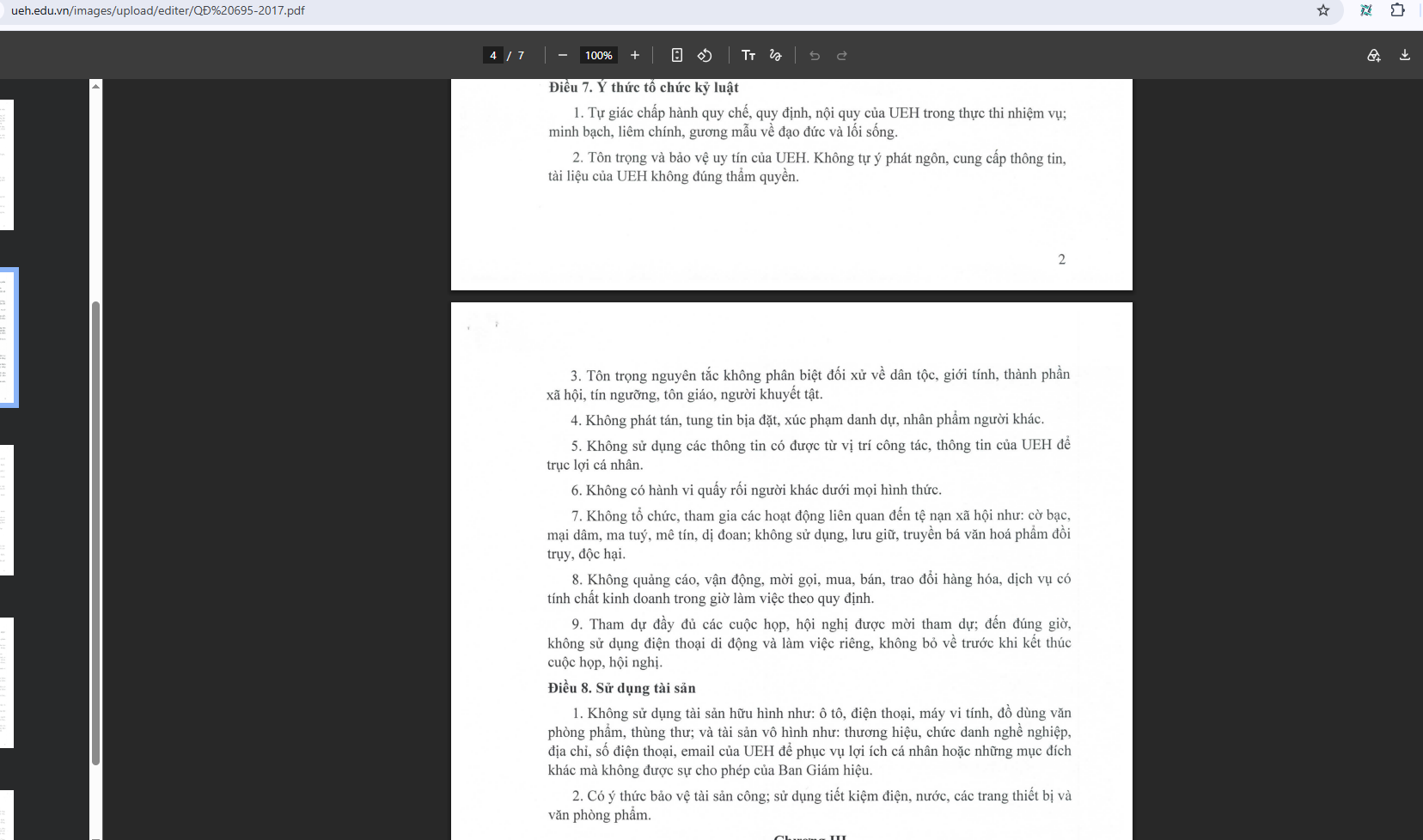
The UEH Code of Conduct establishes principles of non-discrimination, respect for honour and dignity, and a prohibition on harassment in all forms.
Source: https://ueh.edu.vn/images/upload/editer/Q%C4%90%20695-2017.pdf
These provisions constitute binding behavioural standards for staff members covered by the Code. UEH thereby emphasises each individual’s responsibility to maintain a respectful workplace free from harassment and conduct that undermines the dignity of others.
In 2025, UEH continued to publish its anti-harassment principles through its sustainability policy information channels, maintaining access to this guidance for members of the University community.
1.2. Prevention of Sexual Harassment in Employment Relationships
In addition to its Code of Conduct, UEH complies with Labour Code No. 45/2019/QH14, under which Article 8, Clause 3 prohibits sexual harassment in the workplace.
This legal framework protects employees against sexual harassment arising in employment relationships. UEH incorporates the principles of human dignity, non-discrimination and freedom from harassment into human resource management and workplace conduct standards.
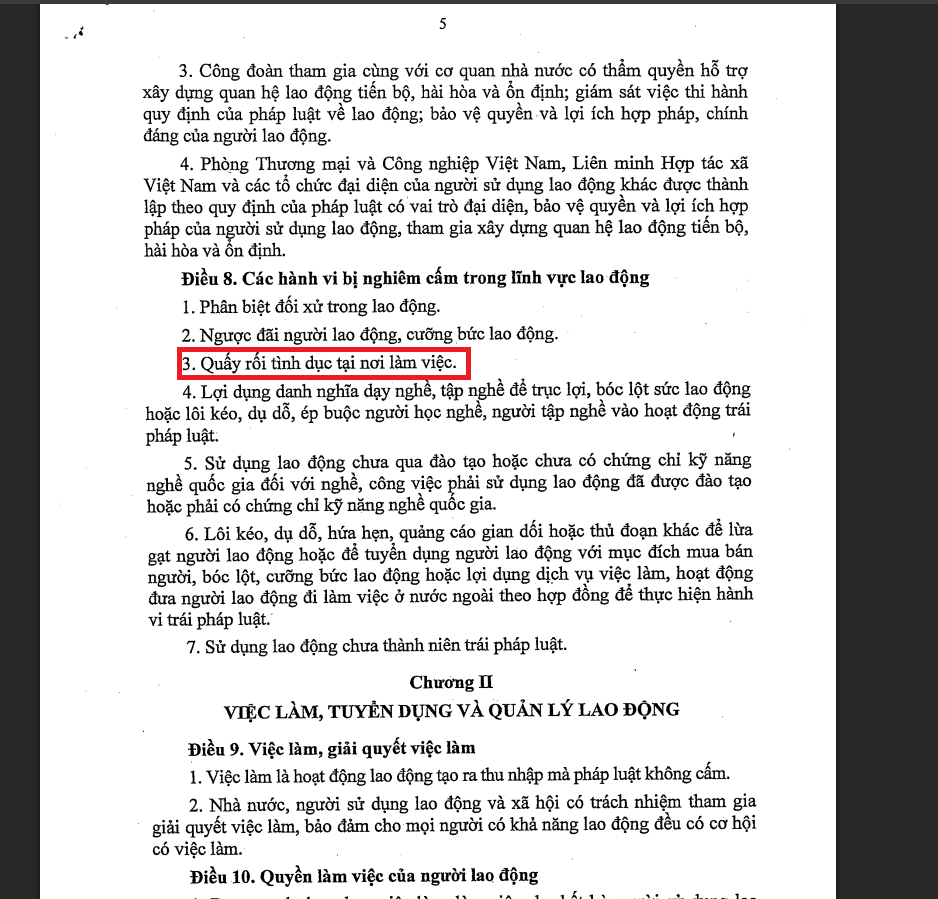
The scope of UEH’s anti-harassment framework is defined through regulations and procedures covering different groups and activities, according to the nature of the employment or educational relationship and the University’s authority:
| Group and setting | Policy basis | Protection provided |
|---|---|---|
| Staff members, lecturers and employees | UEH Code of Conduct and labour law | No harassment of others; no sexual harassment in employment relationships. |
| Learners across levels and modes of study | Procedure for Receiving and Supporting Learners Experiencing Sexual Harassment | A designated point of contact for reporting, counselling, support and referral to the competent authority. |
| Units and activities under UEH management | Codes of conduct and regulations on citizen reception, complaints and denunciations | Receipt, classification and handling of reports according to the persons involved, type of conduct and applicable authority. |
Together, these measures form a protective framework for UEH’s learning and working environment. Each case is handled in accordance with the parties involved, the conduct reported, the applicable rules and the competent authority.
2. Mechanisms for Receiving Reports, Providing Support and Resolving Harassment Cases
2.1. Procedure for Receiving and Supporting Learners Experiencing Sexual Harassment
UEH adopted its Procedure for Receiving and Supporting Learners Experiencing Sexual Harassment, code CSHTNH.QT.009, effective from 30 June 2021. The Department of Student Affairs (DSA) continues to publish the procedure and guide learners in using it as part of the student support system.
DSA serves as the focal unit for receiving information, giving guidance and counselling, and coordinating appropriate responses when learners experience sexual harassment.
The publicly described support mechanism comprises the following stages:
| Stage | Support and handling measures |
|---|---|
| Receiving a report | The learner reports the incident to DSA or through an appropriate reporting channel. |
| Verification and assessment | Information and the circumstances of the case are reviewed to determine an appropriate response within the relevant authority. |
| Counselling and support | The learner is guided towards psychological, medical and other necessary assistance according to the circumstances. |
| Referral for disciplinary or other action | Coordination with the competent unit to review the conduct and apply relevant measures under applicable rules. |
| Follow-up | Continued support and monitoring of the learner’s situation and emerging needs. |
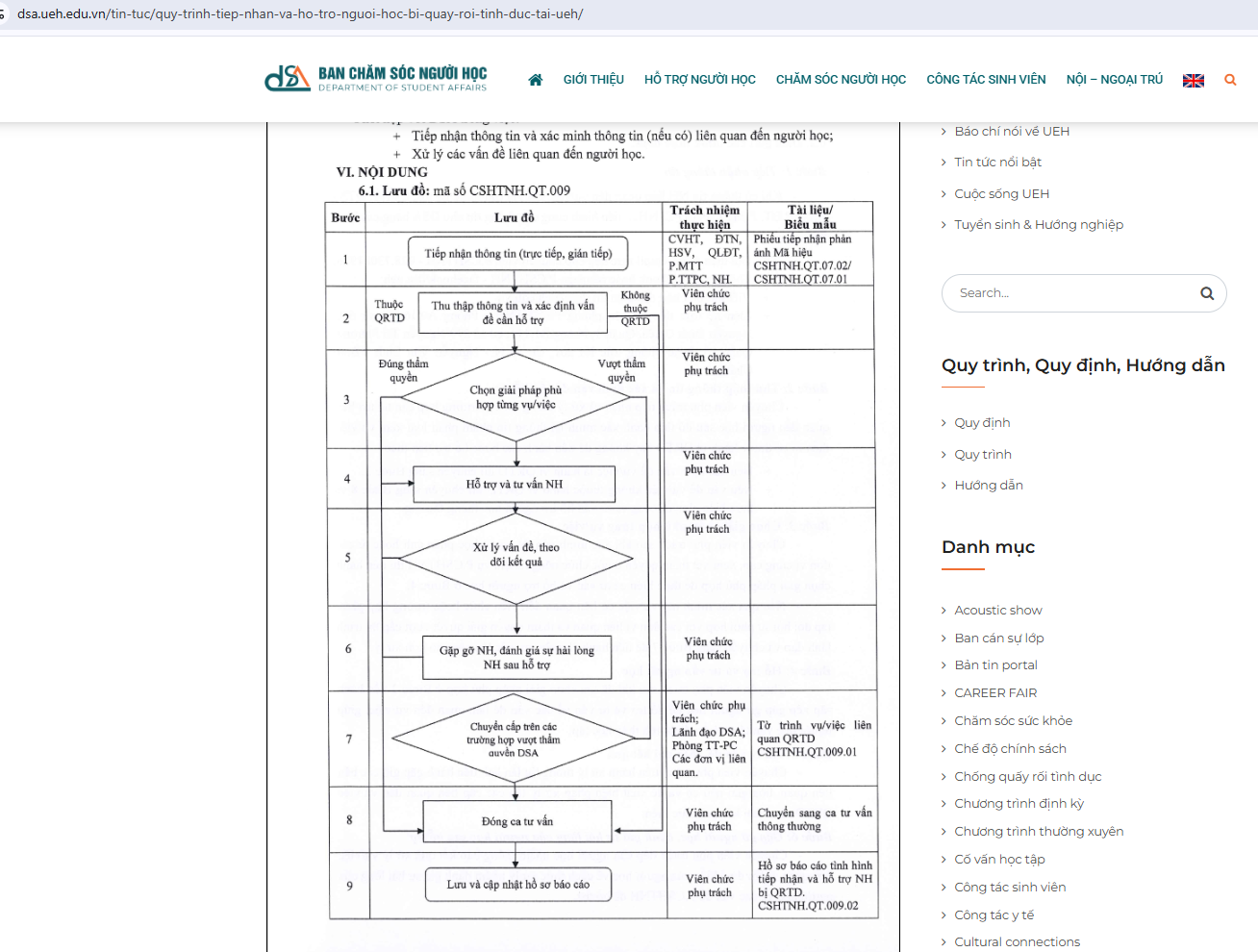
Publicly available information on UEH’s procedure for receiving and supporting learners experiencing sexual harassment.
Source: https://dsa.ueh.edu.vn/tin-tuc/quy-trinh-tiep-nhan-va-ho-tro-nguoi-hoc-bi-quay-roi-tinh-duc-tai-ueh/
Throughout the process, UEH identifies personal information protection, objective case assessment and resolution by the competent authority as key principles for supporting learners and safeguarding the lawful rights of the parties concerned.
According to guidance in the UEH Knowledge Base, learners may visit a DSA office in person or contact the department by telephone or email to report harassment and request assistance.
DSA contact details:
- Email: dsa@ueh.edu.vn
- Telephone: (028) 7306 1976
- Campus A: Room A.016, 59C Nguyen Dinh Chieu Street, Ho Chi Minh City
- Campus B: Room B1.111, 279 Nguyen Tri Phuong Street, Ho Chi Minh City
- Campus N: Room N1.201, UEH Nguyen Van Linh, Ho Chi Minh City
These designated contact points and specialised procedures enable learners to seek help when they experience sexual harassment, rather than having to manage difficult or potentially unsafe situations on their own.
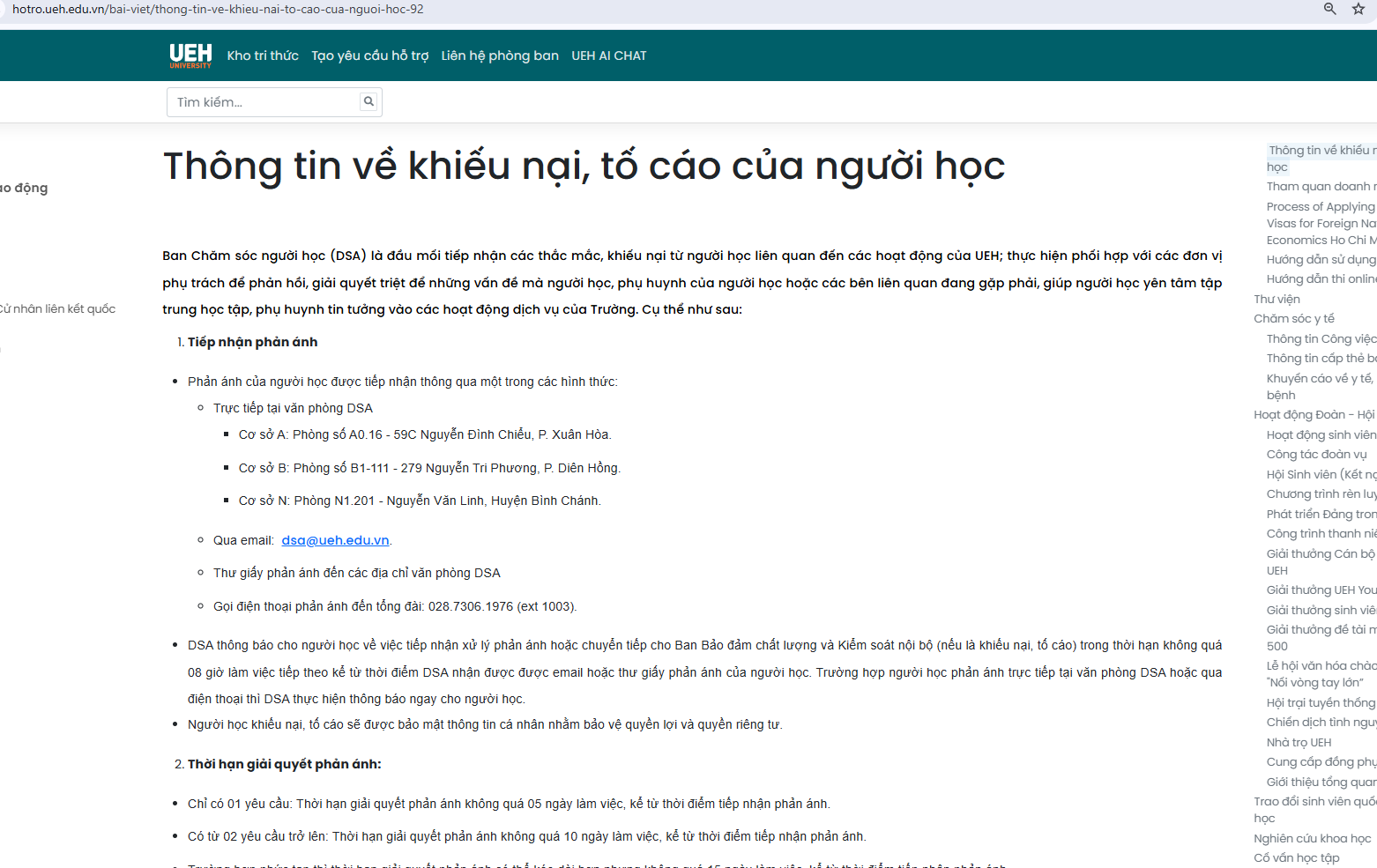
Contact information and guidance on support for learner complaints and denunciations in the UEH Knowledge Base.
Source: https://hotro.ueh.edu.vn/bai-viet/thong-tin-ve-khieu-nai-to-cao-cua-nguoi-hoc-92
2.2. Regulations on Receiving and Resolving Complaints and Denunciations Issued in 2025
During 2025, UEH further developed its regulations for receiving submissions, citizen reception, and resolving complaints and denunciations. These regulations complement the University’s mechanisms for preventing and addressing misconduct.
Specifically:
| Document | Issue date | Subject |
|---|---|---|
| Decision No. 2410/QĐ-ĐHKT-BĐCLKSNB | 14 August 2025 | Regulations on Receiving Submissions and Resolving Complaints and Denunciations at UEH. |
| Decision No. 2514/QĐ-ĐHKT-BĐCLKSNB | 19 August 2025 | Regulations on Citizen Reception. |
| Decision No. 2616/QĐ-ĐHKT-BĐCLKSNB | 30 August 2025 | Procedure for Resolving Denunciations. |
| Decision No. 2617/QĐ-ĐHKT-BĐCLKSNB | 30 August 2025 | Procedure for Resolving Complaints. |
The documents define the receipt and classification of submissions, assessment of admissibility, verification and resolution by the competent authority, thereby strengthening transparency and accountability in university governance.
For harassment-related reports, the applicable procedure depends on the conduct, the parties concerned and the relevant authority. The DSA procedure for learners experiencing sexual harassment is the specialised support mechanism; the 2025 complaints and denunciations procedures are used for matters within their respective legal scope.
The documents issued in August 2025 therefore strengthened UEH’s mechanisms for receiving and handling reports and supported the principles of safety, respect and protection of lawful rights in the University environment.
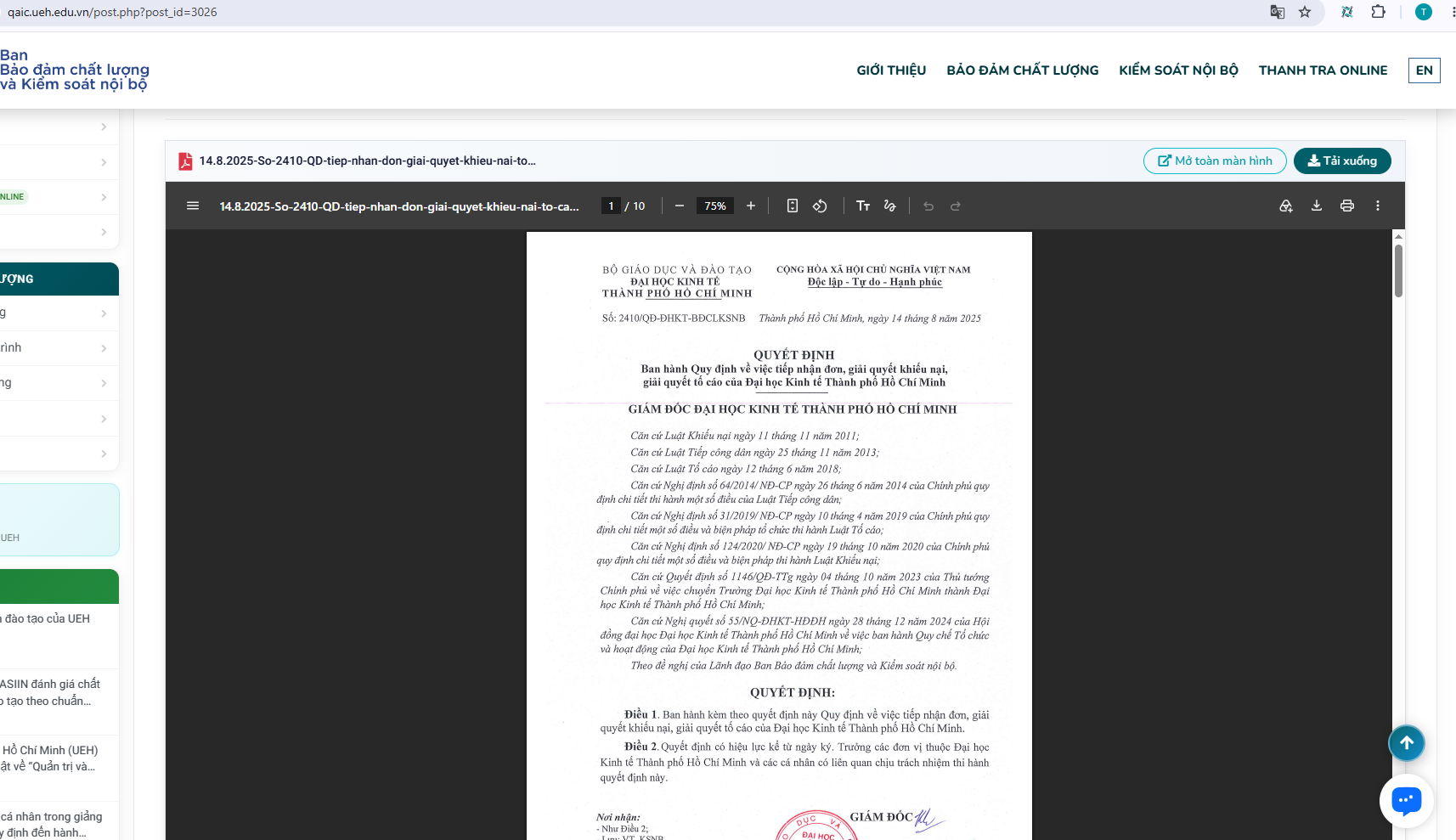
Source: https://qaic.ueh.edu.vn/post.php?post_id=3026
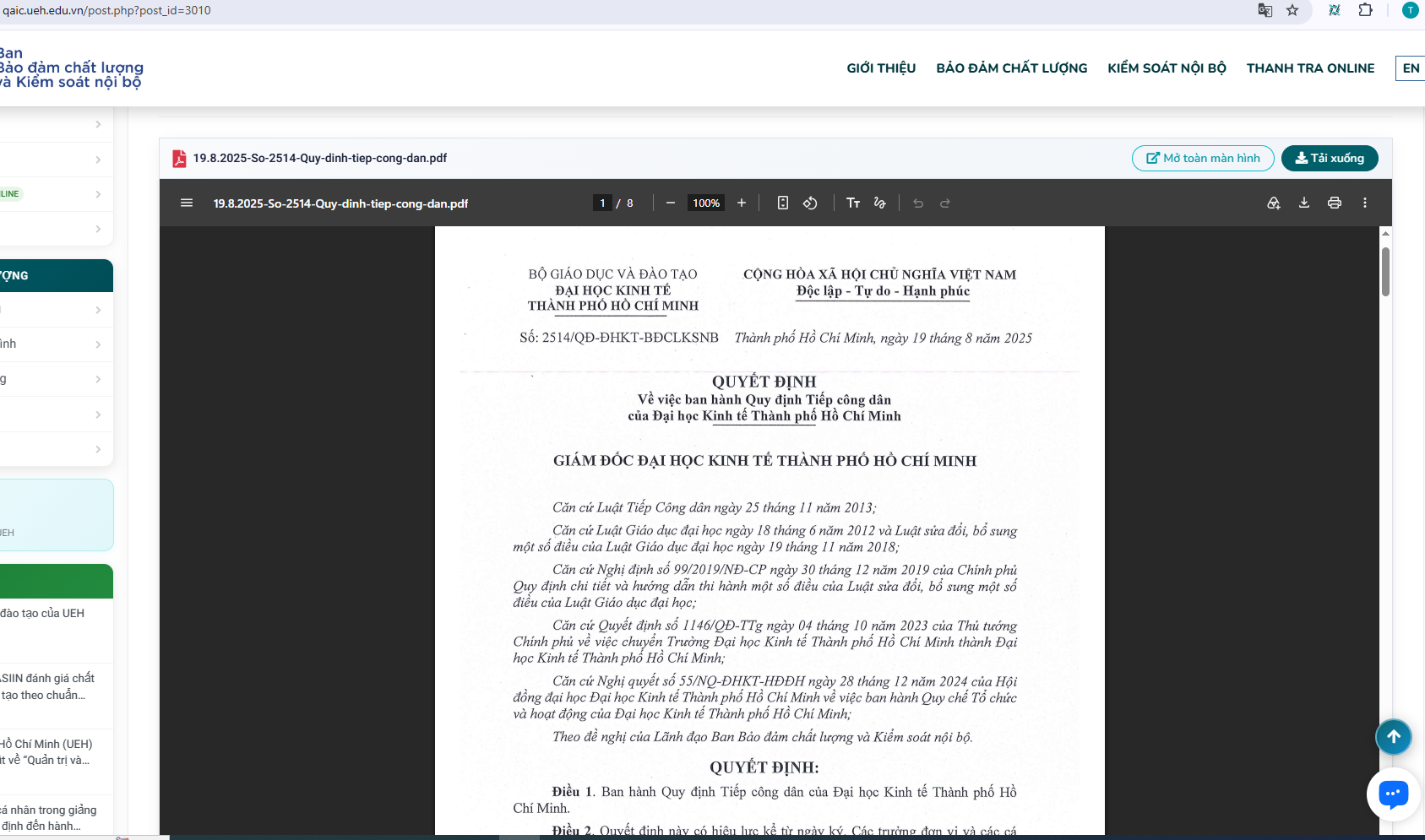
Public information on UEH’s Regulations on Citizen Reception.
Source: https://qaic.ueh.edu.vn/post.php?post_id=3010
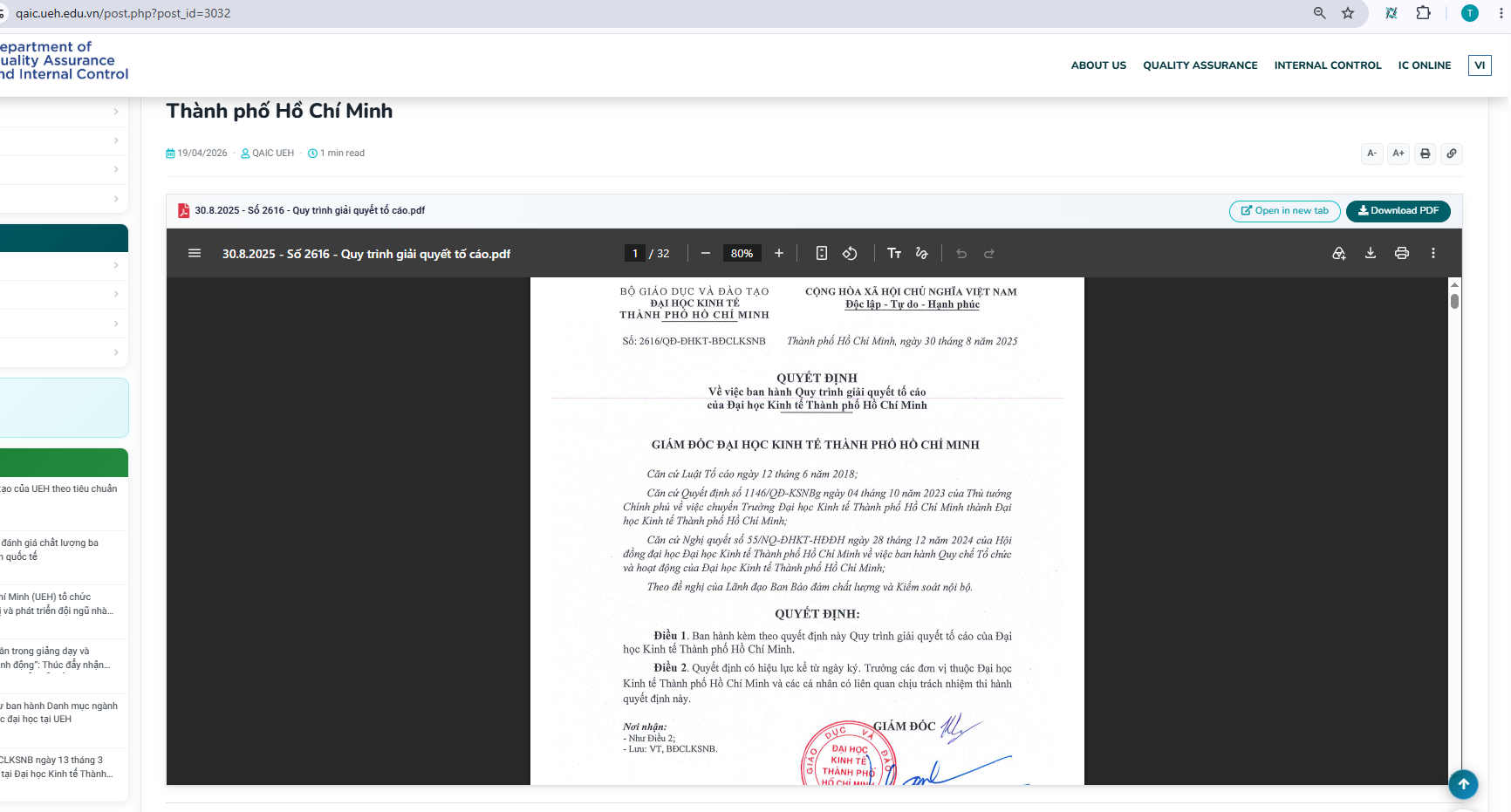
Public information on UEH’s Procedure for Resolving Denunciations.
Source: https://qaic.ueh.edu.vn/post.php?post_id=3032
Public information on UEH’s Procedure for Resolving Complaints.
Source: https://qaic.ueh.edu.vn/post.php?post_id=3037
3. Anti-Harassment Education and Awareness-Raising Activities in 2025
Alongside the continued implementation of policies and safeguarding procedures, UEH undertook initiatives to improve awareness of sexual harassment, the right to respect, consent and self-protection skills in learning, working and online environments.
3.1. Talk Show “Sexual Harassment – Stay Silent or Speak Up?”
On 15 October 2025, DSA co-organised the talk show “Sexual Harassment – Stay Silent or Speak Up?” in Hall B1.302 at UEH Nguyen Tri Phuong, attracting nearly 400 students.
The programme brought together experts in psychology, sociology, sexual health and law. It focused on three themes: recognising sexual harassment; understanding boundaries and consent in relationships; and relevant legal provisions and ways to respond to harassment.
Through direct discussions and case-based questions, learners gained practical knowledge and harassment-prevention skills and were introduced to DSA reporting and support channels for personal safety concerns.

Nearly 400 UEH students attended “Sexual Harassment – Stay Silent or Speak Up?” to learn about harassment, personal boundaries, legal provisions and University support channels.
Source: https://dsa.ueh.edu.vn/tin-tuc/quay-roi-tinh-duc-im-lang-hay-len-tieng-2/
3.2. Communication on Consent and Recognition of Harassment
On 18 November 2025, UEH published an educational article entitled “Consent in Love and Sexual Relationships: Understanding It Correctly to Avoid Becoming a Victim of Sexual Harassment or Causing Harm.”
The article explains voluntary consent, the right to withdraw consent, the establishment of personal boundaries and the identification of harassment in both face-to-face and online relationships.
In particular, it discusses risks arising from power or status imbalances, such as lecturer–student and manager–employee relationships, and helps readers recognise threats, coercion and invasions of privacy.
The initiative raised awareness of harassment prevention across the UEH community, extending personal safety education to digital settings and relationships characterised by unequal power.
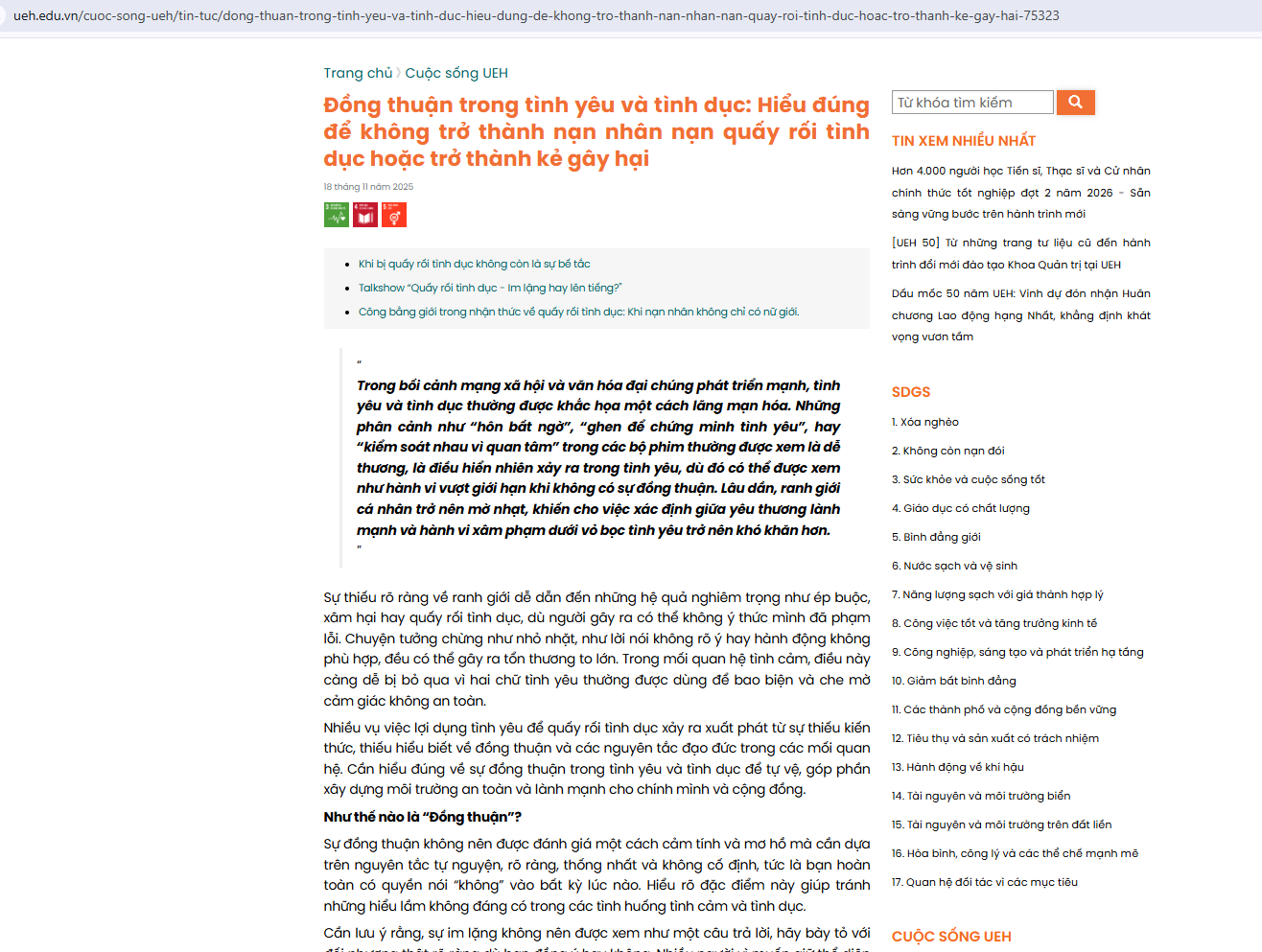
Educational communication on consent and how to recognise harassment.
3.3. Labour Law Education and Workplace Harassment Prevention
On 12 August 2025, UEH Alumni and DSA jointly organised the online workshop “Understanding Labour Law – Entering the Workplace with Confidence” for recent graduates, alumni and learners preparing to enter the labour market.
The programme addressed employment contracts, social insurance, wages, and employees’ rights and responsibilities. During the discussion, lawyers provided guidance on workplace situations, including how to respond to sexual harassment at work.
This activity strengthened legal literacy and the ability of learners to protect themselves, extending anti-harassment education beyond the University to preparation for employment.
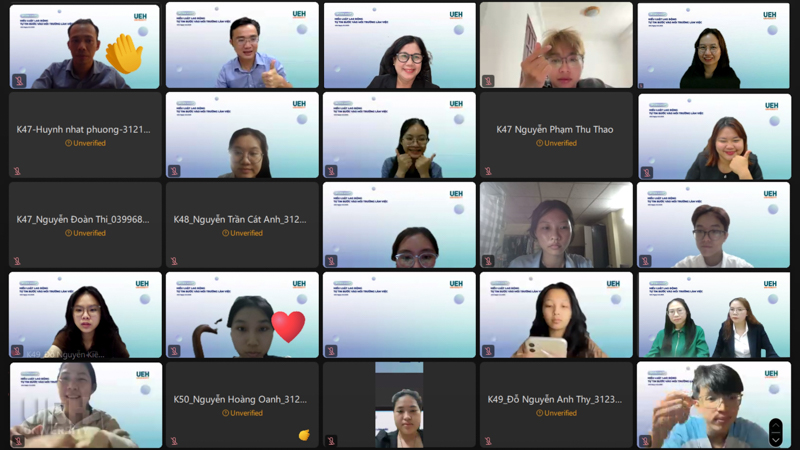
Online workshop “Understanding Labour Law – Entering the Workplace with Confidence”.
4. Summary of Anti-Harassment Policies and Activities in 2025
| No. | Policy / Programme | Classification | Implementation and results | Public source |
|---|---|---|---|---|
| 1 | Implementation of the UEH Code of Conduct, Article 7, Clause 6 | Core policy | Continued application of the prohibition on harassment in all forms in the work of UEH staff members. | 
https://ueh.edu.vn/images/upload/editer/Q%C4%90%20695-2017.pdf |
| 2 | Procedure for Receiving and Supporting Learners Experiencing Sexual Harassment | Specialised policy and procedure | Maintained DSA as the designated contact point for receiving reports, providing support and coordinating cases under CSHTNH.QT.009. | 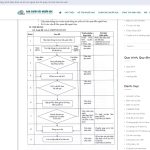
https://dsa.ueh.edu.vn/tin-tuc/quy-trinh-tiep-nhan-va-ho-tro-nguoi-hoc-bi-quay-roi-tinh-duc-tai-ueh/ |
| 3 | Regulations on Receiving and Resolving Complaints and Denunciations | Governance regulation issued in 2025 | Decision No. 2410 of 14 August 2025 established procedures for receiving and resolving submissions within the competent authority. | 
|
| 4 | Procedures for Resolving Complaints and Denunciations | Governance procedures issued in 2025 | Decision No. 2616/QĐ-ĐHKT-BĐCLKSNB (30 August 2025) issued the Procedure for Resolving Denunciations (KSNB.QT.06), while Decision No. 2617/QĐ-ĐHKT-BĐCLKSNB (30 August 2025) issued the Procedure for Resolving Complaints (KSNB.QT.01). These procedures set out the steps for receiving, reviewing, verifying and resolving cases within the competent authority. | 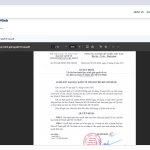
Decision No. 2616 – Denunciations procedure 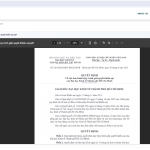
|
| 5 | Talk show “Sexual Harassment – Stay Silent or Speak Up?” | 15 October 2025 | Nearly 400 students discussed harassment recognition, personal safety and ways to respond. | 
https://dsa.ueh.edu.vn/tin-tuc/quay-roi-tinh-duc-im-lang-hay-len-tieng-2 |
| 6 | Communication on consent and personal boundaries | 18 November 2025 | Explained consent, the identification of harassment and risks of abuse of power. | 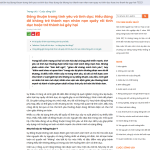
|
| 7 | Workshop “Understanding Labour Law – Entering the Workplace with Confidence” | 12 August 2025 | Provided employment law knowledge, including guidance on responding to sexual harassment at work. | 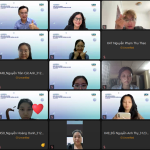
|
5. Results and Continuity of Implementation, 2024–2025
UEH has maintained anti-harassment principles based on its Code of Conduct and the procedure for supporting learners experiencing sexual harassment, both established in earlier years. These measures help define behavioural standards and safeguarding mechanisms for the groups within their scope.
In 2025, UEH continued to publish its anti-harassment policies and issued procedures for receiving and resolving complaints and denunciations to improve consistency in the handling of reports. At the same time, communication and education programmes raised awareness of sexual harassment, personal boundaries and ways to seek assistance.
The combination of behavioural standards, reporting procedures and educational activities demonstrates UEH’s continued efforts to create a respectful, safe and accountable learning and working environment.
6. Conclusion
The University of Economics Ho Chi Minh City maintains anti-harassment policies and mechanisms through a Code of Conduct prohibiting all forms of harassment, legal provisions against sexual harassment in the workplace, and a specialised procedure for supporting learners experiencing sexual harassment.
In 2025, UEH further strengthened its mechanisms for receiving and addressing reports while implementing educational activities on consent, personal safety and harassment prevention. Together, these measures contribute to an equitable university environment that respects human dignity and the lawful rights of its members, supporting SDG 10 – Reduced Inequalities.