

UEH Implements an Equal Pay Policy and Commits to Measuring and Eliminating the Gender Pay Gap
The University of Economics Ho Chi Minh City (UEH) maintains a fair remuneration policy that prohibits gender-based discrimination, ensuring that the salaries and incomes of public employees and workers are determined based on professional qualifications, experience, job positions, responsibilities and other job-related criteria. The University also implements mechanisms to measure and monitor pay differences between male and female employees by job category, combined with reviews and adjustments to address unjustified disparities, towards ensuring equal pay for work of equal value.
In 2025, UEH continued to implement its existing equal pay policies, review its remuneration and welfare mechanisms, adjust income distribution arrangements and consult public employees and workers on the Internal Spending Regulations. These efforts contributed to protecting employees’ rights and promoting SDG 8 – Decent Work and Economic Growth.
1. Equal Pay Policy and Commitment to Gender Equality
UEH identifies equal pay as a fundamental principle of human resource management, implemented in accordance with the Law on Gender Equality No. 73/2006/QH11, the Labour Code No. 45/2019/QH14 and the University’s applicable internal regulations.
Under Article 13 of the 2006 Law on Gender Equality, men and women are entitled to equal treatment in employment, wages, salaries, bonuses, social insurance and working conditions. Furthermore, Article 90 of the 2019 Labour Code requires employers to ensure equal pay without gender discrimination for employees performing work of equal value.
On this basis, UEH determines salaries and income according to job-related criteria, including professional qualifications, experience, position, responsibilities and work performance. Public employees, lecturers and workers are subject to fair remuneration principles, without distinction between men and women in the determination of salaries and related benefits.
UEH’s equal pay policy has been reviewed, maintained and publicly disclosed under 8.2.6 – Equal Pay Policy on the UEH Future platform, outlining the following key commitments:
- Fair remuneration: Ensuring equal pay based on job-related criteria, including professional qualifications, experience, position, responsibilities and other relevant factors.
- Non-discrimination on the basis of gender: Men and women are subject to the same principles of salary, income and welfare entitlements under equivalent conditions.
- Gender pay gap measurement: Collecting, monitoring and analysing salary data for male and female employees across different job categories.
- Review and adjustment: Reviewing salary scales or supplementary welfare mechanisms to address unjustified disparities.
These principles provide a foundation for UEH to maintain a fair remuneration system while proactively identifying and minimising the risk of income inequality between men and women in the workplace.
Existing policies and regulations remain applicable at UEH unless they are amended, replaced or repealed by subsequent documents. The continuation of these policies is accompanied by ongoing reviews and updates to salary and income mechanisms as part of the University’s human resource management.
Policy Sources:
- UEH Future – 8.2.6. Equal Pay Policy, published on 2 November 2025 – sections on fair remuneration and “Gender-equitable Pay Monitoring”.
- UEH Portal – Implementing Human Resource Policies Aligned with the 17 SDGs, published on 8 May 2025 – sections on recruitment, remuneration and gender-equal welfare policies.
- Law on Gender Equality No. 73/2006/QH11 – Article 13.
- Labour Code No. 45/2019/QH14 – Article 90.

UEH’s Equal Pay Policy ensures that remuneration is determined according to job-related criteria, without gender discrimination.
Source: UEH Future, “8.2.6. Equal Pay Policy”, publicly disclosed in 2025.
2. Mechanisms for Measuring, Monitoring and Eliminating the Gender Pay Gap
In addition to its non-discrimination principles, UEH publicly discloses mechanisms for measuring and monitoring the pay gap between male and female employees (Gender Pay Gap – GPG) to identify potential disparities arising in the course of human resource management.
According to the published policy, the Organisation and Human Resource Development Department is responsible for collecting and analysing annual salary data across different job categories, including lecturers, researchers and personnel in functional and support departments.
The monitoring mechanism covers the following activities:
| Area | Implementation Mechanism | Objective |
| Measurement | Determining the percentage difference in salaries between male and female employees within the same job category. | Identifying the extent of gender-based pay differences. |
| Analysis | Comparing salaries against professional qualifications, experience, positions and job responsibilities. | Distinguishing professionally justified differences from unjustified disparities. |
| Monitoring and Reporting | Consolidating annual data and internally reporting analytical findings to UEH’s public employees and leadership. | Enhancing transparency and accountability. |
| Review and Adjustment | Reviewing salary scales or supplementary welfare mechanisms when unjustified disparities are identified. | Working towards narrowing and eliminating gender pay gaps that lack reasonable justification. |
Analysing salaries by job category enables UEH to identify differences in remuneration policies while considering job value and relevant professional factors. Based on monitoring results, the University commits to reviewing and adjusting its policies as appropriate to uphold the principle of equal pay.
Through this mechanism, UEH’s policy goes beyond a general commitment to non-discrimination by clearly establishing responsibilities for measuring, monitoring and addressing unjustified pay disparities.
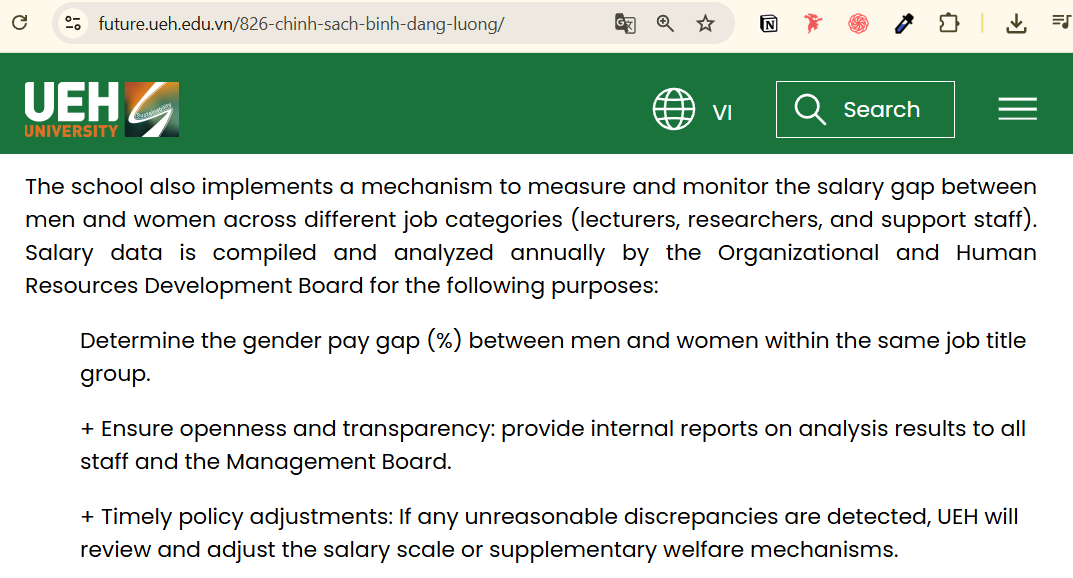
UEH’s commitment to measuring, reporting and adjusting policies to eliminate unjustified pay disparities between male and female employees. Source: UEH Future, “8.2.6. Equal Pay Policy”, 2025.
Policy Sources:
- UEH Future – 8.2.6. Employment Policy Pay Scale Equity – section on “Gender-equitable Pay Monitoring”, particularly the measurement of the Gender Pay Gap (%), internal reporting and policy adjustments.
- UEH Future – 8.2.1. Employment Practice Living Wage – section on the gender pay gap monitoring mechanism and the analytical responsibilities of UEH’s human resource unit.
3. Salary Structure and Income Distribution Principles at UEH
As a public higher education institution operating under an autonomy mechanism, UEH combines the State-regulated salary system with additional income, bonuses and welfare policies provided by the University.
In 2025, the University’s income system consisted of three components:
| Component | Implementation Mechanism |
| Basic Salary and Allowances | Determined according to salary grades, steps and applicable State regulations. |
| Additional Income | Determined according to the Internal Spending Regulations, Income Distribution Plan and work performance evaluation criteria. |
| Bonuses and Welfare Benefits | Provided in accordance with remuneration and reward policies and their respective eligibility conditions. |
UEH upholds the principles of fairness, openness and transparency in the development and implementation of its income policies. Clearly distinguishing the different components of salaries and remuneration provides a basis for the University to monitor, analyse and improve its policies, thereby reducing the risk of pay inequality among different employee groups.
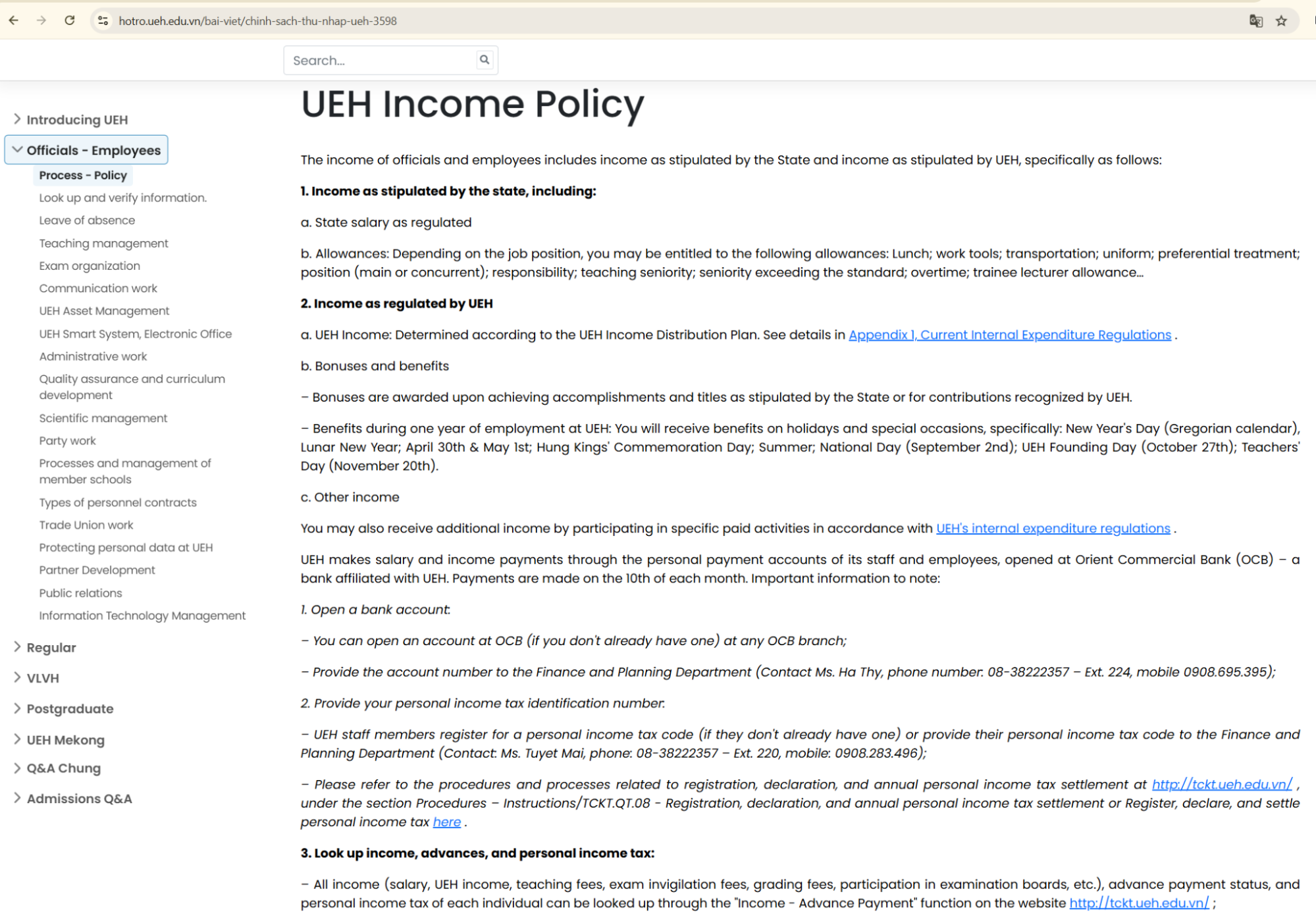
The income structure at UEH comprises salaries, additional income, bonuses and welfare benefits.
Source: UEH Knowledge Repository and UEH Recruitment Website, remuneration and benefits policies.
Policy Sources:
- UEH Portal – Implementing Human Resource Policies Aligned with the 17 SDGs, 2025 – sections on salary, income, welfare and the principle of fair remuneration.
- UEH Future – 8.2.6. Employment Policy Pay Scale Equity – sections on State-regulated salary scales and additional income at UEH.
4. Review of Salary and Income Policies in 2025
In 2025, UEH continued to review its salary and welfare policies in compliance with the State’s guidelines and regulations, while ensuring income-related rights for public employees and workers based on the principles of fairness, openness and transparency.
The University maintained a collective consultation mechanism when reviewing and adjusting its Internal Spending Regulations, creating opportunities for public employees and workers to provide feedback on policies that directly affect their income.
Notably, on 22 July 2025, UEH issued Submission No. 1018/TTr-ĐHKT-TCKHĐT regarding adjustments to the Income Distribution Plan. The allowance was adjusted from VND 700,000 per person per month to VND 2,800,000 per person per month through UEH’s income-point conversion mechanism, equivalent to an increase of 7.5 income points. This represents a specific activity in the University’s ongoing review and improvement of its income distribution mechanism.
These salary reviews and consultation activities complement the equal pay policy by contributing to a transparent remuneration system and creating opportunities for salary principles based on competence, responsibilities and job value to be considered in the policy adjustment process.
Summary of Policies and Activities in 2025
| Policy / Activity | Period | Implementation Details | Outcomes and Significance |
| Maintaining the Equal Pay Policy | 2025 | Applying remuneration principles based on qualifications, experience, position and job responsibilities, without gender discrimination. | Maintains a foundation for fair remuneration for public employees and workers. Source: UEH Future 8.2.6. |
| Maintaining the Gender Pay Gap Monitoring Mechanism | Policy publicly disclosed in 2025 | Stipulating annual collection and analysis of gender pay differences and policy reviews when unjustified disparities are identified. | Demonstrates a commitment to measuring and eliminating the gender pay gap. Source: UEH Future 8.2.6. |
| Reviewing Salary and Welfare Policies | 2025 | Continuing to review income policies based on the principles of fairness, openness and transparency. | Supports the improvement of the remuneration system and the protection of employees’ rights. Source: UEH Portal – 2025 Human Resource Policies. |
| Proposing Adjustments to the Income Distribution Plan | 22 July 2025 | Submission No. 1018/TTr-ĐHKT-TCKHĐT on adjustments to the income distribution plan and personal income tax. | Records the review and updating of the income distribution mechanism in 2025. Source: UEH Finance and Investment Planning Department. |
| Consultation on the Internal Spending Regulations | 2025 | Maintaining a mechanism for collecting feedback from public employees and workers to review and adjust regulations related to income. | Promotes democratic participation and transparency in salary policy management. Source: UEH Portal – 2025 Human Resource Policies. |
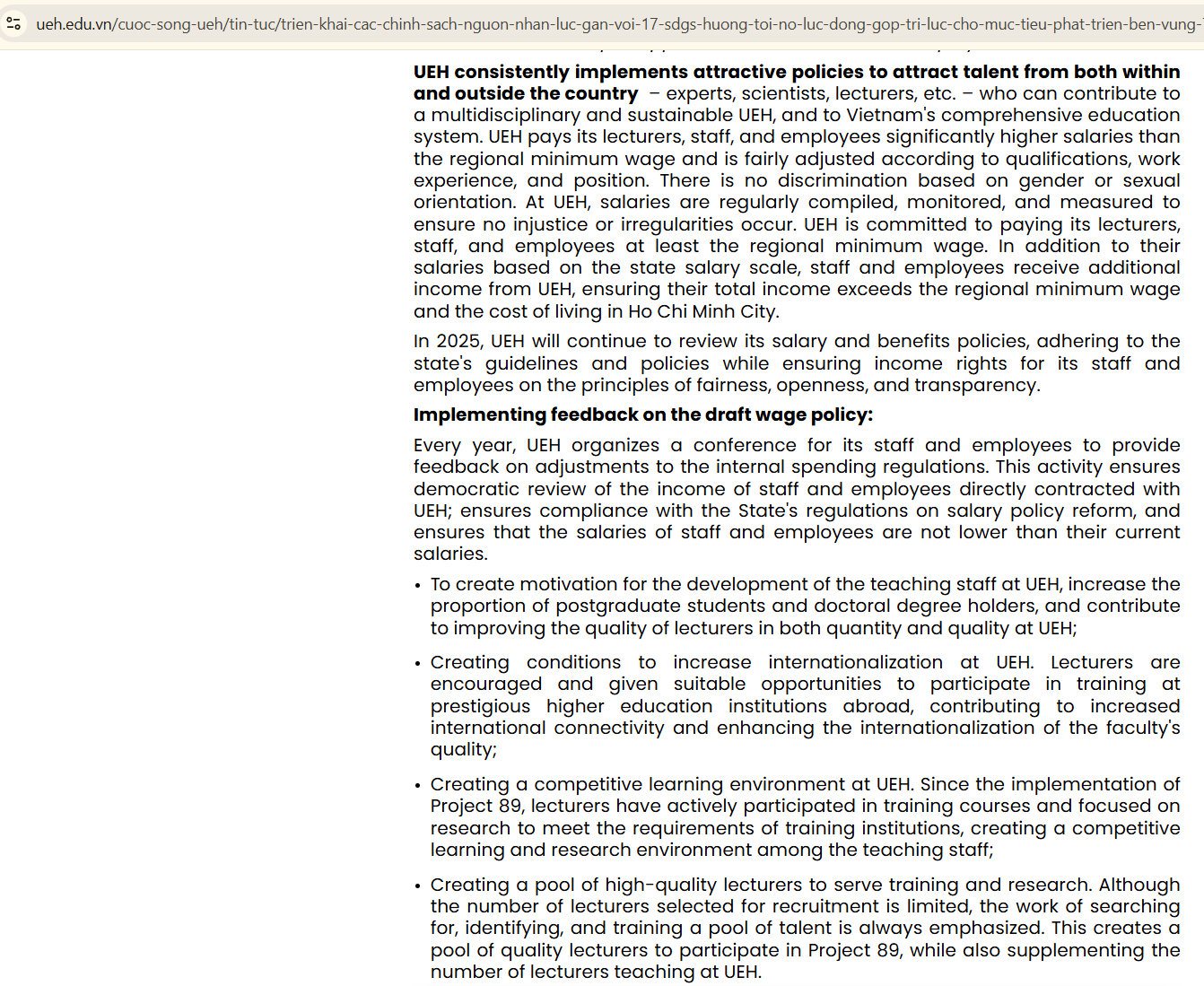
In 2025, UEH continued to review its salary and welfare policies while maintaining the principle of fair remuneration.
Source: UEH Portal, “Implementing Human Resource Policies Aligned with the 17 SDGs to Contribute Intellectual Resources to Sustainable Development”, published in 2026 and reflecting activities in 2025.
5. Welfare Policies Complementing the Fair Remuneration System
In addition to its salary policy, UEH maintains a welfare system for public employees and workers based on the principles of fairness, transparency and non-discrimination on the basis of gender. Insurance schemes, leave entitlements, bonuses, accommodation support during work-related travel, preferential accommodation rates for study and research purposes, support for personnel at UEH Mekong and healthcare benefits are implemented according to the eligibility conditions of each policy. These measures contribute to ensuring equal access to benefits for men and women.
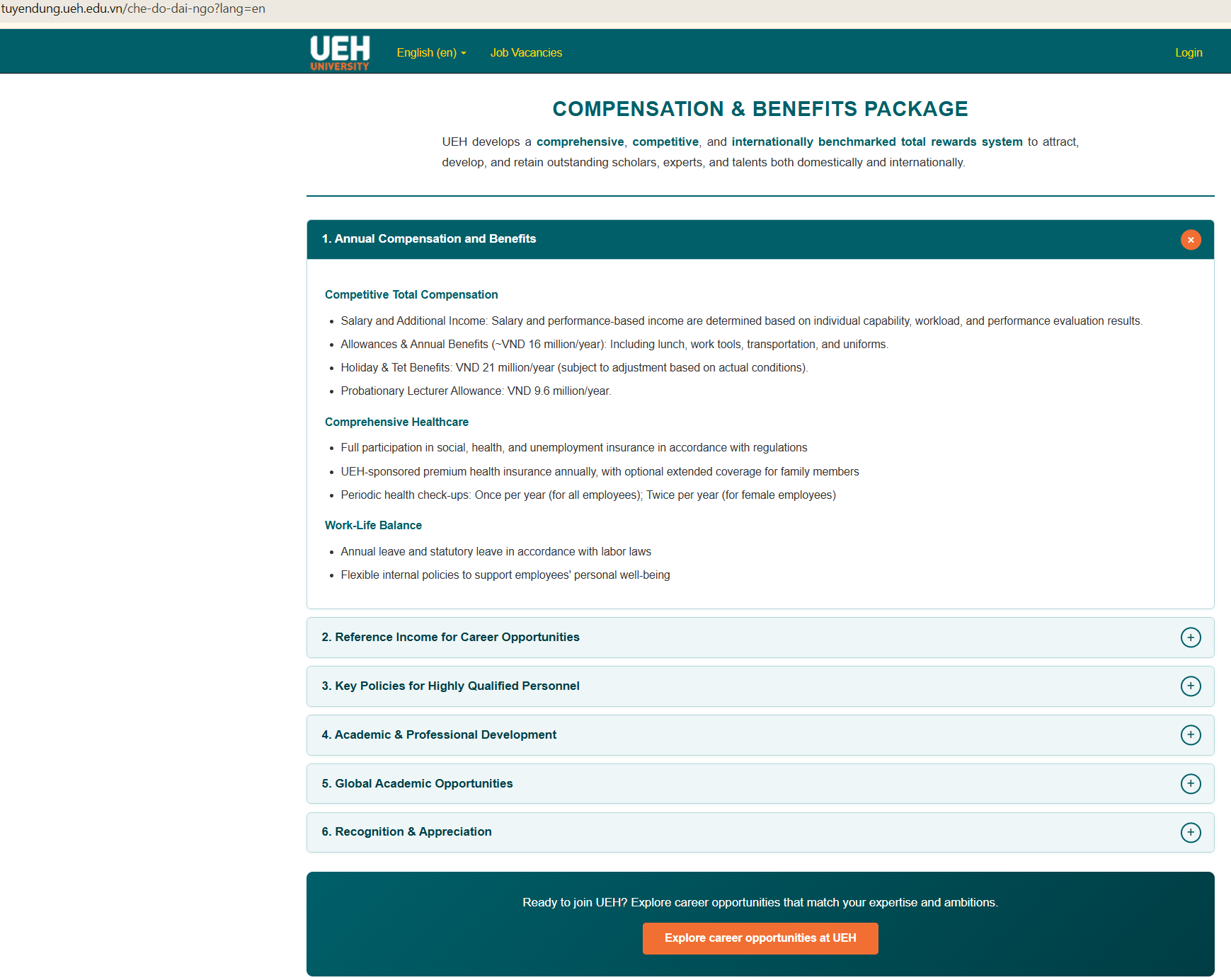
According to the remuneration information publicly disclosed by UEH, the average salary is approximately VND 180 million per person per year, with average welfare expenditure of approximately VND 21 million per person per year, alongside approximately 8 rounds of bonuses and welfare benefits annually. These figures reflect the University’s remuneration framework and provide a reference for reviewing income structures and supplementary benefits.
In line with its commitment to equal pay for work of equal value, UEH monitors salary differences between male and female employees by job category and commits to reviewing salary scales or supplementary welfare mechanisms when unjustified disparities are identified. Accordingly, welfare policies form part of the University’s overall remuneration management system, with the aim of narrowing and eliminating the gender pay gap (Gender Pay Gap), ensuring fair benefits and equal opportunities for professional development among employees.
Evidence Sources:
- UEH Future – 8.2.6. Equal Pay Policy – section on “Gender-equitable Pay Monitoring”, including the measurement and review of pay disparities.
- UEH Portal – Implementing Human Resource Policies Aligned with the 17 SDGs, reflecting activities in 2025 – information on fair remuneration principles and the review of salary and welfare policies.
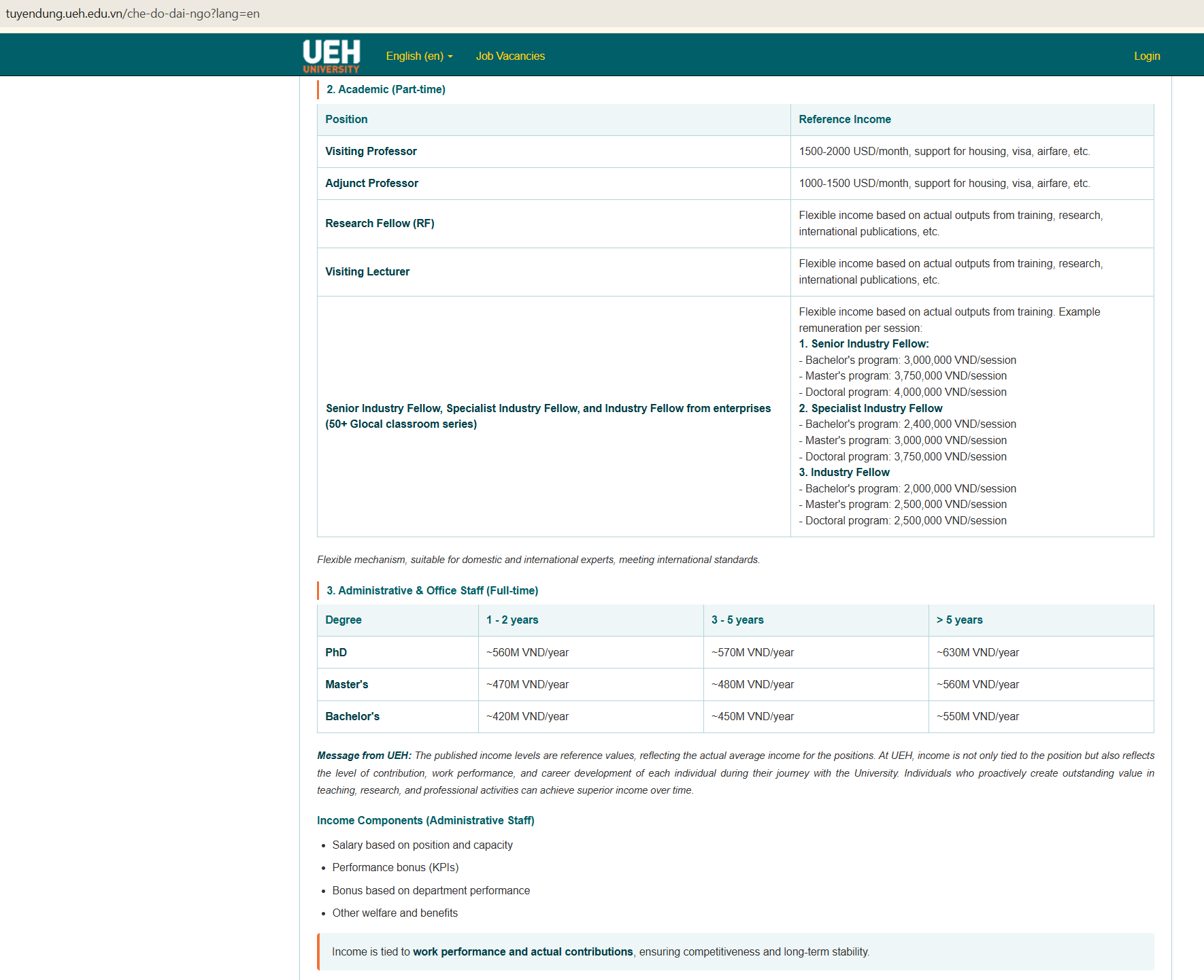
UEH publicly communicates salary, bonus and welfare benefits for public employees and workers, contributing to a transparent remuneration system and supporting the implementation of equal pay principles. Source: UEH Recruitment Website – “Compensation & Benefits Package”.
6. Implementation Results and Conclusion
In 2025, the University of Economics Ho Chi Minh City continued to maintain its equal pay policy, ensuring non-discrimination on the basis of gender, while publicly disclosing mechanisms for measuring and monitoring the gender pay gap across different job categories. The policy includes a commitment to reviewing and adjusting salary scales or welfare mechanisms when unjustified disparities are identified, towards ensuring fair remuneration for work of equal value.
Maintaining the principle of equal pay, together with reviewing salary policies, income distribution arrangements and employee consultation mechanisms in 2025, contributed to strengthening transparency, accountability and fairness in human resource management.
Through these policies and activities, UEH continues to promote an equitable working environment, protect employees’ rights and work towards eliminating unjustified gender-based pay disparities, contributing to SDG 8 – Decent Work and Economic Growth.