

With the aim of fostering a fair, transparent and gender-equal working environment, the University of Economics Ho Chi Minh City (UEH) maintains a mechanism for monitoring, compiling and measuring salary data to identify differences between male and female employees in its remuneration policies. Through the analysis of salary data by job category, together with internal reporting and reviews of income policies, UEH seeks to uphold the principle of equal pay for work of equal value. In 2025, the University continued its salary management and review of income policies based on the principles of fairness, openness and transparency, contributing to SDG 8 – Decent Work and Economic Growth.
1. Policies and mechanisms for monitoring gender pay equity at UEH
UEH implements a remuneration policy based on professional qualifications, experience, job position, responsibilities and other work-related criteria, without gender discrimination. The policy is implemented in accordance with Article 13 of the Law on Gender Equality No. 73/2006/QH11 and Article 90 of the Labour Code No. 45/2019/QH14, ensuring the principle of equal pay for work of equal value.
In addition, the UEH Code of Conduct for Public Employees, issued under Decision No. 695/QĐ-ĐHKT-CTCT dated 4 April 2017, establishes principles prohibiting discrimination under Clause 3, Article 7, and harassment under Clause 6, Article 7. These provisions contribute to building a working environment that respects diversity and employees’ rights and interests.
Building on this policy foundation, UEH publicly discloses its Gender Pay Gap Monitoring mechanism, which analyses salary data across different job categories, including lecturers, researchers, and administrative and support staff.
Under the published mechanism, the Human Resources and Organisation Development Department (HOD) is responsible for compiling and analysing annual salary data and comparing the remuneration of male and female employees within corresponding job categories. This process provides a basis for UEH to identify pay differences, examine relevant professional factors and propose adjustments when unjustified disparities are identified.
Clearly defining the employee groups covered, the responsible unit and the analysis cycle enables UEH to maintain a systematic salary-monitoring mechanism, with the aim of ensuring gender equity in remuneration policies.
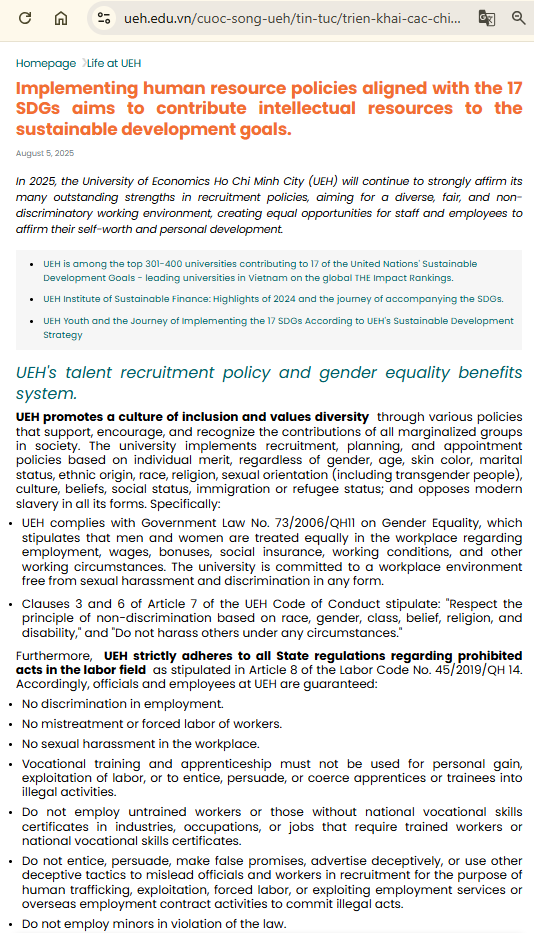
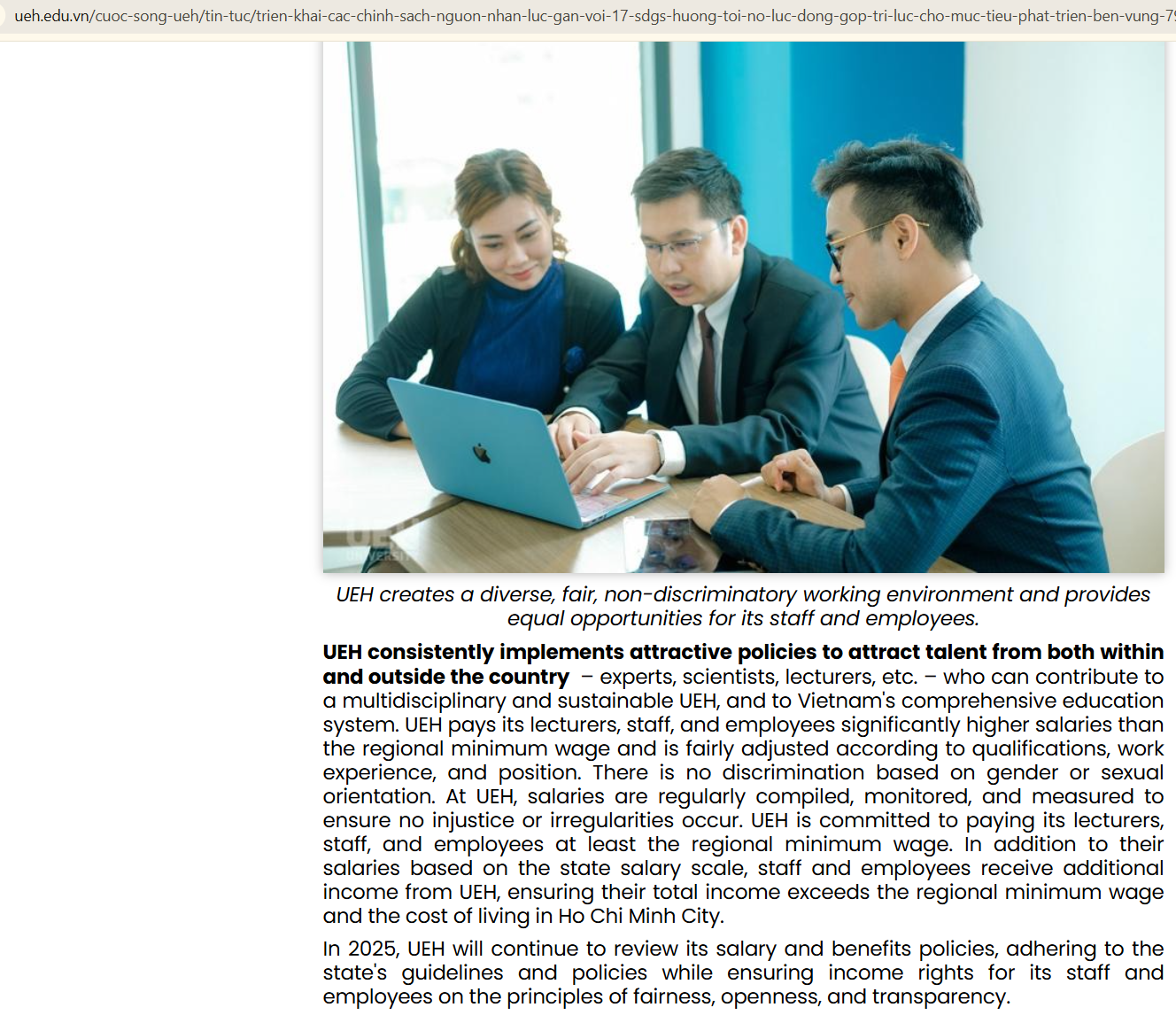
Gender equality policies and principles of fair remuneration at UEH.
Source: University of Economics Ho Chi Minh City Portal, “Implementing Human Resource Policies Linked to the 17 SDGs to Contribute Intellectual Resources to Sustainable Development Goals”, 5 August 2025.
Policy references:
- UEH Future – 8.2.7. Tracking Pay Scale for Gender Equity, 5 November 2025 – section “Monitoring and ensuring gender pay equity”.
- UEH – Code of Conduct for Public Employees, Decision No. 695/QĐ-ĐHKT-CTCT dated 4 April 2017 – Clause 3 and Clause 6, Article 7.
- Law on Gender Equality No. 73/2006/QH11 – Article 13 on gender equality in the labour sector.
- Labour Code No. 45/2019/QH14 – Article 90 on wages and the principle of equal pay.
2. Measuring, analysing and addressing gender pay gaps
UEH’s salary-monitoring mechanism focuses on identifying pay gaps between male and female employees, analysing work-related factors and reviewing policies when unjustified differences are identified.
| Monitoring area | UEH’s published mechanism | Objective |
| Gender Pay Gap measurement | Determining the percentage difference in remuneration between male and female employees within each job category | Monitoring gender-based pay differences |
| Data analysis | The Human Resources and Organisation Development Department compiles and analyses salary data annually | Identifying disparities that require further examination |
| Reporting and transparency | Internally reporting the analysis results to public employees, staff and UEH leadership | Strengthening accountability in salary management |
| Review and adjustment | Reviewing and adjusting salary scales or supplementary welfare arrangements if unjustified disparities are identified | Seeking to eliminate pay differences that lack reasonable justification |
Analysing salary data by job category enables UEH to assess pay differences in relation to professional qualifications, experience, job positions and responsibilities. The reporting and review mechanism provides a basis for the University to consider necessary adjustments, contributing to the continuous improvement of its income policies in accordance with the principle of gender equality.
Gender Pay Gap Monitoring and Results Summary for 2025
To provide a comprehensive account of the monitoring mechanism, the measurement results are compiled by job category, with data for male and female employees separated within the same reporting period.
Reporting period: 2025.
Data compilation and analysis unit: UEH Human Resources and Organisation Development Department.
| Job category | Number of male employees | Number of female employees | Average male income (VND/month) | Average female income (VND/month) | Gender Pay Gap (%) |
| Lecturers and researchers
(Number of academic staff) |
647 | 358 | 84063099 | 71942073 | 14% |
| Administrative and support staff (remaining FTE) | 237 | 131 | 48759639 | 46665375 | 4% |
| UEH total | 884 | 489 |
Reference formula: Gender Pay Gap (%) = [(Average male income – Average female income) / Average male income] × 100.
In addition to identifying the extent of pay differences, the analysis results are examined in relation to job characteristics to identify disparities that require further review. Where differences without reasonable justification are identified, UEH reviews its salary scales or welfare arrangements in accordance with its published policies.
Supporting evidence:
- UEH Future – 8.2.7. Tracking Pay Scale for Gender Equity – sections on Gender Pay Gap (%), annual data compilation and analysis, reporting results and policy adjustments.
- UEH Future – 8.2.6. Equal Pay Policy – section “Monitoring and ensuring gender pay equity”.
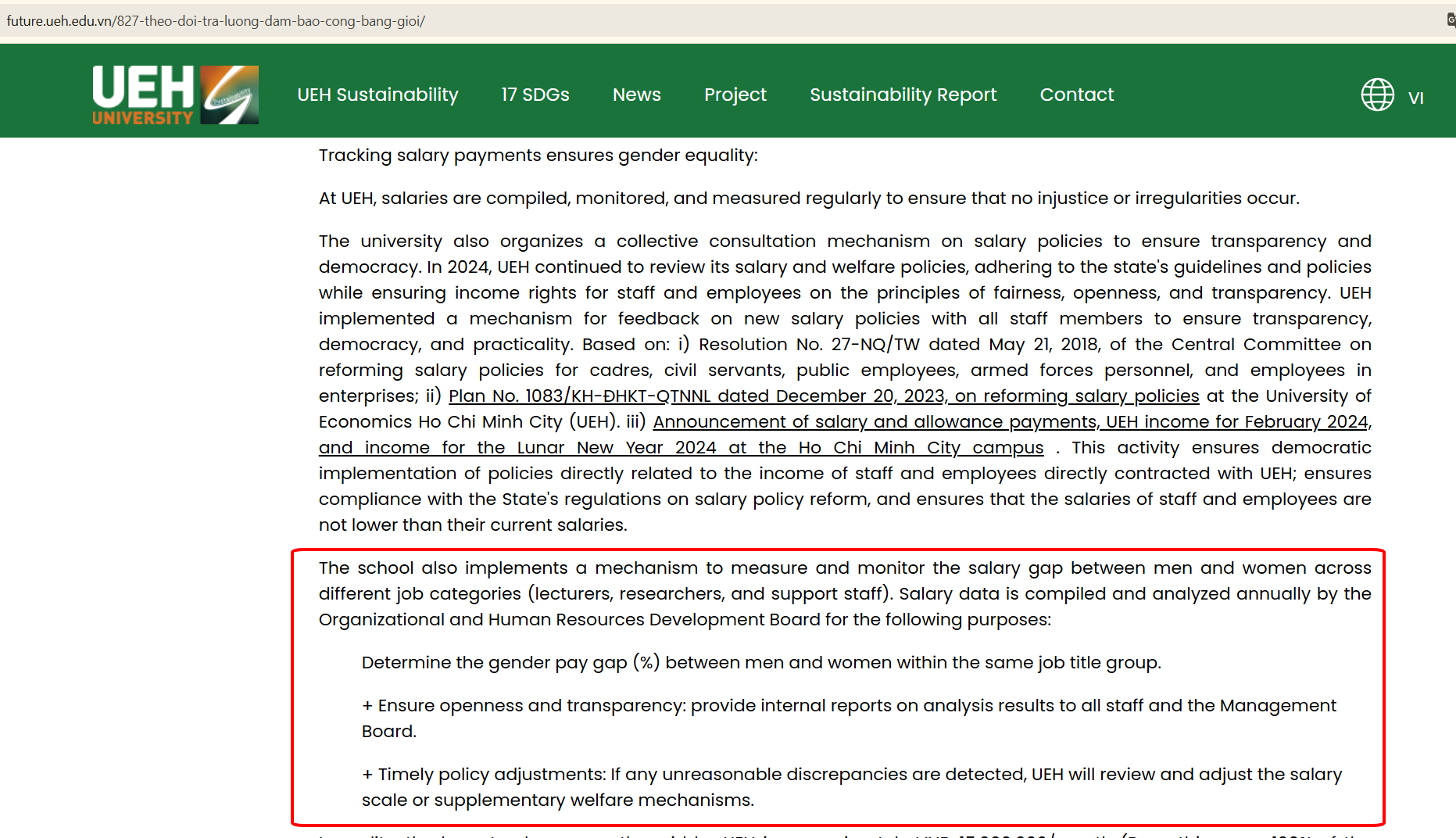
UEH identifies measures for monitoring, analysing and reporting gender pay gaps, while publicly disclosing its mechanism for reviewing and adjusting policies when unjustified differences are identified. Source: UEH Future, “8.2.7. Tracking Pay Scale for Gender Equity”, 5 November 2025.
3. Salary monitoring and policy review activities in 2025
In 2025, the University of Economics Ho Chi Minh City (UEH) continued compiling, monitoring and measuring salary data to identify irregularities, prevent unjustified disparities and uphold the principle of fairness in remuneration policies. These activities were implemented within the University’s human resource management system, with salaries determined according to professional qualifications, experience, job positions and responsibilities, without gender discrimination.
UEH reviewed its income and welfare policies while maintaining a collective consultation mechanism for matters related to its Internal Expenditure Regulations. Seeking feedback from public employees and staff contributed to greater openness, transparency and accountability in the process of improving remuneration policies.
These review activities continued the implementation of Plan No. 1083/KH-ĐHKT-QTNNL dated 20 December 2023 on salary policy reform at UEH. Notably, on 22 July 2025, UEH prepared Submission No. 1018/TTr-ĐHKT-TCKHĐT on adjustments to the income distribution plan and personal income tax, reflecting the University’s review and updating of its income distribution arrangements in 2025. Under the proposal, the allowance was increased from VND 700,000 per person per month to VND 2,800,000 per person per month, representing an increase of VND 2,100,000 per person per month through an adjustment equivalent to 7.5 additional UEH income points.
The review of income distribution arrangements serves as a complementary management activity, creating conditions for the principles of fair remuneration to be considered in the process of improving institutional policies.
Summary of activities in 2025
| Policy / Activity | Period | Implementation details | Relevance to gender equity |
| Gender Pay Gap monitoring by job category | Mechanism maintained in 2025 | Compiling and analysing salary data for male and female employees across lecturer, researcher, and administrative and support staff categories | Provides a direct basis for identifying gender pay gaps |
| Review of salary and welfare policies | 2025 | Reviewing remuneration arrangements based on the principles of fairness, openness and transparency | Supports the improvement of income policies |
| Collective consultation on income policies | 2025 | Collecting feedback from public employees and staff on matters related to the Internal Expenditure Regulations | Strengthens employee participation and transparency in salary management |
These activities demonstrate how UEH combines its gender pay gap monitoring mechanism with the management and review of income policies. In particular, measuring the Gender Pay Gap by job category directly addresses indicator 8.2.7, while employee consultation and policy reviews play a supporting role.
Supporting evidence:
- UEH Future – 8.2.7. Tracking Pay Scale for Gender Equity – information on Gender Pay Gap monitoring by job category, data compilation, analysis and reporting.
- UEH Portal – Implementing Human Resource Policies Linked to the 17 SDGs – information on salary and welfare policy reviews in 2025.
- UEH Department of Finance and Investment Planning – List of documents issued in 2025 – Submission No. 1018/TTr-ĐHKT-TCKHĐT dated 22 July 2025, concerning adjustments to the income distribution plan and personal income tax.
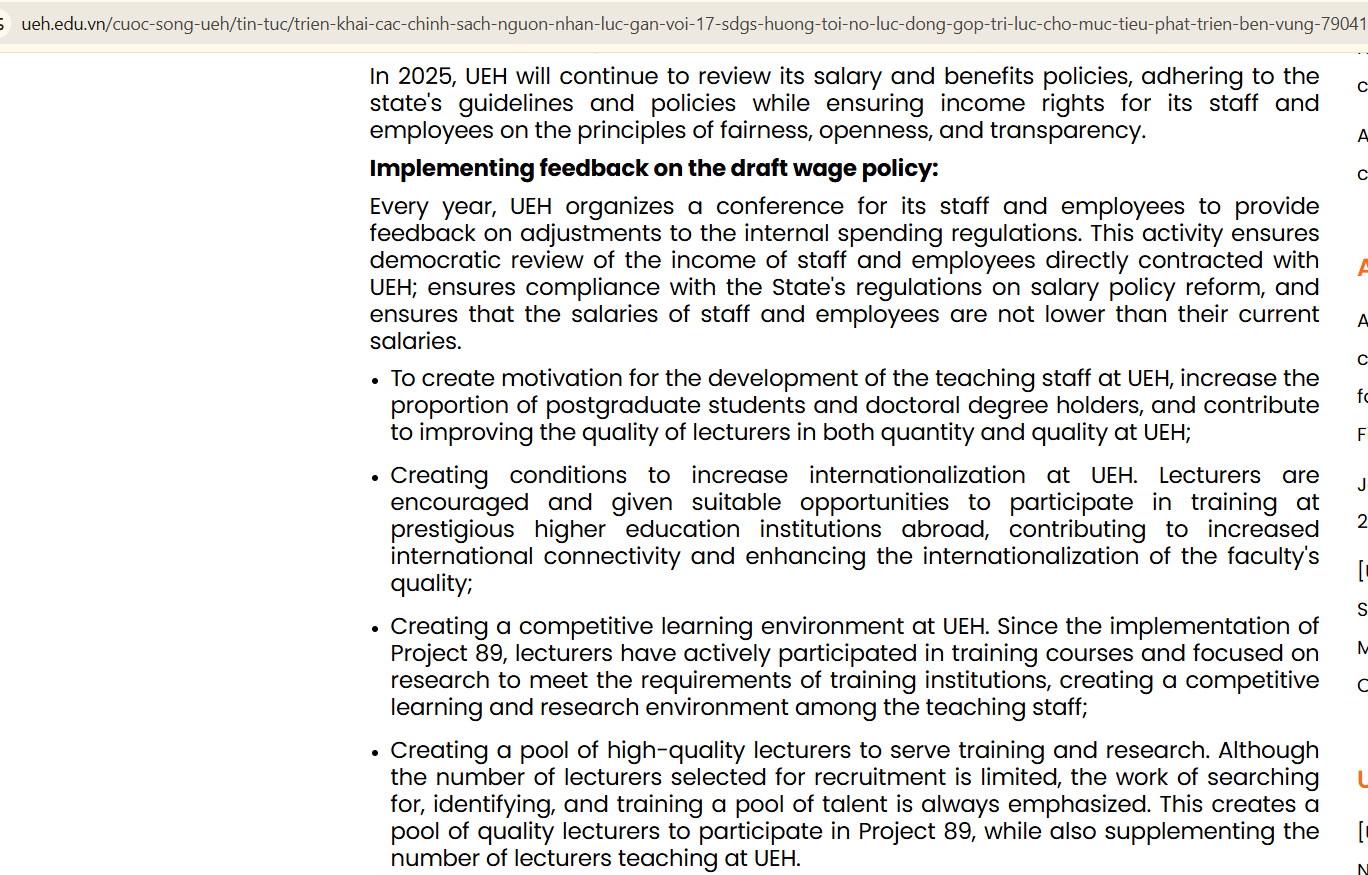
Salary monitoring and income policy review activities in 2025.
Source: UEH Portal, “Implementing Human Resource Policies Linked to the 17 SDGs to Contribute Intellectual Resources to Sustainable Development Goals”, 5 August 2025.
4. Implementation results and continuity of the monitoring mechanism
Building on its established equal pay policy, UEH continued developing its mechanism for monitoring gender pay gaps across different job categories, with clearly defined responsibilities for data compilation, analysis and internal reporting.
In 2025, salary monitoring was integrated with the review of income and welfare policies and employee consultation, contributing to the improvement of the University’s salary management system based on the principles of fairness, openness and transparency. Maintaining the Gender Pay Gap analysis mechanism enables UEH to continue assessing income differences and implement appropriate adjustments when unjustified disparities are identified.
5. Conclusion
The University of Economics Ho Chi Minh City (UEH) maintains a mechanism for monitoring gender pay equity by compiling and analysing salary data for male and female employees across different job categories, together with internal reporting and reviews of remuneration policies.
In 2025, UEH continued its salary management activities and reviewed income arrangements based on the principles of fairness, openness and transparency. This provides a foundation for the University to identify gender pay gaps, safeguard employees’ rights and promote gender equality in the workplace, contributing to SDG 8 – Decent Work and Economic Growth.