

Towards building a safe, fair working environment that respects human rights, the University of Economics Ho Chi Minh City (UEH) maintains an employment policy prohibiting all forms of forced labour, modern slavery, human trafficking and unlawful child labour. This commitment is translated into specific regulations on recruitment and employment, the protection of employees’ rights and mechanisms for receiving and handling complaints and denunciations.
In 2025, UEH continued to uphold these principles while implementing transparent recruitment practices and preventing fraudulent recruitment activities, thereby contributing to the promotion of decent work under SDG 8 – Decent Work and Economic Growth.
1. UEH’s Commitment to a Modern Slavery-Free Policy
UEH considers respect for human dignity, freedom of employment and the protection of employees’ legitimate rights and interests to be fundamental principles of human resource management. The University does not tolerate any form of coercion, labour exploitation, fraudulent recruitment intended for human trafficking, or unlawful child labour within its operations.
This policy remained in effect throughout 2025 and was publicly available in the UEH Knowledge Repository under the title “Prohibited Practices in the Employment of Workers at the University of Economics Ho Chi Minh City”. The commitment was also reflected in the dedicated policy “8.2.4. Employment Policy on Modern Slavery”, published on 2 November 2025, and referenced in UEH’s human resource policy aligned with the United Nations’ 17 Sustainable Development Goals.
UEH’s commitment covers four key areas:
| Policy Area | UEH’s Commitment |
| Prohibition of Forced Labour | No tolerance for abuse, coercion or the use of any means to compel employees to work against their will. |
| Prohibition of Modern Slavery | No tolerance for labour exploitation, the abuse of employment relationships, or the exploitation and coercion of individuals through vocational training, apprenticeships or work placements. |
| Prohibition of Human Trafficking | No tolerance for deception, enticement or fraudulent recruitment intended to facilitate human trafficking, exploitation or forced labour. |
| Prohibition of Child Labour | No unlawful employment of minors; compliance with legal requirements concerning minimum working age and conditions of employment. |
These commitments form the foundation of UEH’s modern slavery prevention policy. They are applied in human resource management and employment practices while guiding the University’s efforts to protect employees’ rights and interests.
Policy Sources:
- UEH Knowledge Repository – Prohibited Practices in the Employment of Workers at the University of Economics Ho Chi Minh City – Sections 2, 4, 6 and 7.
- UEH Future – 8.2.4. Employment Policy on Modern Slavery, dated 5 November 2025.
- UEH Portal – Implementing Human Resource Policies Aligned with the 17 SDGs to Contribute Intellectual Resources to Sustainable Development, dated 5 August 2025.
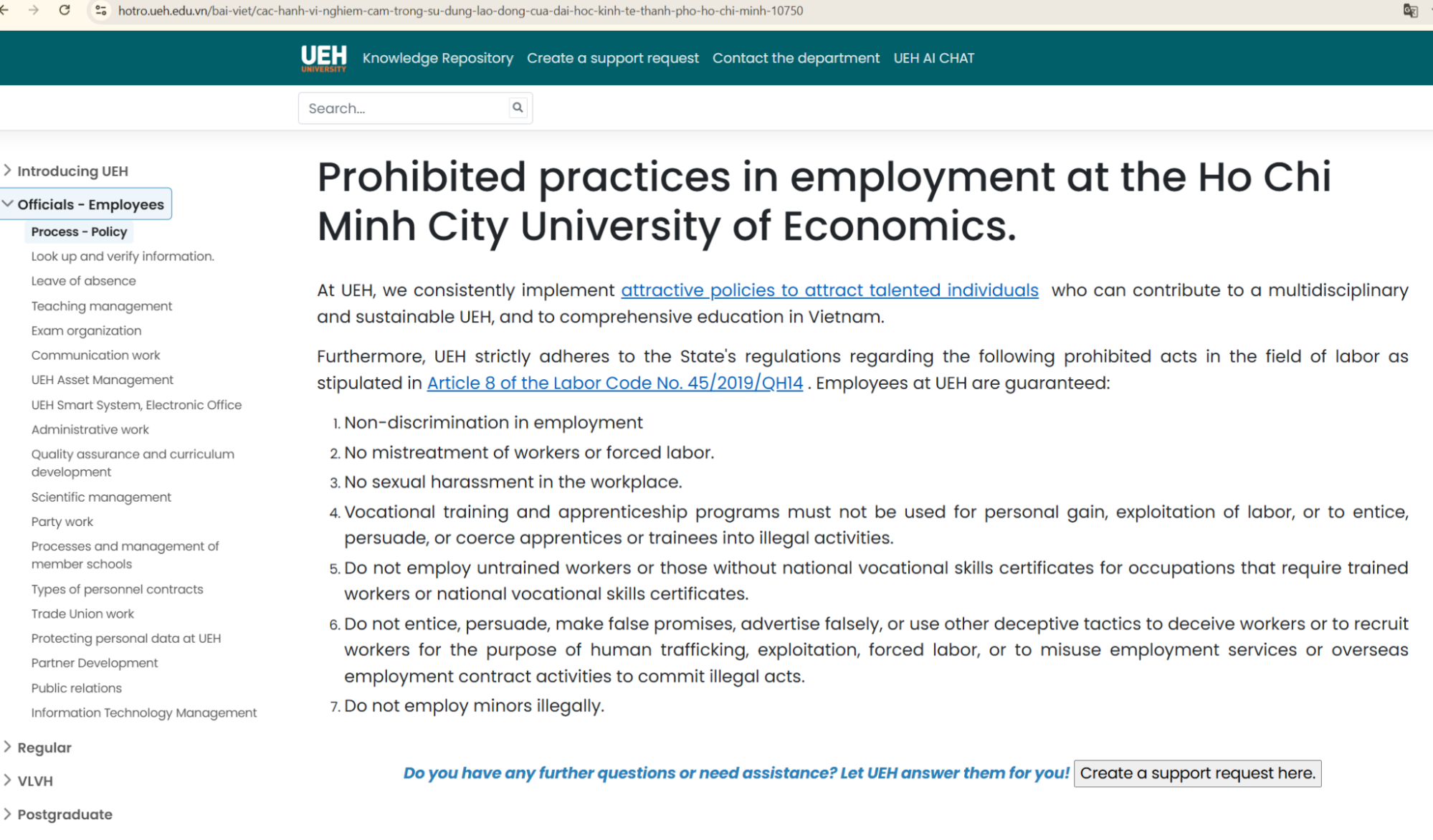
The UEH Knowledge Repository publishes “Prohibited Practices in the Employment of Workers at the University of Economics Ho Chi Minh City”.
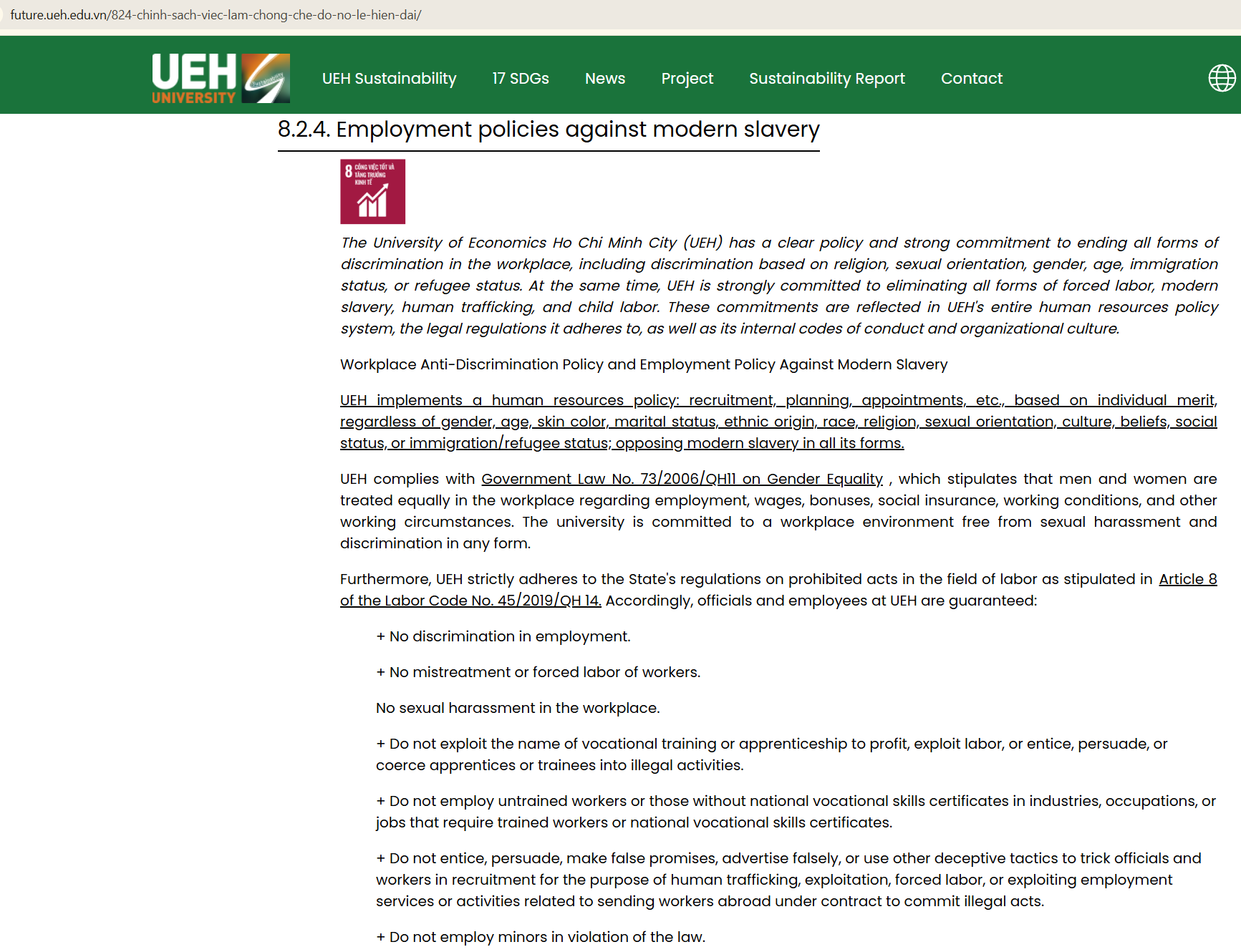
UEH’s Employment Policy on Modern Slavery, published on 2 November 2025.
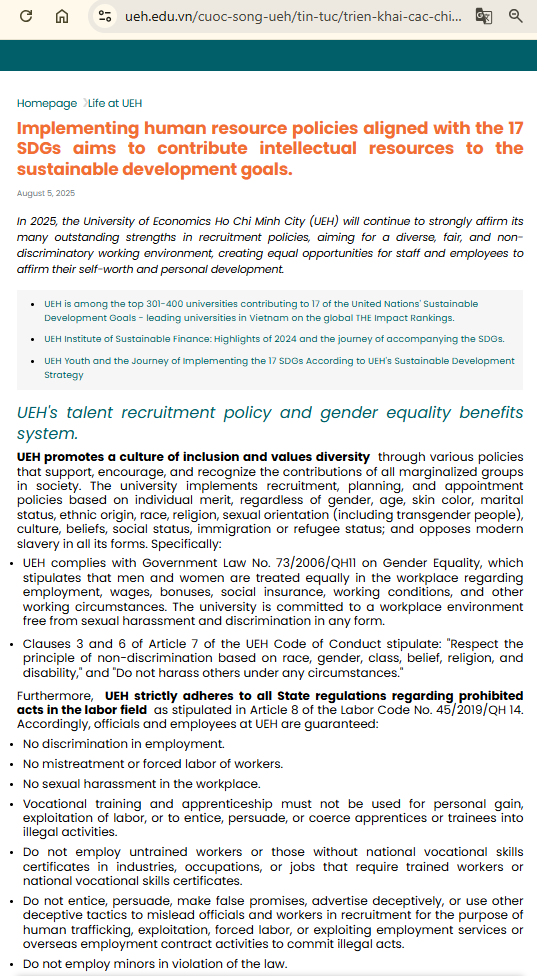
UEH publicly communicates its commitment to combating modern slavery through its human resource policy aligned with the 17 SDGs – UEH Portal article dated 8 May 2025.
2. Legal Framework and Specific Regulations for Employee Protection
UEH implements its employment policy on modern slavery in compliance with the Labour Code No. 45/2019/QH14, particularly Article 8, which specifies prohibited acts in the field of labour.
Accordingly, UEH applies the following principles:
- No abuse or forced labour. Employees must not be compelled to work through violence, threats, abuse or other unlawful measures.
- No exploitation through vocational training activities. Vocational teaching, training and apprenticeships must not be used for personal gain, labour exploitation or to force participants to undertake unlawful work.
- No fraudulent recruitment for the purpose of exploitation or human trafficking. UEH strictly prohibits solicitation, enticement, false promises, misleading advertisements or the misuse of recruitment activities to deceive workers for the purposes of human trafficking, exploitation or forced labour.
- No unlawful employment of minors. UEH complies with current legal requirements concerning minimum working age, employment conditions and the protection of minor workers.
In addition, Clauses 3 and 6 of Article 7 of the UEH Code of Conduct for Public Employees, issued under Decision No. 695/QĐ-ĐHKT-CTCT dated 4 April 2017, establish principles prohibiting discrimination and harassment under all circumstances. These provisions help protect the dignity, rights and legitimate interests of employees, complementing the University’s measures to prevent forced labour and exploitation.
Policy Sources:
- Labour Code No. 45/2019/QH14 – Article 8 on prohibited acts in the field of labour.
- Decision No. 695/QĐ-ĐHKT-CTCT dated 4 April 2017 – UEH Code of Conduct for Public Employees – Clauses 3 and 6 of Article 7.
UEH publicly identifies prohibited employment practices, including forced labour, exploitation, fraudulent recruitment for human trafficking and the unlawful employment of minors.
3. Implementation and Employee Protection Mechanisms in 2025
In addition to publicly communicating prohibited practices, UEH maintains mechanisms for receiving and handling complaints and denunciations to protect the legitimate rights and interests of relevant parties.
In 2025, the University issued several documents to standardise the receipt of submissions and the handling of complaints and denunciations:
| Document | Date of Issuance | Content |
| Decision No. 2410/QĐ-ĐHKT-BĐCLKSNB | 14 August 2025 | Regulations on receiving submissions and handling complaints and denunciations. |
| Decision No. 2616/QĐ-ĐHKT-BĐCLKSNB | 30 August 2025 | Procedure for handling denunciations. |
| Decision No. 2617/QĐ-ĐHKT-BĐCLKSNB | 30 August 2025 | Procedure for handling complaints. |
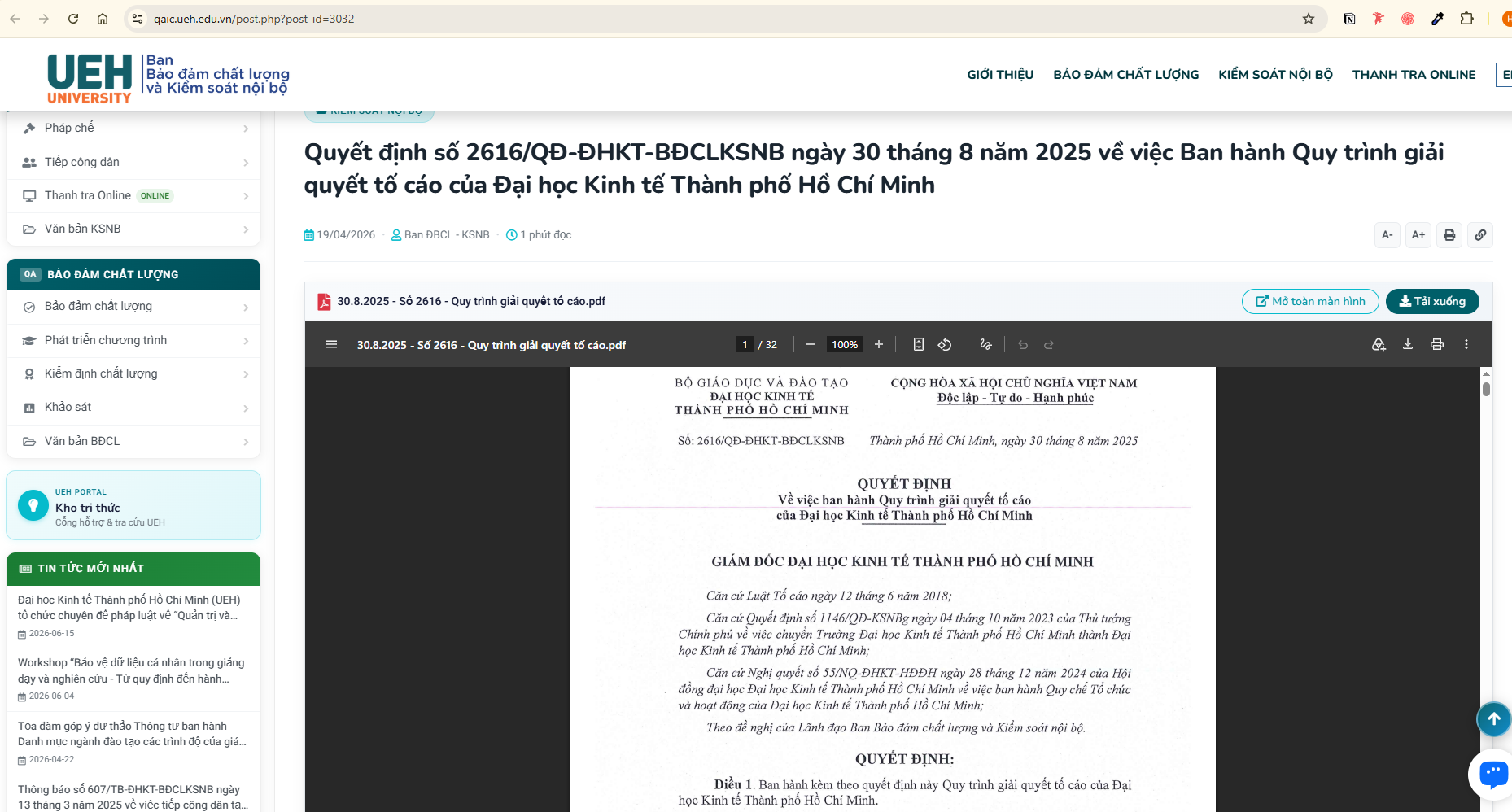

In 2025, UEH issued regulations and procedures for receiving and handling complaints and denunciations, contributing to the strengthening of mechanisms to protect employees’ legitimate rights and interests. Source: UEH Quality Assurance and Internal Control Department.
These documents provide a basis for receiving, classifying and handling submissions within the appropriate jurisdiction, ensuring objectivity and transparency while protecting the legitimate rights and interests of those submitting complaints or denunciations in accordance with the law.
For matters concerning rights and interests arising from employment relationships, these mechanisms support the review and handling of violations falling within the scope of the relevant regulations. They form part of the supporting framework for implementing UEH’s employee protection policy.
Sources:
- UEH Quality Assurance and Internal Control Department – Legal Affairs section – Decisions No. 2410, 2616 and 2617 issued in 2025.
- UEH Future – 5.6.8. Policy on the Protection of Whistleblowers and Reporting Discrimination.
4. Implementation and Risk Prevention Activities in 2025
In 2025, UEH continued to implement policies on salaries, social insurance, welfare and working conditions in accordance with legal requirements. The University also continued to review its salary and welfare policies based on the principles of fairness, openness and transparency, providing a foundation for protecting the legitimate rights and interests of its public employees and workers.
UEH also carried out activities to publicly communicate recruitment information, warn the public about fraudulent schemes and promote legal awareness of human trafficking prevention.
| Date | Activity | Details and Outcomes | Contribution to Indicator 8.2.4 |
| 14 August 2025 | Warning against job scams and fraudulent recruitment impersonating UEH | Publicly communicated guidance on identifying fraudulent recruitment activities and the University’s official recruitment procedures. Source: UEH Portal.
|
Helps prevent fraudulent recruitment and protect job seekers. |
| 19 September 2025 | Warning against impersonation and fraudulent activities involving UEH | Publicly disclosed cases of fraudulent recruitment involving requests for advance payments to secure positions, and provided guidance on verifying information. Source: UEH Portal.
|
Strengthens the public’s ability to identify and avoid recruitment-related scams. |
| 29 October 2025 | UEH Mekong and Vinh Long Provincial Police jointly conducted a legal awareness session on human trafficking prevention | Organised a legal education session for more than 800 students, focusing on identifying fraudulent schemes and human trafficking methods. Source: UEH Mekong.
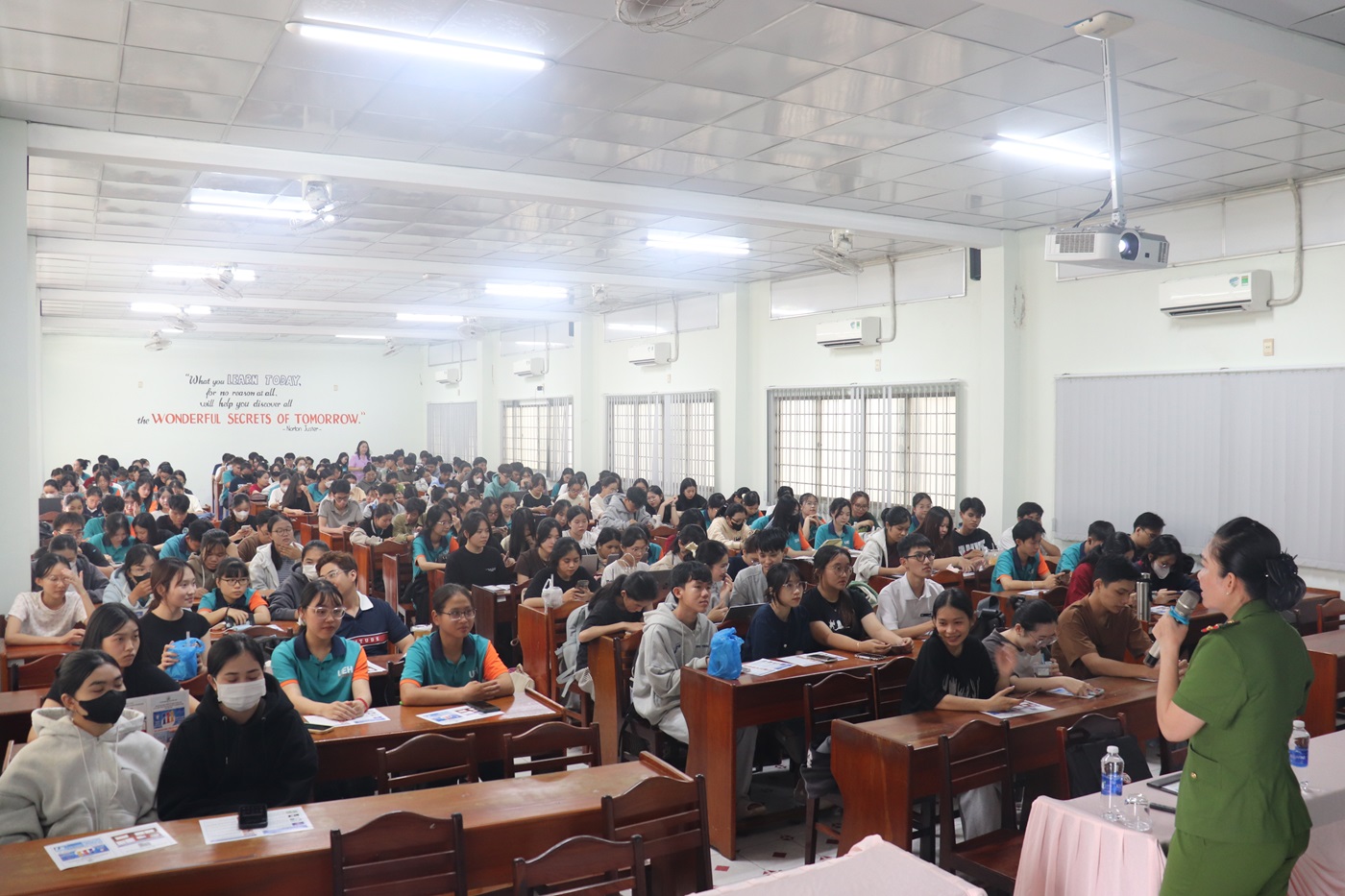
UEH Mekong and Vinh Long Provincial Police jointly organised a legal education session on preventing fraud and human trafficking for more than 800 students. |
Supports the commitment to preventing human trafficking through legal education and raising community awareness. |
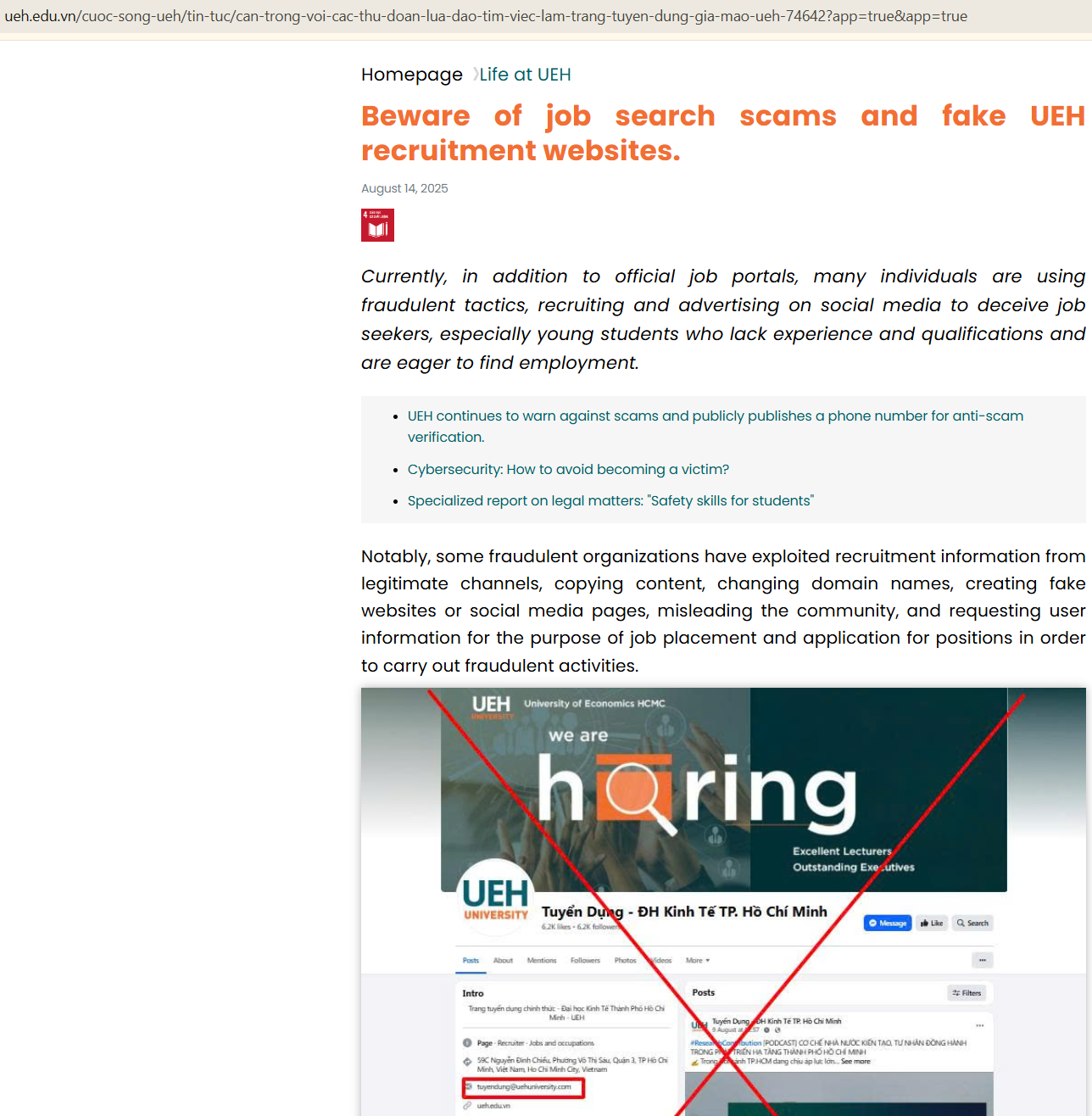
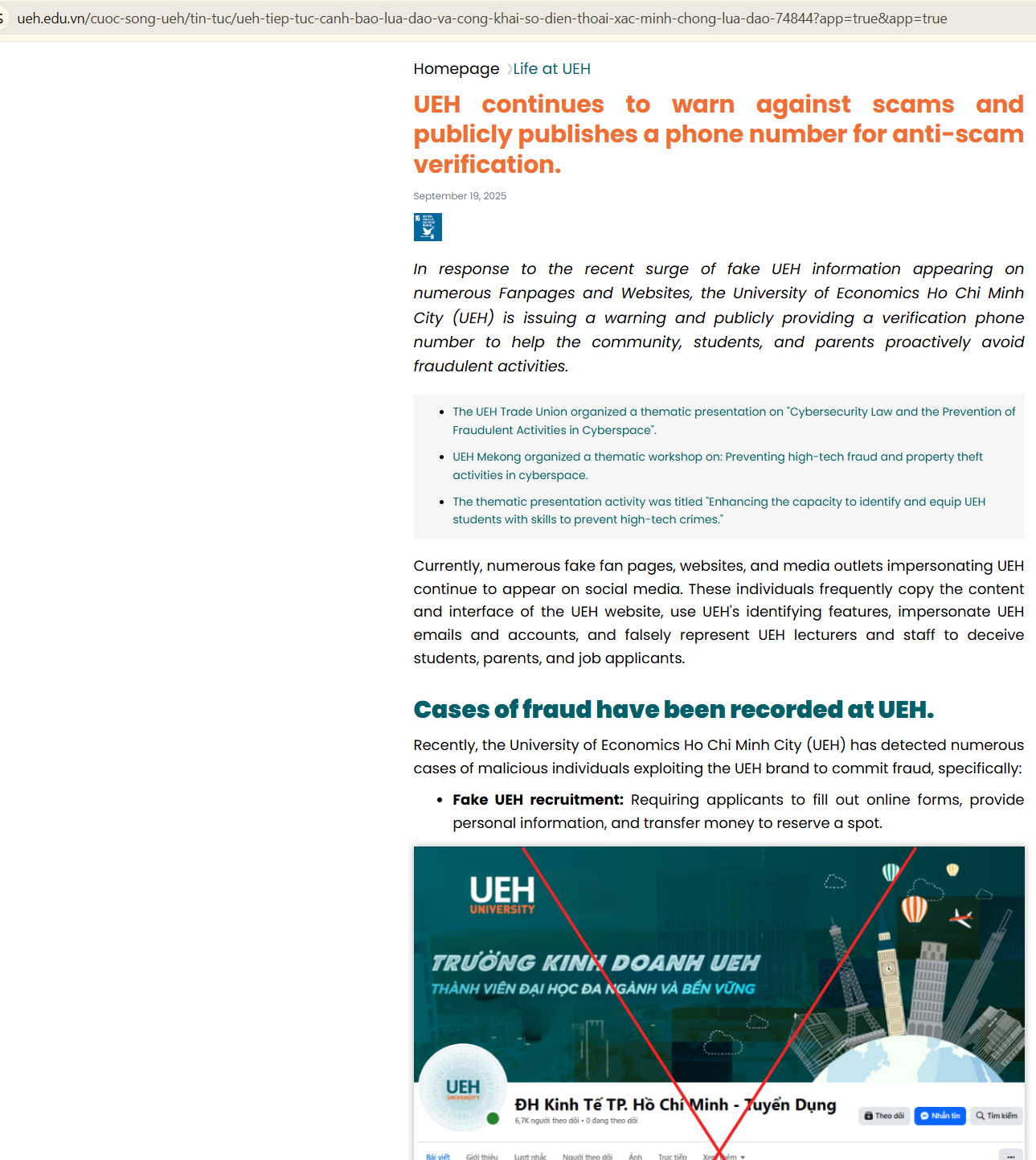
These activities helped strengthen awareness, improve transparency in access to employment opportunities and prevent fraudulent recruitment practices. They complement UEH’s modern slavery prevention policy but do not replace the direct regulations governing employees’ rights and working conditions at the University.
5. Implementation Results and Conclusion
In 2025, the University of Economics Ho Chi Minh City continued to maintain its employment policy on modern slavery, with clear commitments to prohibiting forced labour, exploitation, fraudulent recruitment for human trafficking and unlawful child labour.
The public disclosure of prohibited employment practices, the maintenance of the Code of Conduct and the issuance of procedures for handling complaints and denunciations have contributed to strengthening the University’s governance framework and mechanisms for protecting employees’ rights and interests. At the same time, warnings about fraudulent recruitment and human trafficking prevention awareness activities in 2025 further raised public awareness and helped prevent deception and exploitation.
Through the implementation of its policy and supporting activities, UEH continues to work towards a safe and transparent working environment that respects human dignity and protects human rights, contributing to SDG 8 – Decent Work and Economic Growth.