

6.5.1. Water management educational opportunities
University of Economics Ho Chi Minh City (UEH) promotes education on the management, protection and sustainable use of water resources through formal curricula, free awareness-raising and experiential activities, community training, applied research and international knowledge exchange. Since 2024, UEH has integrated Sustainable Development into degree programmes across all disciplines, providing a foundation in the Sustainable Development Goals (SDGs), including SDG 6 – Clean Water and Sanitation. In 2025, UEH continued water-related educational activities, community capacity-building under the 2024–2025 GS4Infra project, research on water scarcity by the Sustainable Finance Institute (SFI), and learning from Singapore’s water management practices. Together, these initiatives promote responsible water use and connect higher education with local and regional environmental challenges.
- Water management education through the Sustainable Development curriculum
1.1. Integrating Sustainable Development across degree programmes
Under its Multidisciplinary and Sustainable University strategy for 2021–2025, with a vision to 2030, UEH identifies educating globally minded citizens capable of taking sustainable action as a key priority of its Education pillar, alongside Research, Operations, Governance and Community Engagement.
UEH’s College of Economics, Law and Government (CELG) has provided professional training for lecturers teaching Sustainable Development. CELG is responsible for developing the course syllabus, training instructors and assuring course quality.
Since 2024, Sustainable Development has been incorporated as one of six compulsory courses across UEH degree programmes. It provides students from different disciplines with systematic knowledge and approaches to environmental, resource-related, economic and social challenges. UEH has planned delivery of the course to approximately 8,000 full-time undergraduate students in their second year. This figure indicates the potential scale of the curriculum rather than a verified number of students who completed water-specific training.
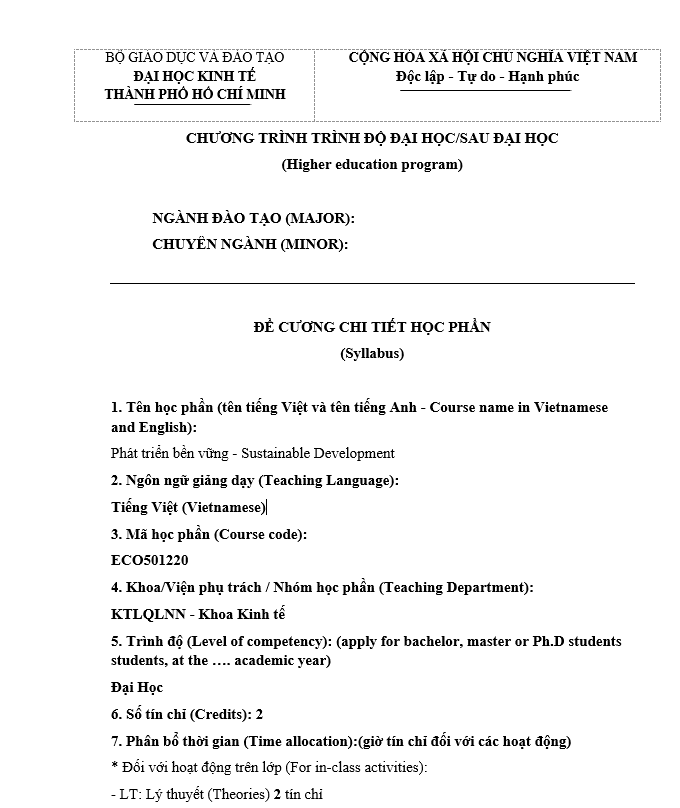
Sustainable Development is a compulsory course across all disciplines.
Evidence: Detailed syllabus for Sustainable Development (ECO501220), Faculty of Economics, UEH.
https://docs.google.com/document/d/1MJT4zYzW44Go4Jjc5b1DdMqM7SIMG9ei/edit
The course introduces principles, concepts and challenges of sustainable development, particularly in the Vietnamese context. It develops critical thinking, global awareness, civic responsibility and the ability to apply sustainability principles to real-world issues.
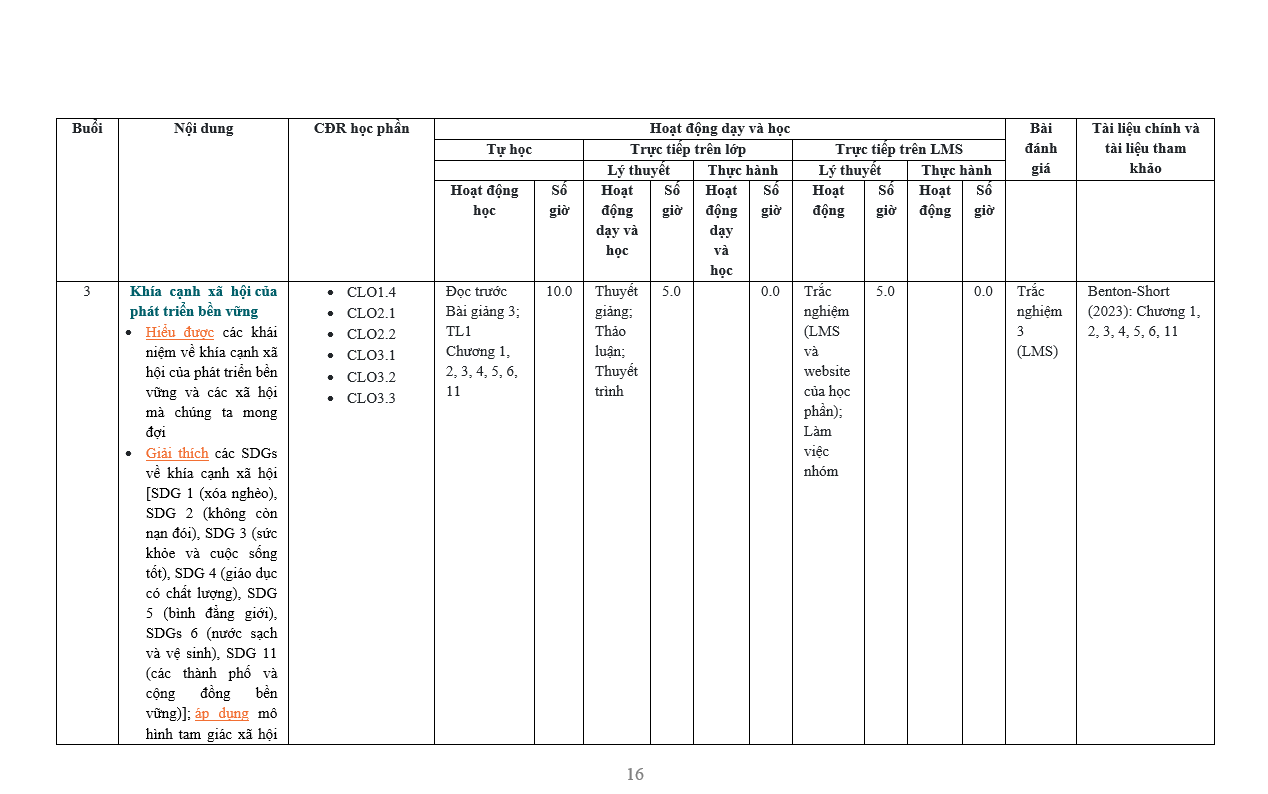
The course teaching plan includes a discussion session on SDG 6.
Evidence: Detailed syllabus for Sustainable Development (ECO501220), Faculty of Economics, UEH.
https://docs.google.com/document/d/1MJT4zYzW44Go4Jjc5b1DdMqM7SIMG9ei/edit
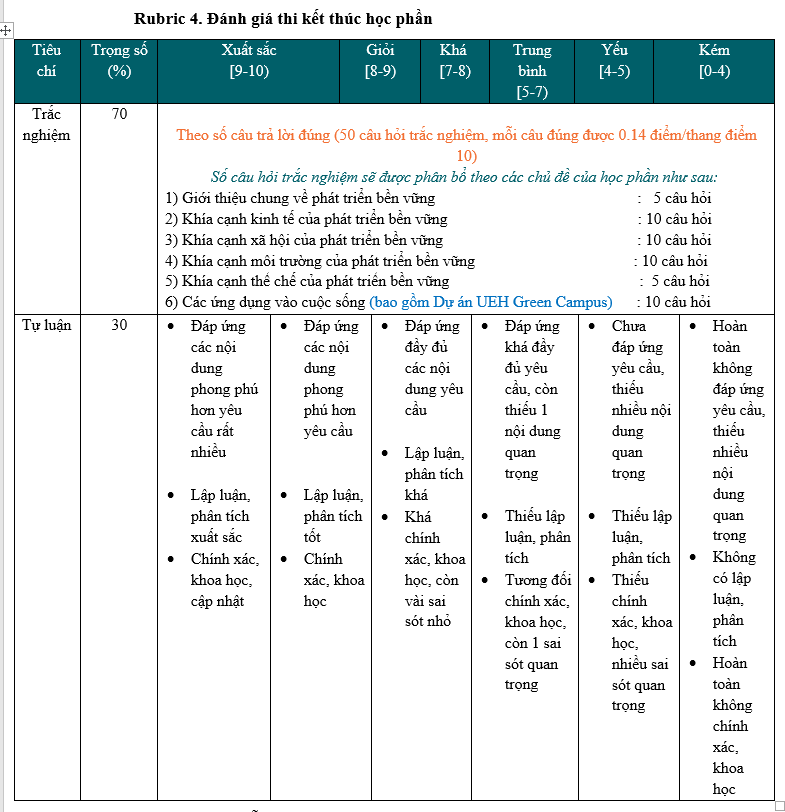
Methods of assessing learning outcomes.
Evidence: Detailed syllabus for Sustainable Development (ECO501220), Faculty of Economics, UEH.
https://docs.google.com/document/d/1MJT4zYzW44Go4Jjc5b1DdMqM7SIMG9ei/edit
UEH’s published learning outcomes emphasise identifying major environmental issues and developing strategies for sustainable resource use and management. Topics relevant to SDG 6 include:
- Protecting clean water sources and using water efficiently.
- Identifying the causes and impacts of water pollution.
- Managing water resources amid climate change, drought and saltwater intrusion.
- Connecting water management with SDGs 11, 12, 13 and 15.
- Strengthening individual, institutional and community responsibility for natural resource protection.
- Free educational opportunities on water management and conservation
2.1. GS4Infra – Community training on irrigation infrastructure and local water resources
The GS4Infra project, Gender Mainstreaming in Irrigation Infrastructure and Disaster Risk Reduction in the Context of Climate Change in Cu Lao Dung District, Soc Trang, was implemented during 2024–2025 with support from the Australian Government. It connected academic research with local infrastructure needs and community capacity-building.
UEH collaborated with the Cu Lao Dung District Department of Agriculture and Rural Development to deliver training for local officials, civil society representatives and residents. Sessions addressed the role of irrigation infrastructure, water resource management, and the effects of saltwater intrusion, flooding and drought on local livelihoods.
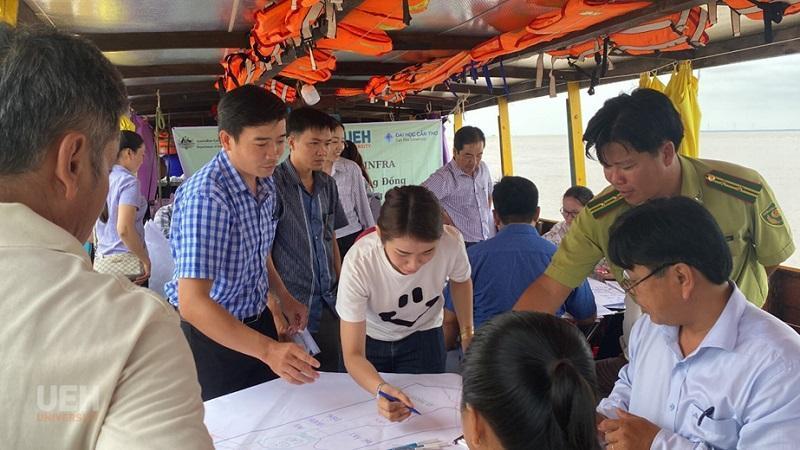
Local officials and residents participate in group discussions.
Public evidence: GS4Infra Research Project: Community Capacity-Building Workshop in Cu Lao Dung District, Soc Trang (UEH Portal, 2 January 2025).
Through practical exercises, participants identified critical infrastructure such as sluice gates, dykes and canals; examined barriers faced by vulnerable groups in accessing irrigation infrastructure; and proposed improvements to resource allocation and community infrastructure.
GS4Infra engaged residents of An Thanh Dong and An Thanh Nam communes and district officials, alongside policy consultations to integrate gender perspectives into irrigation and disaster risk reduction. This initiative directly served local communities beyond UEH campuses and supported their capacity to participate in water-related infrastructure decisions.
2.2. “Save Water, Save Future” – Water conservation awareness and experiential learning
From 30 October to 6 November 2025, the UEH Social Work Team organised the free “Save Water, Save Future” educational programme, combining online communication with in-person activities at 279 Nguyen Tri Phuong Street, Ho Chi Minh City.
Target participants: University students across Ho Chi Minh City.
The programme addressed water pollution, its consequences for human health and ecosystems, and practical approaches to protecting and sustainably using water resources.
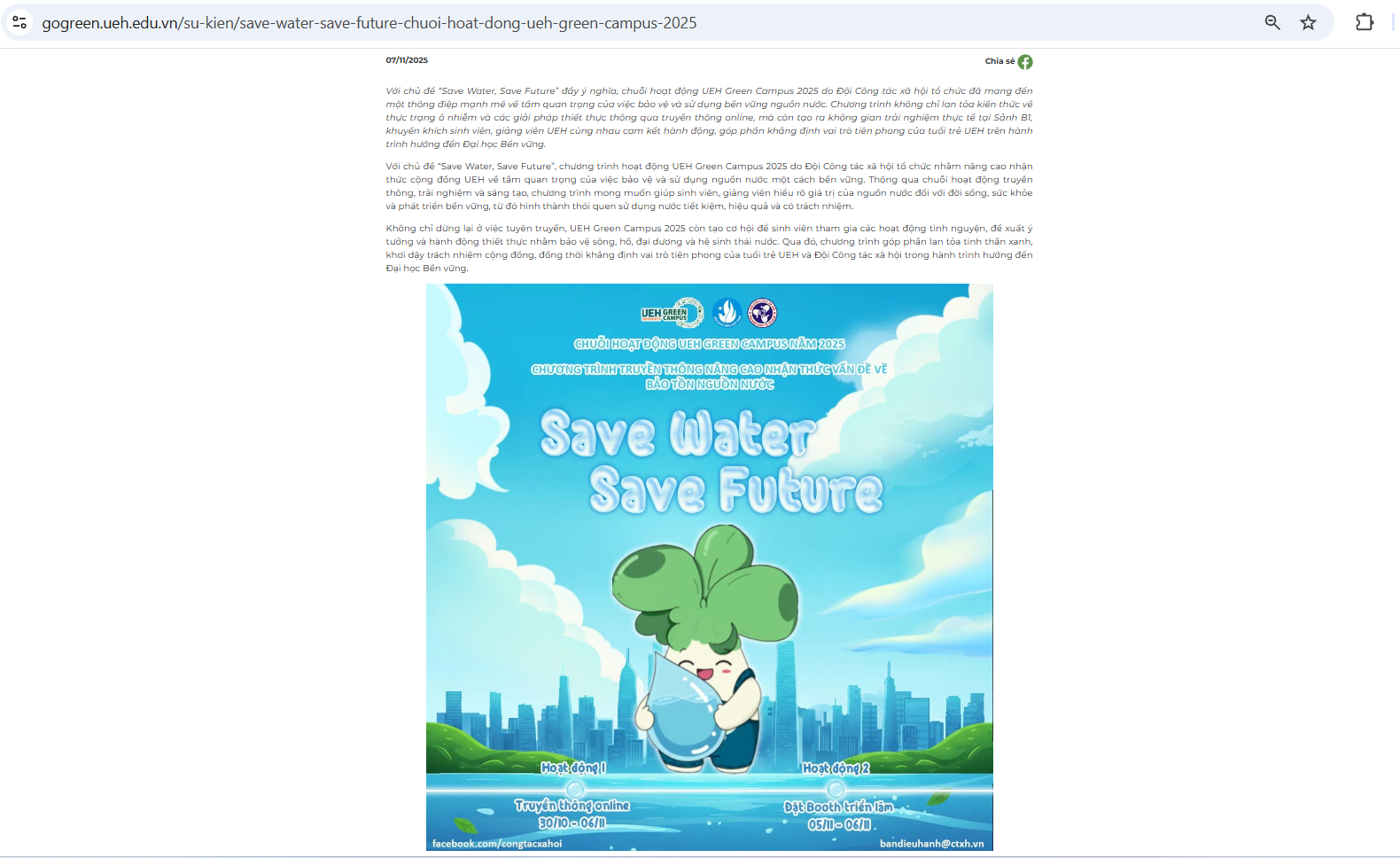
Sharing knowledge about water pollution and water conservation solutions.
Public evidence: Save Water, Save Future – UEH Green Campus 2025 Activity Series (UEH Green Campus Portal, 7 November 2025).
https://gogreen.ueh.edu.vn/su-kien/save-water-save-future-chuoi-hoat-dong-ueh-green-campus-2025
On 5–6 November 2025, interactive stations in the B1 lobby used visual materials and pollution data to help participants identify causes, assess impacts and propose changes to everyday water-use habits. The online and in-person activities helped translate water conservation awareness into practical commitments.
- Professional training and applied research on sustainable water management
UEH’s Sustainable Finance Institute (SFI) connects education, research, consultancy and knowledge transfer in sustainable development. Its activities include specialist programmes, organisation-specific training and knowledge-sharing opportunities that support understanding of financial solutions for sustainability.
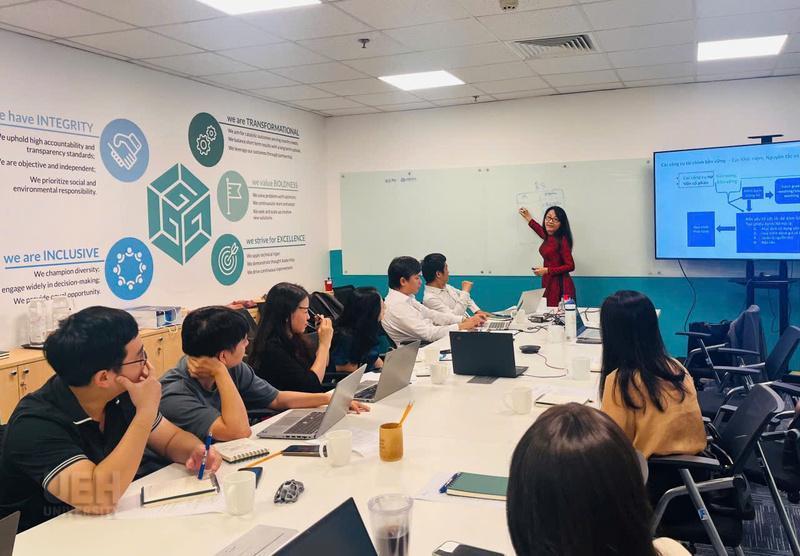
Illustration of SFI’s annual fee-based professional training activities.
Public evidence: UEH Sustainable Finance Institute: 2024 Highlights and Contributions to the SDGs (UEH Portal, 12 January 2025).
In the field of water resources, the USD 135,000 Nature-based Solutions research project supported by APN addresses water scarcity and climate change in Vietnam, Thailand and Cambodia. It builds research capacity to assess water balance and supply issues and explore nature-based approaches to sustainable water management.
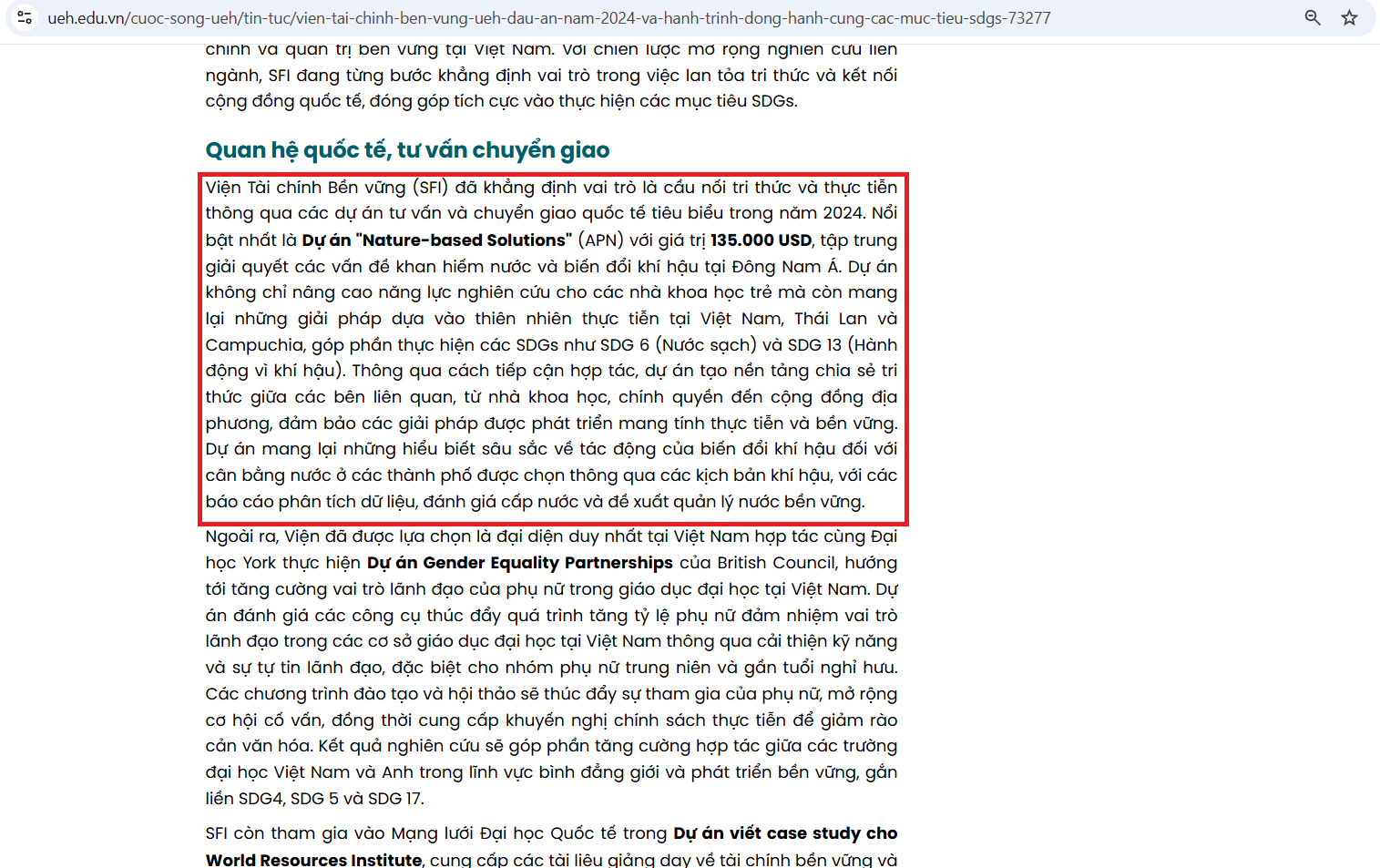
Information on the Nature-based Solutions project addressing water scarcity and climate change in Southeast Asia.
Public evidence: UEH Sustainable Finance Institute: 2024 Highlights and Contributions to the SDGs (UEH Portal, 12 January 2025).
Through international research collaboration, the project strengthens the evidence base for water resource management and provides opportunities for knowledge exchange among researchers, public authorities and local stakeholders.
- International learning and knowledge exchange on water management
During the ISB ASEAN Co-op Study Tour in Singapore on 9–11 July 2025, UEH students explored water resource management and sustainable development through international experiential learning.
At PUB Gallery, Singapore’s exhibition centre for water management and sustainability, participants learned about modern water supply and drainage systems, water recycling processes and national water conservation strategies.
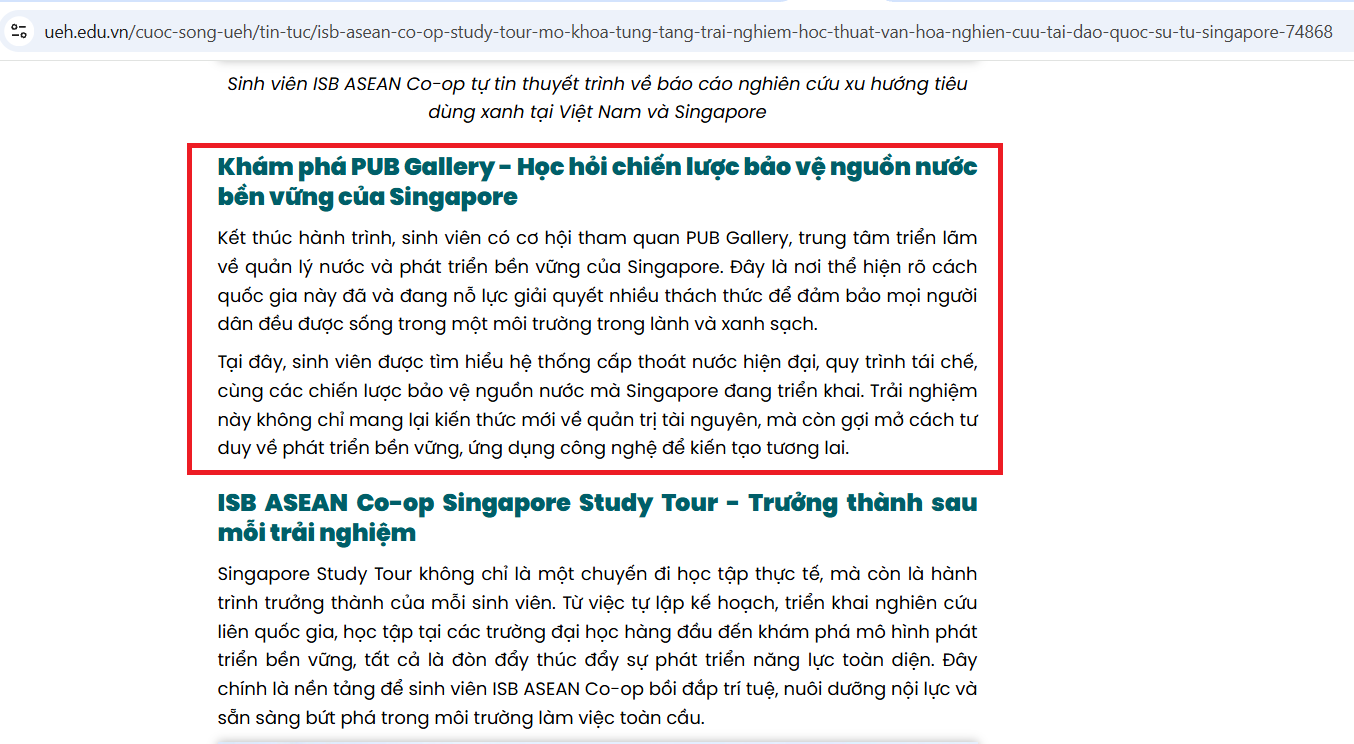
Learning about strategies for sustainable water resource protection.
Public evidence: ISB ASEAN Co-op Study Tour: Exploring Academic, Cultural and Research Experiences in Singapore (UEH Portal, 13 November 2025).
The visit provided practical perspectives on water governance, technology applications and water security amid urbanisation and climate change. Students could compare Singapore’s approaches with water management challenges in Vietnam. The programme illustrates how water education can be incorporated into international academic experiences.
- Implementation outcomes and highlights in 2025
In 2025, UEH delivered water management and conservation education through complementary approaches, including formal teaching, free outreach, community training, applied research and international learning.
At the curriculum level, the compulsory Sustainable Development course continued to introduce students across disciplines to the SDGs, resource management and social responsibility. The free “Save Water, Save Future” initiative combined online awareness-raising, interactive games, experiential stations and workshops.
Beyond campus, the 2024–2025 GS4Infra project connected research with capacity-building for residents and local officials in Cu Lao Dung, focusing on irrigation infrastructure, water access and disaster risk reduction. SFI also maintained specialist education, organisation-focused training and knowledge-sharing activities in sustainable finance.
SFI’s APN-supported Nature-based Solutions research contributed knowledge on water scarcity and nature-based responses, while the ISB ASEAN Co-op Study Tour introduced students to Singapore’s water management systems.
Compared with earlier activities, these initiatives show how UEH links water education with its wider sustainability curriculum. Combining teaching, public engagement, research and community collaboration supports awareness and responsible water use in line with SDG 6 – Clean Water and Sanitation.