

6.5.6. Promoting conscious water usage on campus
THE Sustainability Impact Ratings 2027 | SDG 6 – Clean Water and Sanitation | Reporting year: 2025
University of Economics Ho Chi Minh City (UEH) actively promotes water conservation, efficient water use and responsible behaviour across its campuses through Green Campus regulations applicable to students, academic staff and employees; awareness campaigns, experiential activities and behaviour-change challenges; and the management and use of water-saving fixtures. These measures form part of UEH’s Multidisciplinary and Sustainable University Strategy and its Green Campus initiative, integrating responsible water use into everyday study and work.
- Long-term policies promoting conscious water usage on campus
1.1. Continued implementation of the Green Campus Regulations through 2025
In 2022, UEH issued the Green Campus Regulations under Decision No. 2059/QD-DHKT-CSVC, establishing a framework for environmental protection and resource conservation at its campuses. Implementation continued throughout 2023–2025, supporting sustained efforts to encourage environmentally responsible behaviour.
Specifically, Article 2, Clause 1 identifies resource conservation, including water, as a core Green Campus practice. Article 5, Clause 4 explicitly requires the economical use of resources and utilities on university premises, including washing water and drinking water from dispensers.
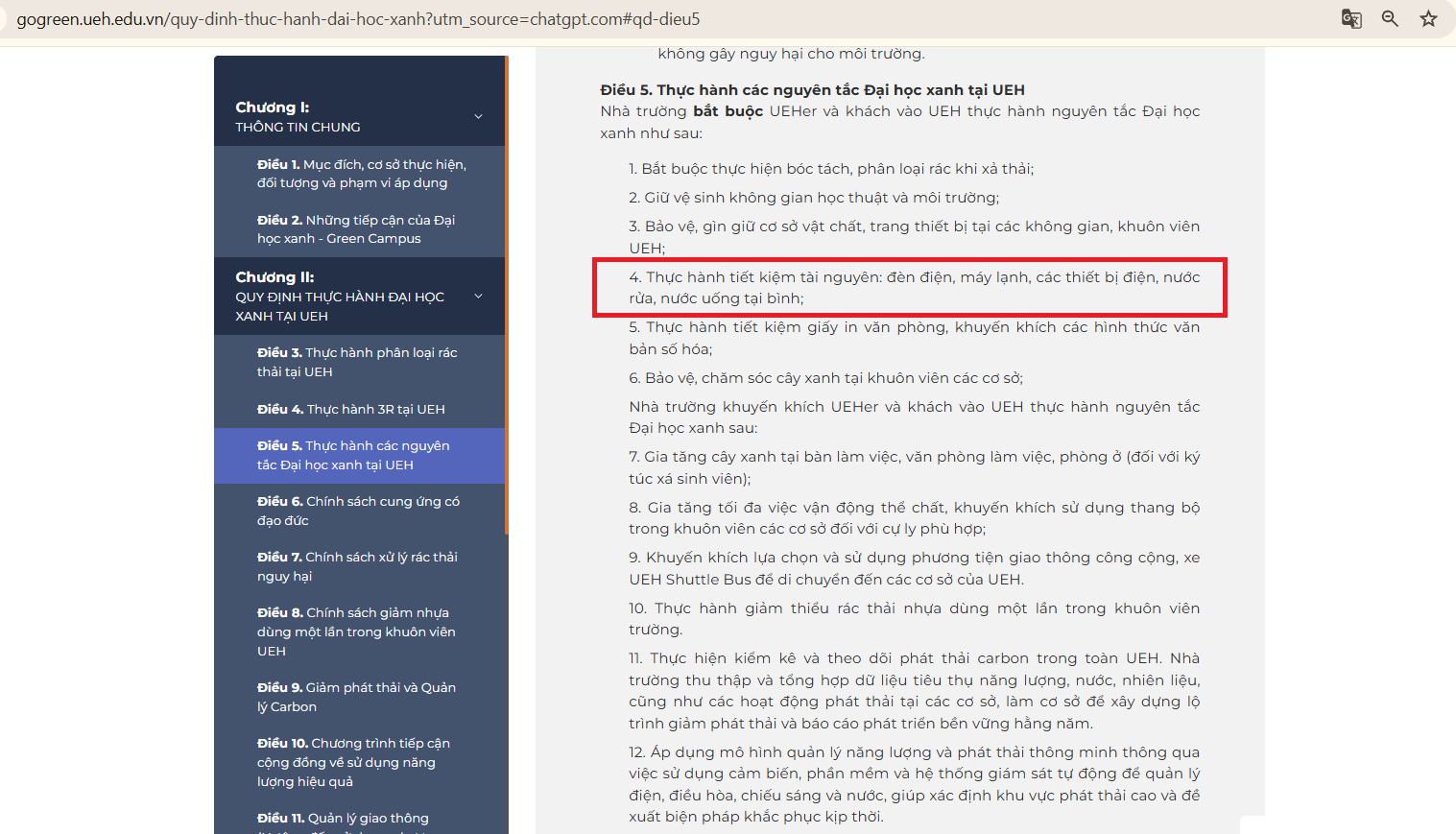
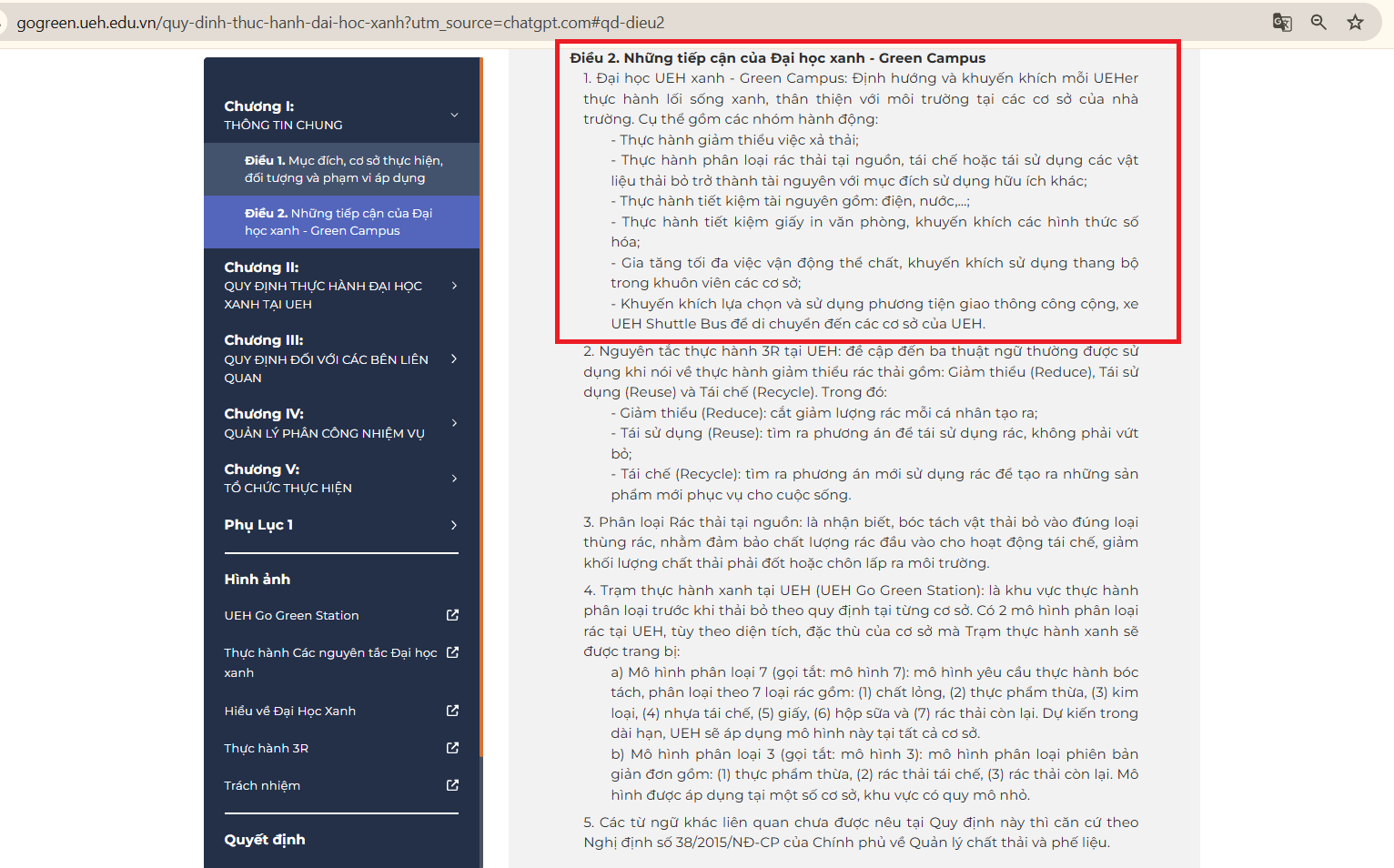
Relevant provisions of the Green Campus Regulations.
Public evidence: Green Campus Regulations (UEH Green Campus).
https://gogreen.ueh.edu.vn/quy-dinh-thuc-hanh-dai-hoc-xanh
These provisions establish water conservation as an institutional expectation rather than a purely voluntary awareness message, applying to staff, learners and campus visitors within the scope of the regulations.
Article 12, Clause 1 assigns responsibility for implementing and continuously evaluating the Green Campus initiative during 2023–2025 as a foundation for the subsequent period. Article 14, Clause 3 encourages UEH community members to communicate and promote Green Campus practices among colleagues and peers.
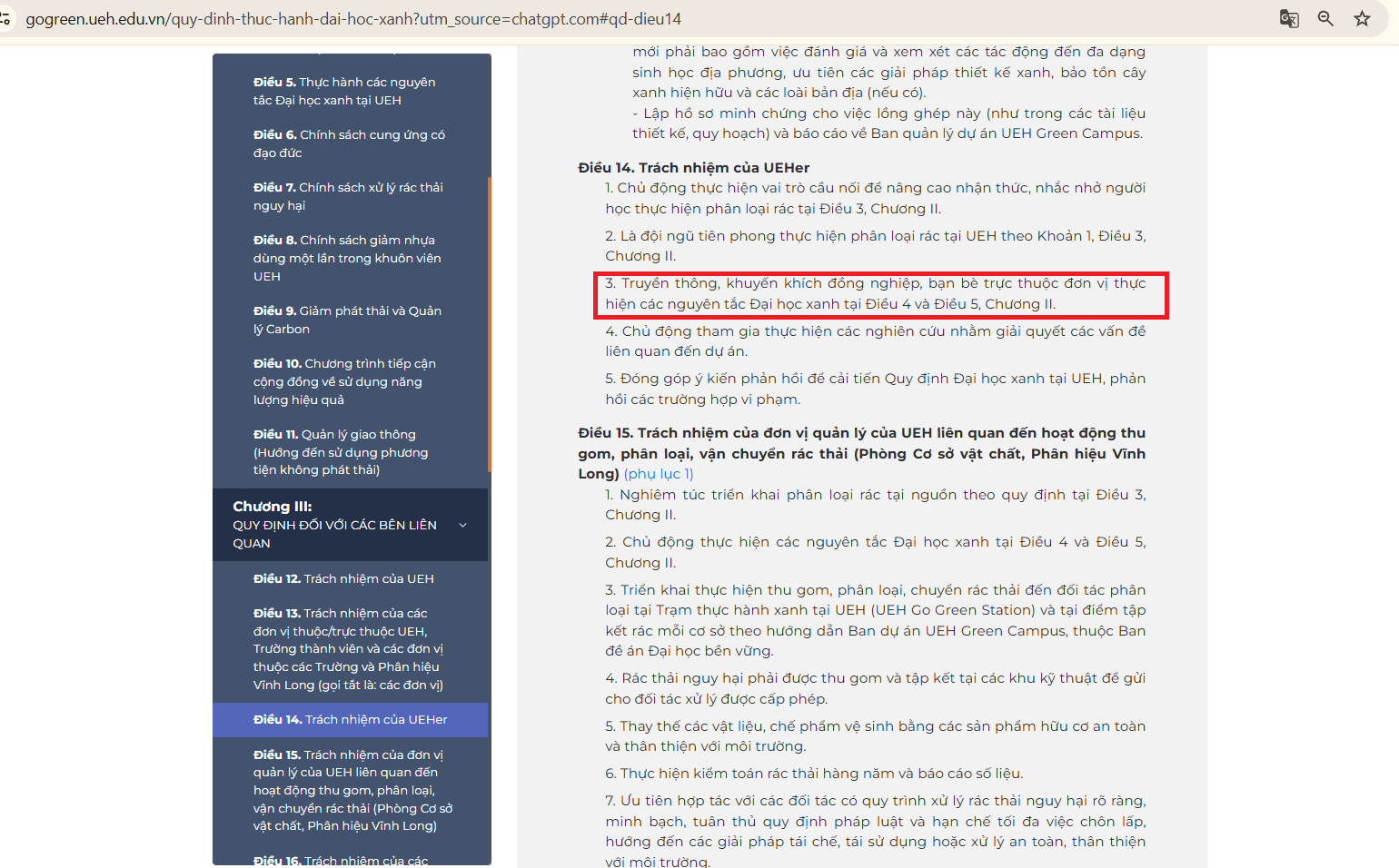
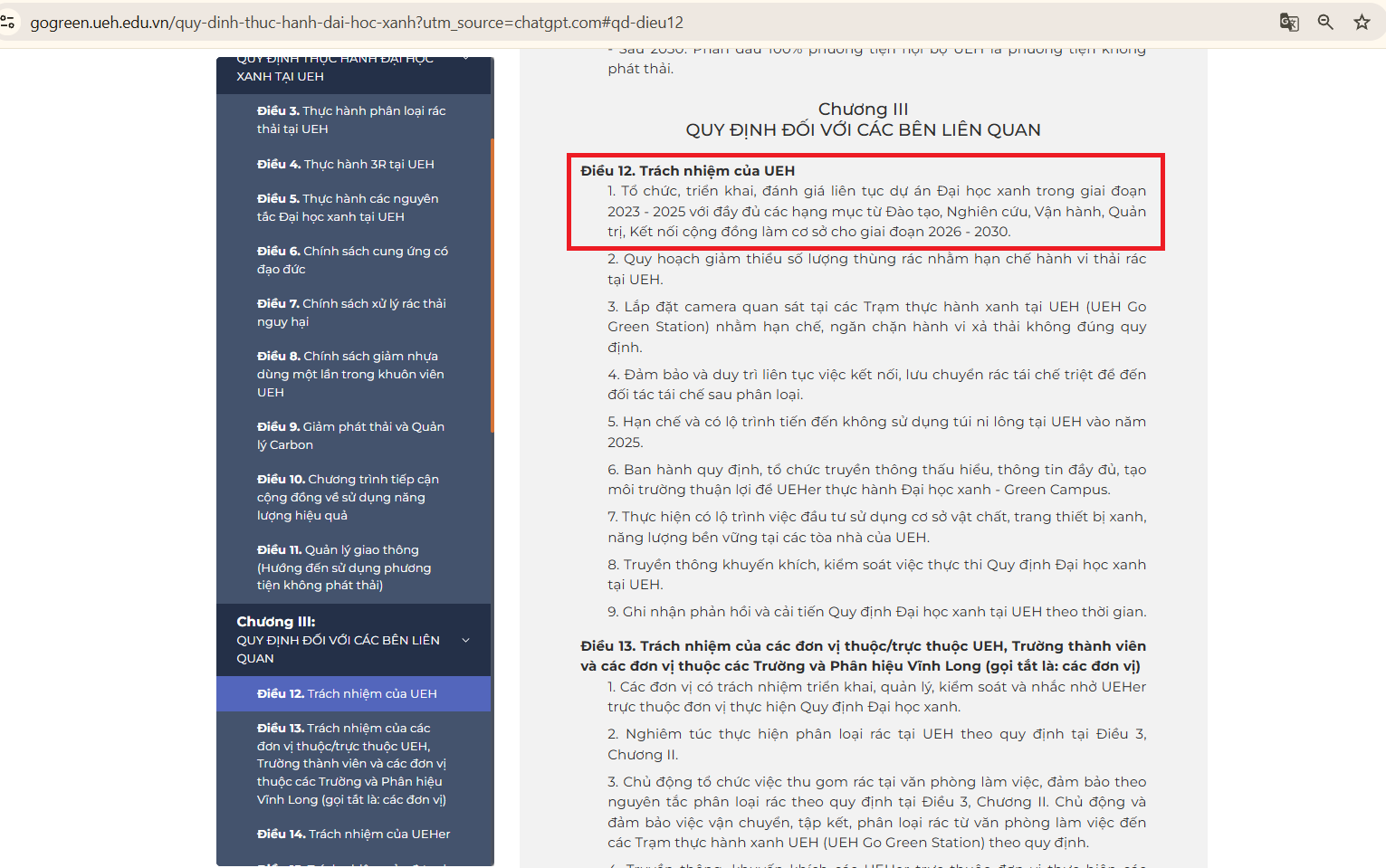
UEH Green Campus Regulations establish responsibilities for conserving water resources and maintaining implementation during 2023–2025.
Public evidence: Green Campus Regulations (UEH Green Campus).
https://gogreen.ueh.edu.vn/quy-dinh-thuc-hanh-dai-hoc-xanh
1.2. Integrating water conservation into facilities management
Alongside behavioural guidelines, UEH has introduced water-management measures in campus operations.
According to UEH Green Campus’s 2025 progress review, the university inspected the wastewater treatment system at its Nguyen Van Linh campus and reviewed the use of water-saving fixtures. The report recorded that more than 80% of the fixtures within the project’s surveyed scope were water-saving devices.
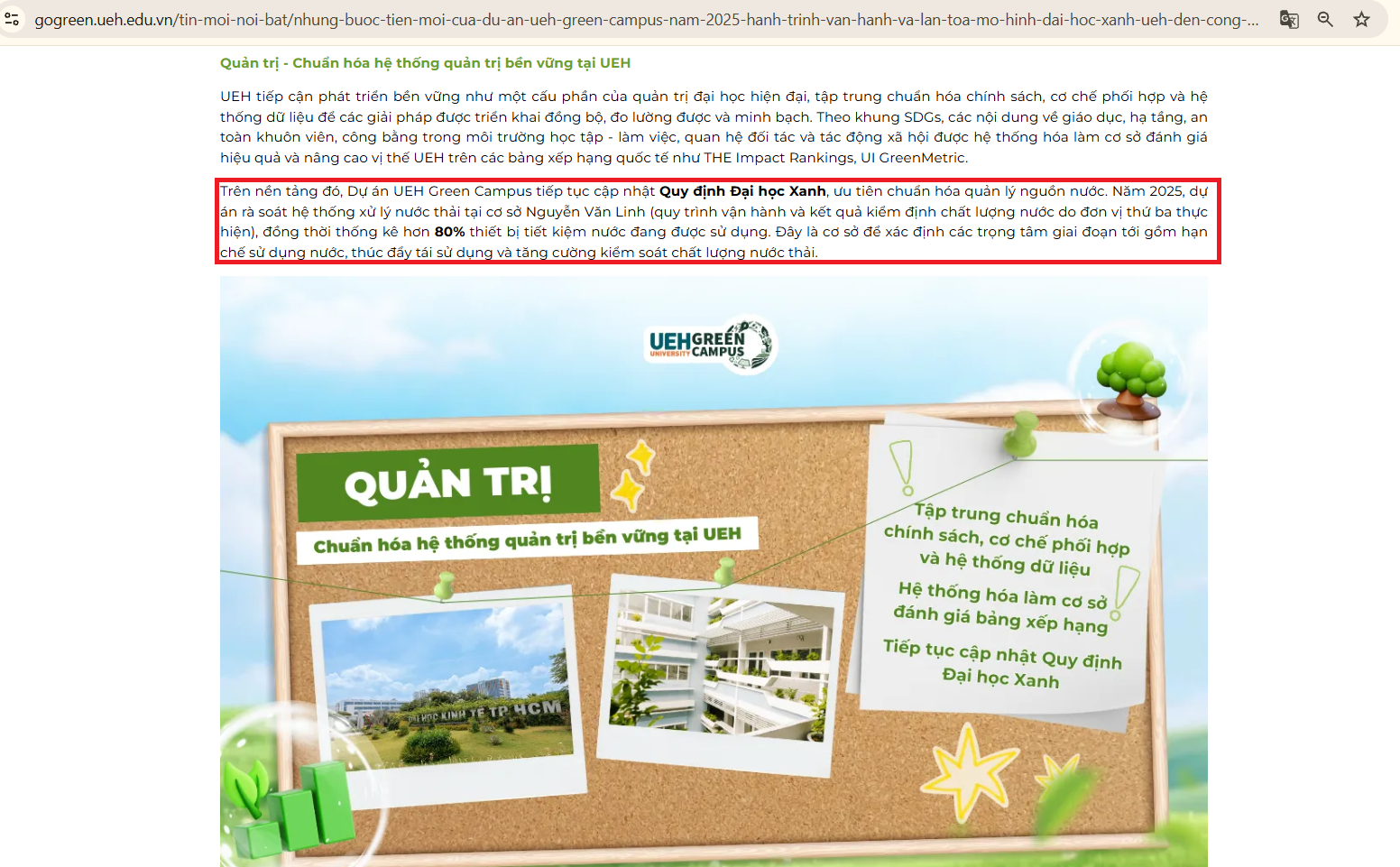
Results of the 2025 UEH Green Campus review of water-saving fixtures.
Public evidence: New Progress in UEH Green Campus 2025: Operating and Sharing the UEH Green University Model with the Community (UEH Green Campus, 4 February 2025).
In addition to encouraging students to change their habits, UEH uses water-efficient equipment to help reduce unnecessary consumption in campus operations. The reported percentage refers to the surveyed project scope and should not be interpreted as a verified university-wide figure.
- Campus programmes promoting conscious water usage in 2025
2.1. “Protect Water, Nurture Life” – Water conservation guidance and practice at Campus B
In September 2025, the UEH Faculty of Law and the 43–45 Nguyen Chi Thanh Student Dormitory jointly organised a series of Green Campus activities under the theme “Protect Water, Nurture Life”, encouraging students to protect water resources and use them responsibly.
The programme combined online and in-person activities.
From 22 to 28 September 2025, students joined an online challenge by sharing photographs of their environmental actions, including saving water in daily activities and using reusable water bottles. This encouraged participants to practise, document and share positive changes in their routines.
On 29–30 September 2025, the programme hosted an interactive booth in the B2 lobby at UEH Campus B, featuring three learning stations. At the “Green Knowledge Corner”, students explored the importance of clean water and water-saving practices through infographics. The “Sorting Challenge” simulated cleaning a river, helping participants recognise the effects of waste on water resources. The “Green Quiz” used questions on clean water, pollution and conservation to reinforce knowledge and encourage action.
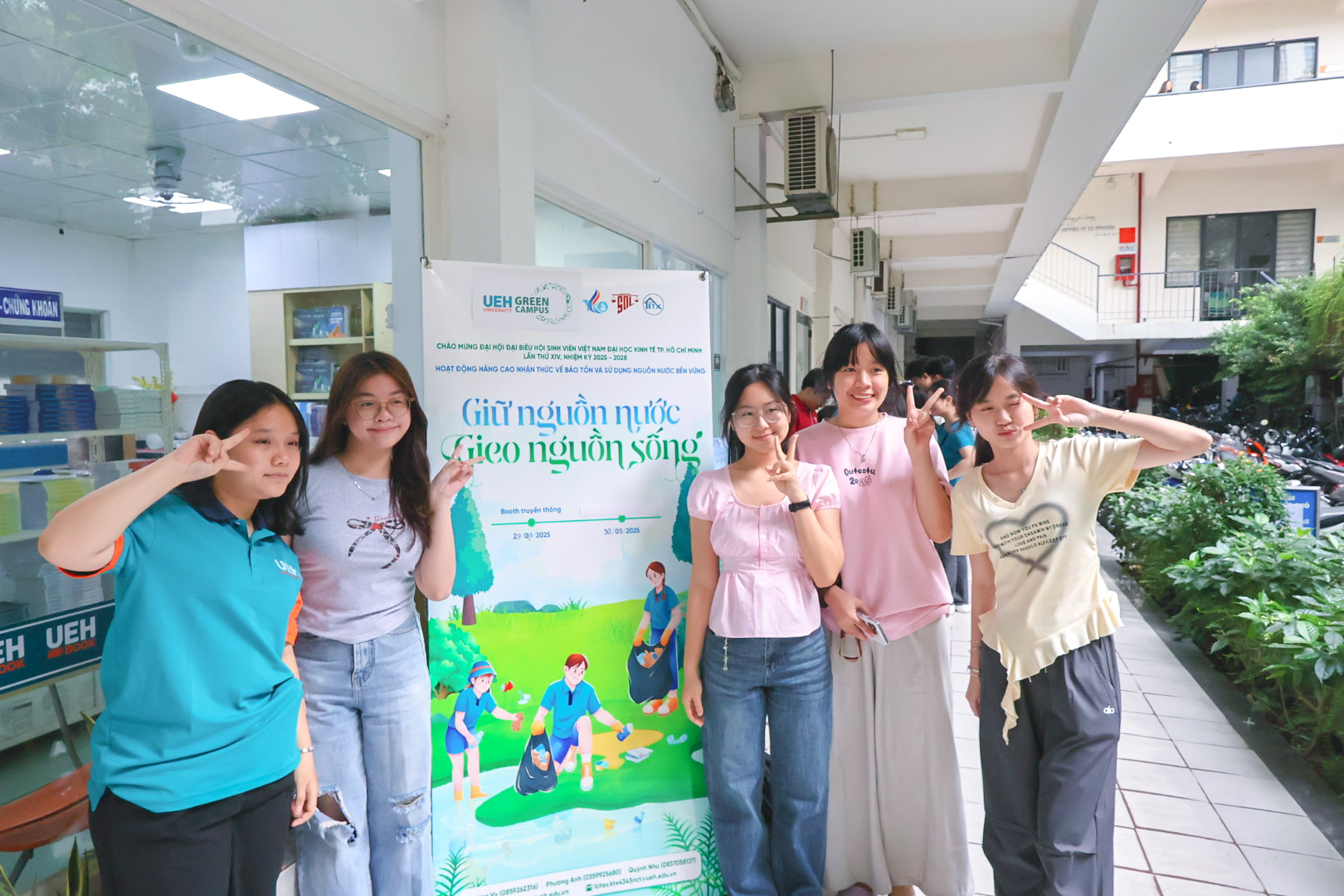
Students learn about water conservation and responsible practices at the “Protect Water, Nurture Life” booth.
Public evidence: UEH Green Campus 2025 – Faculty of Law: “Protect Water, Nurture Life” (UEH Green Campus, 1 October 2025).
2.2. “Save Water, Save Future” – Awareness and responsible water-use commitments at Campus B
Continuing its on-campus awareness initiatives, the UEH Social Work Team organised “Save Water, Save Future” in late October and early November 2025.
From 30 October to 6 November 2025, the programme shared online educational content on water pollution, its effects on daily life, and practical ways for students to adopt more responsible water-use habits.
Its main in-person activities took place on 5–6 November 2025 in the B1 lobby at Campus B, 279 Nguyen Tri Phuong Street. Interactive stations used images and visual information to explain the causes and consequences of water pollution and encouraged students and lecturers to discuss responsible water-use solutions.
Participants were also invited to record personal commitments to protecting water resources. This activity translated awareness into specific pledges intended to encourage water-saving behaviour beyond the programme.
By combining online communication, on-campus experiential learning and personal commitments, the programme engaged UEH’s student and academic community in sustainable water use.
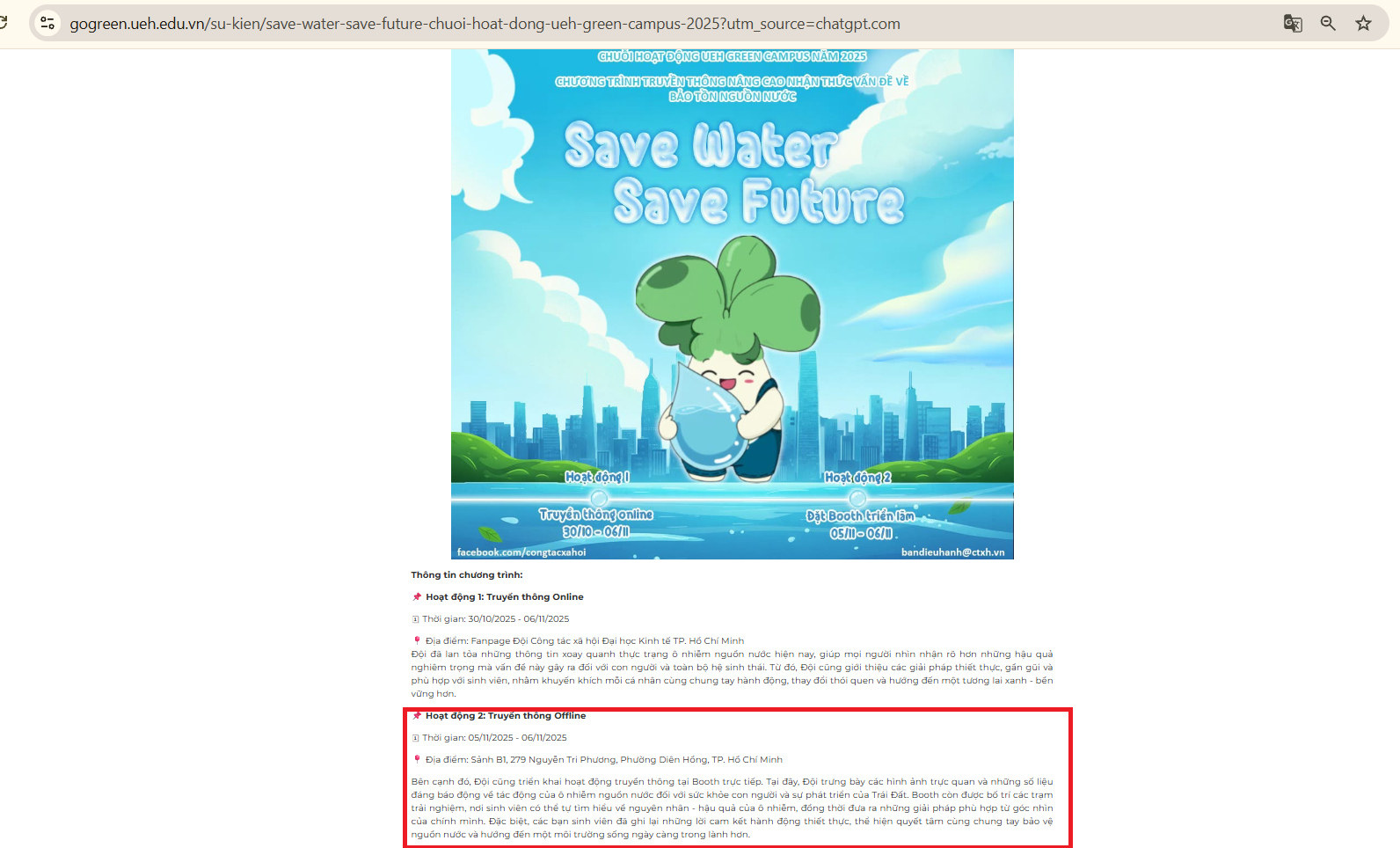 The “Save Water, Save Future” booth at Campus B helps UEH students and lecturers understand sustainable water use.
Public evidence: Save Water, Save Future – UEH Green Campus 2025 Activity Series (UEH Green Campus, 7 November 2025).
https://gogreen.ueh.edu.vn/su-kien/save-water-save-future-chuoi-hoat-dong-ueh-green-campus-2025
2.3. “The Blue’s Call” – Developing water-saving awareness and habits through a workshop at English Zone
In 2025, the UEH SSG Student Support Group organised “The Blue’s Call” as part of the UEH Green Campus campaign.
The programme had two main components. First, the online “Tide of Awareness” communication series provided information about the value of water resources and students’ responsibility for protecting aquatic environments.
Second, the “Answer the Call” workshop at UEH’s English Zone created a learning environment for students to explore clean-water challenges, the relationship between consumption and water resources, and the environmental impacts associated with the textile industry.
Through discussion and creative activities using fabric offcuts, students were encouraged to view water protection as part of everyday consumption and resource-use decisions. The workshop also introduced practical water-saving actions to promote awareness and responsible habits.
Held in a UEH learning space for students, “The Blue’s Call” further strengthened conscious water-use education within the university community.
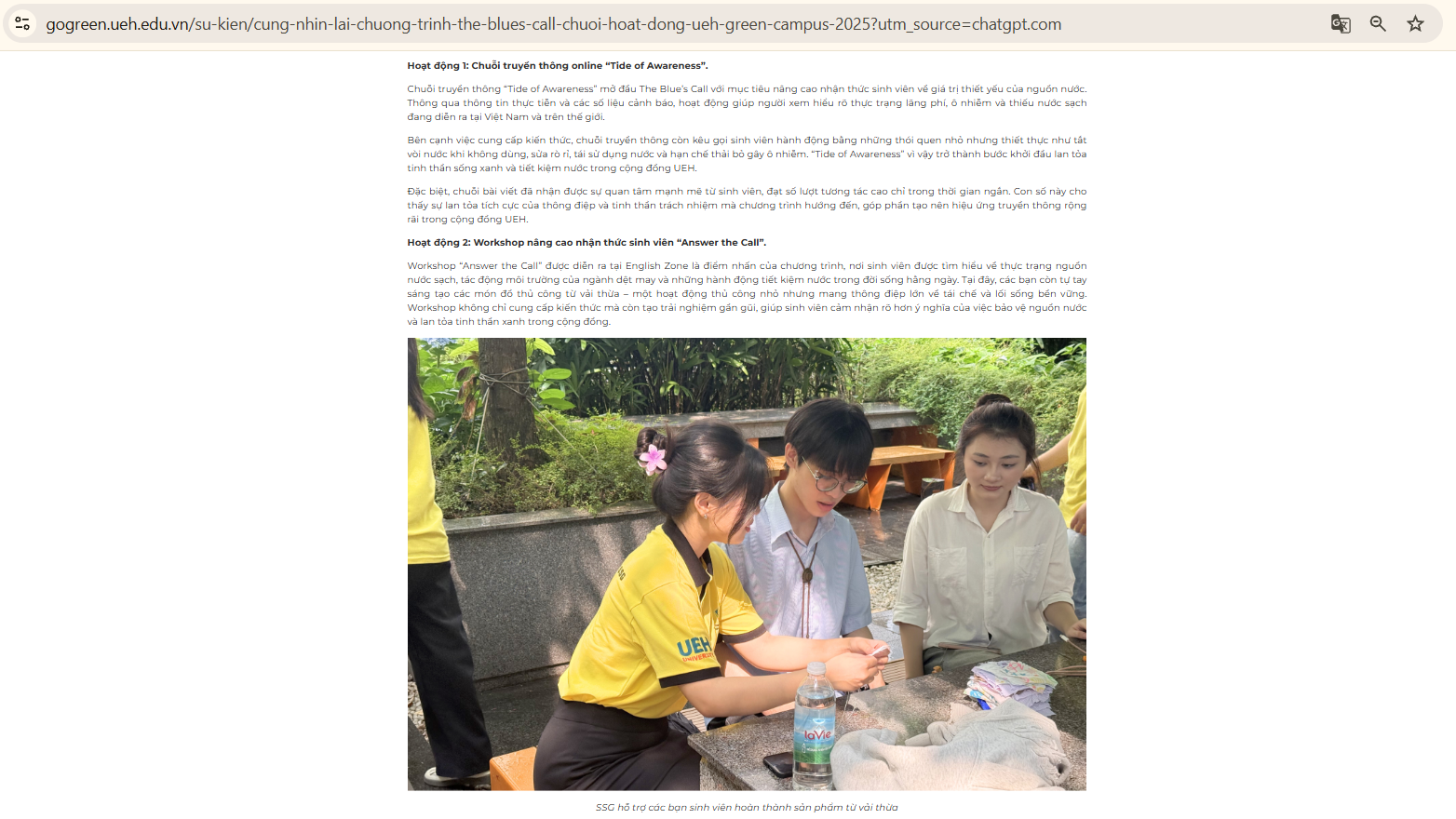
UEH students participate in the “Answer the Call” workshop, exploring water-saving actions and sustainable consumption during “The Blue’s Call” in 2025.
Public evidence: Looking Back at “The Blue’s Call” – UEH Green Campus 2025 Activity Series (UEH Green Campus, 5 December 2025).
- Outcomes, impact and highlights in 2025 compared with the previous year
4.1. Implementation outcomes in 2025
Although the programmes used different formats, they shared a common objective: helping students identify water-wasting behaviours, learn practical conservation methods and take personal responsibility for water resources.
In addition to awareness and experiential activities, the 2025 UEH Green Campus review reported that more than 80% of fixtures within the project’s surveyed scope were water-saving devices. This provides supplementary operational evidence that conscious water use is supported by campus facilities, not only by awareness-raising.
4.2. Participation and impact within the UEH community
The programmes involved several UEH units, including the Faculty of Law, the 43–45 Nguyen Chi Thanh Student Dormitory, the Social Work Team and the SSG Student Support Group.
In addition to public sources, UEH units’ 2025–2026 activity reports recorded programme participation figures: the Faculty of Law reported 1,362 participants or participation instances for “Protect Water, Nurture Life”, while the student dormitory recorded 150; “Save Water, Save Future” recorded 25 participants; and “The Blue’s Call” recorded 300. Because the two figures for the first programme may overlap or use different counting methods, they should not be combined into a verified unique-participant total.
4.3. Comparison with the previous evidence submission
In 2025, UEH continued implementing its Green Campus Regulations and documented at least three thematic programmes targeting learners on campus. Organised at different points throughout the year by multiple university units, the programmes diversified approaches to water conservation education, experiential learning and practical action.
The 2025 evidence also includes a progress review of water-saving fixtures, adding an operational dimension to the university’s awareness programmes.
- Conclusion
In 2025, UEH continued translating its water conservation policy into educational activities, practical experiences and personal commitments at Campus B and other student learning and activity spaces.
These initiatives demonstrate the university’s active promotion of conscious water usage on campus, with publicly documented organisers, dates, locations, activities and photographs. The review of water-saving fixtures provides additional evidence of operational support for efficient resource use.
Together, the policy framework, hands-on activities, communication and supporting infrastructure contribute to a campus culture of responsible water use and progress towards SDG 6 – Clean Water and Sanitation.