

15.3.4 – Alien species impact reduction (policies)
The University of Economics Ho Chi Minh City (UEH) placed emphasis on protecting biodiversity, maintaining native ecosystems, and limiting the adverse impacts of alien species in campus operations. Building on the Green Campus Regulations under Decision No. 2059/QD-DHKT-CSVC, UEH implemented requirements to protect existing trees and further developed its approach to controlling alien species, protecting ecosystems, and strengthening accountability for biodiversity management. In 2025, this approach was reflected in research on native plants, inventories of campus trees, and efforts to expand green spaces across the university.
1. Strategic orientation
UEH identified biodiversity conservation and mitigation of the impacts of alien species as matters requiring attention in the management of teaching campuses, dormitories, and other spaces under the University’s responsibility.
Under the Green Campus Regulations, UEH sought to research and further specify its biodiversity management approach to support the protection of native plants, limit the risk of alien species spreading, and consider ecological impacts when selecting plants, upgrading landscapes, or developing new facilities. This helped establish a professional basis for considering measures to reduce the impacts of alien species on ecosystems, as outlined below.
2. Internal commitments and supporting policies
Article 5, Clause 6 – UEH required the protection and care of trees across its campuses. This provision established a foundation for responsibility in maintaining vegetation, preserving existing landscapes, and limiting the emergence of alien species among campus trees. In 2025, UEH continued to apply this policy with an emphasis on ecological suitability in landscape management, preserving existing plants, and considering risks associated with introducing tree species unsuitable for local natural conditions.
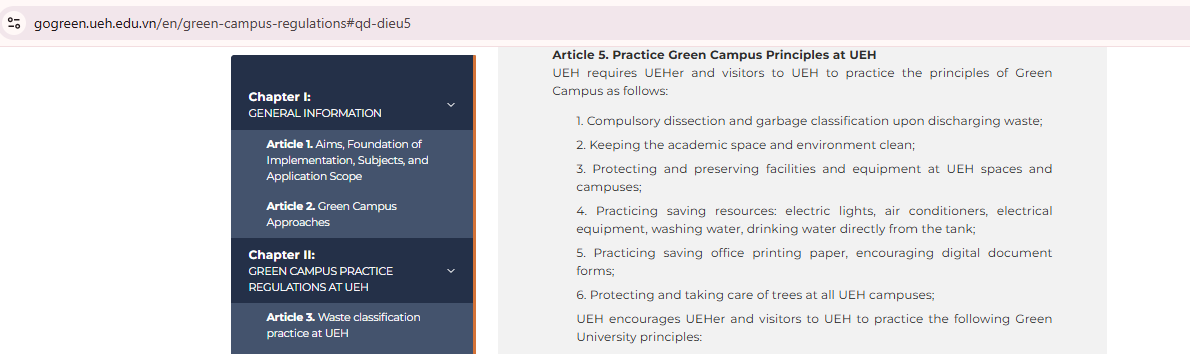
Article 5, Clause 6 stipulated the care and protection of trees on campus
Public source: UEH Green Campus Website, Green Campus Regulations under Decision No. 2059/QD-DHKT-CSVC
https://gogreen.ueh.edu.vn/en/green-campus-regulations
Article 12, Clause 4 – UEH encouraged the implementation or co-organization of education, research, knowledge transfer, innovation, and community engagement activities to conserve and restore natural ecosystems, protect biodiversity and rare animal and plant species, and control alien species. Accordingly, UEH approached the reduction of alien-species impacts on campus through three dimensions: identifying risks from introduced species; limiting adverse impacts on native ecosystems; and promoting research and appropriate management measures tailored to each campus.
Article 15, Clause 8 – UEH stipulated responsibilities for incorporating local biodiversity, ecosystem conservation, and responsible land-resource use into planning, investment, and infrastructure development. New facilities were also encouraged to prioritize green design, conserve existing trees, and minimize impacts on natural ecosystems.
Article 15, Clause 7 – UEH directed specialized units to implement programmes for ecosystem conservation and restoration, the protection of species requiring conservation, and biodiversity monitoring. In addition, Article 15, Clause 9 encouraged students, lecturers, and staff to research and apply technology in resource management, environmental protection, and ecosystem monitoring, while maintaining records, consolidating results, and reporting periodically to evaluate and improve policies.
These provisions supported UEH’s activities to protect existing ecological components on campus, assess the suitability of plant species for local natural conditions before planting, and develop management solutions suited to UEH’s actual circumstances.
3. Evidence of programmes and events implemented in 2025
| No. | Programme/
Project |
Format/
Category |
Description | Public source |
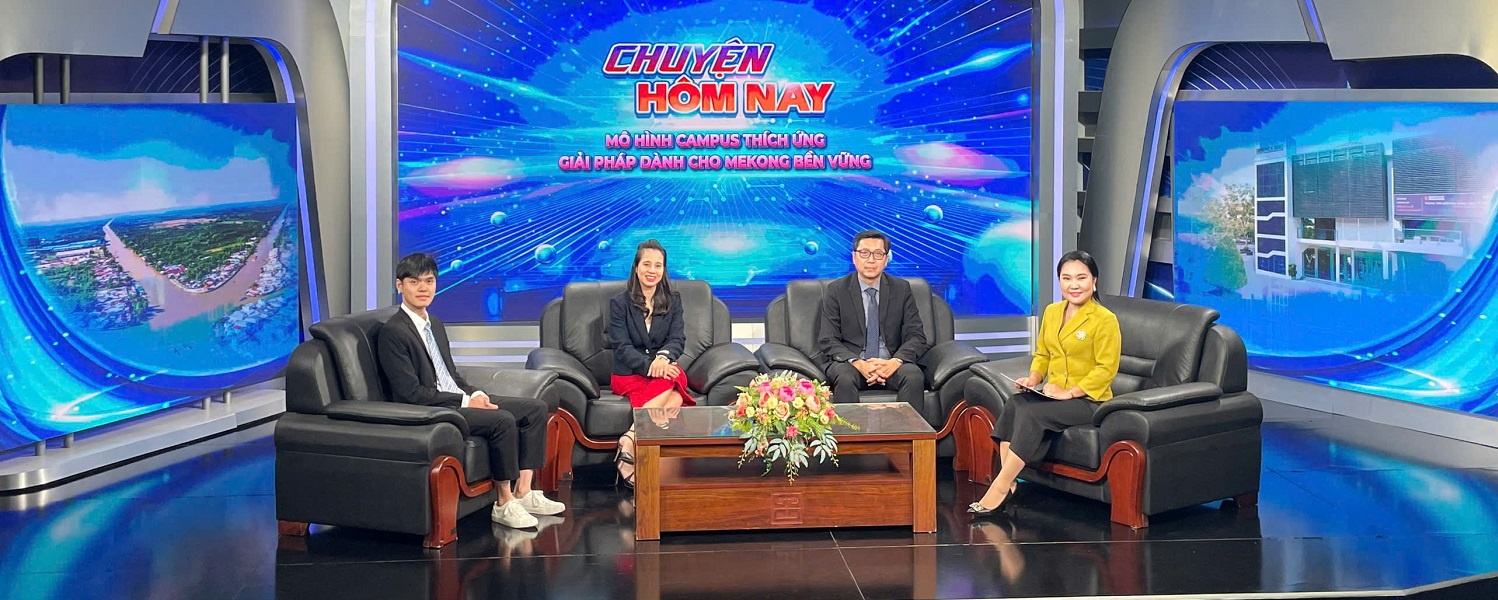
| 1 | “Adaptive Campus Model – Solutions for a Sustainable Mekong” | Applied research; Ecological landscape development; Knowledge sharing on selecting local plants and protecting biodiversity | In 2025, UEH shared and discussed specialized insights into the “Adaptive Campus Model – Solutions for a Sustainable Mekong,” with contributions from experts at the Institute of Smart City and Management (ISCM-UEH) and GreenViet Green Building Consultancy. The experts discussed a university campus model adapted to the natural conditions of the Mekong Delta, emphasizing research into and development of native plant species capable of tolerating flooding, providing shade, and improving air quality. Prioritizing plants suited to local ecological conditions reflected UEH’s approach to plant selection in landscape planning, native ecosystem maintenance, and preventing potential impacts from unsuitable plant species.
|
UEH Future, “[Podcast] Adaptive Campus Model – Solutions for a Sustainable Mekong”, 13 January 2025 |
| 2 | Inventory of trees across UEH campuses | Landscape inventory; Classification and management of the plant inventory | For the 2025 reporting year, UEH reviewed and compiled an inventory of trees at campuses A, B, N, E, and H and in dormitory areas, recording 156,414 trees. The data were categorized by campus, plant name, and quantity, providing a basis for landscape management, biodiversity protection, and reviewing potential risks posed by alien species.
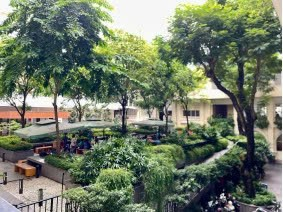
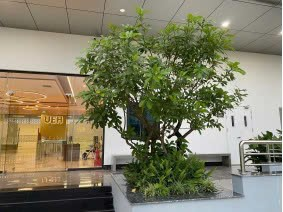
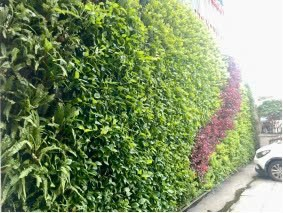
UEH conducted an inventory and management of campus trees to help monitor and control the risk of alien species appearing |
Inventory of trees across UEH campuses |
4. Conclusion
Building on the Green Campus Regulations issued in 2022 and subsequently updated and improved in 2024, UEH continued to promote tree protection and biodiversity conservation across its campuses in 2025. Research on the adaptive campus model, inventories of campus trees, and published ecosystem conservation orientations provided a basis for selecting plants suited to natural conditions, managing landscapes, and assessing risks associated with alien species in campus operations.
Animals observed on campus were primarily familiar species such as dogs, cats, and ducks. UEH emphasized caring for and protecting these animals and maintaining suitable living environments while ensuring hygiene, safety, and harmony with spaces for learning and work. UEH had not recorded any confirmed cases of invasive alien species causing adverse impacts on campus ecosystems. If an alien species potentially causing adverse impacts were detected, the University would verify its presence, assess the extent of its impact, and implement appropriate management and control measures in accordance with applicable regulations and guidance from competent authorities, with the aim of limiting its spread, protecting native species, and maintaining the stability of campus ecosystems.
By combining landscape management, care for plants and animals, scientific research, and the gradual improvement of policies to prevent and control alien species, UEH demonstrated its commitment to protecting biodiversity and maintaining a safe and sustainable ecological environment, contributing to indicator 15.3.4 – Alien Species Impact Reduction (Policies).