

13.4.1. Commitment to a Carbon-Neutral University
As part of its journey towards becoming a Multidisciplinary and Sustainable University, the University of Economics Ho Chi Minh City (UEH) identifies greenhouse gas (GHG) emissions management and reduction as a core priority of its Green Campus strategy. Building on the UEH Green Campus initiative launched in 2021 and its initial emissions inventory, UEH aims to achieve comprehensive carbon neutrality by 2050, following a decarbonisation roadmap based on the Greenhouse Gas Protocol (GHG Protocol), encompassing direct emissions (Scope 1), indirect emissions from purchased energy (Scope 2), and other indirect emissions across its activities and value chain (Scope 3).
The year 2025 marked a phase of strengthening the research foundation, reviewing data sources and preparing a university-wide emissions management methodology, paving the way for the 2026 Greenhouse Gas Inventory Project and the UEH Neutral Carbon Campus 2026–2030. By progressively standardising GHG inventories, building a database, identifying significant emission sources and proposing mitigation measures, UEH seeks to move beyond individual Green Campus practices towards measurable, monitorable carbon management with long-term performance evaluation.
1. Carbon-Neutrality Commitment and Policy Framework
1.1. UEH’s Commitment, Targets and Scope
UEH has publicly announced its ambition to become a carbon-neutral university by 2050, aligning with Vietnam’s net-zero emissions target. Under its published roadmap, 2024–2025 focuses on establishing the foundations of carbon governance; 2026–2030 aims for carbon neutrality in Scope 1 and Scope 2 emissions; 2030–2040 expands management of Scope 3 emission sources; and 2040–2050 further advancesthe pathway towards comprehensive Net Zero.
UEH’s commitment is not limited to CO₂ but encompasses the management of other relevant greenhouse gases generated by university operations, including CO₂, CH₄, N₂O and other gases depending on their emission sources. Emissions are expressed in carbon dioxide equivalents (CO₂e), providing a consistent basis for monitoring and assessing progress in emissions reduction.
In particular, 2026–2030 represents a milestone for establishing inventory and management capabilities and implementing priority mitigation measures; the target of comprehensive carbon neutrality remains the long-term vision for 2050.
Source: UEH evidence article – 13.4.1. Commitment to a Carbon-Neutral University: https://future.ueh.edu.vn/1341-cam-ket-ve-truong-dai-hoc-trung-hoa-carbon/
1.2. Legal and Institutional Policy Framework
UEH’s commitment and approach to greenhouse gas management are aligned with Vietnam’s legal and policy frameworks for environmental protection, emissions mitigation and sustainable development.
| Legal instrument | Provisions and relevance to UEH |
| Law on Environmental Protection No. 72/2020/QH14 – Article 91 | Establishes the legal framework for GHG inventories, measurement, reporting, verification and emissions mitigation. |
| Decree No. 06/2022/ND-CP | Regulates GHG emissions mitigation, inventories and emissions management. |
| Decree No. 119/2025/ND-CP, effective 1 August 2025 | Amends and supplements Decree No. 06/2022/ND-CP, updating the regulatory framework for greenhouse gas emissions management. |
| Decision No. 896/QD-TTg dated 26 July 2022 | Approves the National Climate Change Strategy to 2050, setting the direction towards nationwide net-zero emissions. |
| TCVN ISO 14064-1:2025, equivalent to ISO 14064-1:2018 | Provides requirements and guidance for quantifying and reporting greenhouse gas emissions and removals at the organisational level. |
With regard to internal policies, UEH implements the Green Campus Practice Regulations, promulgated under Decision No. 2059/QD-DHKT-CSVC in 2022, and publicly provides carbon-management guidance through the UEH Green Campus platform.
Article 9 sets out provisions for measuring, managing and reducing greenhouse gas emissions at UEH, with the objective of advancing carbon neutrality and sustainable development across teaching, research and university operations.
Source: Green Campus Practice Regulations – UEH Green Campus: https://gogreen.ueh.edu.vn/quy-dinh-thuc-hanh-dai-hoc-xanh
2. Research Foundation and University-Wide Inventory Plan
The year 2025 represented an important transition in UEH’s carbon-neutrality commitment: from individual Green Campus practices and environmental impact reduction towards data-driven greenhouse gas emissions management. Building on the initial 2023 inventory and energy-saving and resource-management measures implemented in 2024, UEH identified the need to research, review and standardise emissions data across the university in preparation for a university-wide inventory.
During this preparatory phase, UEH planned to systematise activity data from 2024–2025, including fuel consumption, electricity use, air-conditioning operations, waste treatment, water use and travel by members of the UEH community. Emission sources were considered across the three GHG Protocol scopes (Scope 1, Scope 2 and Scope 3), providing a basis for identifying required datasets, appropriate calculation methodologies and coordination mechanisms among administrative units.
Alongside data preparation, UEH planned to examine inventory methodologies based on guidance from the Intergovernmental Panel on Climate Change (IPCC), in conjunction with the GHG Protocol and ISO 14064-1, to support consistency, transparency and comparability. The focus extends beyond calculating total emissions to identifying material emission sources, assessing data quality and establishing a scientific basis for selecting mitigation measures in subsequent phases.
These preparatory directions and outcomes were formalised in 2026 through Plan No. 1678/KH-DHKT-TTPTDT dated 14 May 2026 for the implementation of the Greenhouse Gas Inventory Project, towards the establishment of the UEH Neutral Carbon Campus 2026–2030, together with the establishment of the UEH Greenhouse Gas Inventory Committee on 21 May 2026. The plan specifies the collection and review of 2024–2025 emissions data, selection of emission factors, calculation and uncertainty assessment, quality control, preparation of an inventory report in accordance with ISO 14064-1:2018, and integration of data into UEH’s Smart Rankings Management System.
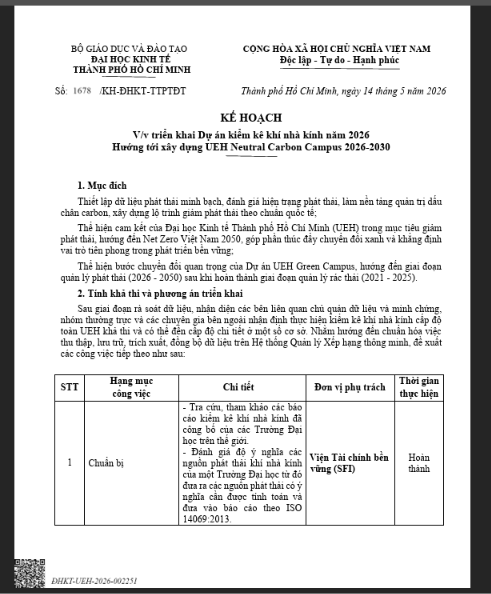
Figure: Implementation Plan for the Greenhouse Gas Inventory Project, No. 1678/KH-DHKT-TTPTDT.
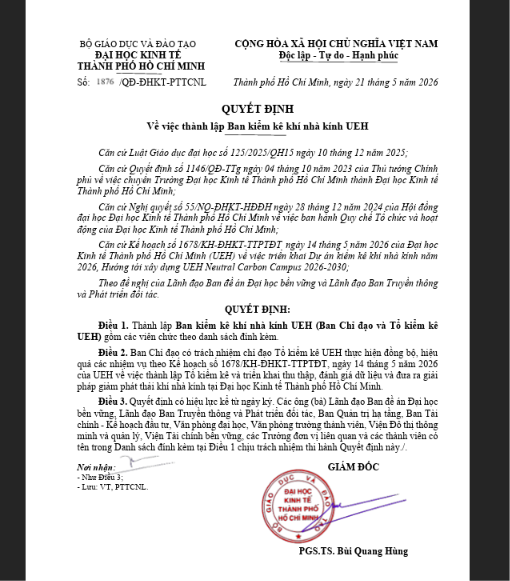
Figure: Decision No. 1876/QD-DHKT-PTTCNL establishing the UEH Greenhouse Gas Inventory Committee.
Accordingly, 2025 served as the baseline data and methodological preparation phase, laying the foundation for UEH to transition progressively from activity-specific environmental management to systematic carbon governance. This was an important preparatory step for UEH Neutral Carbon Campus 2026–2030, supporting the ambition to reduce Scope 1 and Scope 2 emissions, expand Scope 3 management and achieve comprehensive carbon neutrality by 2050.
- Greenhouse Gas Emissions Measurement and Inventory Methodology
UEH intends to develop its greenhouse gas inventory system using an integrated approach: applying the GHG Protocol to define boundaries and classify emissions under Scopes 1, 2 and 3, with calculations guided by the IPCC and TCVN ISO 14064-1:2025 to standardise organisational-level management, quantification and reporting.
The inventory methodology is based on identifying emission sources, collecting activity data, selecting the corresponding emission factors, quantifying GHG emissions and expressing the results in CO₂e. For each source category, data and emission factors must be selected according to the type of activity, reporting period and available information.
3.1. Defining Inventory Boundaries and Emission Sources
A university-level inventory requires clearly defined organisational and operational boundaries, covering teaching and research campuses, offices, student residences and activities under UEH’s operational control.
| Scope | Identified emission sources | Data required for the inventory |
| Scope 1 – Direct emissions | UEH-operated fuel-powered vehicles and equipment; generators; refrigerant leakage; and other direct sources within the inventory boundary | Fuel consumption; vehicle and equipment information; refrigerant types and quantities |
| Scope 2 – Indirect emissions from purchased energy | Grid electricity purchased for teaching, research, operations and everyday activities across university facilities | Electricity meter readings, utility bills, purchased electricity volumes and grid emission factors |
| Scope 3 – Other indirect emissions | Commuting by students, faculty and staff; business travel; procurement of goods and services; waste management, water supply and wastewater; and other relevant activities | Travel surveys, procurement records, waste data, treatment contracts, water consumption records and related activity data |
Scope 3 sources are identified and prioritised based on materiality, data availability and relevance to university operations. Measurement coverage will continue to expand and improve during subsequent inventory cycles.
3.2. IPCC-Based Emissions Calculation Method
The quantitative emissions calculation methodology is based on combining activity data (Activity Data – AD) with the corresponding emission factor (Emission Factor – EF) for each source, following IPCC guidance.
General formula:
Greenhouse gas emissions = Activity data × Emission factor
When individual greenhouse gases are calculated separately, results are converted to CO₂ equivalents using the appropriate global warming potential (Global Warming Potential – GWP) values for the methodology and reporting period. Where an emission factor is already expressed in CO₂e units, no second GWP conversion is applied.
For fuel combustion sources, activity data are determined from the quantity of petrol, diesel or other fuels consumed; where necessary, fuel quantities are converted into energy units to apply the appropriate emission factors. For purchased electricity, consumption is multiplied by the grid emission factor for the reporting period. For cooling systems, refrigerant leakage emissions are estimated using refrigerant types, refill records or other appropriate methods. Waste and wastewater emissions are quantified based on quantities, waste characteristics, treatment processes and relevant parameters.
Priority is given to emission factors officially published or otherwise appropriate for Vietnam. Where source-specific information is unavailable, reference factors from the IPCC may be used, with assumptions, factor sources and methodological limitations documented.
3.3. Inventory Workflow and Data Quality Assurance
UEH’s 2026 Greenhouse Gas Inventory Plan defines successive technical tasks, from identifying emission sources to finalising reports and managing the resulting data:
| Stage | Implementation activities |
| 1. Identify and list emission sources | Identify significant emission sources and define inventory scope and boundaries |
| 2. Collect activity data | Collect data for Scopes 1, 2 and 3; conduct surveys where directly documented data are unavailable |
| 3. Review and standardise | Verify data, identify information gaps and determine how incomplete records will be handled |
| 4. Calculate emissions | Select emission factors, quantify emissions by source and aggregate the results across UEH |
| 5. Assess uncertainty | Evaluate the influence of activity data quality, collection methods and emission factors |
| 6. Conduct quality control | Cross-check bills, supporting records, inventory boundaries, assumptions and calculations |
| 7. Finalise the inventory report | Prepare the inventory report in accordance with ISO 14064-1:2018, corresponding to TCVN ISO 14064-1:2025 |
| 8. Manage and use data | Store, retrieve and integrate data into UEH’s Smart Rankings Management System |
Implementation is organised through interdepartmental coordination, with the Institute of Sustainable Finance providing technical expertise on GHG inventories, while units responsible for infrastructure, finance, administration and related operations collaborate in supplying, validating and managing the data needed for emissions assessment.
Implementing inventories through a consistent process will support the gradual development of UEH’s emissions measurement, reporting and data quality-control system, enabling assessment of progress against emissions reduction commitments at each stage.
4. Roadmap Towards a Carbon-Neutral University
Based on its Green Campus strategy and Net Zero 2050 vision, UEH has developed a phased carbon management roadmap combining enhanced measurement systems, technological innovation, resource efficiency and broader emissions reduction efforts across the university.
| Phase | Implementation priorities | Objective |
| 2021–2023 | Establish the UEH Green Campus foundation and undertake initial research and emissions inventory activities | Identify emission sources and the emissions profile |
| 2024–2025 | Implement emission-reduction practices, undertake research and prepare the foundations for carbon management data | Strengthen the basis for a university-wide inventory plan |
| 2026–2030 | Standardise inventories, develop carbon management mechanisms, expand renewable energy use, improve building efficiency and promote green transport | Work towards Scope 1 and Scope 2 carbon neutrality under the published roadmap |
| 2030–2040 | Expand Scope 3 management and other indirect emissions across the value chain | Increase inventory coverage and reduce indirect emissions |
| 2040–2050 | Further develop mitigation measures and manage residual emissions | Work towards comprehensive Net Zero by 2050 |
Developing UEH Neutral Carbon Campus 2026–2030 is a key implementation step in this roadmap. Rather than focusing solely on individual actions such as saving electricity, using solar power or reducing waste, UEH aims to link these measures to an inventory system and quantitative data, enabling assessment of each measure’s contribution towards university-wide emissions reduction goals.
Conclusion
UEH has publicly declared its ambition to become a carbon-neutral university by 2050, with an emissions management roadmap covering all three scopes of the GHG Protocol. Building on its initial inventory work and Green Campus policies, UEH continued developing its data foundation, measurement methodologies and interdepartmental coordination mechanisms during 2025–2026, towards the implementation of UEH Neutral Carbon Campus 2026–2030.
Combining IPCC-based inventory methodologies, GHG Protocol emissions classification and reporting standardisation under TCVN ISO 14064-1:2025 provides a technical foundation for monitoring, evaluating and advancing UEH’s emissions reduction roadmap. Through these efforts, the university aims progressively to fulfil its commitment to reducing climate impacts and move towards a carbon-neutral university model grounded in sustainable governance and long-term environmental responsibility.