

13.3.4. Early Warning or Monitoring of Climate Change Disaster Risks
In 2025, the University of Economics Ho Chi Minh City (UEH) collaborated with local authorities and specialized agencies to research, analyze, and exchange information on climate change-related disaster risks, focusing on flooding, saltwater intrusion, erosion, and changes in coastal environments.
Through technical presentations, a national-level research project, and the proposal for a National Ocean Technology Research Center commissioned by the Khanh Hoa Provincial People’s Committee, UEH contributed scientific evidence to hazard identification, climate impact assessment, and the development of local risk-monitoring capabilities. Activities conducted with government authorities and departments in the Mekong Delta and Khanh Hoa supported access to scientific information for disaster risk management and prevention.
The following representative activities demonstrate how academic expertise was connected with social responsibility and practical collaboration with local authorities.
| Activity | Beneficiaries | Key Content and Contributions | Outcomes, Figures, and Verifiable Sources |
| GS4Infra Project – Research on Climate Risk Information and Support for Disaster-Prevention Infrastructure Management in Cu Lao Dung (2024–2025) | Agricultural agencies, Cu Lao Dung District officials, local authorities, and residents of An Thanh Dong and An Thanh Nam communes. | The GS4Infra project (June 2024–May 2025) examined the impacts of climate change on irrigation infrastructure, disaster prevention, and livelihoods in Cu Lao Dung. UEH worked with partners and local agencies to survey community needs and identify challenges in the design and management of flood-protection dikes, irrigation canals, and water-control sluices, particularly for women and vulnerable residents. Survey information and consultation findings provided an evidence base for risk assessment and recommendations on climate-resilient infrastructure management.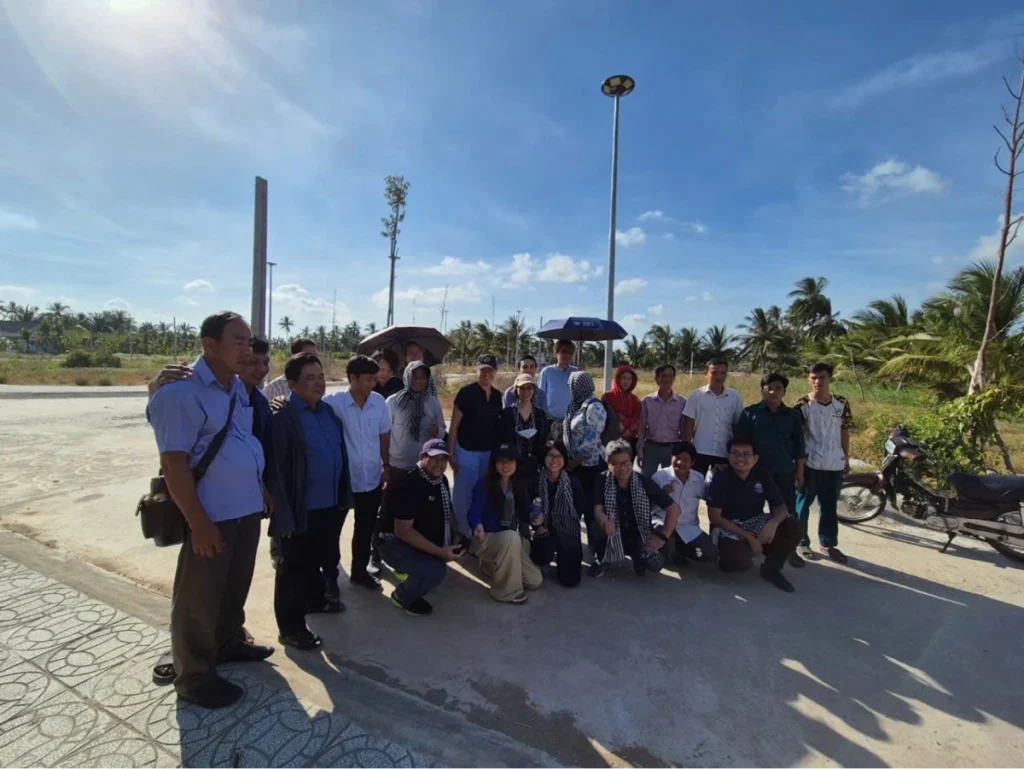 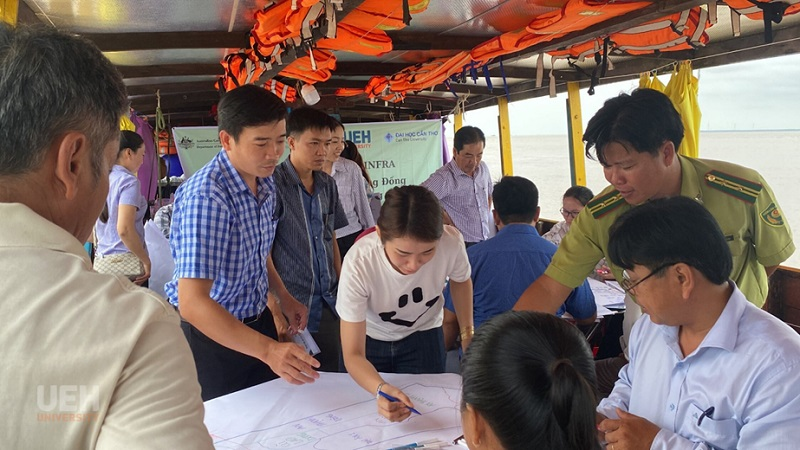 Images: Researchers and representatives of local government agencies. |
The GS4Infra project (June 2024–May 2025) examined the impacts of climate change on irrigation infrastructure, disaster prevention, and livelihoods in Cu Lao Dung. UEH worked with partners and local agencies to survey community needs and identify challenges in the design and management of flood-protection dikes, irrigation canals, and water-control sluices, particularly for women and vulnerable residents. Survey information and consultation findings provided an evidence base for risk assessment and recommendations on climate-resilient infrastructure management. Source:[GS4Infra Research Project] Community Capacity-Building Workshop in Cu Lao Dung District, Soc Trang (UEH Portal, 2 January 2025). – UEH Portal, Introduction to the GS4Infra Research Project: https://ueh.edu.vn/khoa-hoc/ueh-gioi-thieu-du-an-nghien-cuu-long-ghep-gioi-vao-cac-cong-trinh-thuy-loi-va-phong-chong-thien-tai-trong-boi-canh-bien-doi-khi-hau-tai-huyen-cu-lao-dung-soc-trang-gs4infra-72582 |
| 2. Proposal for a National Ocean Technology Research Center Commissioned by the Khanh Hoa Provincial People’s Committee and the Organization of the Ocean Futures 2025 Conference on Coastal Urban Planning and Resilience. | Khanh Hoa Provincial People’s Committee, Department of Science and Technology, marine and environmental management agencies, research bodies, and natural resource authorities in the South Central Coast region. | In 2025, under a research assignment commissioned by the Khanh Hoa Provincial People’s Committee, UEH, through the Institute of Smart City and Management (ISCM), developed a proposal for a National Ocean Technology Research Center. The proposal identified seven priority technology areas, including ocean monitoring and observation, data management and analytics, and marine environmental modeling. These technologies were proposed to enhance the capacity to track environmental changes, support research into climate hazards, and improve marine resource management.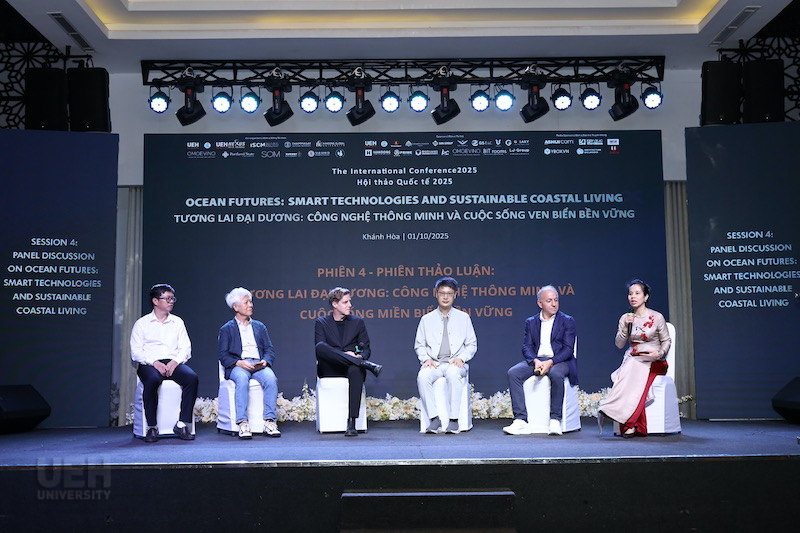 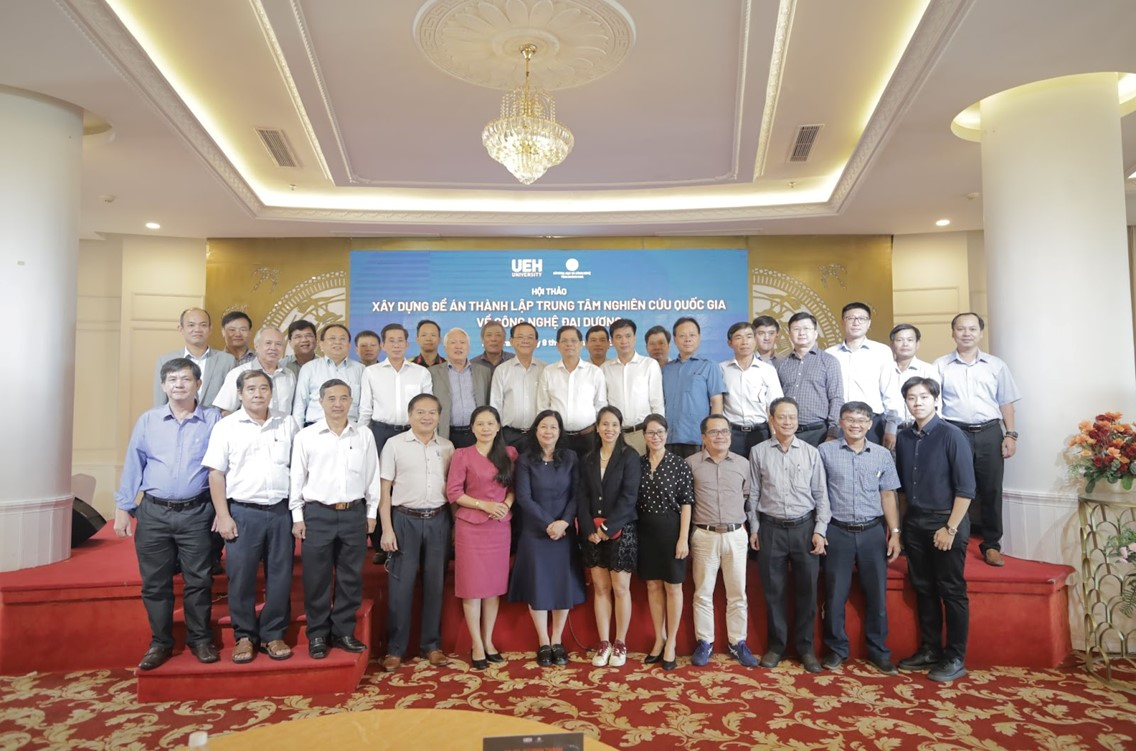 Images: The conference and UEH’s working visit to the Khanh Hoa Provincial People’s Committee. |
In 2025, UEH publicly presented the proposal’s research content and technological priorities and shared its findings at the international Ocean Futures 2025 Conference in Khanh Hoa. The proposal was a research output addressing a provincial government assignment, providing scientific and technical directions for developing ocean observation and environmental risk-analysis capacity. These results demonstrated UEH’s direct role in providing research directions and proposed technological capabilities to the Khanh Hoa provincial government. Source: Ocean Futures 2025 International Conference in Khanh Hoa: Smart Technology and Sustainable Coastal Living (UEH Portal, 2 October 2025). [Research Contribution] Establishing a National Ocean Technology Research Center: Building a Marine Technology Ecosystem for a Sustainable Future (UEH Future, 16 July 2025). |
| Sharing Information on Climate Impacts on Transport Infrastructure in the Mekong Delta (2025) | People’s Committees and relevant departments in Vinh Long, Can Tho, Dong Thap, and An Giang; planning, infrastructure management, and disaster prevention agencies. | As part of national-level research project KX.01.04/21-30, UEH collaborated with authorities and specialized departments in four localities to organize sessions presenting research on climate change impacts on transport infrastructure. In Vinh Long and Dong Thap, representatives of the Departments of Agriculture and Environment presented climate impact assessments for infrastructure, while other agencies provided planning and investment information. In Can Tho and An Giang, UEH and stakeholders discussed flooding, saltwater intrusion, erosion, and the need to strengthen infrastructure resilience. These activities linked local technical information with UEH’s research and analysis to support hazard identification and the development of climate risk management approaches. | In 2025, the series provided forums for direct exchanges of technical presentations and research findings between UEH and the authorities of four localities. Discussions contributed scientific evidence for impact assessment and the selection of climate-adaptation measures in transport infrastructure development. No evidence confirmed that an early-warning system or continuously monitored dataset supplied by UEH had been put into operation. |
| 3. UEH–Vinh Long Provincial People’s Committee Scientific Workshop on Climate-Resilient Transport Infrastructure (8 September 2025) | Vinh Long Provincial People’s Committee; Departments of Construction, Finance, and Agriculture and Environment; infrastructure management agencies; and local communities. | UEH worked with the Vinh Long Provincial People’s Committee to convene a forum for sharing information on climate change impacts on local transport systems. Specialized departments presented current infrastructure plans, investment resources, and adaptation measures, including an assessment of climate impacts on infrastructure. UEH connected research with scientific review, supporting the identification of challenges and the development of policy directions for climate-resilient infrastructure. 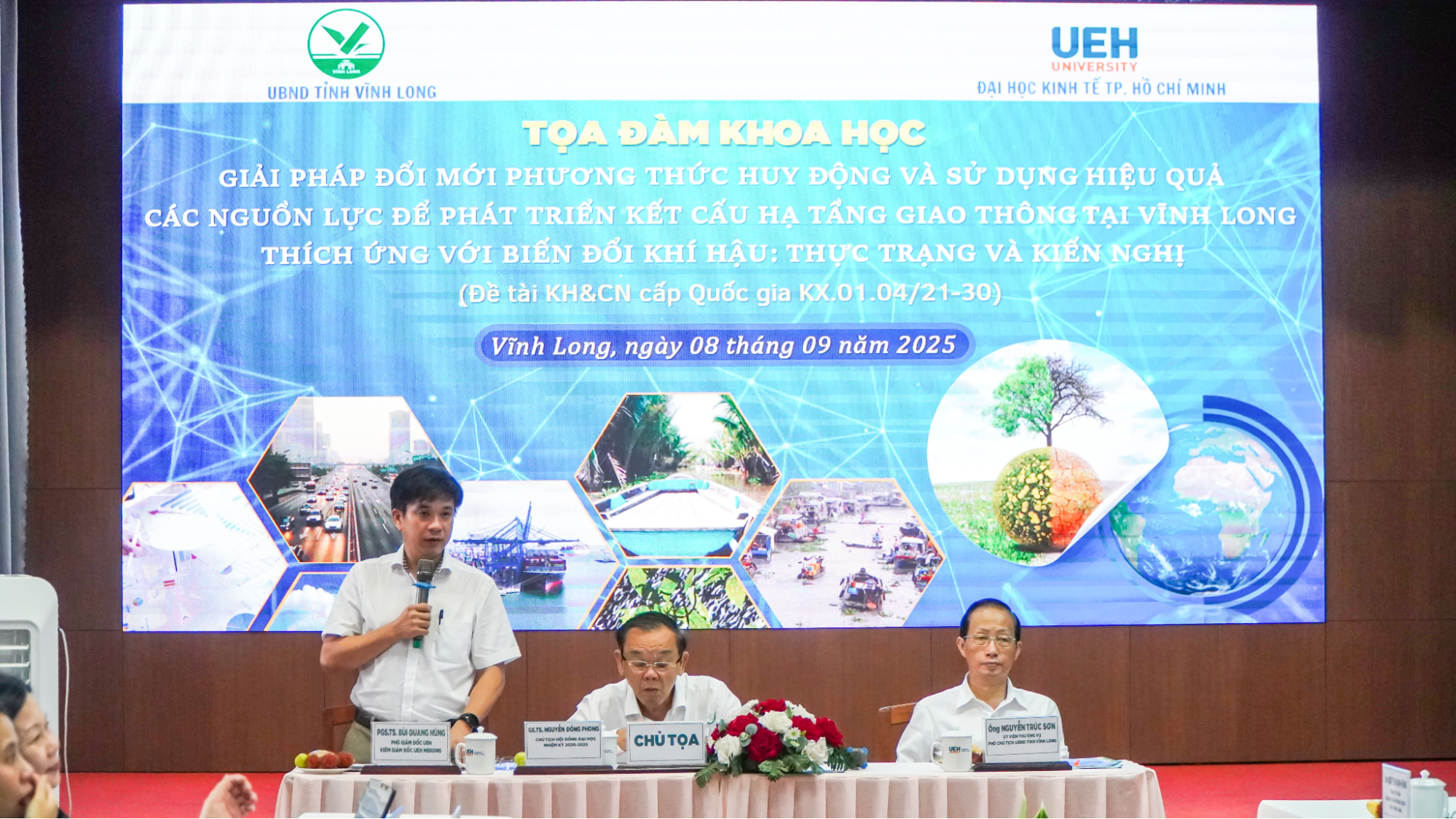 Figure: The chairing panel leading the discussion. |
One provincial-level workshop jointly chaired by provincial government and UEH leaders, featuring three groups of technical presentations from specialized departments under project KX.01.04/21-30. Source:Scientific Workshop on Mobilizing and Efficiently Using Resources for Climate-Resilient Transport Infrastructure Development in Vinh Long, held at UEH Mekong (UEH Mekong Portal, 11 September 2025). |
| 4. UEH–Can Tho Department of Science and Technology Workshop on Climate-Resilient Infrastructure (9 September 2025) | Can Tho Department of Science and Technology; Departments of Construction and Finance; policymakers, businesses, and infrastructure development organizations. | UEH collaborated with the Can Tho Department of Science and Technology to organize a scientific exchange between researchers and government agencies on innovation and climate change adaptation. The sessions provided information on planning directions, resource mobilization, and sustainable local transport infrastructure. Through interdisciplinary dialogue, UEH supported government access to research evidence for assessing and responding to climate-related infrastructure challenges. 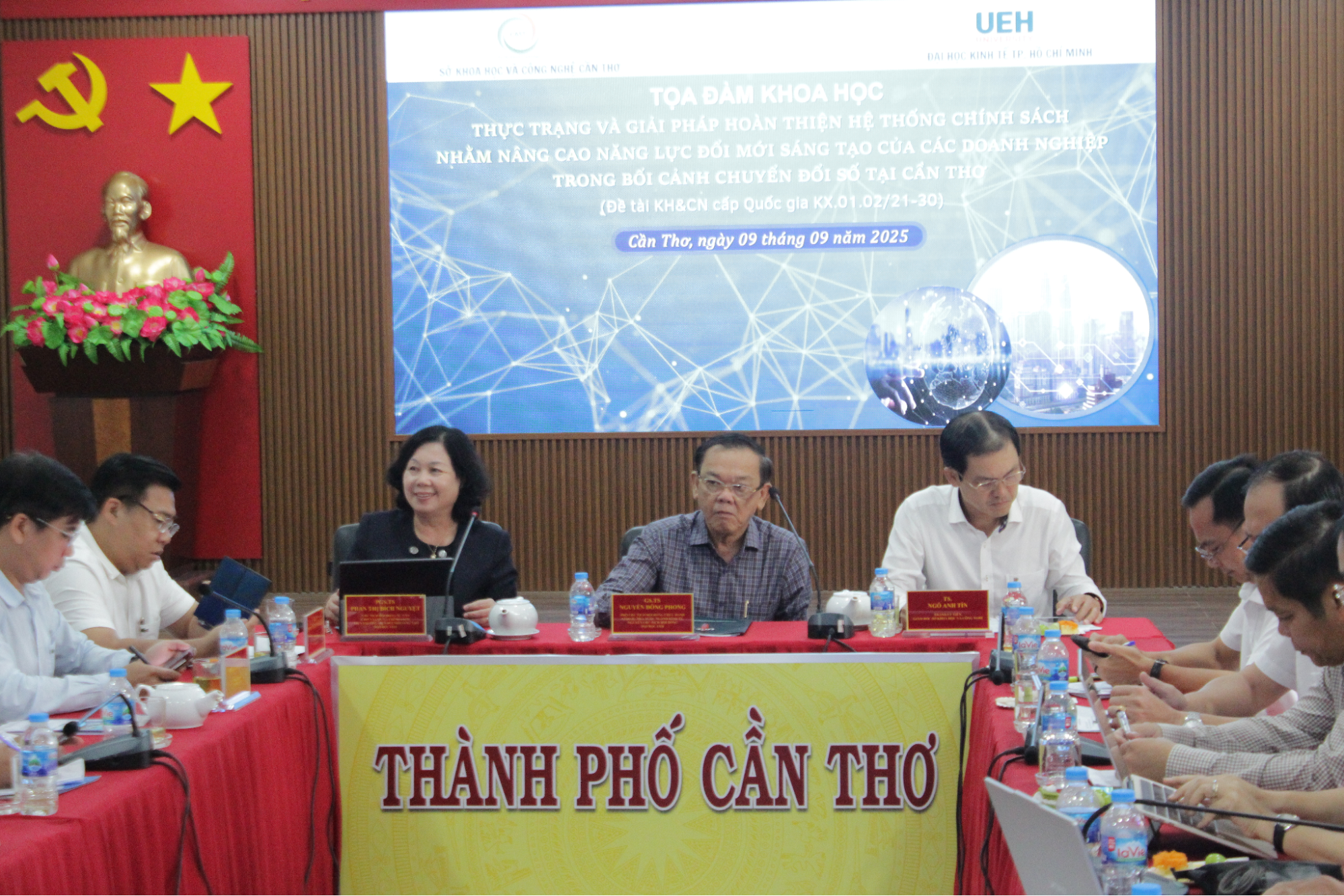 Figure: The chairing panel presiding over the presentation session. |
One workshop with two main thematic sessions, attended by leaders of the Department of Science and Technology and representatives of the Departments of Construction and Finance; held within the framework of two national-level research projects. Source: Scientific Workshop in Can Tho: Innovation and Climate-Resilient Transport Infrastructure Development (UEH Portal, 12 September 2025). |
| 5. UEH–Dong Thap Department of Construction Workshop on Climate-Resilient Transport Infrastructure (9 October 2025) | Dong Thap Departments of Construction, Agriculture and Environment, and Finance; local planning and infrastructure management agencies. | UEH collaborated with the Dong Thap Department of Construction to share and discuss scientific information on the impacts of climate change on transport infrastructure. A presentation by the Department of Agriculture and Environment assessed climate impacts and proposed measures to strengthen infrastructure adaptability. The forum connected research knowledge with local government needs, contributing evidence for directions toward safe and sustainable infrastructure development. 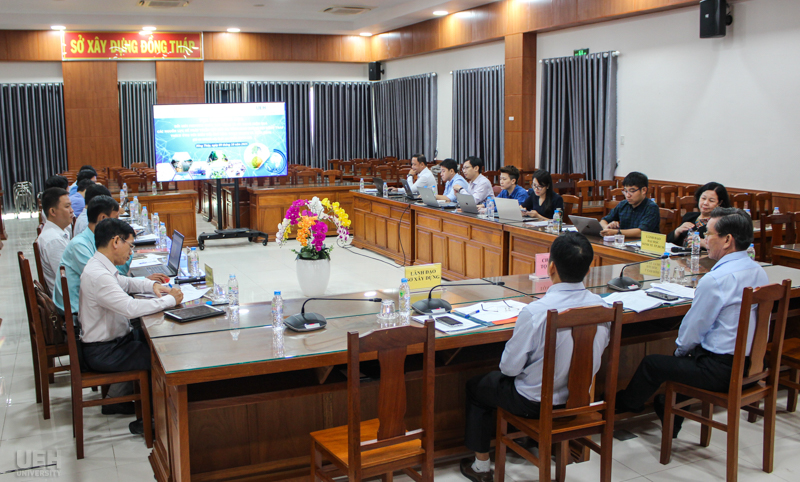 Figure: Overview of the scientific workshop. |
One provincial workshop with three groups of technical presentations covering infrastructure planning through 2030 and vision to 2045, finance, and climate change impacts. Source: Scientific Workshop in Dong Thap on Innovating Resource Mobilization and Efficient Resource Use for Climate-Resilient Transport Infrastructure Development (UEH Portal, 13 October 2025). |
| 6. UEH–An Giang Provincial People’s Committee Workshop on Climate-Resilient Infrastructure Development (18 October 2025) | An Giang Provincial People’s Committee; Departments of Construction and Finance; other specialized departments; and communities affected by climate change. | UEH worked with the An Giang Provincial People’s Committee to exchange information on climate change, erosion, saltwater intrusion, and challenges facing transport infrastructure. UEH experts analyzed barriers, financing needs, and possible approaches for developing climate-resilient infrastructure. The activity enabled direct research exchange and policy recommendations with provincial leaders, supporting local climate adaptation planning. 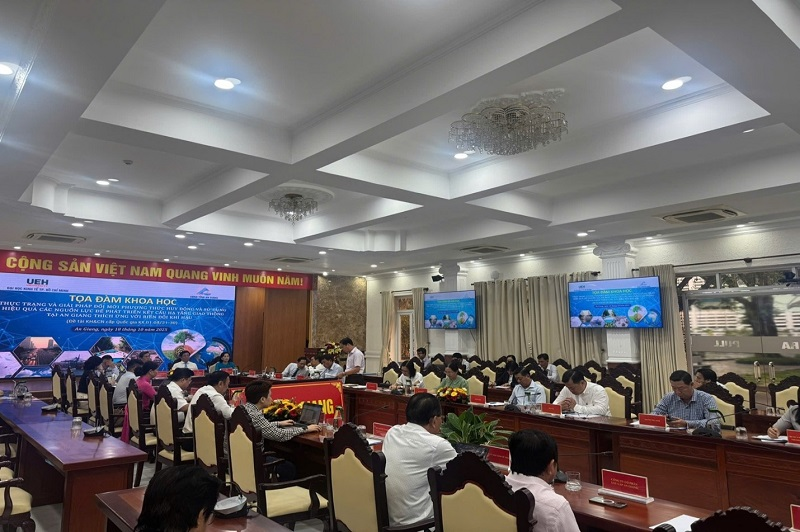 Figure: Overview of the workshop at the An Giang Provincial People’s Committee headquarters. |
One workshop co-chaired by the provincial People’s Committee Chairperson and UEH leadership, addressing three priorities: planning, resource mobilization, and climate impacts and adaptation scenarios. Provincial baseline figures included three expressways extending over 106 km and 5,421 km of inland waterways; these were not construction achievements by UEH. Source: UEH Supports An Giang in Finding Solutions for Sustainable, Climate-Resilient Transport Infrastructure (UEH Portal, 22 October 2025). |
| 7. UEH–NEU National Scientific Conference on Climate-Resilient Transport Infrastructure, Hanoi. | Representatives of central government agencies, ministries and departments, policy-making bodies, researchers, and infrastructure development management agencies. | UEH and the National Economics University (NEU) jointly organized a conference sharing international experience in climate change adaptation for transport systems. Presentations examined infrastructure development trends, financing approaches, public–private partnership frameworks, and green infrastructure practices. The discussions contributed research evidence and policy implications for government agencies at national and regional levels. 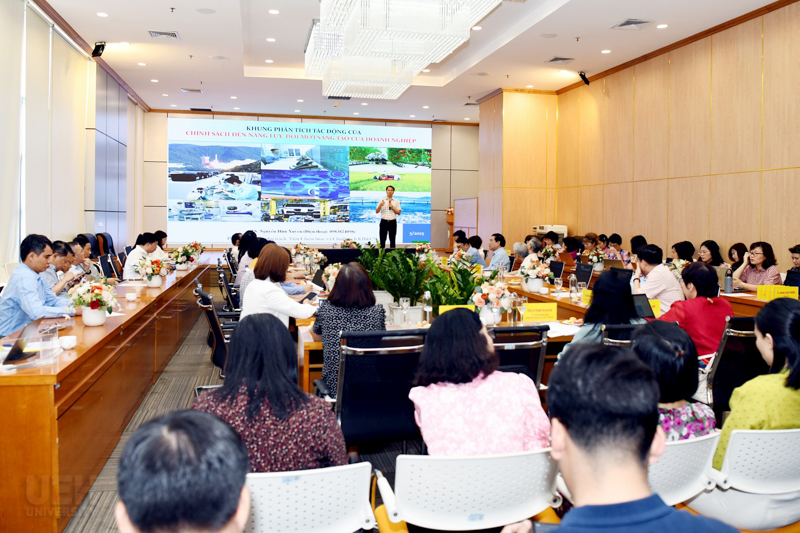 Figure: Overview of the conference. |
Two national scientific conferences held on the same day; the climate-resilient infrastructure theme received more than 30 papers. No evidence showed that the information had been used in a disaster early-warning or monitoring system. Source: UEH and NEU Co-organize Two National Scientific Conferences on Innovation and Climate-Resilient Transport Infrastructure Development (UEH Portal, 16 May 2025). |
| 8. UEH–NEU Conference Series on Climate-Resilient Transport Infrastructure in the Mekong Delta. | Regional authorities, representatives of ministries and agencies, researchers, and Mekong Delta infrastructure development organizations. | UEH and NEU organized a forum to share analyses of transport infrastructure conditions in the context of sea-level rise, saltwater intrusion, and climate change. Experts discussed resource mobilization and allocation, transport planning, logistics, and infrastructure adaptability. The activity contributed research information and policy recommendations for sustainable infrastructure governance at regional level. 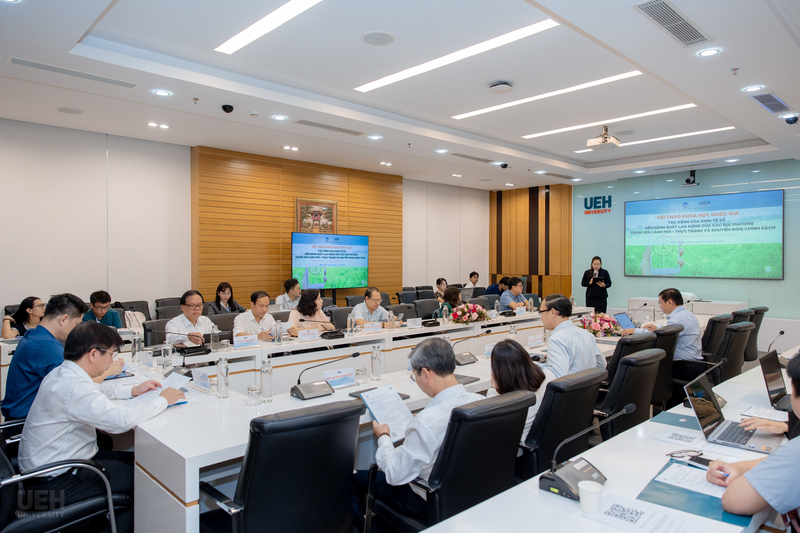 Figure: Overview of the conference. |
The conference series was associated with two national-level research projects and included two main discussion sessions. The infrastructure session presented and discussed research on the Mekong Delta. Source: UEH–NEU National Scientific Conference Series: Mekong Delta Transport Infrastructure Development and the Digital Economy in a New Context (UEH Portal, 6 December 2025). |
| 9. UEH and Ca Mau Provincial People’s Committee Sign Comprehensive Cooperation MOU for 2025–2030. | Ca Mau Provincial People’s Committee; specialized departments; and policy-making bodies for the marine economy, energy, and climate adaptation. | UEH and the Ca Mau Provincial People’s Committee established a research and policy advisory cooperation mechanism to address local development challenges under climate change. Priority areas identified in the agreement included the marine economy, clean energy, and climate adaptation. The parties planned to share expertise, mobilize specialists, and develop analytical reports, laying the groundwork for future support to local government in climate risk research and management. 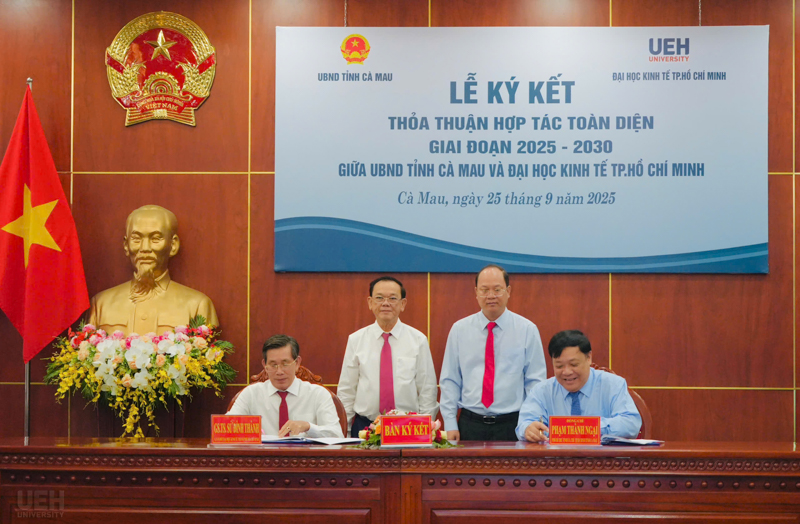 Figure: UEH and Ca Mau Provincial People’s Committee leaders signing the comprehensive cooperation MOU. |
One MOU for 2025–2030, covering five main areas of cooperation and signed by provincial and UEH leaders. No figures demonstrated that observation or early-warning activities had been implemented under the MOU in 2025. Source: Signing Ceremony for the Comprehensive Cooperation Agreement 2025–2030 between the University of Economics Ho Chi Minh City and Ca Mau Provincial People’s Committee (UEH Portal, 26 September 2025). |
| 10. UEH and Can Tho City People’s Committee Sign Strategic Cooperation MOU for 2025–2030 (26 November 2025) | Can Tho City People’s Committee; specialized departments; urban management, research, and local policy-making agencies. | UEH and the Can Tho City People’s Committee signed an agreement on research, policy advice, and smart urban development amid the green transition and climate change adaptation. The agreement envisaged data-informed analytical reports and policy proposals. It provided a framework for UEH to share expertise and support government research into climate impacts, but did not demonstrate that an early-warning system was operational.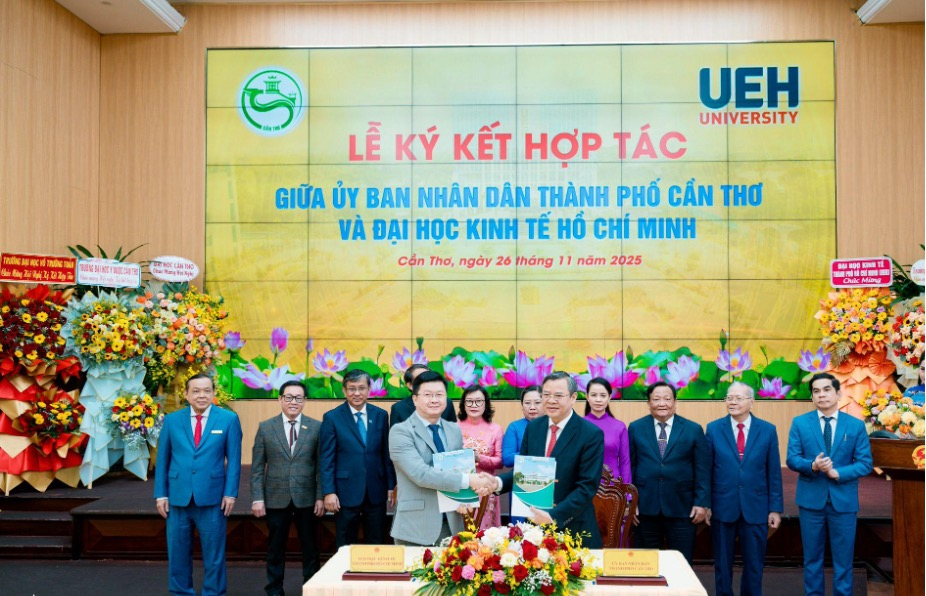 Figure: UEH and Can Tho City People’s Committee leaders signing the cooperation MOU. |
One 2025–2030 MOU covering five main areas of cooperation and signed by city and UEH leaders. Additional implementation records are needed to substantiate specific risk-monitoring or early-warning activities. Source: Signing Ceremony for the 2025–2030 Cooperation Agreement between UEH and Can Tho City People’s Committee: Expanding Strategic Cooperation for Sustainable Development in the Mekong Delta (UEH Portal, 27 November 2025). |
| 12. International Workshop on Climate-Adaptive Urban Park Design in Thanh Da Peninsula, Ho Chi Minh City (6–10 October 2025) | Students, lecturers, and urban design experts; the Thanh Da Peninsula community could indirectly benefit from the proposals. | UEH–ISCM and AVANS University of Applied Sciences organized field surveys and analyzed climate challenges on the Thanh Da Peninsula, including low elevation, flood risk, high tides, and land subsidence. Research groups shared field observations and developed climate-adaptive urban design proposals to improve flood resilience. The outputs provided knowledge potentially useful for local urban planning, but did not demonstrate that a risk report had been transferred to Ho Chi Minh City authorities. 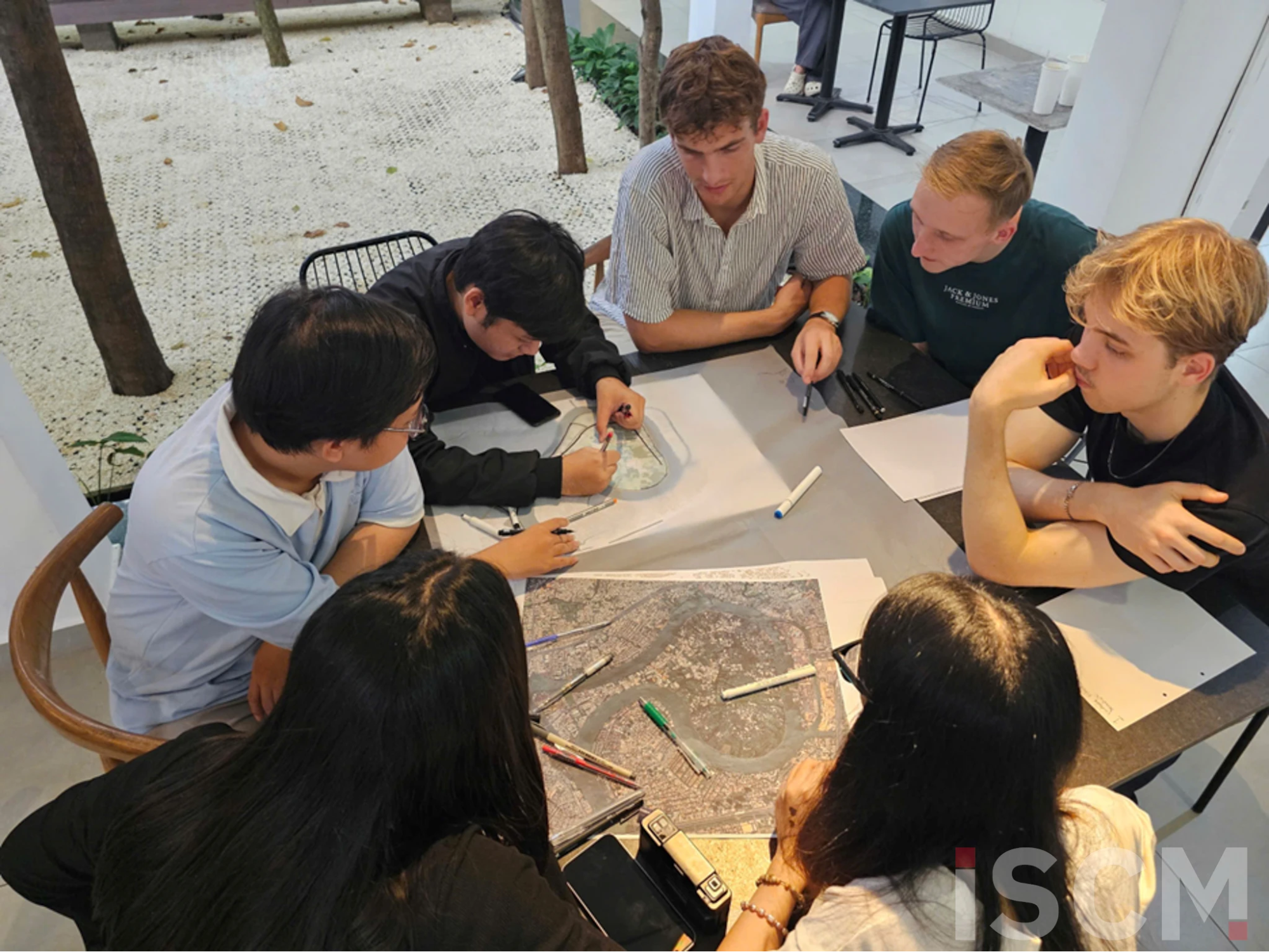 Figure: Vietnamese and Dutch students outlining urban design strategies for Thanh Da Peninsula, Ho Chi Minh City. |
Five days of workshops involving 56 students (20 international and 36 Vietnamese) and six lecturers, surveying an area of approximately 426.9 hectares, examining four urban design themes, and presenting maps and spatial design proposals. Source: International Workshop “Finding Thanh Da Peninsula Identity – An Urban Climate Adaptive Park” (ISCM–UEH, 20 October 2025). |
Conclusion
In 2025, UEH collaborated with government authorities and specialized agencies in Khanh Hoa and the Mekong Delta to conduct research, exchange technical reports, and provide scientific information on climate change-related disaster risks.
Key activities included the proposed National Ocean Technology Research Center, research on disaster-prevention infrastructure in Cu Lao Dung, and national-level project KX.01.04/21-30 on climate-resilient transport infrastructure.
These activities reflected UEH’s contribution to helping local authorities identify hazards, assess impacts, and develop approaches for monitoring and preventing climate risks. They provided a foundation for UEH to strengthen future support for local disaster monitoring and early warning, contributing to SDG 13 – Climate Action.