

13.2.2. Low-carbon Energy Use
As part of its development as a Multidisciplinary and Sustainable University, the University of Economics Ho Chi Minh City (UEH) has identified the transition to low-carbon energy sources as an important measure to reduce environmental impacts, improve resource efficiency, and move towards a carbon-neutral university model. By investing in and maintaining solar photovoltaic systems at its campuses, while monitoring energy consumption and developing green infrastructure, UEH has progressively integrated renewable energy into its actual operations. This provides an important foundation for sustaining renewable energy use, reducing reliance on grid electricity, and gradually implementing its greenhouse gas emission reduction pathway towards Net Zero by 2050.
1. Operating Solar Power Systems – UEH’s Primary Source of Low-carbon Energy
1.1. Maintaining Solar Power Operations at Campuses A, B and N
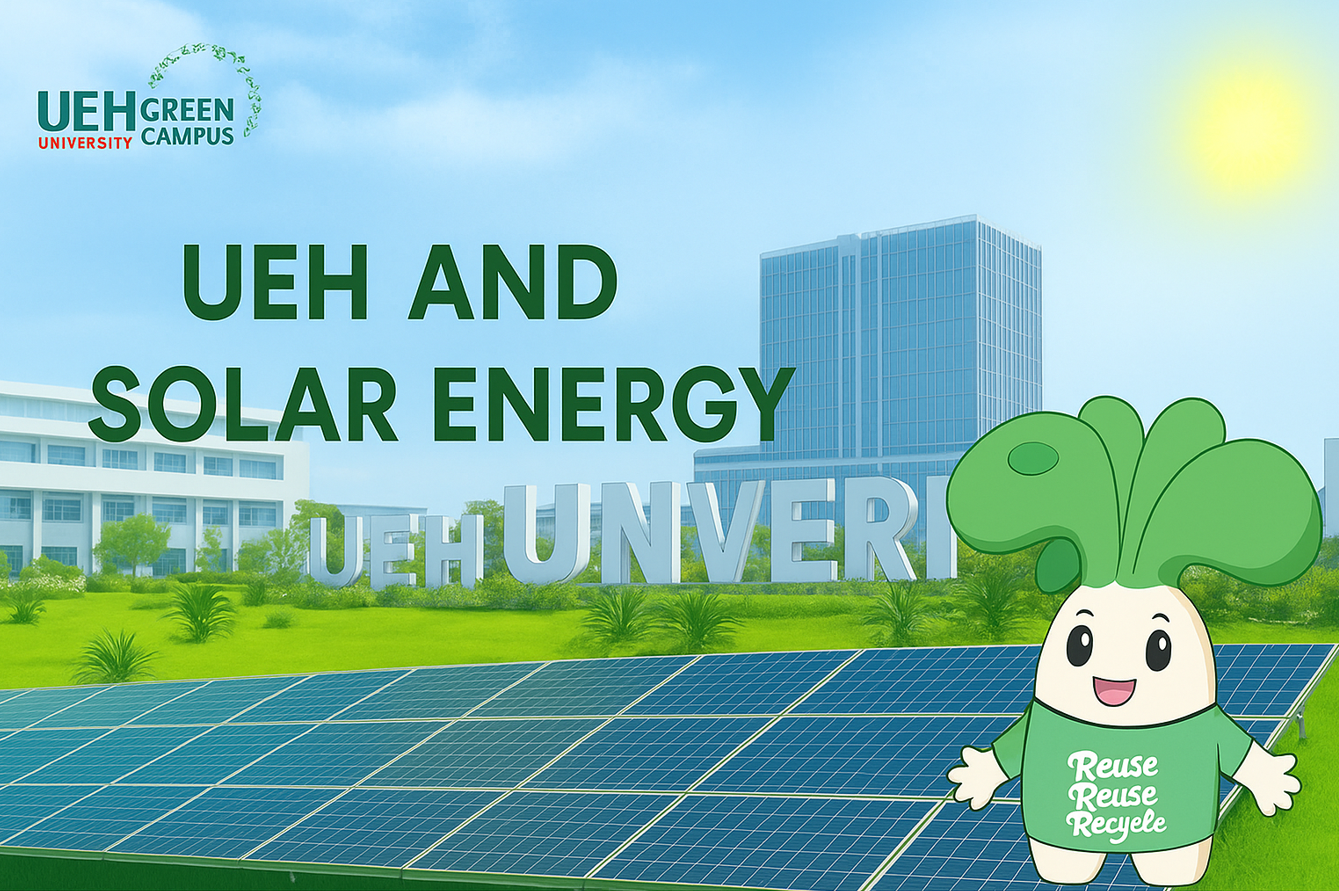
Since 2022, UEH has invested in installing solar photovoltaic systems at three main campuses: Campus A (59C Nguyen Dinh Chieu Street), Campus B (279 Nguyen Tri Phuong Street), and Campus N (Nguyen Van Linh). This is one of the University’s key investments in renewable energy infrastructure, designed to harness solar irradiation, supply clean electricity for campus operations, and reduce demand for electricity from the national grid.
The systems currently have a combined installed capacity of more than 509 kWp, comprising 528 solar panels installed on building rooftops, with a total installation area of 2,563.974 m². The panels are positioned at suitable rooftop locations across buildings A, B, N1 and N2 to capture sunlight, convert it into electricity, and meet electricity needs at these campuses.
Bringing the solar power systems into operation not only demonstrates UEH’s commitment to renewable energy development but also helps the University gradually diversify its energy supply. On-site generation contributes electricity for lighting, electrical equipment, and other loads supporting teaching, research, and administrative activities on campus.
Building on previous years’ achievements, UEH continued operating its solar power systems in 2025, while monitoring electricity generation and consumption data to assess the contribution of renewable energy to University operations.
Maintaining these systems is particularly significant to UEH’s long-term sustainable university strategy. Rather than implementing energy-saving measures in isolation, the University has progressively established on-campus low-carbon energy generation infrastructure, providing a basis for expanding green building models and smart energy management.
2. Results of Low-carbon Energy Use in 2025
In 2025, UEH continued compiling total energy consumption and energy from low-carbon sources across its campuses using operational data recorded and monitored periodically. This enabled the University to identify the contribution of renewable energy to overall energy use and develop a dataset to support energy management and the planning of emission reduction measures.
UEH reported its energy use in gigajoules (GJ), using two principal indicators:
| Indicator | 2025 Result |
| Total energy used | 109,633 GJ |
| Total energy used from low-carbon sources | 1,828 GJ |
In particular, the solar photovoltaic systems at Campuses A, B and N recorded generation of 508 MWh in 2025. This was the main renewable energy source directly used by UEH in its operations and provided the basis for determining the University’s low-carbon energy volume.
Solar electricity generation was monitored alongside energy consumption data at the campuses, enabling UEH to gradually evaluate system performance and the contribution of solar power to actual energy demand.
Compared with earlier periods, UEH continued developing its use of low-carbon energy with an emphasis on continuous measurement and monitoring. The solar power systems not only provide direct operational benefits but also generate real-world data for management, energy efficiency assessments, and the development of long-term emission reduction measures.
3. Contribution of Solar Power Systems to CO₂ Emission Reduction
In addition to supplying renewable energy, solar photovoltaic systems play an important role in limiting greenhouse gas emissions associated with electricity use at UEH. When solar electricity replaces electricity purchased from the national grid, the University can reduce indirect emissions associated with its electricity consumption.
Based on solar electricity generation of 508 MWhin 2025, avoided CO₂ emissions were estimated by multiplying the amount of solar electricity assumed to displace grid electricity by a reference Vietnam grid emission factor of 0.6592 tCO₂/MWh.
Calculation formula:
Avoided CO₂ emissions = Solar electricity replacing grid electricity × Grid emission factor
Calculation:
508 MWh × 0.6592 tCO₂/MWh = 334.8736 tCO₂
Accordingly, assuming that all solar electricity generated replaced grid electricity, UEH’s solar systems could have avoided approximately 334.87 tonnes of CO₂ in 2025.
This result is an estimate based on a reference emission factor and indicates the potential contribution of solar energy systems to UEH’s indirect emission reduction objectives. It also provides a basis for the University to continue assessing renewable energy system performance, exploring capacity expansion options, and optimising electricity use at its existing campuses.
4. Plans to Expand Low-carbon Energy in Green Buildings and Smart Buildings
In addition to harnessing solar power in existing buildings, UEH intends to expand the application of low-carbon energy in the planning, design, and development of new facilities. In particular, dormitory facilities at Nguyen Van Linh Campus and the UEH Nexus Campus Nha Trang project have been identified as potential locations for integrating advanced energy management solutions under Smart Building and green building approaches.
For dormitory facilities at Campus N (Nguyen Van Linh): UEH continued developing accommodation infrastructure associated with green living spaces, efficient energy use, and improved living conditions for students. Drawing on experience in operating existing solar power and smart building systems, the University plans to explore integrating low-carbon energy solutions, energy-efficient equipment, efficient lighting, and smart energy management as the dormitory infrastructure is developed.
For UEH Nexus Campus Nha Trang: Construction of the project commenced in 2025, with the aim of developing a green, smart, and sustainable campus for education, research, and community engagement. During development, UEH plans to apply green building design principles, take advantage of natural conditions, optimise daylight and ventilation, and explore the integration of low-carbon energy solutions and smart building management systems.
Integrating Smart Building and low-emission energy solutions into new educational infrastructure reflects a transition from using renewable energy at selected existing campuses towards incorporating sustainable energy management principles from the building development stage.
Facilities under construction and measures being explored for future implementation represent subsequent development plans and were not included in the low-carbon energy actually used in 2025.
5. The Value of Low-carbon Energy Use for Sustainable University Development
Maintaining and expanding low-carbon energy use at UEH offers not only operational benefits but also opportunities for teaching, research, and raising awareness of sustainable development.
Solar photovoltaic systems installed directly at teaching campuses allow the UEH community to engage with a practical example of renewable energy in use. Students and lecturers can thereby gain a deeper understanding of the role of clean energy, resource efficiency, and the relationship between energy consumption and greenhouse gas emissions.
Data on solar electricity generation and energy use also support research, operational efficiency assessments, and the development of green technology solutions. This provides a foundation for UEH to connect operational infrastructure more closely with learning, applied research, and sustainable development practices on campus.
Alongside maintaining its existing systems, UEH intends to integrate low-carbon energy and Smart Building solutions into new infrastructure projects, particularly at Nguyen Van Linh Campus and UEH Nexus Campus Nha Trang. These activities help strengthen the foundation of UEH’s Green Campus development, improve energy management, and progressively advance its pathway towards becoming a carbon-neutral university by 2050.