

11.4.1. Setting Targets for Sustainable Commuting Practices
In 2025, the University of Economics Ho Chi Minh City (UEH) continued to measure and promote sustainable commuting among students, lecturers and staff, aiming to reduce reliance on private vehicles and increase the use of public transport, walking, cycling, carpooling and low-emission transport.
Based on a 2024 travel behaviour survey of 4,000 students, lecturers and staff, UEH recorded a 57.5% share of sustainable commuting modes, while private transport accounted for 42.5%. Using this baseline, UEH announced a target to increase the sustainable commuting share to 65% by 2026 and reduce private vehicle use to no more than 35%, an improvement of 7.5 percentage points from 2024.
In 2025, UEH continued to monitor progress through Shuttle Bus operating data and a survey on willingness to switch transport modes. The UEH Shuttle Bus recorded 86,131 journeys, up 17.1% from 2024; the University allocated more than VND 1.1 billion in subsidies while maintaining a fare of VND 5,000 per trip. Meanwhile, a survey with more than 5,747 responses found that 66.2% of students were willing to use green transport and 26.5% would consider switching depending on price and vehicle type.
Alongside measurement, UEH continued to improve its on-campus transport management policy, extend Shuttle Bus connections to Metro Line 1 and implement programmes to change travel behaviour. Activities in 2025 demonstrate UEH’s combination of quantitative targets, monitoring data and practical measures to develop a more sustainable university transport system.
Sources:
- UEH Future – 11.4.1. Setting Targets for Sustainable Commuting Practices, 3 November 2025:
https://future.ueh.edu.vn/1141-dat-muc-tieu-cho-thuc-hanh-giao-thong-ben-vung/ - UEH Department of Student Affairs – UEH Encourages Sustainable Transportation: Expanding Shuttle Bus Services and Strengthening Public Transport Connectivity:
https://dsa.ueh.edu.vn/ueh-shuttle-bus/ueh-khuyen-khich-tham-gia-giao-thong-ben-vung-mo-rong-dich-vu-shuttle-bus-va-tang-cuong-ket-noi-giao-thong-cong-cong/ - UEH Portal – UI GreenMetric 2025:
https://www.ueh.edu.vn/ueh-mekong/cuoc-song-ueh-mekong/ueh-tang-hang-tren-bang-xep-hang-dai-hoc-xanh-ui-greenmetric-2025-top-896-the-gioi-va-top-5-viet-nam-75564
1. Green Campus Regulations and Sustainable Commuting Targets
1.1. Policy Encouraging Public Transportation
UEH implements the Green Campus Practice Regulations under Decision No. 2059/QĐ-ĐHKT-CSVC of 2022, applicable to UEH campuses and the Vinh Long Branch.
Under Article 2, Clause 1, UEH encourages staff, employees and students to use public transportation and the UEH Shuttle Bus when travelling to its campuses.
Article 5 also provides for encouraging public transport, using the UEH Shuttle Bus and increasing physical activity on campus.
These policies are integrated with the UEH Green Campus model to foster green commuting habits throughout the university community.
Source: UEH Green Campus – Green Campus Practice Regulations, Articles 2 and 11:
https://gogreen.ueh.edu.vn/quy-dinh-thuc-hanh-dai-hoc-xanh
1.2. Zero-Emission Vehicle Management and Monitoring of Transition Outcomes
UEH aims to develop a lower-emission campus transport system, encouraging public transportation and vehicles with zero tailpipe emissions, including bicycles, electric bicycles, electric motorcycles and electric cars.
Under Article 11 of the publicly available Green Campus Practice Regulations, the transport management policy covers encouraging zero-emission vehicles; developing bicycle and electric vehicle parking and charging infrastructure; prioritising spaces for pedestrians, bicycles and zero-emission vehicles; and assigning the Facilities Management Office, in coordination with the Youth Union and Student Association, to compile, monitor and report the share of zero-emission vehicle use in the annual Green Campus report.
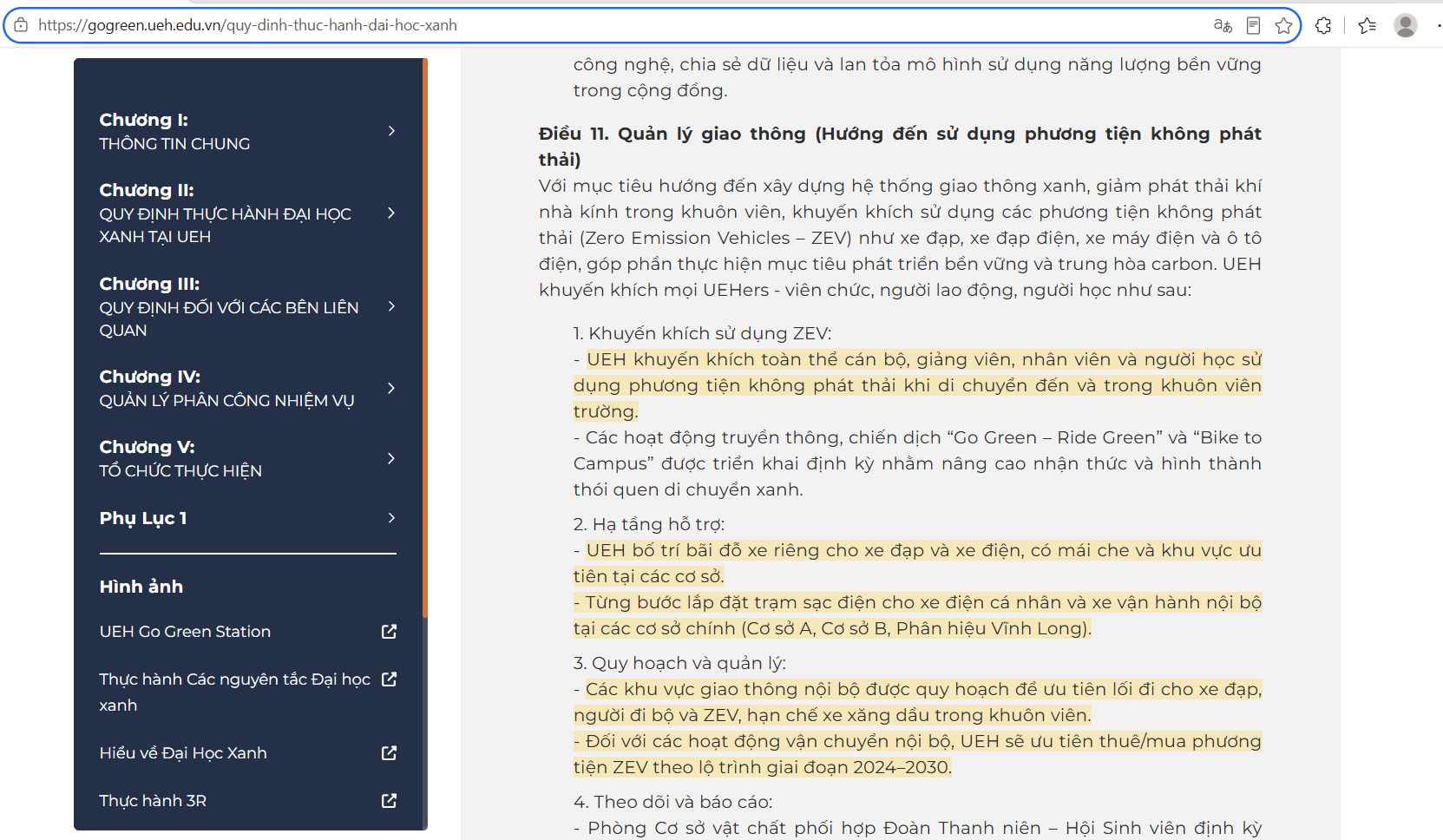
UEH sustainable transport management policy. Article 11 of the Green Campus Practice Regulations published on the UEH Green Campus website encourages zero-emission vehicles, annual monitoring of their usage share and a transition roadmap for internal transport.
The published roadmap has three phases: 2024–2026, focusing on infrastructure, communication and surveys of zero-emission vehicle use; 2027–2030, aiming to introduce zero-emission vehicles for internal transport; and after 2030, aspiring to achieve 100% zero-tailpipe-emission vehicles in UEH’s internal operations.
According to the 2025 UEH Green Campus Project Report, UEH continued developing and improving its campus transport management provisions, focusing on encouraging sustainable travel, supporting electric vehicle infrastructure and reducing dependence on fossil-fuel-powered vehicles. These activities support the implementation of modal-shift targets and the progressive standardisation of the University’s green transport monitoring system.
Sources:
- UEH Green Campus – Green Campus Practice Regulations, Articles 2 and 11:
https://gogreen.ueh.edu.vn/quy-dinh-thuc-hanh-dai-hoc-xanh - Internal document – UEH Green Campus Project Report 2025, section on updates to Green Campus Regulation criteria and campus transport management.
1.3. Modal Shift Targets
Based on a 2024 survey of 4,000 students, lecturers and staff, UEH established a baseline commuting mode distribution, enabling it to announce targets for increased sustainable travel and reduced reliance on private vehicles by 2026. The indicators, monitoring methods and implementation results for 2025 are summarised below.
Summary of Targets, Measurement Measures and Results
To track progress against sustainable commuting targets, UEH combines travel mode surveys with Shuttle Bus operating data and surveys of willingness to change transport modes. Table 1 summarises the indicators, measurement methods and results recorded through 2025.
Table 1. Sustainable Commuting Targets and Monitoring Results at UEH, 2024–2026
| Monitoring indicator | Baseline / target | Measurement method | 2025 results and progress |
| 1. Share of sustainable commuting modes | 2024: 57.5%. 2026 target: ≥65% (+7.5 percentage points) | Survey the commuting modes of students, lecturers and staff; classify them by transport type | Continued surveying willingness to switch; no verified actual sustainable commuting share for 2025 is available |
| 2. Share of private vehicle use | 2024: 42.5%. 2026 target: ≤35% (−7.5 percentage points) | Survey commuting modes and compare with the 2024 baseline | No actual 2025 figure is available to establish the reduction |
| 3. UEH Shuttle Bus usage | Annual monitoring since 2023 | Compile ridership from service operating records | 86,131 journeys, up 17.1% from 2024; indicating increased collective transport use |
| 4. Willingness to switch to green transport | Assess demand and willingness to switch in 2025 | Survey with more than 5,747 responses on vehicle types and conditions of use | 66.2% willing; 26.5% considering a switch depending on price and vehicle type; these figures represent intention rather than actual usage share |
| 5. Zero-emission vehicle (ZEV) share | Based on the annual monitoring and internal fleet transition roadmap | Record vehicle types, calculate usage shares and report under Article 11 of the Green Campus Regulations | Continued refining the management mechanism; no verified actual ZEV share for 2025 is available |
Monitoring results for 2025 indicate continued growth in UEH Shuttle Bus usage and substantial student interest in green transportation. However, these are supporting indicators and cannot substitute for an actual commuting mode share survey when assessing progress towards the 2026 targets.
2. Measurement of Implementation Results in 2025
2.1. Measuring Actual UEH Shuttle Bus Ridership
The UEH Shuttle Bus is a shared passenger transport service for students, staff and lecturers travelling between teaching campuses, dormitories and transit connections.
According to the Department of Student Affairs, service usage increased continuously from 2023 to 2025. Ridership in 2025 was 12,602 journeys higher than in 2024 and 27,963 higher than in 2023, an increase of approximately 48.1%.
| Year | Number of Shuttle Bus journeys | Change from previous year |
| 2023 | 58.168 | Baseline year |
| 2024 | 73.529 | +26,4% |
| 2025 | 86.131 | +17,1% |
In 2025, UEH allocated more than VND 1.1 billion to subsidise the Shuttle Bus, maintaining fares of VND 5,000 per trip to reduce students’ transport costs. These figures demonstrate that UEH monitors collective transport usage through actual operating data, while also documenting growing service uptake over time.
2.2. Survey of Willingness to Use Green Transport in 2025
In its UI GreenMetric 2025 results report, UEH reported a student survey with more than 5,747 responses. The survey found:
| Survey indicator | Result |
| Survey responses | More than 5,747 |
| Willing to use green vehicles | 66,2% |
| Considering a switch depending on price and vehicle type | 26,5% |
| Selections for electric motorcycles | 3.624 |
| Selections for electric buses | 2.571 |
| Selections for electric cars | 1.929 |
| Selections for UEH Shuttle Bus | 1.846 |
| Selections for electric bicycles | 678 |
The results help UEH identify levels of interest and acceptance, as well as the factors influencing decisions to switch transport modes.
3. Activities Promoting Sustainable Transportation in 2025
3.1. Expanding the UEH Shuttle Bus and Connecting to Metro Line 1
In 2025, UEH continued adjusting the Shuttle Bus service to meet travel demand between campuses. From 3 March 2025, the Department of Student Affairs announced four additional Shuttle Bus journeys, bringing the total to 24 per day, with 12 morning and 12 afternoon journeys. The changes responded to commuting needs and feedback from students and staff, demonstrating UEH’s ongoing use of service feedback to improve capacity.
On 3 August 2025, UEH announced the new academic year timetable, with routes connecting central Ho Chi Minh City, dormitories, Nguyen Van Linh Campus and the Ben Thanh Metro area. Integration between public transport services provides students with an option to combine the Metro and Shuttle Bus, reducing the need to use a private vehicle for the entire journey.
Source 1: UEH Department of Student Affairs – Notice of Additional Services and Updated UEH Shuttle Bus Routes, effective 3 March 2025.
https://dsa.ueh.edu.vn/tin-tuc/thong-bao-bo-sung-va-cap-nhat-lo-trinh-ueh-shuttle-bus/
Source 2: UEH Portal – UEH Shuttle Bus Accompanies UEHers in the New Academic Year, 3 August 2025.
https://ueh.edu.vn/cuoc-song-ueh/tin-tuc/ueh-shuttle-bus-dong-hanh-cung-uehers-trong-nam-hoc-moi-74545
Routes 1 and 3 connect directly to the Ben Thanh Metro area, Exit 4, allowing students to combine Metro and Shuttle Bus travel. UEH also added departures from Nguyen Tri Phuong at 08:30 and 14:30 to support travel between campuses, particularly for Physical Education courses. Connecting collective transport with the Metro expands commuting options without requiring a private vehicle for the entire journey.
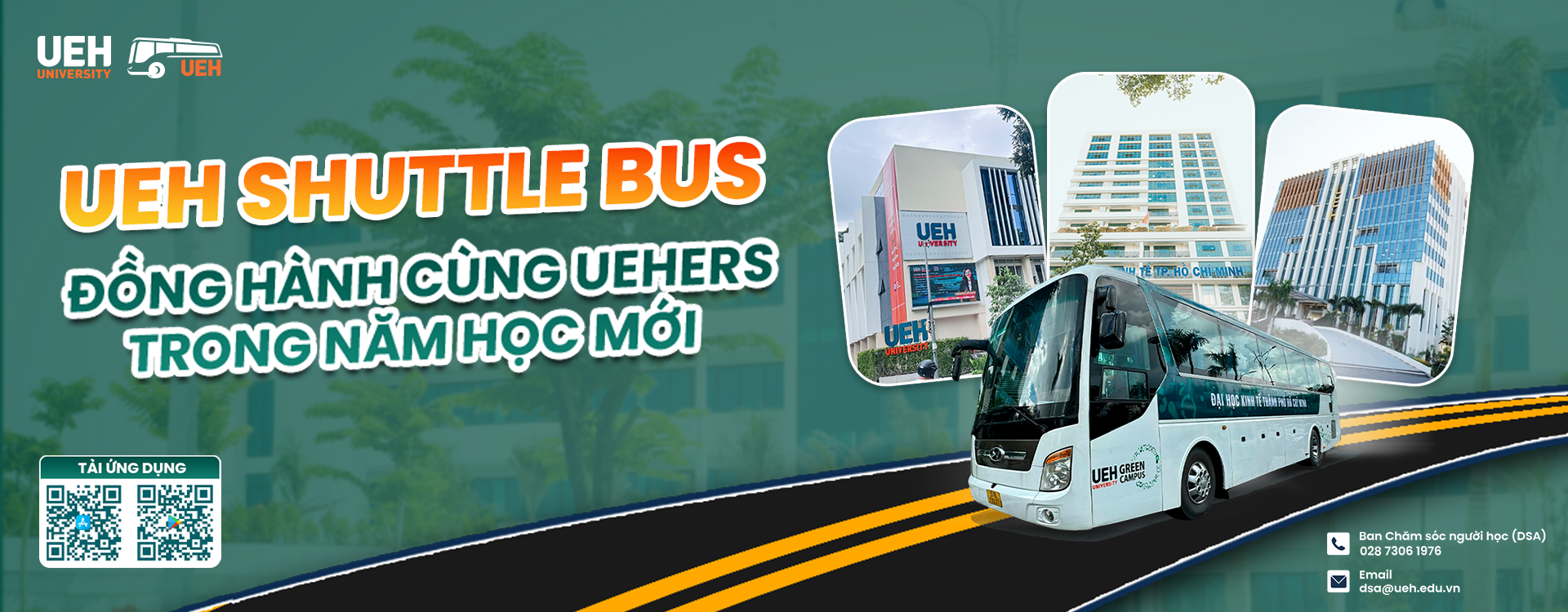
UEH Shuttle Bus updated its routes in 2025
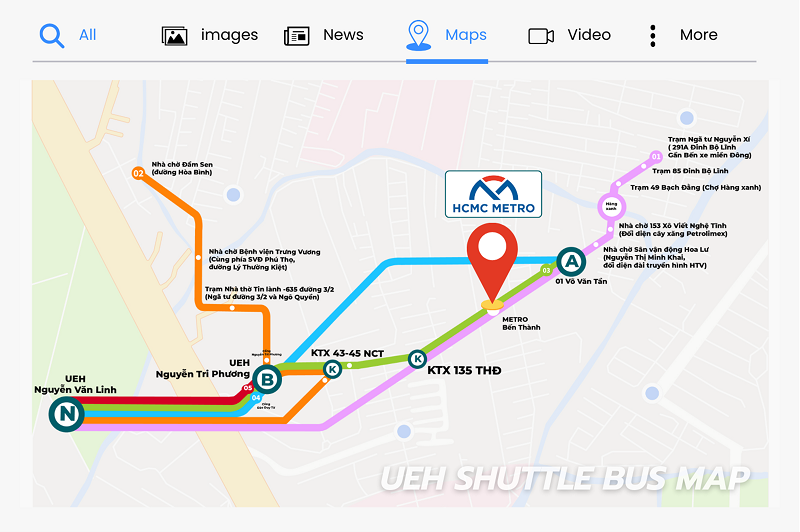
UEH Shuttle Bus added a stop with direct access to Metro Line 1
3.2. Green Pulse – Green Rhythm: Changing Commuting Behaviour
From 6 to 17 November 2025, the Student Association of the School of Accounting organised Green Pulse – Green Rhythm as part of UEH Green Campus. More than 700 students registered and nearly 600 committed to participate. The Green Your Mind communications series reached more than 10,000 views and 500 interactions. The programme illustrates how UEH translated behavioural change objectives into time-bound activities and specific participation commitments.
A key activity was a seven-day challenge to use green transportation modes, including:
- Walking
- Carpooling.
- Taking public buses or the UEH Shuttle Bus.
- Completing one day without petrol- or diesel-powered transport.
- Participating in activities and documenting experiences at UEH green infrastructure sites.
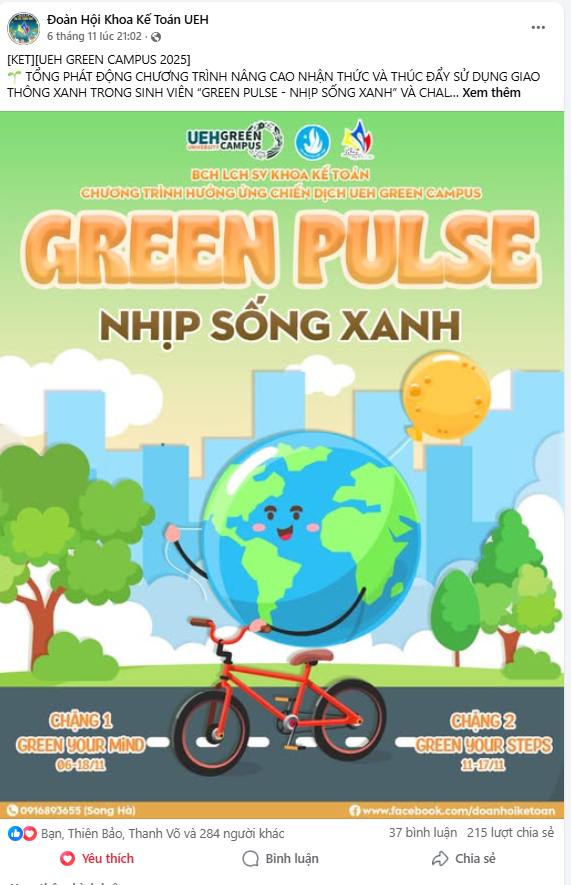
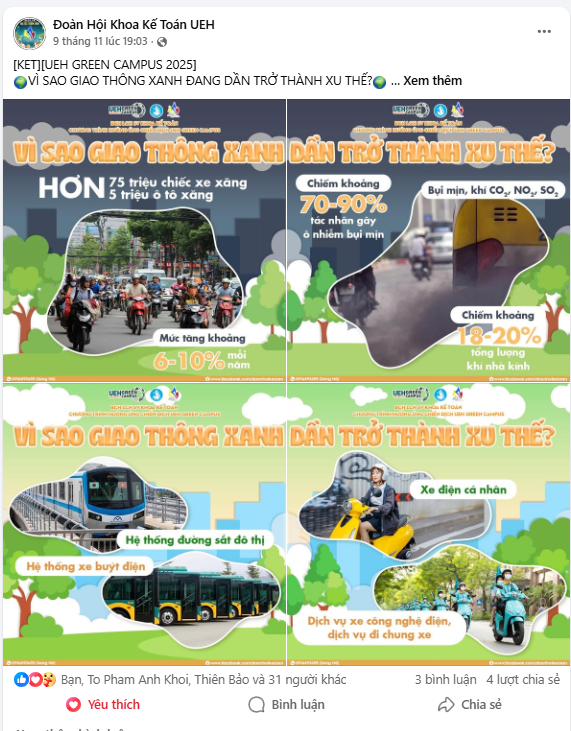
Green Pulse – Green Rhythm programme in 2025.
3.3. Go Green, Be Seen – Practising Sustainable Transport Choices
As part of UEH Green Campus 2025, the Youth Union and Student Association of the School of Business Information Technology organised “Go Green, Be Seen”, focusing on awareness and encouraging students to change how they choose transport.
A key component was the “Green Ride 5-Day Challenge”, complemented by interactive stations at the communications booth on Campus B. Through these activities, participants learned about, compared and assessed transport options, identified the limitations of relying on private motorcycles and were encouraged to prioritise more environmentally friendly commuting choices.
UEH Green Campus published a programme recap on 6 December 2025, showing students taking part directly in interactive stations and selecting suitable transport modes. This activity complements UEH’s sustainable transport targets through education and hands-on behavioural change practice.
Source: UEH Green Campus – A Look Back at “Go Green, Be Seen” – UEH Green Campus 2025 Activity Series, 6 December 2025.
https://gogreen.ueh.edu.vn/su-kien/nhin-lai-hanh-trinh-go-green-be-seen-chuoi-hoat-dong-ueh-green-campus-2025
3.4. Experiencing One Month Without Petrol
In an article published on 30 November 2025, a group of UEH students described a four-week experience of replacing petrol-powered motorcycles with alternatives such as buses, the Metro and walking. The account covered both benefits and challenges of changing commuting habits, including travel time, cost, convenience and access to public transport. This illustrates sustainable commuting practices at an individual level and supports UEH’s programmes promoting greener travel habits.
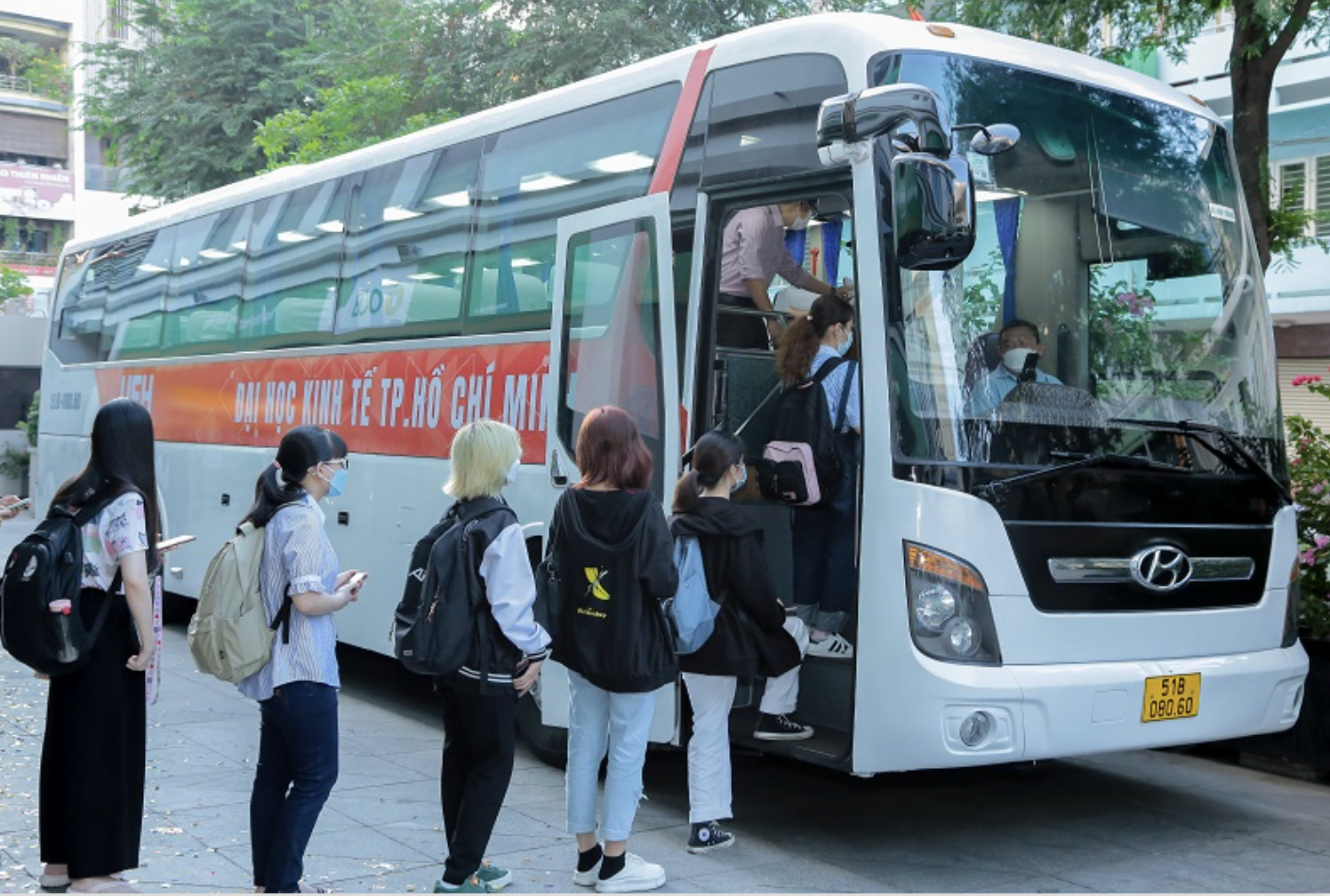
UEH students support the use of public transportation
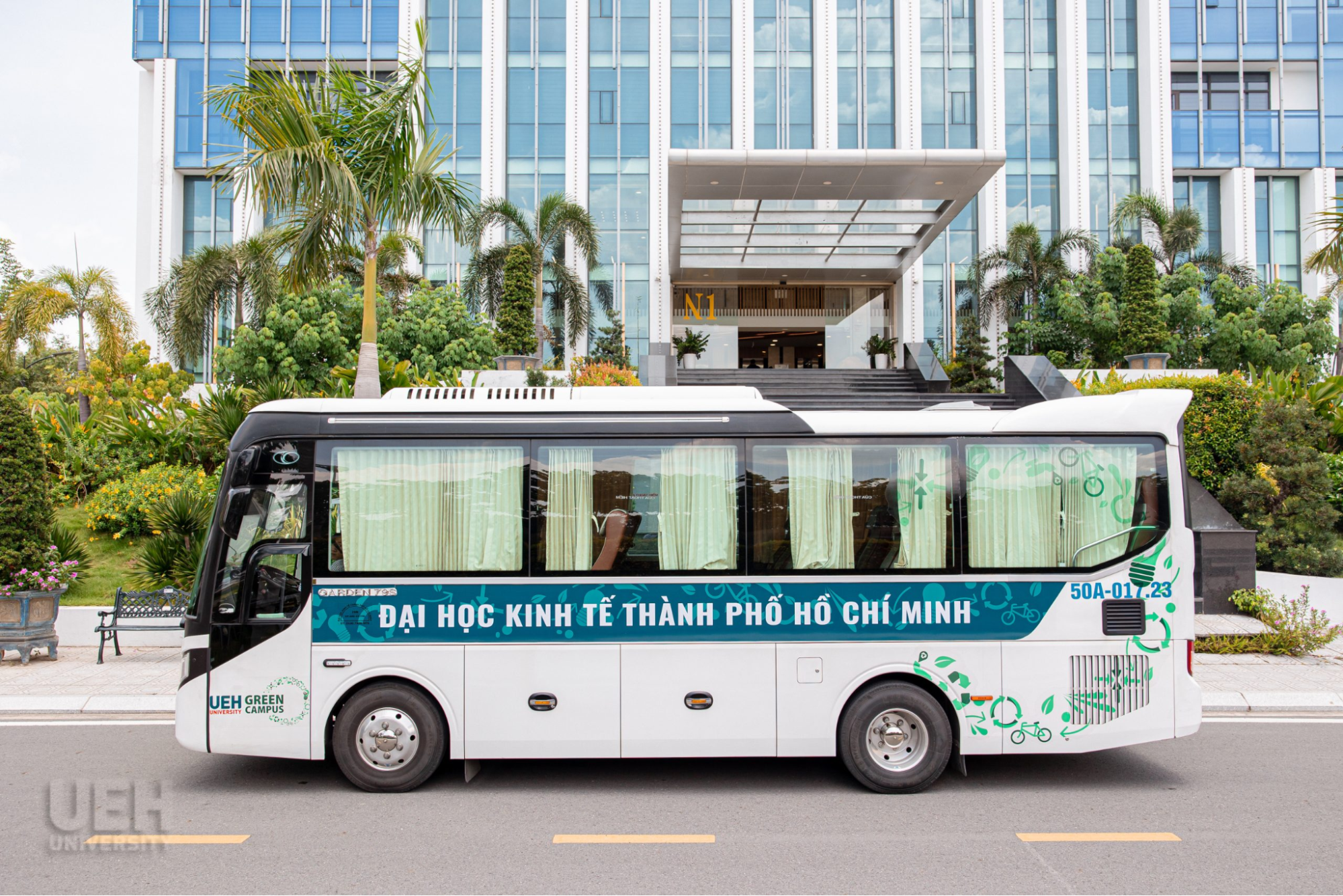
UEH Shuttle Bus – A travel companion for UEHers
3.5. UEH Green Campus Living Lab and Research Activities
The UEH Green Campus Living Lab 2025 continued integrating sustainability into teaching, research, operations and community engagement. In transportation, UEH encouraged increased use of shared transport, electric vehicles, walking and other lower-impact commuting modes.
UEH research on green transport transitions in Ho Chi Minh City also provides scientific evidence to inform urban transport development, assess barriers to modal shifts and propose implementation measures. These research activities support UEH’s sustainability ecosystem but do not replace actual measurements of commuting patterns among University students and staff.
4. Results and Future Directions for Sustainable Commuting Targets
In 2025, UEH continued measuring and promoting sustainable commuting through behavioural surveys, shared passenger transport operating statistics and adjustments to support travel between its campuses.
Using survey findings as a baseline to set 2026 targets, combined with annual Shuttle Bus monitoring and assessments of willingness to switch, demonstrates that UEH has begun establishing a data foundation for sustainable transport management. Operating results for 2025 show increased collective transport use and provide information for further refining methods to measure sustainable commuting shares across the University.
By combining quantitative targets, monitoring mechanisms and practical operating measures, UEH continues to promote sustainable commuting choices and contribute to SDG 11 – Sustainable Cities and Communities.