

11.4.9. Building on Brownfield Sites
Building on brownfield sites – Build on brownfield sites, where possible
The University of Economics Ho Chi Minh City (UEH) promotes sustainable infrastructure development by making use of, renovating, and repurposing previously developed campuses and buildings, thereby supporting efficient use of urban land and reducing the need for development on previously undeveloped natural land.
A notable initiative in 2025 was the redevelopment of Campus V at 232/6 Vo Thi Sau Street, Ho Chi Minh City, into the smART Hub – Living Labs space. The site has undergone several phases of development and use, and UEH selected it for conversion into a space for research, art, technology, and co-creation of sustainable urban solutions.
The project is supported by three categories of direct evidence: (1) the history of the campus and its existing buildings; (2) construction investment and contractor selection decisions issued in August–September 2025; and (3) academic and community activities held on the campus in September 2025. These outcomes demonstrate that UEH took concrete steps to redevelop an existing built site, consistent with the approach of building on previously used land.
1. Approach to Development on Previously Built Sites
UEH pursues infrastructure development that makes efficient use of existing land and buildings through renovation, infrastructure upgrades, and sustainable construction solutions. The Green Campus Regulations, particularly Articles 19 and 20, provide a foundation for improving building operations. For indicator 11.4.9, direct evidence is drawn from specific projects with documented land-use histories, construction activities, and redevelopment outcomes.
Source: UEH Green Campus – Green Campus Regulations, Articles 19 and 20.
https://gogreen.ueh.edu.vn/quy-dinh-thuc-hanh-dai-hoc-xanh
2. Redevelopment of Campus V into smART Hub – Living Labs
2.1. Site History and Basis for Identifying the Redevelopment Location
The smART Hub – Living Labs project is being developed at Campus V, 232/6 Vo Thi Sau Street, Ho Chi Minh City, on a site with existing buildings and a history of use preceding the project.
The campus has undergone several phases of use, from a site containing a French-style villa and spaces associated with the Fulbright Economics Teaching Program to activities undertaken by UEH units. This history demonstrates that the land is not a previously undeveloped natural site.
Using the existing campus as its foundation, UEH decided to reorganize the space into smART Hub – Living Labs, an experimental center combining research, art, design, technology, urban environmental policy, and community engagement.
Selecting a site with pre-existing buildings enables UEH to capitalize on its location and established urban infrastructure while redeveloping its functional uses rather than simply expanding onto an entirely new site.
Source 1: UEH Institute of Smart City and Management – smART Hub Living Labs, Our History.
https://iscm.ueh.edu.vn/smart-hub-living-labs/pages/about.html
Source 2: ISCM – Overview of UEH facilities on Vo Thi Sau Street.
https://iscm.ueh.edu.vn/vi/facilities
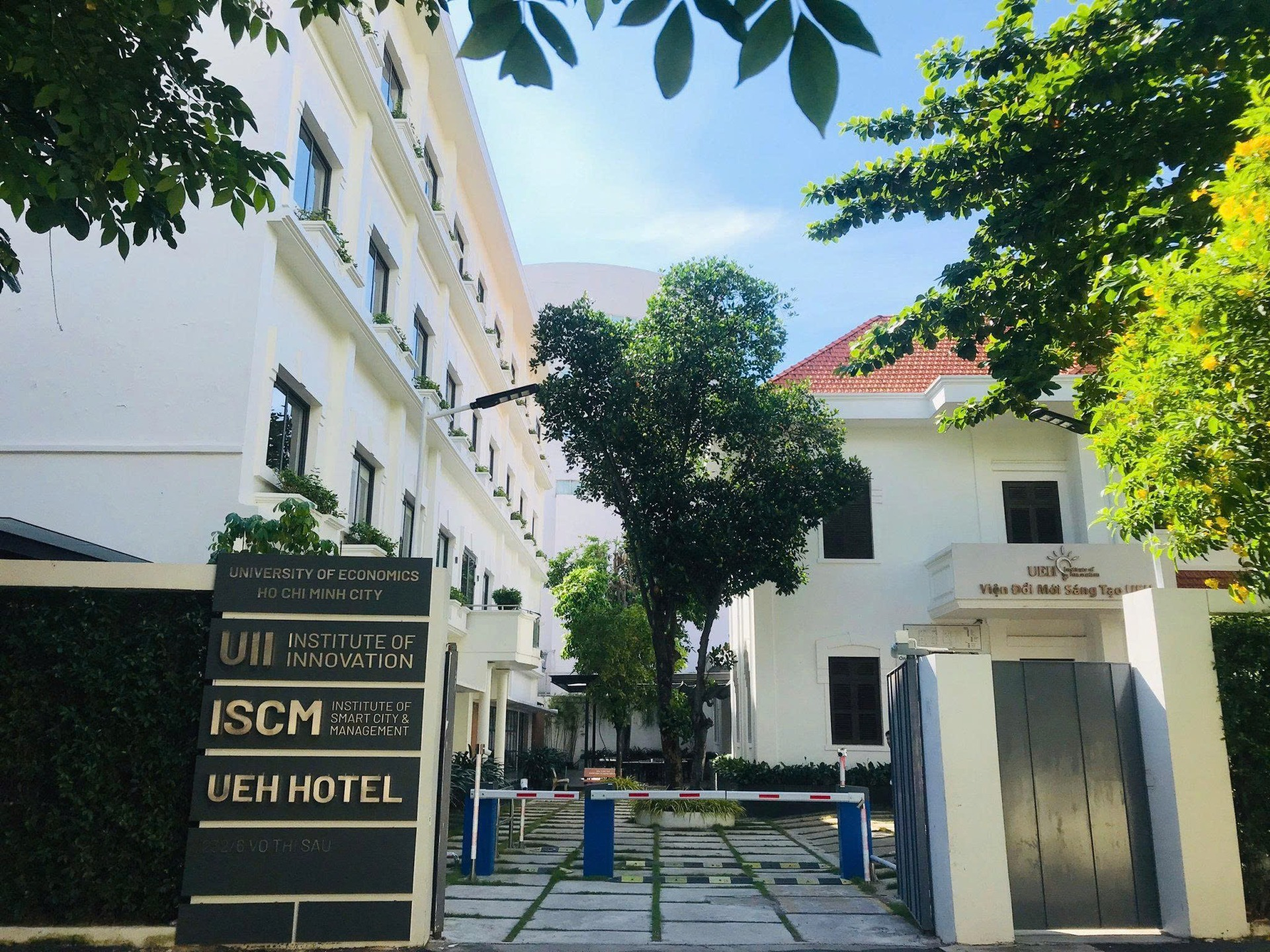
Figure 1. Existing conditions and historical uses of the Campus V site before the development of smART Hub – Living Labs. Source: ISCM–UEH.
2.2. Announcement of the Space Redevelopment Project in 2025
On 12 February 2025, UEH published a research feature entitled Transforming UEH V-Campus into smART Hub – A Center for Art, Technology and Sustainability in the Heart of Ho Chi Minh City. The project proposed repurposing Campus V as a creative and experimental space, incorporating design solutions adapted to urban environmental conditions, landscape development, efficient resource use, and stronger community connections.
This approach was articulated through four solution areas of smART Hub Living Labs:
| Solution Area | Description |
| No Single-Use Plastic Journey | Promoting the reduction of single-use plastics and circular economy practices |
| Glocal Design | Integrating local knowledge, design, and environmentally adaptive solutions |
| Towards Net Zero | Testing technologies, data, and solutions that support emissions reduction |
| Art for All | Developing spaces for art, research, and community engagement |
Source: UEH Portal – Research Contribution: Transforming UEH V-Campus into smART Hub, 12 February 2025.
https://ueh.edu.vn/khoa-hoc/%5Bresearch-contribution%5D-du-an-chuyen-doi-khong-gian-v-campus-ueh-thanh-%E2%80%9Csmart-hub%E2%80%9D-trung-tam-nghe-thuat-cong-nghe-va-ben-vung-tai-trung-tam-tphcm-73734
2.3. Investment and Construction Documentation Approved in 2025
During August–September 2025, UEH issued a series of decisions relating to construction works for the “smART Hub – Living Lab Space” project.
These documents were made public in the 2025 decision register of the UEH Department of Finance and Investment Planning, indicating that the project had progressed from research and design concepts to formal construction investment procedures.
Table 1. Construction Investment Documentation for smART Hub – Living Lab in 2025
| Date Issued | Document Number | Description |
| 22/08/2025 | 1519/QĐ-ĐHKT-TCKHĐT | Approval of the construction implementation proposal |
| 25/08/2025 | 1521/QĐ-ĐHKT-TCKHĐT | Approval of the construction cost estimate |
| 27/08/2025 | 1523/QĐ-ĐHKT-TCKHĐT | Approval of the construction contractor selection plan |
| 28/08/2025 | 1524/QĐ-ĐHKT-TCKHĐT | Approval of the construction works tender package cost estimate |
| 05/09/2025 | 1526/QĐ-ĐHKT-TCKHĐT | Approval of the construction contractor selection results |
These decisions constitute verified investment-management outputs from 2025, demonstrating that the project had entered formal implementation procedures rather than remaining only a proposal.
Source: UEH Department of Finance and Investment Planning – 2025 document register, Decisions Nos. 1519, 1521, 1523, 1524, and 1526/QĐ-ĐHKT-TCKHĐT.
https://tckt.ueh.edu.vn/VanBan/?m=185&year=2025
2.4. Construction and Infrastructure Conversion Works
The official smART Hub Living Labs project website includes a Construction Phase section describing six categories of work related to building development and campus infrastructure.
Table 2. Work Categories Listed in the Project Documentation
| Work Category | Description |
| BioSwale Preparation | Preparing bioswales to support stormwater management and landscaping |
| Demolition Works | Demolition to facilitate the conversion of the space |
| Excavation Works | Excavation works |
| Groundworks & Utilities | Ground preparation and technical utilities |
| Foundation Construction | Foundation construction works |
| Site Construction Activities | On-site construction activities |
The published work categories and construction images indicate that the project involves physical infrastructure development on a previously occupied campus.
Source: ISCM–UEH – smART Hub Living Labs, Construction Phase.
https://iscm.ueh.edu.vn/smart-hub-living-labs/index.html
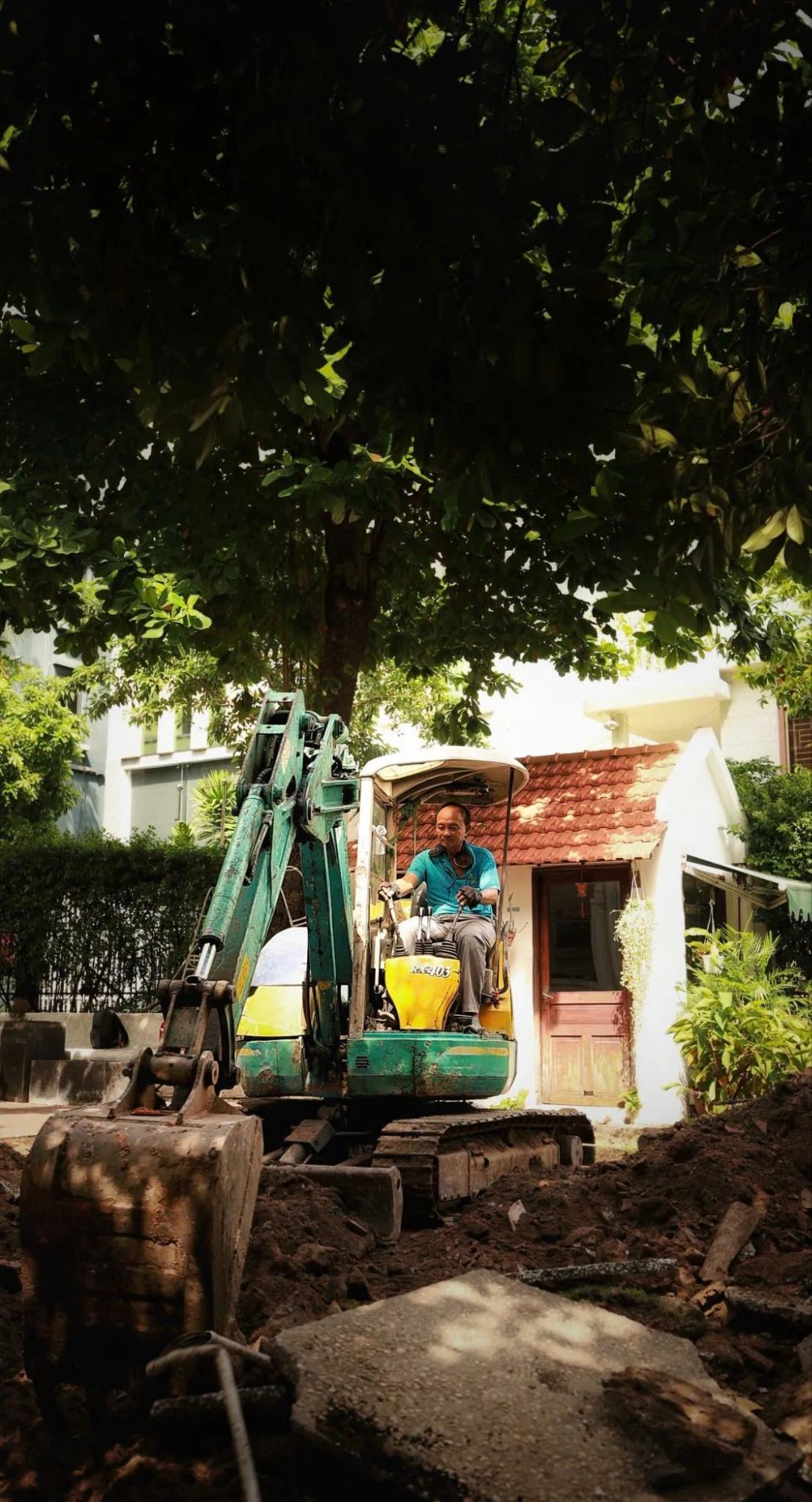
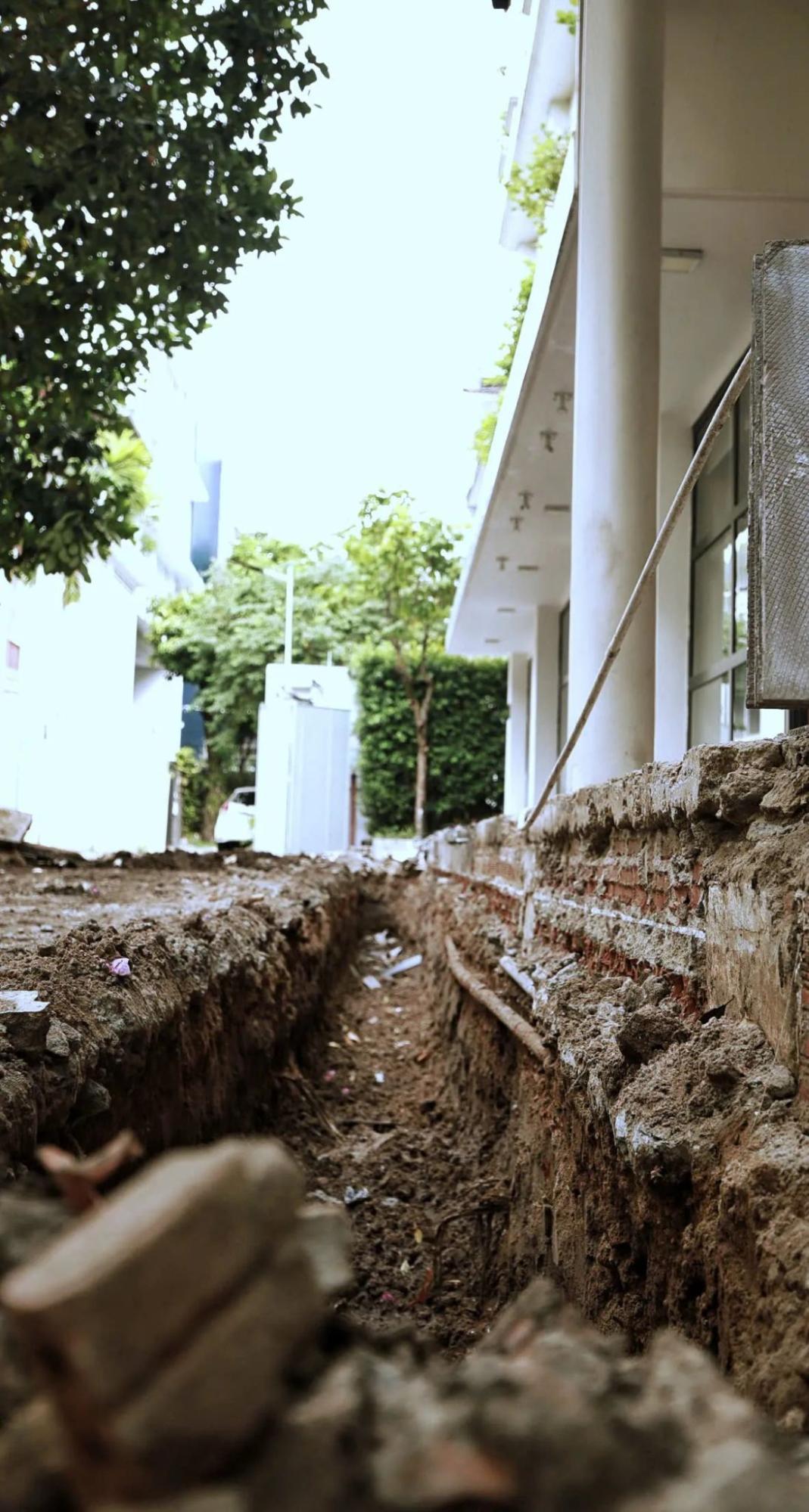
Figure 2. Construction and renovation works on the smART Hub – Living Labs campus. Source: ISCM–UEH, Construction Phase section.
2.5. Use of the Space in 2025
Alongside the investment documentation, on 28 September 2025, UEH–ISCM organized academic and community activities at Campus V – smART Hub Living Labs as part of the fifth anniversary of the Institute of Smart City and Management. The programme included the launch of the book Smart City: Global Design, the exhibition Future Campuses towards Net Zero, and the dialogue Co-creation for Net Zero. These events brought together researchers, experts, and community members to discuss and experience smart and sustainable urban solutions.
The organization of these activities at Campus V in September 2025 demonstrates that the campus continued to serve as an academic and community space during the development of smART Hub Living Labs.
Source 1: ISCM–UEH https://www.ueh.edu.vn/cuoc-song-ueh/tin-tuc/le-ky-niem-5-nam-thanh-lap-vien-do-thi-thong-minh-va-quan-ly-ueh-hanh-trinh-dong-sang-tao-thanh-pho-thong-minh-ben-vung-74897
Source 2: ISCM–UEH – Co-creation for Net Zero, published on 21 September 2025.
https://iscm.ueh.edu.vn/vi/events/co-creation-for-net-zero
Beyond smART Hub, UEH continued to invest in and develop facilities in Ho Chi Minh City, Vinh Long, and Khanh Hoa in accordance with sustainable construction principles.
Nguyen Van Linh Campus – Green Building Development on Planned Urban Land
In 2025, Nguyen Van Linh Campus was recognized by the Ho Chi Minh City People’s Committee as a representative construction project marking the 50th anniversary of the Reunification of Viet Nam, under Decision No. 1590/QĐ-UBND dated 24 April 2025.
The campus has a total planned land area of more than 11.1 hectares, is located in Functional Zone 15 of the Southern New Urban Area, and began operating on 1 January 2021. The facility was developed according to green architectural principles, with technical infrastructure, landscaped spaces, and renewable energy systems.
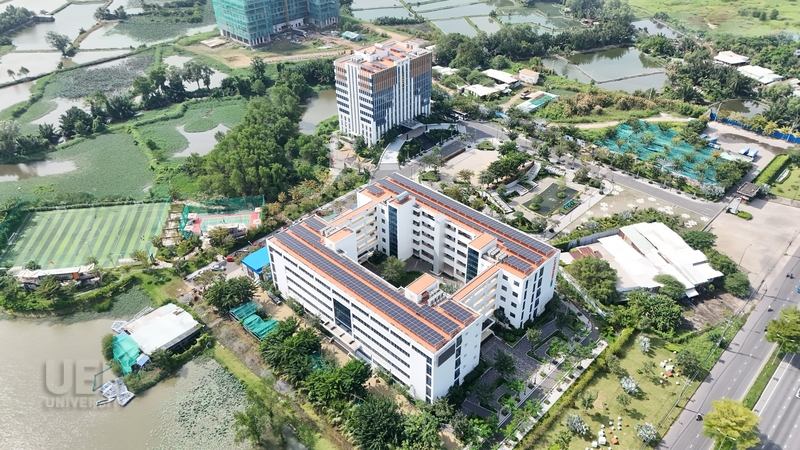
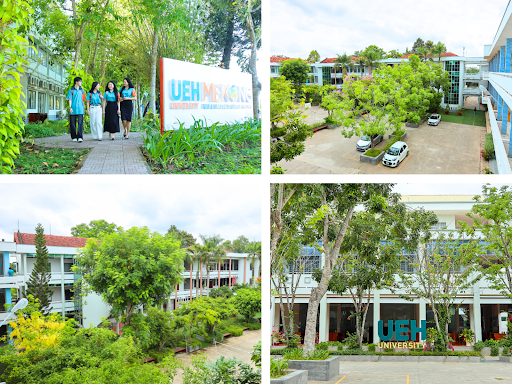
Aerial view of UEH Nguyen Van Linh Campus
Source: UEH Portal – Nguyen Van Linh Campus Recognized as an Exemplary Green, Smart and International Facility of Ho Chi Minh City, 28 April 2025.
https://ueh.edu.vn/ueh-mekong/cuoc-song-ueh-mekong/co-so-nguyen-van-linh-ueh-duoc-cong-nhan-la-cong-trinh-xanh-thong-minh-va-quoc-te-tieu-bieu-cua-tp-hcm-chao-mung-50-nam-ngay-giai-phong-mien-nam-thong-nhat-dat-nuoc-73962
UEH Mekong – Campus 2 in Vinh Long
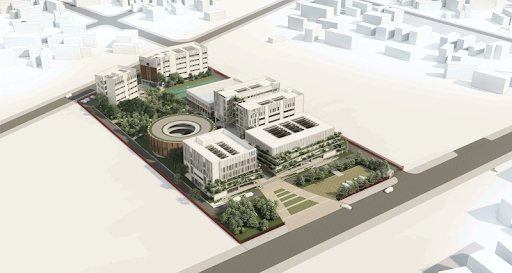
UEH continued planning the development of Campus 2 of its Vinh Long branch on approximately 1.43 hectares of land in Phuoc Hau Commune, Long Ho District, Vinh Long Province, based on an architectural design announced in 2024.
The project envisages a modern educational facility with an open design, green spaces, and infrastructure for teaching and research.
Overview of UEH Mekong in Vinh Long
Source: UEH Portal – Results of the Architectural Design Competition for Campus 2 of the UEH Branch in Vinh Long Province, 22 August 2024.
https://www.ueh.edu.vn/ueh-mekong/cuoc-song-ueh-mekong/ket-qua-thi-tuyen-phuong-an-kien-truc-co-so-2-phan-hieu-dai-hoc-kinh-te-thanh-pho-ho-chi-minh-tai-tinh-vinh-long-thiet-ke-mo-hien-dai-xanh-ben-vung-doat-giai-72299
UEH Nexus Campus Nha Trang – Distinguishing Green Construction from Brownfield Development
On 19 August 2025, UEH officially broke ground on UEH Nexus Campus Nha Trang, covering approximately 2.1 hectares within the Bac Hon Ong Education and Vocational Training Zone in Khanh Hoa Province. The project follows a green architectural approach designed to optimize teaching, research, and community engagement spaces.
Source: UEH Portal – Official Groundbreaking of UEH Nexus Campus Nha Trang, 19 August 2025.
https://www.ueh.edu.vn/cuoc-song-ueh/tin-tuc/chinh-thuc-khoi-cong-ueh-nexus-campus-nha-trang-phan-hieu-chien-luoc-moi-cua-ueh-cong-trinh-trong-diem-quoc-gia-chao-mung-80-nam-quoc-khanh-dau-moc-tri-thuc-dong-hanh-cung-tinh-khanh-hoa-74663
Conclusion
In 2025, UEH undertook formal construction investment steps to transform Campus V into smART Hub – Living Labs, redeveloping a site with existing buildings and a history of multiple uses into a space for research, creativity, and experimentation with sustainable urban solutions.
The evidence—comprising the site’s historical use, construction investment documentation issued in August–September 2025, and activities held at Campus V in September 2025—shows that UEH moved beyond a stated sustainability ambition and took concrete action to reuse and redevelop an existing built environment.
The smART Hub – Living Labs case demonstrates UEH’s approach to prioritizing the efficient use of previously developed land and infrastructure, contributing to urban regeneration and SDG 11 – Sustainable Cities and Communities.